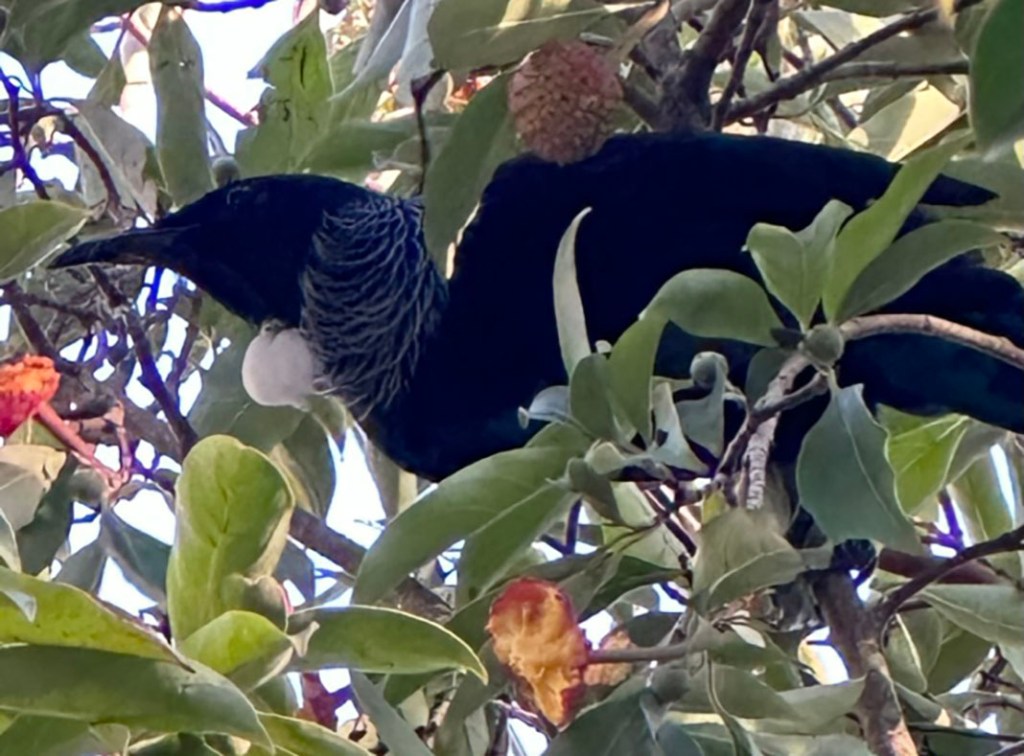
This is a tui, the mockingbird of New Zealand. It has two little white feather balls or tufts hanging from its neck and a comb. They are black iridescent in color.
It imitates other birds and just random snippets of sounds. Certain sounds–bells and beeps and squeaks and whirs–remind me of Artoo Detoo. The link will let you hear them. It is really charming. They were nearly wiped out by the 1990’s with only a few pairs left (thanks to predators and I am looking at you neighborhood cats). But with a concerted effort at restoration they now number in the thousands. You can hear them everywhere beeping and exiting bell-like notes.
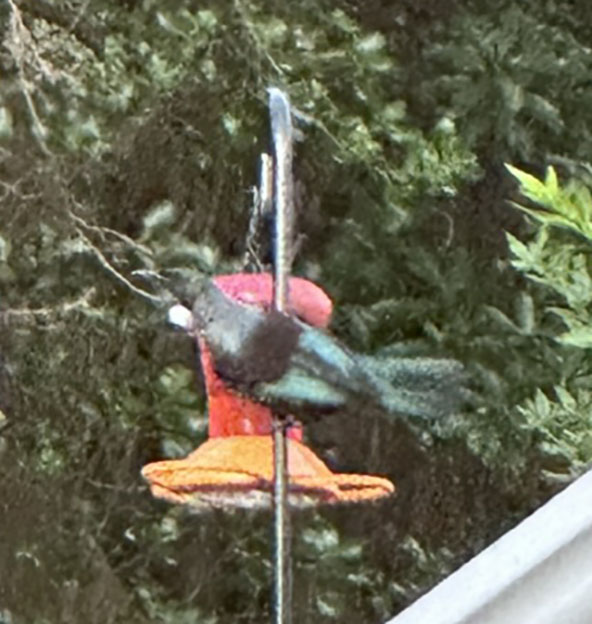
They love nectar. I put out some feeders and they have started to come by. (He was far away and so the picture is blurry. Sorry. I’ll post a better one if I can get him to stand still. He is a flitter.)
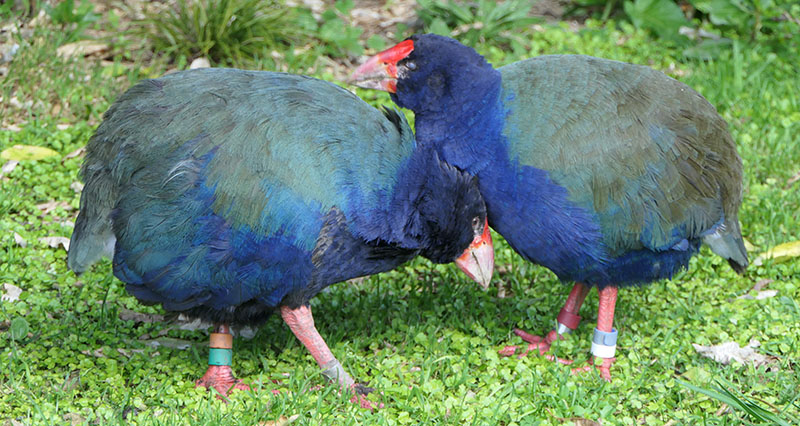
Another still endangered bird we saw at Zealandia was the takahe. Flightless and looking pretty darn clueless. If you are a flightless bird, unless you have some kind of defense through claws, it’s a tough life. All you can do is run. They are working at increasing their numbers by keeping them away from predators and hoping they breed.
[I know I talk a lot about food, but what do you expect from a cook?]
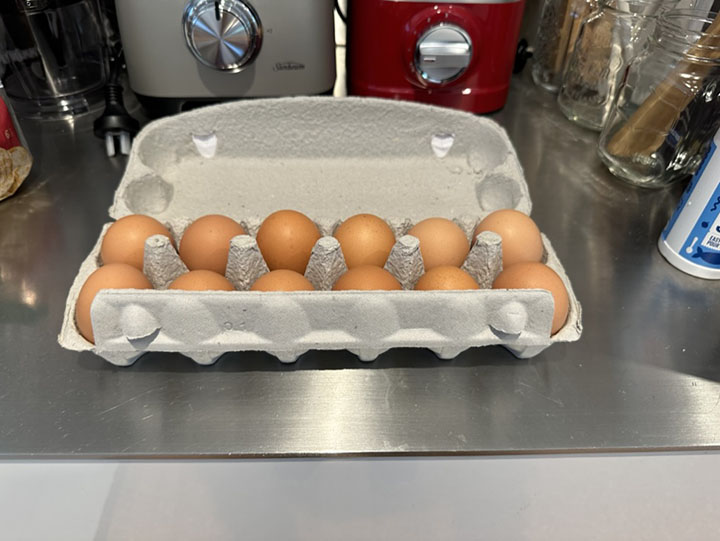
Eggs are not refrigerated here. Yep. Here they are sitting on my counter.
As you browse through the grocery store and eggs are on the shelf in the egg aisle. Matt was a bit freaked out by this, but he discovered the explanation—Americans have to refrigerate their eggs because we wash them after they are laid.
Eggs have a natural protective coating on the eggshell that keeps the egg inside stable preserving water and oxygen while it prevents bacteria from getting into the egg. Washing this coating off results in the eggshell being compromised and any tiny crack can let in bacteria. So once washed, they have to be refrigerated to keep them safe to eat. The U.S. is actually one of a a handful of countries that washes eggs. Imagine that. We are the paranoid ones on this.
The eggs are washed because of a fear of salmonella. Salmonella can be passed from the hen to the egg while the egg is forming and people have been sickened from salmonella infected eggs. This is why they tell us not to eat raw eggs. Washing the egg is meant to clean way any potential salmonella. But the salmonella is inside the egg, so why bother? Aesthetics of course. No one wants to see a dirty egg.
In countries where they do not wash eggs, they either vaccinate the hens keeping the egg salmonella free or, in the case of New Zealand, being an island, there is no salmonella. (There was one outbreak that they quickly addressed. The theory is that is arrived by an infected human or bird.) So I am free to eat raw eggs here if I want and I will not have to worry about salmonella.
If the hen has not been vaccinated, and in the U.S. we do not vaccinate, due to its cost and complexity (of course it is all about cost) then there is still the chance of being exposed, egg washing or not because the salmonella is already in the egg or the eggshell has been compromised somehow.
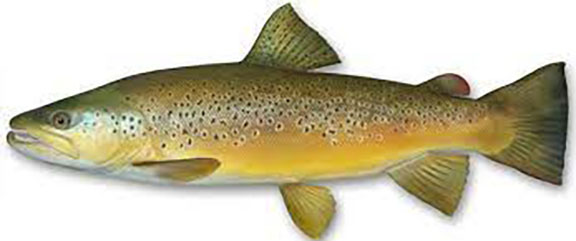
I have been searching for interesting fish for dinner and figured I would find some trout in the grocery store. But I did not see trout anywhere. I was completely puzzled by this because New Zealand is known for its trout fishing. Brown trout and rainbow trout are an introduced species, but they thrive here because there are plenty of streams and there are no predators. It is a huge recreational economy, with fishermen from all over the world coming in for some fly fishing. So I know there are trout here. Why could I not find it?
There was a guy here doing repair work and I asked him if they had trout. Maybe I was wrong. Yes, he confirmed there is a trout fishery here. And then it dawned on him: no, he had never seen it in a grocery store and he did not know why.
I did some investigating and the answer is surprising. The sale of wild trout is illegal in New Zealand. Trout farming is also prohibited. There is no prohibition on the sale of imported trout except for the fact that importation itself is prohibited. Thus, you can neither buy trout at the grocery store nor order trout in a restaurant.
The reason for these prohibitions has to do with the value of the recreational fishing industry. The New Zealand trout industry is “wild” trout. The fishery is not sustained and managed by stocking fish. So they are very concerned about the impact if people were allowed to take their catch and sell it. They fear poaching would occur to a degree that it would decimate the fishery. There are a lot of folks who are employed in the industry, and it generates millions in tourism dollars. They claim this is a delicate balance and that if they stocked they fishery, it would harm its value as a wild trout fishery. And they are adamantly opposed to farming trout for fear of disease that can be generated in farming pens. They also see a similar issue with any sale of farmed trout–it would be impossible to determine if wild trout were being poached and sold as farmed trout.
In a study I read, they acknowledge that people want to be able to buy trout. They also acknowledge that trout farming is economically beneficial. They know that many other countries have commercial trout fisheries. They have a farmed salmon industry here and the wild salmon fishing industry does not suffer from poaching issues. But all of this is discounted because their fear of damage to the wild fishery and to the tourism industry outweighs all of this.
Despite their claim that the fishery could be quickly decimated, it is hard to imagine because there are so many trout. This is not a threatened species by any means. There are places where the per day bag limit is eight fish and in some places there is no limit at all. Most other areas you can take two trout a day. The season runs from October to April.
This does not even get into the fact that trout are an introduced species and they are not great for the environment. They have been decimating native fish species.
But tourism dollars rule on this one and the Government seems to be quite comfortable depriving non-fishing Kiwis of a great fish so it can be made it available to tourists. Yes, anyone can go fishing and if they catch a trout, they get to eat it. But not everyone fishes. They encourage catch and release which also impacts whether a New Zealander gets to eat what he catches. It all seems quite unfair.
Well, I guess the only way I get to enjoy eating trout here is to learn how to fly fish. If I can’t land a trout, I will be deprived for years to come, which is very sad.
Matt and I joined the Wellington Astronomical Society because we love learning about astronomy, and we want to learn about astrophotography. After the last meeting, we were chatting with a woman who, when she found out we were from the U.S., asked if we thought it odd that we could not see the north star? I had not thought about it really, but she explained that she had learned to navigate her boat by using the stars and wondered if we knew where to look.
I did not have the heart to tell her that I can’t tell my right from my left let alone trying to figure out where north is using stars. Then she said something that really blew our minds. She asked us how we felt with the sun being in the north. I had no idea what she was talking about. But Matt had come home one day and said he did not understand why the sun is in the wrong place. It did not look right to him.
She explained to us that in the Southern Hemisphere, the sun crosses the sky in the north, and it goes from right to left. My response? I turned into Bill & Ted–No way! Yes way! Think about this. You folks up there in the Northern Hemisphere–find the southern exposure of your house. you know that on the south side of the house, the sun shines all day. In addition, the sun rises to your left and crosses along the south to the west which is on the right.
Here in the Southern Hemisphere, the sun does the opposite. It is the north side of the house that has the sun all day and the sun travels from right to left. There is an explanation as to why this happens. I found several websites on the subject, but I did not understand it and certainly cannot sum it up. (I admit I am not the smartest when it comes to math.)
This then raised in my mind the simple question, does that mean the moss grows on the south side of a tree? The answer is yes, the moss grows on the south side of the tree.
As for the rest of the sky, we will have to get used to the different constellations. There is no Little Dipper here but there are many more significant stars to see, and much more of the universe is visible from the Southern Hemisphere—the Milky Way, plus other galaxies, a few nebula are all fairly visible in a dark sky. We will certainly spend a lot of time getting to know that sky.
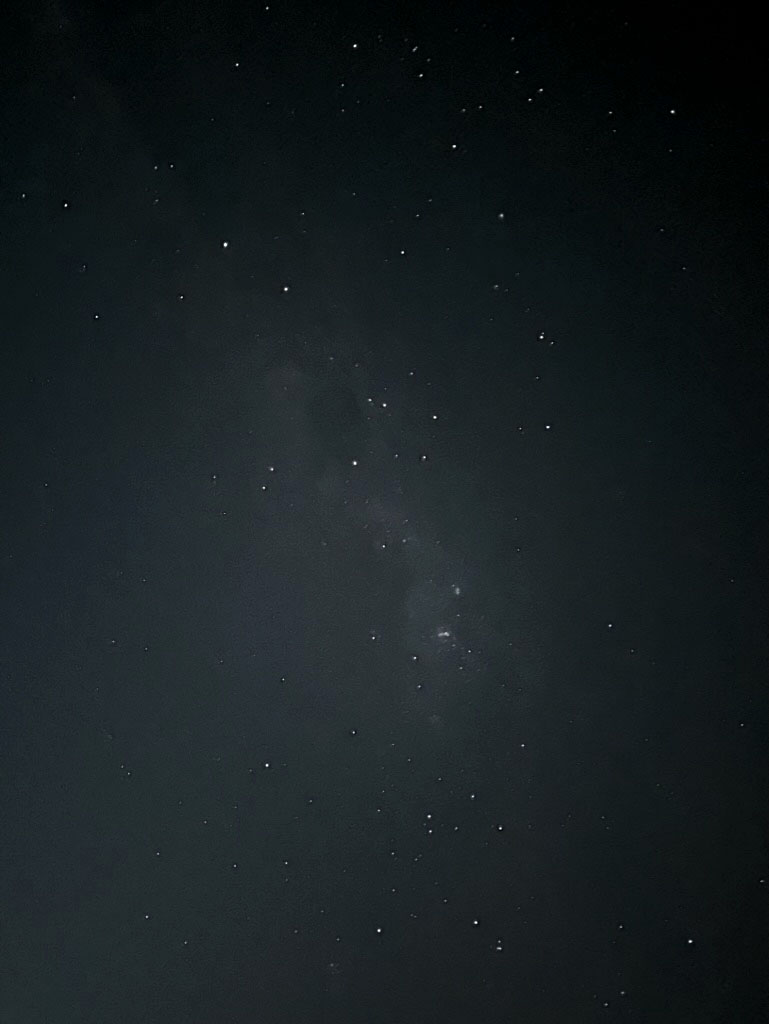
In the Southern Hemisphere you can see the galactic core of the Milky Way. It can be pretty dark here and we figure that taking great night sky pictures should be pretty easy here. Matt signed us up with the local Astronomical club to learn more about astrophotography. But just for fun, we decided to go into the backyard and see what we might shoot. I took the picture above with my iPhone. I was not even using a tripod. It is a little blurry. but there is the Southern Cross and the faint Milky Way. If we can see that much of the Milky Way in the backyard, going to a dark sky park is going to be awesome.
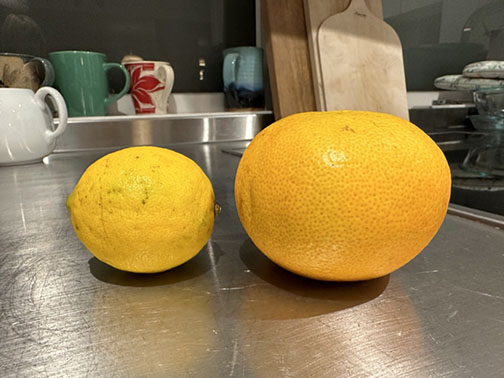
I like eating grapefruit in the winter. When I first arrived I went to the grocery store on the assumption that I could buy one here. Um, no. There were no juicy ruby red grapefruits anywhere I looked. Until one day there was a sign—grapefruit. But they were really small, about the size of a navel orange. I figured I would try them.
I learned that these are not true grapefruits. They are called Poorman orange. They are a hybrid of the pomelo and the mandarin orange. A pomelo is a grapefruit relation, so the New Zealand grapefruit is not really that far off from a real grapefruit. The Poorman orange is slightly tart like a grapefruit. The biggest difference is size and juiciness. I will have to accept it as my winter fruit since there is no way I am getting a ruby red from the U.S. any time soon.
I put together a little Q&A to give you a feel of where we live.
1. Where do you live?
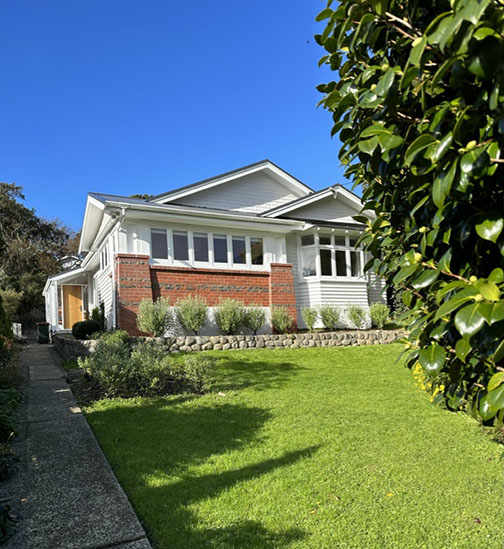
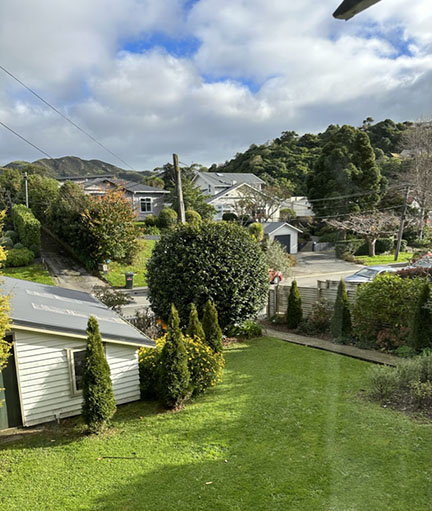
In this house in Khandallah, which is a suburb of Wellington. I say suburb but we are only fifteen minutes from the central business district (CBD). I would not consider this a suburb by a U.S. city measure.
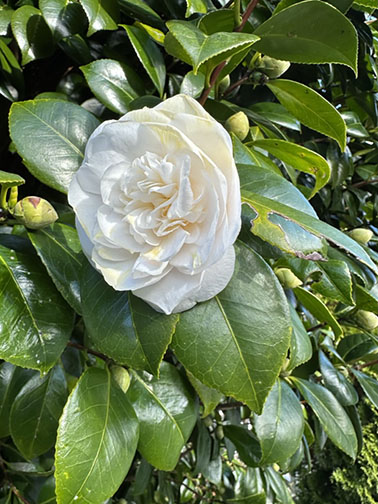
This house has a lovely and large gardenia bush in the front yard. Generally, houses are situated very close to each other and the yards are quite small. The garages are in the front of the yard and the houses sit back from the road.
Gardenia bush in front yard
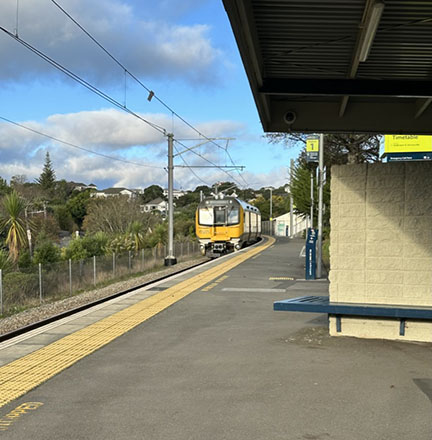
When Matt first arrived, he took the train everywhere. It is right up the street from the house.
2. What is the weather like?
Unpredictable. The weather report usually reads something like, “today it is going to be sunny, cloudy, windy and rainy.” I wonder why they even bother to give a forecast at all. Today is a good example. The forecast had been for sunny and mild. It was partly cloudy, windy and cold.
It is winter here and we are heading into what would be similar to our December. But the temperature at least stays pretty much the same—in the 50’s, anywhere from 53 to 59, during the day and the mid- to high 40’s at night. Sometimes it can get a little warmer or a little colder. One day it went down to 32 according to my weather station. even so, there is not going to be a hard freeze or snow. We are looking primarily at rain.
3. What are the people like?
Very nice so far. They make me want to be nice back. They speak with an accent that, like the U.S., varies according to where a person grew up, education level and the like. Some folks are very easy to understand and for others I need subtitles. Of course, they think I have an accent too. When I see a New Zealander looking at me and clearly not understanding what I am saying, I’ll say, “I sound funny, don’t I?” That usually makes them laugh because to them I do sound funny–American with a faint Pittsburgh accent. But there is a lot of American t.v. here so for the most part, they understand us better than we can understand them.
They have their share of phrases and colloquialisms that we are learning. We might say “figured it out.” They say “sorted.” We might say “sweater,” they say “jumper.” Of course, that is British. As Churchill said, “two countries divided by a common language.”
4. Is it as beautiful as people say?
It is pretty nice. Very green with lots of large trees (I call them “ents” from Lord of the Rings), lots of ocean, and lots of sheep on the hills.
5. Is there crime?
There is crime in every city but not where we live and not that I have noticed. It is actually pretty uneventful here.
6. I heard they don’t have guns.
There are guns here, but after a mass shooting in 2019, they banned assault style weapons and limited magazine sizes. People voluntarily turned in their assault weapons. Yes, it only took one mass killing. It is also very hard to get a gun because you have to get a license. No one can buy a gun without a license and that includes private sales. The license and the sales have to be okayed by the police who will verify that you qualify by having a license.
To get a license, you have to show you have a legitimate reason to own a gun. Owning a gun in anticipation that you need it for self defense is not a basis to get a gun. But they do hunt here, and people can have hunting rifles no problem. You also have to pass a mental health check, prove the lack of a criminal record, and have no record of drug use. You also have to prove you can store the gun safely.
It is all so refreshing!
Believe it or not, we have seen a gun store that seems to be taking a page from the U.S. and the NRA, but that is really unusual. For the most part, they don’t understand our gun culture and it is embarrassing to even try to explain it.
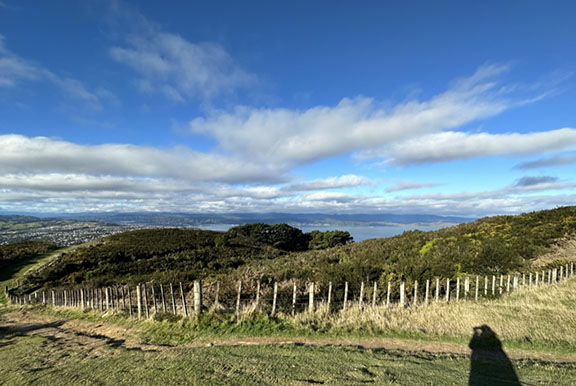
I went out for another walk, this time I walked from a town about fifteen minutes away, Johnsonville, up into the hills and over to Mt. Kaukau again. This time I went 4.5 miles. I had a walking stick and thank God I did because I made the mistake of trying a less used path and it turned into a very steep and slippery downhill trek. I needed all the help I could get.
Here are some pics:
Good Lord, more steps.
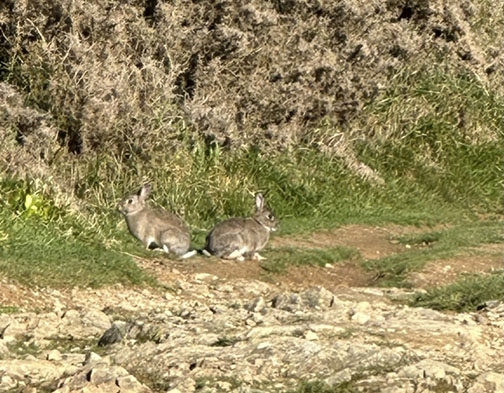
Saw some rabbits. As Matt noted, that is not a good thing. The people of New Zealand spend and enormous amount of money trying to keep the rabbit population down. There are no predators here so these guys are free to propagate fairly easily if they want. And they are rabbits so they do want…
I am coming for you Mt. Kaukau! I see that radio tower.
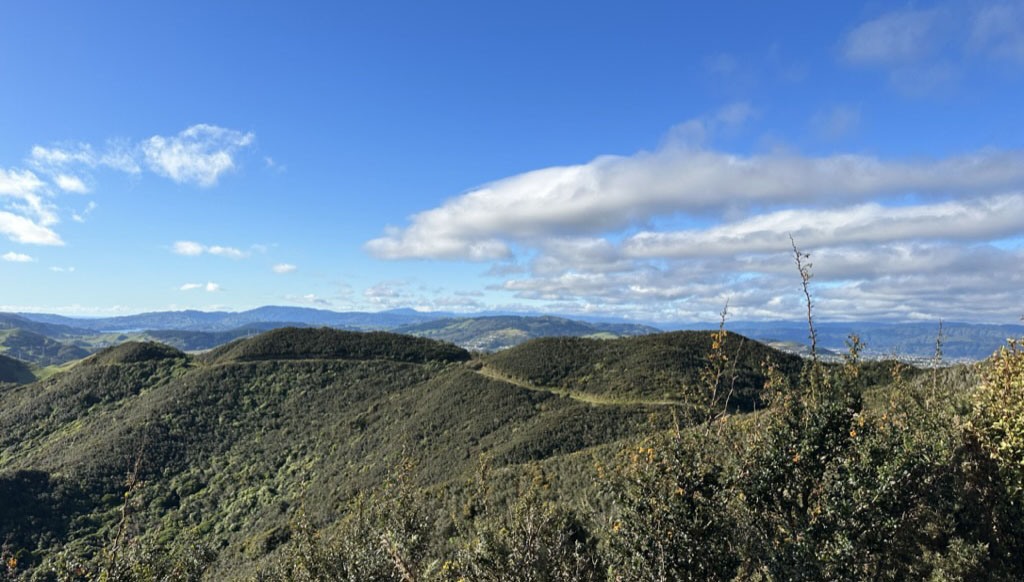
This picture looks back at the track I have been walking. You can see it along the ridge line.
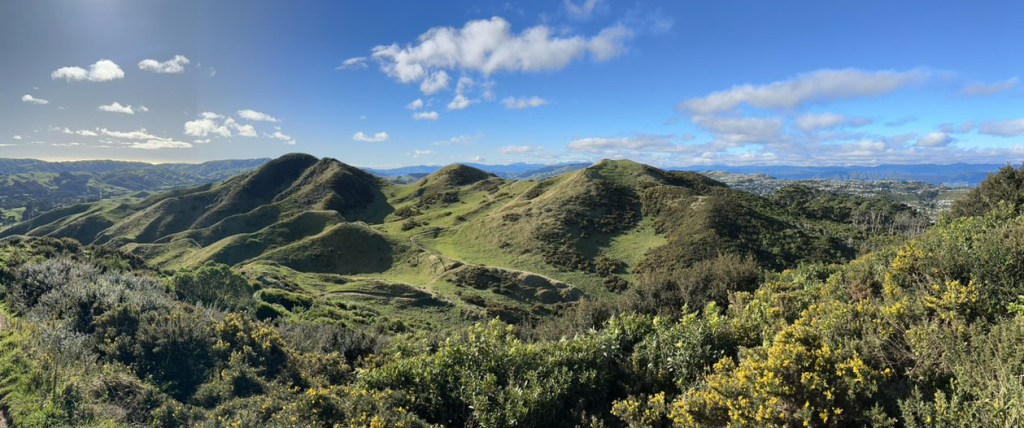
The view from Mt. Kaukau once again. It was a gorgeous day.
From here I headed back to Khandallah by a different path. The signage was not great and I ended up on a rarely used trail. Thank goodness for Google. It found me and showed me how to get back on the main route. Overall it took about two hours door to door.
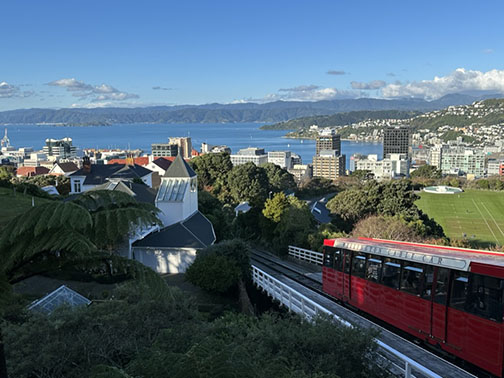
It was a gorgeous sunny day in Wellington so we did the tourist thing and took a ride on the cable car in downtown Wellington. Just a little factoid.While they call it the cable car, it is actually a funicular. A funicular operates on one cable that both cars are attached to. One car goes up, one goes down and they pass each other along the way. Cable cars are pulled by separate cables.
Look at that sun shine.
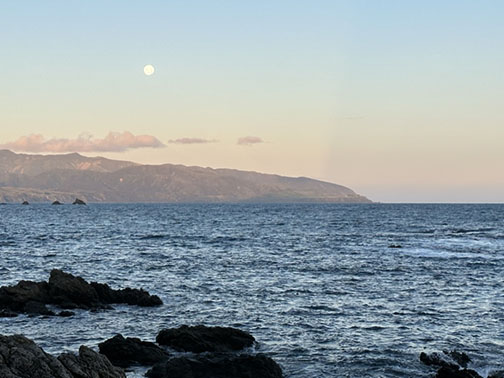
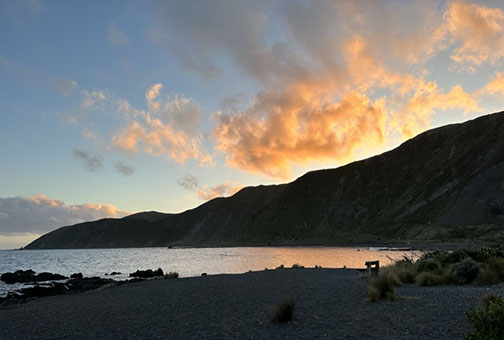
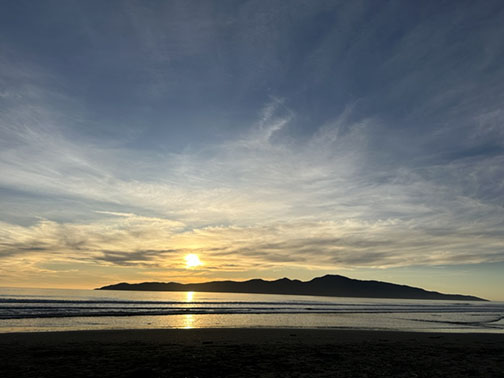
After the funicular ride, we drove down to the southern coast of Wellington. It was beautiful as the sun was setting.
There are two problems with shopping here in New Zealand. First, there is no Amazon. Second, there are no mega-retailers like Walmart or Target. We have traveled back in time to the pre-online days when shopping means going from store to store picking up what you need and being stuck with whatever selection or lack of selection they have. If anything good can be said of Amazon, if you can think of it, you can find it and someone will ship it to you. Here, we have to shop Amazon Australia where the selection is very limited and the shipping takes weeks. We often end up ordering from the US Amazon but that can get expensive.
Worse, we cannot rely on one stop superstores to fill the Amazon void. There is no one place where you can shop for clothes and sporting goods and housewares and groceries and whatever else you can think of. If I want something for the cats, I have to go to the pet store. If I need gym equipment, I have to go to the fitness store. If I want home stuff like small appliances, sheets, that sort of thing, I go to the home store. If I want a book, I go to the book store. Office supplies, well, good luck to you. Groceries are found at the grocery store. Some grocery stores are large, most are small, and each chain has its own niche. There are mega-building stores similar to Lowe’s and Home Depot, so that is a relief. There is no giant pharmacy chain. They are trying, but mostly a pharmacy, or the chemist, is a small store with not much selection. There is a Macy’s-like department store called Farmer’s that I have yet to visit but is still not anything akin to a superstore.
I know that folks in the U.S. do still shop store-to-store as I am describing. That is fine. My issue with store shopping is the limited and limiting selections. There might be two colors, not six. Items may or may not be in stock. It is a total crap shoot. Give me the ability to choose. To me, that is what online shopping is all about. As a consequence, I have not shopped at a mall or done anything like going store-to-store for years.
We had pretty much everything delivered. We knew all of the online retail sites. Pet supplies, groceries, office, home and garden, and whatever else we could think of, we would get from Amazon or some other on-line store. With those kinds of options, we never had to settle for what was in stock and we did not have to leave the house.
Here, we are trying to get stuff delivered so we don’t have to run from store to store. But not all stores deliver, there is usually a charge, and the selection is often limited to what they sell. Just as an example, I wanted to buy something as simple as bathroom rugs. I tried three home stores, and the selection was just terrible. Gray, black, tan. Gray black, tan. It was maddening. I did not want to just settle for what they had—sad colors and cheap materials. I finally turned to Amazon AU and I found a few better choices. In the U.S. I could think of probably half a dozen online retailers who I could buy from and more than a few stores that I could have gone to that would have had better choices.
Then there is food shopping. If I want to have any chance of choices in ingredients, I will have to wander from small store to small store. Today I found a tiny deli that stocked Middle Eastern ingredients and Peruvian ingredients. I was filled with joy. But it is going to take up a lot of time to pursue what I want.
And that is what it is really all about—I am used to having choices at hand. The way it is here, sometimes you just have to take what they have or spend an enormous amount of time searching. I am sure I will learn to make do but going from so many choices it was hard to chose to lack of any choices at all is sad.
I decided that in order to convert into something less than a wimp, I would walk the “tracks” around Wellington. I do not usually walk or hike. I am more of a pool person. But here, walking is the thing. A track is a hiking or walking trail and there are a lot of them. New Zealanders like to get out and walk. One of the oldest parks in Wellington, Khandallah Park, is very near our house. It has a track that goes to Mount Kaukau which, at 445 meters (about 1500 feet), is the highest summit in Wellington. I did not know this when I decided to give it a go. Remember, they refer to these as “hills.”
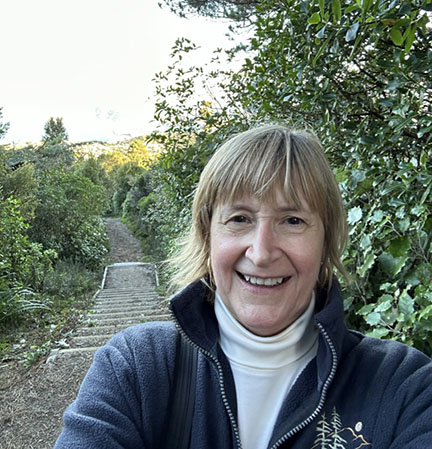
I gingerly set off up the trail, not knowing what to expect. I soon realized that for me this was going to be a stiff uphill climb. For the people of Wellington, this track is considered an easy walk up a hill, fun for the whole family. It is rated as easy/intermediate by the local trail group.
The track consists of a trail built out with steps where needed, mostly where it becomes so steep the trail becomes vertical. You would think steps would make it easier. No. This was not one or two steps to make a transition but eight or ten steps with very high risers. The ascent was 245 meters (about 800 feet up) and about half of that distance was stair climbing.
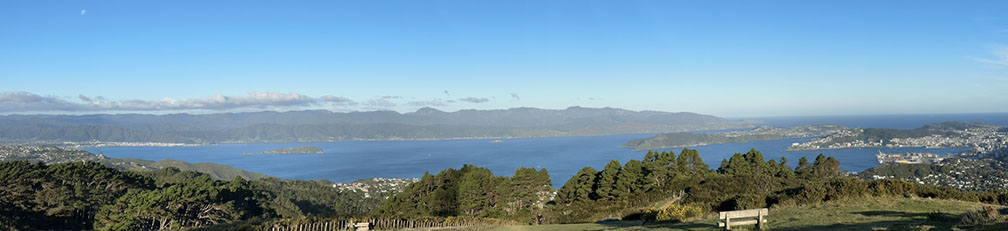
Along the way, I ran into casual walkers, runners, and even a woman with her young kids. Everyone seemed fresh. I was breaking a sweat and breathing fairly hard. There were moments when I had to argue with myself to keep going. When was this trail going to end? But I was not going to wimp out and turn around. My hips were screaming by the end, (stupid piriformis) but I made it to the summit. There I found the woman with her three boys enjoying the view. Wellington harbor was spread out in front of us. It was so clear I could even see the South Island. One of the boys told me he was seven. He asked me how old I was. I said too old to be climbing this damn hill.
South Island from Mt. Kauai
The entire loop is 4.9 km, (about 3 miles). I only went up and back, a mere 1.5 miles. I covered the ground in the allotted 30 minutes to the top and about 45 minutes down. Those steps are tough on the old knees. By the time I got back home, I was hurting. My poor hips. So much stretching to do. But I did it. My first track—the easy Mount Kaukau summit.
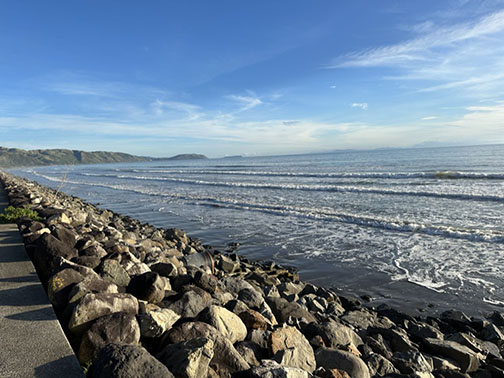
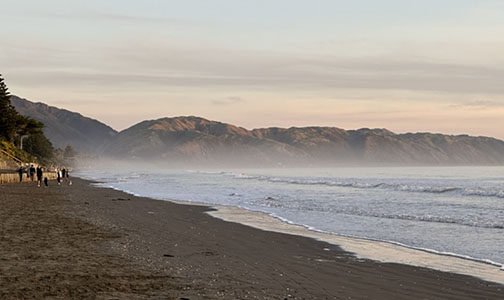
I told Matt that in retirement, I had to live next to water. I have promised myself my entire life that I would live at the beach. This may be my chance. Wellington is on the southern end of the North Island. There are beach towns arrayed along the Kapiti Coast, the west coast north of town. These towns are not as expensive as living in the city and they have a great view. Even better, their weather is not as harsh as Wellington for reasons that have to do with wind patterns.
Most people in Wellington consider the Kapiti Coast very far away. The drive is 40 minutes. As people who lived in D.C. and dealt with traffic from an outer suburb, a 40-minute drive is a piece of cake. So we are thinking we might live on the Kapiti Coast. We visited this past weekend. Here are some pics.
Wellington is a port city surrounded by hills. I say “hills,” but these are HILLS. Actually, they are at the end of the Remutaka and Tararua mountain ranges. To the people of Wellington they are just some hills. We live in those hills, in a village called Khandallah. The hills are full of steep, winding, narrow roads. Everything seems like it is uphill. Think backroads of West Virginia.
What is amazing is the number of cyclist and runners who make their way up those hills every day. Just yesterday I saw a woman around my age powering her bicycle up Ngaio Gorge Road. Yes, it is a gorge. This road had what the Kiwis euphemistically call “a slip” after an earthquake. We would call it a rock slide. It will take years to fix and it has reduced part of the road to one lane. Today we saw two other older folks, heavy set but obviously with better leg muscles and lungs than I have, pumping along in the rain. I just cannot imagine taking that on. Setting aside the power needed to get up the hills, the bike lane is narrow and not very well protected from cars. It is about a half a shoulder. There is no room for error. No matter to the bicyclists. They manage it.
Wellington is also known for its wild winter weather—rain and strong winds. Despite the weather, people are out running or walking. They just get wet. Sometimes a person might be wearing a rain jacket, but more often than not, they are in shorts and soaking wet tees, hair sticking to their heads. I suppose you learn that you have to live with the weather. There is no calling the game because it is raining. We saw kids outside in the rain playing soccer and rugby. I saw a young man on the waterfront at what appeared to be the end of his run. He was wearing shorts but no shirt in a driving rain. (Okay, that seemed like a bit much.). The lesson is that you can’t let the weather stop you because you would be locked inside all winter. I guess I am destined to do the same. If I don’t, I will have wimped out. I just can’t do that.
Since I arrived, part of my mission has been to fill the larder. Matt has been living like a bachelor and the freezer is full of dumplings–Chinese, Japanese, Nepali, Thai. The guy clearly can’t resist a dumpling. I’ve done what I can to cook them for dinner but there is a point at which I say, I’ve had enough dumplings.
So I have gone gathering at the grocery stores. Americans are spoiled in a lot of ways but one of the biggest is food. We take for granted the dozens and dozens of options we have of everything from yogurt to fruit to ice cream. It is hard for us to remember the days when blueberries were not available year-round, when asparagus was a spring treat, or when there was no such thing as chicken sausage.
Here in Wellington, I am living those days again. They don’t seem to be a stop on the South American fruit and vegetable train. Even though winter strawberries taste like cardboard, it is comforting to know they are there. I have not seen a strawberry except in the frozen food aisle. I have seen some very expensive blueberries. But it is autumn here and we are looking at apples and the beginning of citrus season.
I wanted to get some breakfast sausage to have on hand. I had no idea how important breakfast sausage is to me until I could not find it. They don’t have breakfast sausage here. Well, that is too categorical. You will find beef sausage, lamb sausage, and pork sausage, but none are “breakfast” sausage as we know it. They do have something called pork sausage that kind of looks like breakfast sausage, but it certainly does not look appetizing. Matt says it is terrible and I don’t want to try it. I figured they would at least have Irish breakfast sausage, something we could not avoid in our trip around Ireland. Nope.
I had a very long chat about sausage with the meat guy in the supermarket. He assured me that there is a breakfast sausage. They were just out of it. When I asked what it was made from he hesitated. He seemed to suggest that they eat the other sausages for breakfast. I was not clear on that. I had a hard time imagining beef sausage and then thinking of it for breakfast. Yeah, I’m not down with that. Some of their sausage looks like hot dogs and it is meant for grilling not as a side to eggs.
Nor is there Italian sausage as we know it—sweet or spicy. I have been told that I may need to go to an Italian specialty store for Italian sausage. (This topic will get its own blog post. There is no one-stop shopping. You have to go to individual stores to fill your needs.)
I am used to eating Italian chicken sausage that I would get at Whole Foods. There is absolutely no option for chicken or turkey sausage here. Lamb, on the other hand, is ubiquitous. If you can think of a dish that has a meat in it, there will be some version of it made with lamb. I don’t think that is a bad thing. I love lamb and we have had lamb sausage that was delicious. I made a pasta sauce with lamb sausage, mushrooms and tomatoes that was plate-licking good.
But someone needs to work on the breakfast sausage problem preferably with a chicken or turkey option. And no folks, you can’t ship it to me. It will not get through customs. We just have to soldier on.
Matt’s focus is the cereal aisle. In an American store, there is usually one aisle devoted to breakfast foods, with so many cereal choices it can be hard to even pick. Everything from Cheerios to granola to breakfast bars to oatmeal. And don’t forget the frozen foods breakfast section–frozen waffles and baked goods and breads. Not here. There is no breakfast section in the frozen food aisle. No Eggo waffles. The cereal aisle is limited. They sell Special K and a version of Raisin Bran. There is muesli and granola. That is pretty much it. The granola can be hit or miss. Some of it is pretty darn good. Some of it is like eating cardboard flakes.
Matt loves his cereal for breakfast, so this makes him very sad. Should he ship it here through Amazon? That would be some expensive cereal if he did. So he has to find what works.
None of this makes New Zealand a bad place. It just makes us aware of how spoiled we are in the U.S. We have choices that are unimaginable to others.




 A Yank Among the Kiwis