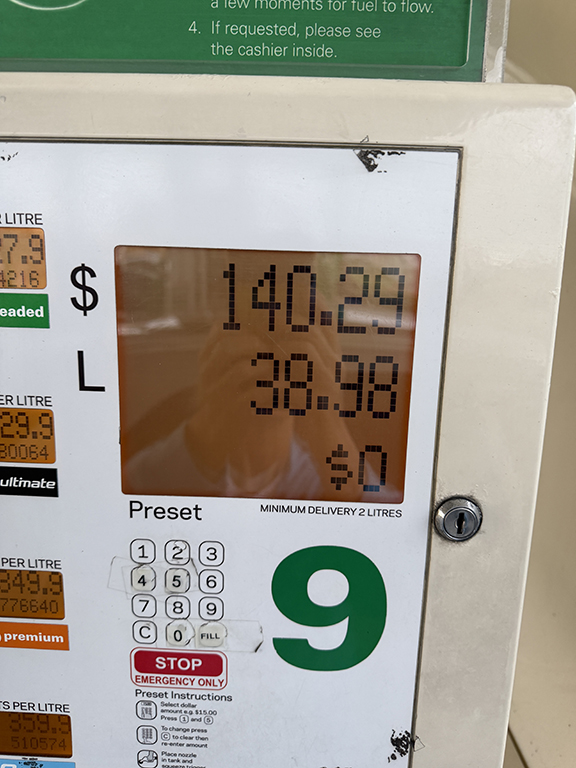
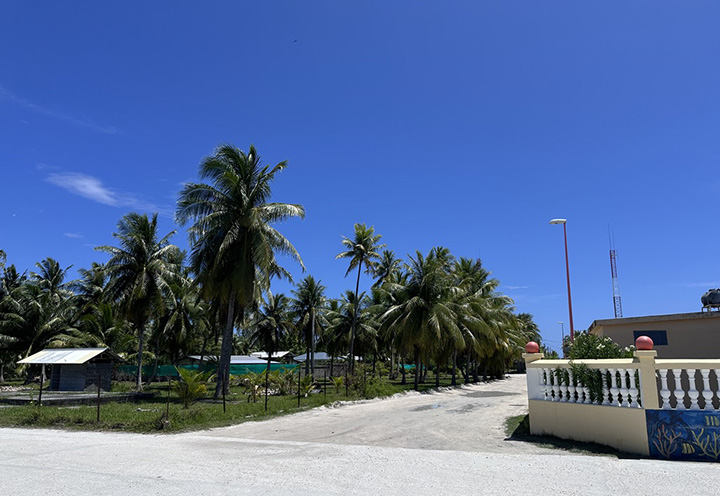
I really don’t want to hear about the cost of gas in the U.S. Nope. I can assure you whatever you are paying, I am paying more. They sell gas by the liter. There are 3.785 liters to a gallon. At the time of that photo, where the price was “only” $3.50NZD per liter, I paid $141NZD or $85USD for about 10 gallons of gas, a little over a half tank. OUCH! To put this in perspective, I used to pay about $5 USD per gallon and I could fill my car for around $85USD. At this point, the price has risen to about $3.82NZD per liter. Based on my math, at $3.82/ltr, that adds up to $14.46NZD per gallon. In U.S. dollars that is $8.55USD per gallon. I am regularly shelling out $100NZD ($60USD) to top off my tank.*
The good news is that Matt drives an electric car and I only drive locally so, despite the cost, we are not feeling this too much. The more concerning point is that New Zealand is trying to not run out of gas. The government says that there is enough supply, but New Zealand imports all of its gas, getting it through other Asian countries like South Korea and Singapore. If they run short, so do we. I keep topping off my tank in case there is a complete meltdown of supply. Diesel is much worse, the and the cost of jet fuel is depleting the finances of the airlines. At this point Air New Zealand is pretty much out of jet fuel. They tell us that the cost has doubled and they just cannot afford to buy what they normally would. So they are cutting flights and costs where they can. This is significant because New Zealand has two main islands. Without a plane, getting from one to the other is doable, using a car and ferry, but it would take time. What a mess.
*Just as an FYI – I am terrible at math and I could be entirely wrong with my calculations. But you get the point.
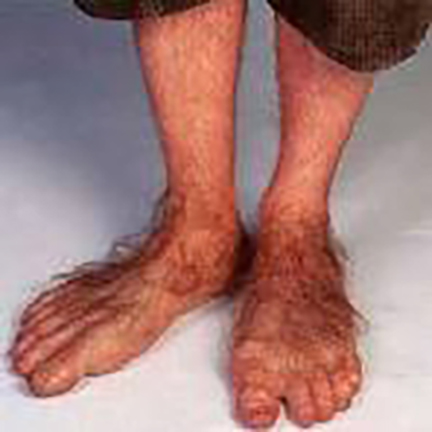
We have now said goodbye to summer and the Southern winds are bearing down on us. Summer was not great. We had weeks of wind and rain. I only made it into the ocean to boogie board four times. The good news is that I no longer have to think about the people who are walking around with bare feet. I don’t mean at the beach. I mean on city streets and, yikes, at the grocery store. As I understand it, this is considered a right and a New Zealand tradition. There are many Kiwis who disapprove of this particular tradition. But I haven’t seen any store or establishment with the guts to put up a sign that says, “No shoes, no shirt, no service.” (Okay, those are Hobbit feet. But that is what I think about when I see bare feet on the street!)
I don’t particularly like running as an exercise. I am not sure why but I have never taken to it. But not to worry. I have a better option—day hikes. There are numerous tracks around New Zealand most headed up into the hills and mountains where I can get sufficient exercise, particularly the aerobic variety.
New Zealand takes their trails and tracks seriously. They are well maintained and offer everything from day hikes to back country hikes that last for days on tracks that are described as only for experienced back country travelers. These tracks are not well marked, and you better know how to read a map and a compass. Some tracks have huts available for an overnight stay. Given the changeability of the weather, you also need to be prepared to face four seasons in a day.
I’m not interested in that kind of difficulty. I’m at most a glamper. So I stick to the day hikes. These trails take me into the bush, preserved forests that look like New Zealand probably looked before settlement—massive trees, palms, ferns, vines. I love going into the dark green forests and marveling at the densely packed flora. You expect a dinosaur to pop out any minute. These also give you an idea of the effort settlers had to make to clear the bush for farming. A Maori friend of mine told me there are photos of settlers burning hundreds of acres of forest to clear for crops and grazing. But the clearing is not necessarily permanent. Any place that is not attended to regularly will eventually be taken over by the bush. Everything grows here on a large scale. The sun is intense and the weather is temperate. It would only be a matter of time.
Saving these environments is important since a lot of land in New Zealand is being taken over by pine forests. Logging is one of the main economic drivers now. Sheep pastures are being turned into logging operations. This is problematic because pine seeds travel on the wind which means that pine trees end up in places they do not belong. There is a huge effort here to combat what they term “wilding pines.” Much like invasive animals and plants, pines can take over quickly if left unchecked. There are community groups that go out on eradication forays, cutting them down, even better digging them out roots and all. So let’s celebrate the wild forest where we can.
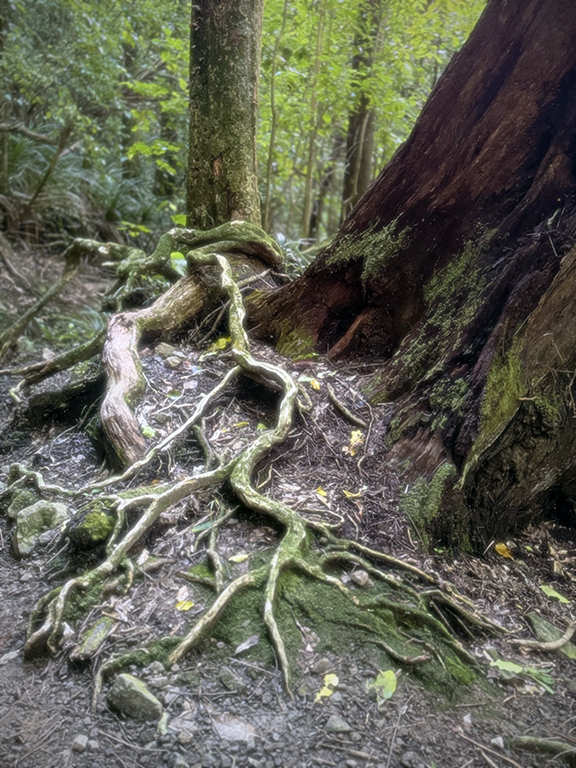
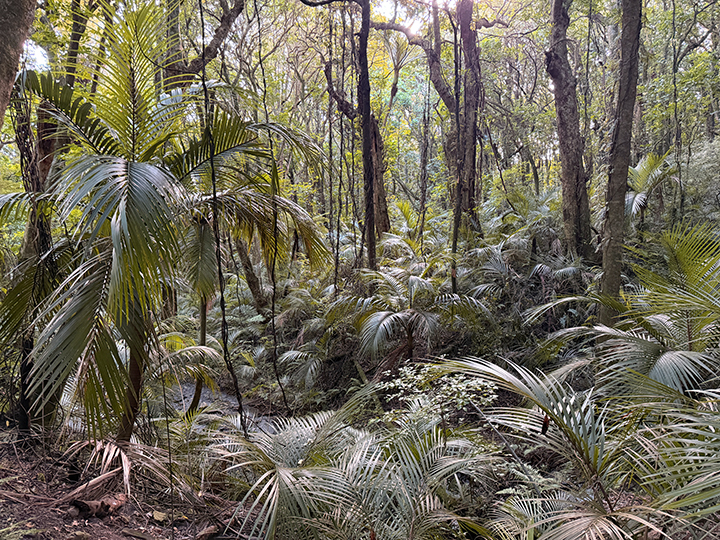
Here are some pics from some recent hikes. This is the Hemi Matenga Scenic Reserve where there is a think jungle of palm, ferns and vines:
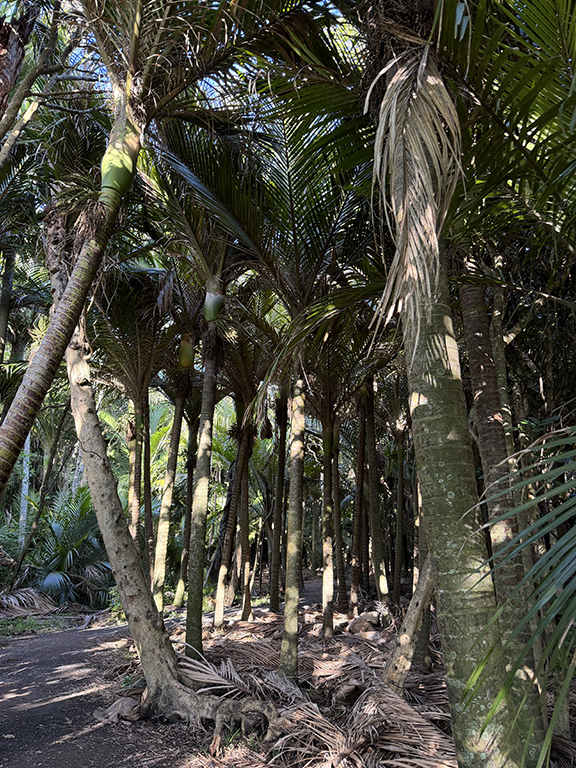
This is the Barry Hadfield Nikau Reserve, one of the few remaining untouched forests of Nikau palm. This trail is primarily steps up the hillside:
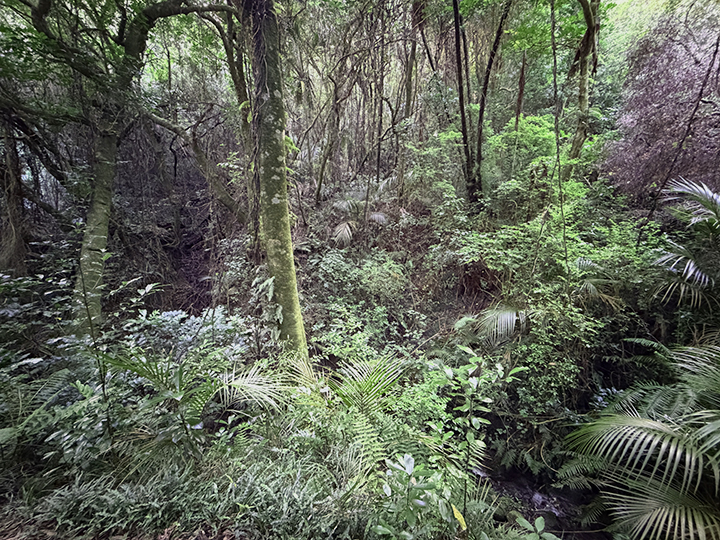
This is a trail along the Otaki River through native bush where they have reserved an area of cabbage palms along a stream at a place called Chrystall Lagoon. It is really beautiful back there.
All really lovely and so much better then running.
We learned something important. If we want to feel like we are in a cosmopolitan place, with energy and diversity and mountains of things to do, we have to go to Australia. This is particularly true if we want to see concerts. Few artists come to New Zealand, and those that do usually play in Auckland (the largest city) and leave. We folks here in Wellington are often forgotten. We now know how to fix that. Go to Australia.
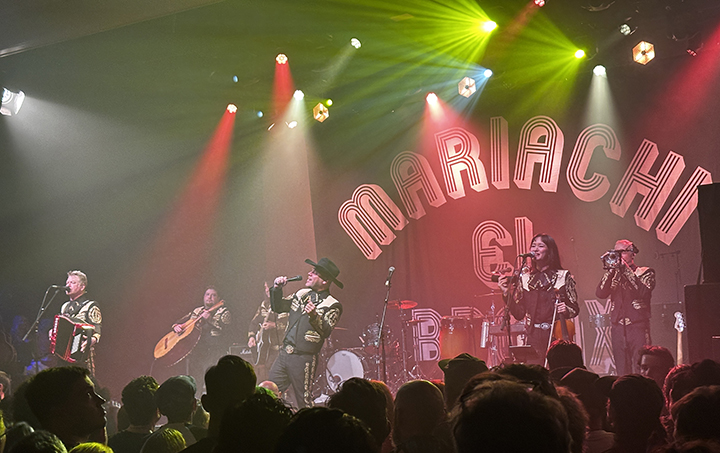
One of our favorite bands, Mariachi El Bronx from L.A., has a new record out and they were coming on a tour to Australia. Mariachi El Bronx is the alter ego of the punk band The Bronx. Every so often they release a mariachi record, which is great fun. They get dressed up in mariachi clothes and entertain us with Mexican music. I have no idea how I discovered them, but I am glad I did. They just make me happy. What is not to love when you listen to a band that has horns, a violin, and an accordion? (The accordion is particularly close to my heart since I am Polish.). We never had the chance to see them in the U.S., so when we had the opportunity, we jumped on it. We bought tickets to see them in Sydney and Brisbane. Off we flew to Australia for a mini-tour.
We like Sydney. There is plenty to do and see. But we had no time to dawdle. We walked around the Darling Harbor and that night we saw the show. It was fantastic and a good time was had by all.
MEB Sydney – They were great
Then we had a plane to catch to Brisbane. Brisbane (pronounced Briz-bn) is the capital of Queensland. If you visit Australia, Queensland is usually on the list of places to go to visit the Great Barrier Reef and Daintree Rainforest. You might go through Brisbane to get there. Brisbane is more like a city in Florida–tropical, hot, and humid. Did we see any part of Brisbane? Not really. But we did not care. Our focus was seeing MEB. And see them we did. It was a blast.
MEB Brisbane -They were great again!
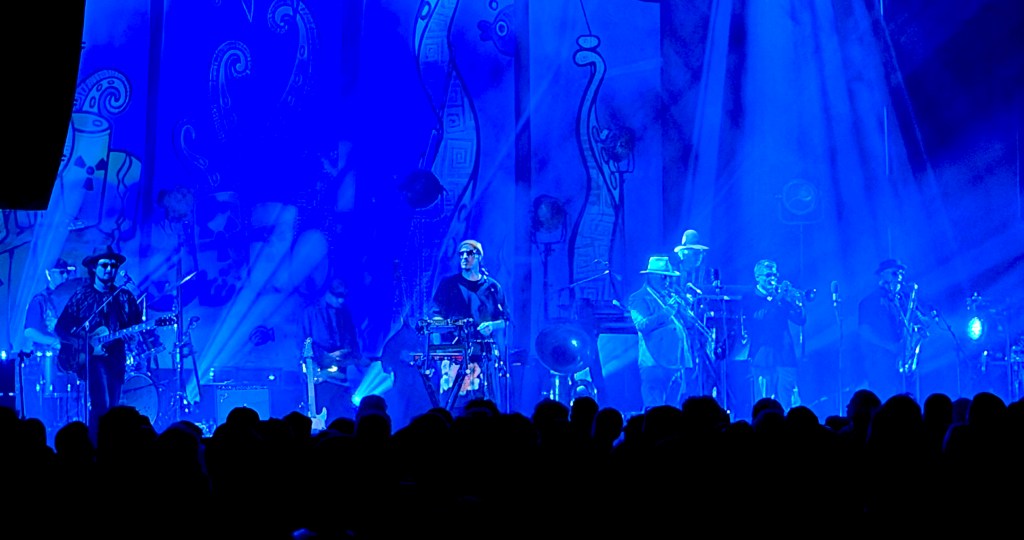
And then what did we do? We went back to Australia two weeks later for another concert. Another of our all-time favorite bands, Fat Freddy’s Drop, a band based in Wellington, was on tour. About six months ago, the leader of the band, Chris Faimu (DJ MU) died. I was heartbroken. Many wondered what would happen since he was a driving force in their music. The remaining band members decided to do a tour celebrating the 20th anniversary of their first album, something MU wanted to do. They hired some musicians to take his place (an impossibility really) and announced they were going to first appear in Australia. We bought tickets to see them in Melbourne. (And I am not ashamed to say, we later saw them in Wellington.)
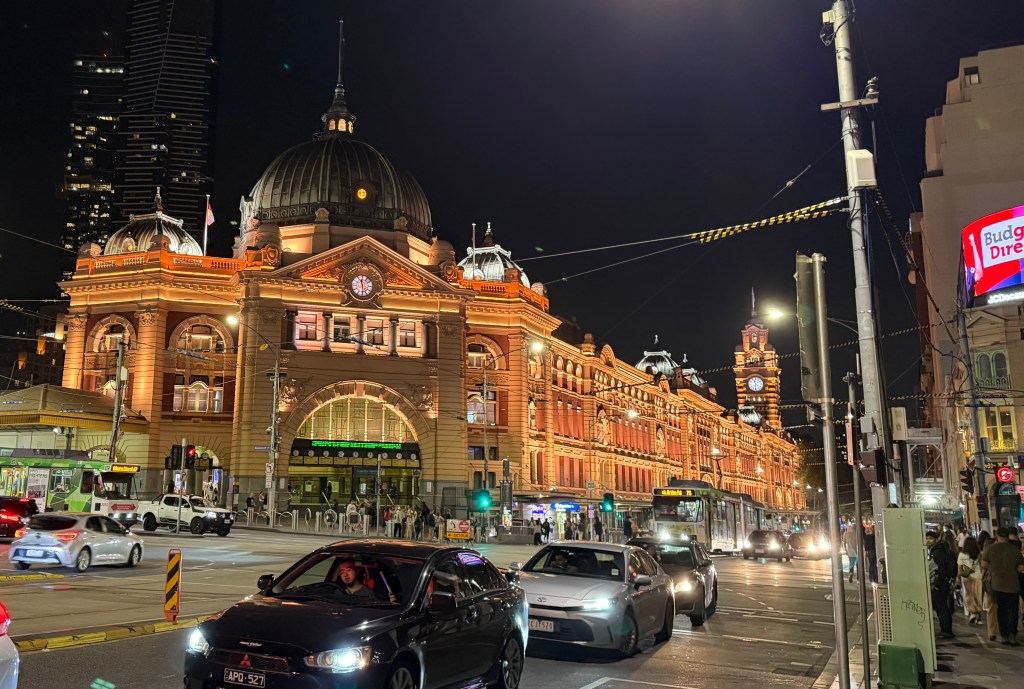
For this visit, we also made sure we had time to enjoy the city. Melbourne has become my favorite place to visit in Australia. People tend to go to Sydney because that is where the international flights end and everyone needs to see the opera House. But Melbourne, a city of six million and counting, it is now the largest city in Australia, beating Sydney. It has so much energy and so much to do—restaurants of all kinds, museums, shopping, parks, and markets. And shows. Lots and lots of shows. If there were a place in Australia I’d live, it would be Melbourne (pronounced Mel-bn).
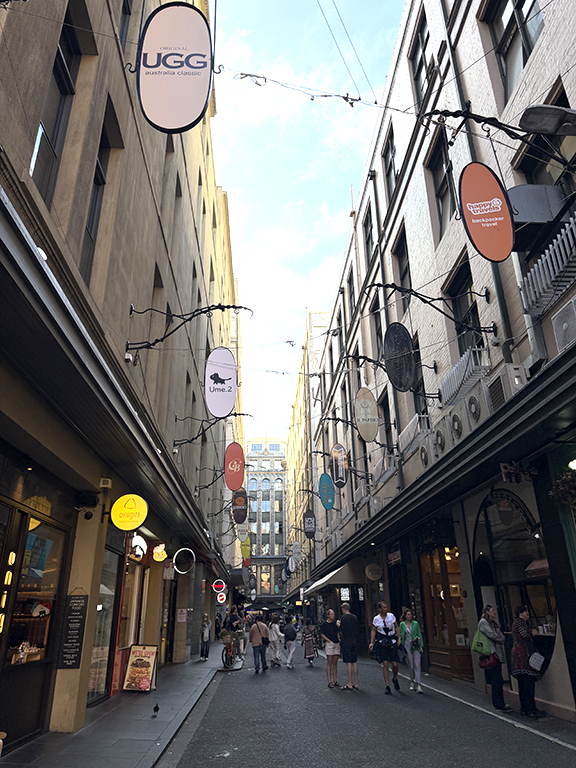
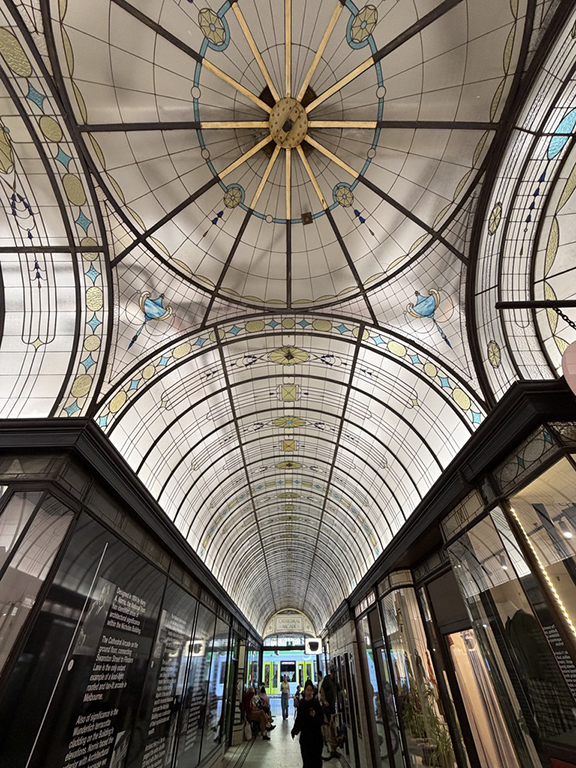
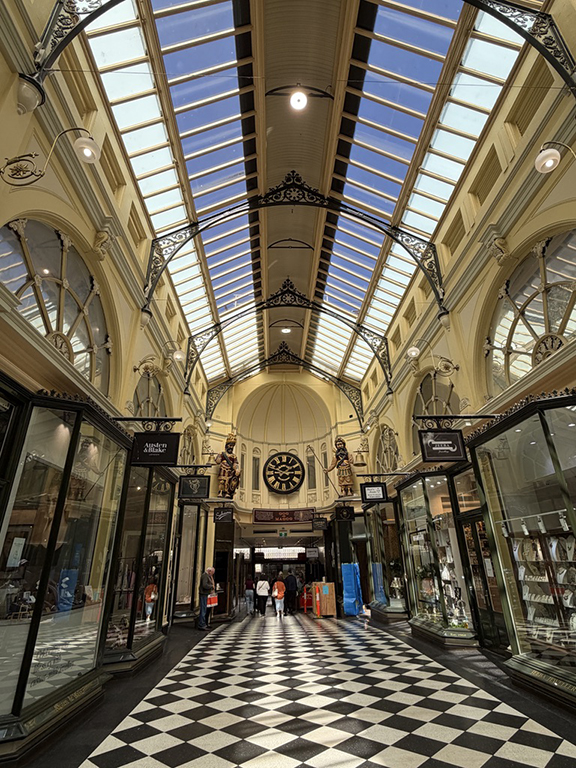
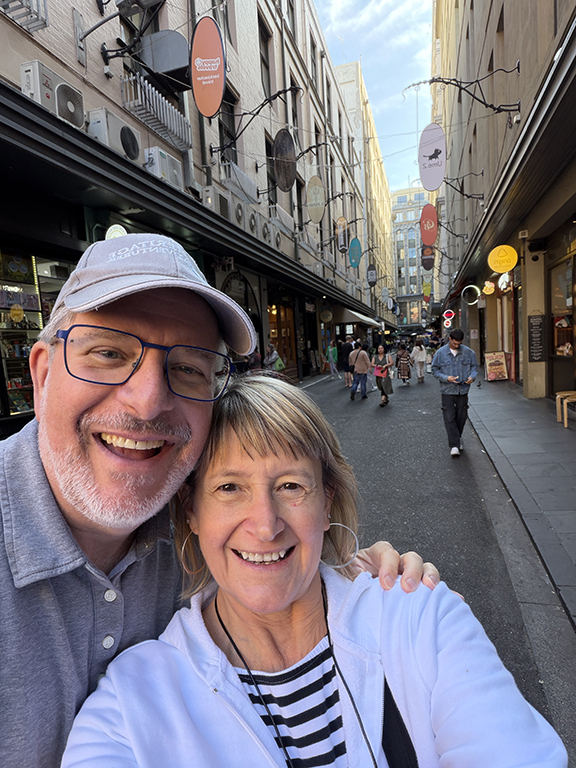
On this trip, we walked the laneways. Melbourne has been around a while and as the city has grown, rather than tear down old buildings to make room, they use them, preserving many of its older buildings and that history. The laneways are part of that history. This is a fascinating and fun walk through narrow alleys full of restaurants and shops. There are also arcades, old indoor shopping centers from the late 1800’s that shine with art glass ceilings and dark wood paneling. I strongly recommend taking this walk if you visit Melbourne.
Here are some pics:
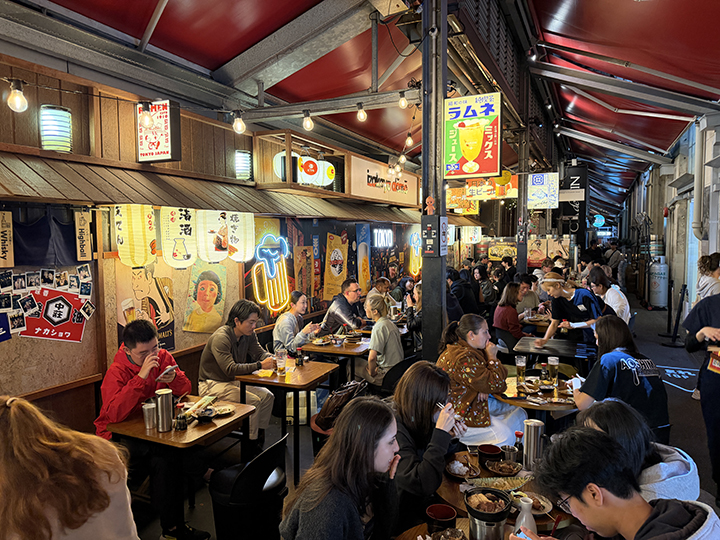
This is a Japanese restaurant located in a laneway. We ate too much and enjoyed a bottle of sake.Shopping arcade – Part of the laneway tourAnother shopping arcade
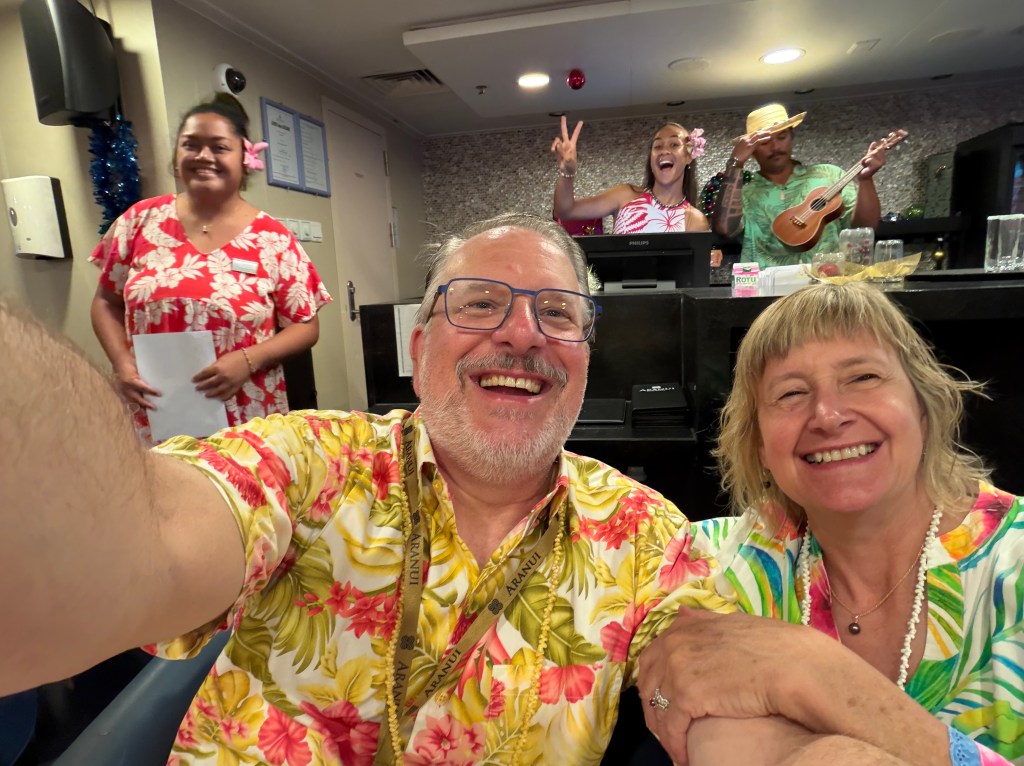
The entertainers on board sent us an invitation to a surprise event. Based on an off-hand remark by one of the guides, I had an inkling as to what was up. I was guessing that they were going to ask us to renew our wedding vows. I remembered that they had asked us if we had anything to celebrate while onboard and I stupidly answered that this was our 30th anniversary trip. I pressed people on the ship as to what was going on and they would not say. To be clear, I was pretty agitated. I know some folks really like this ritual, but I am not really into this idea. If I meant it the first time, and I have been at it for decades, do I really need to renew them? It is just smarmy Hallmark stuff to me.
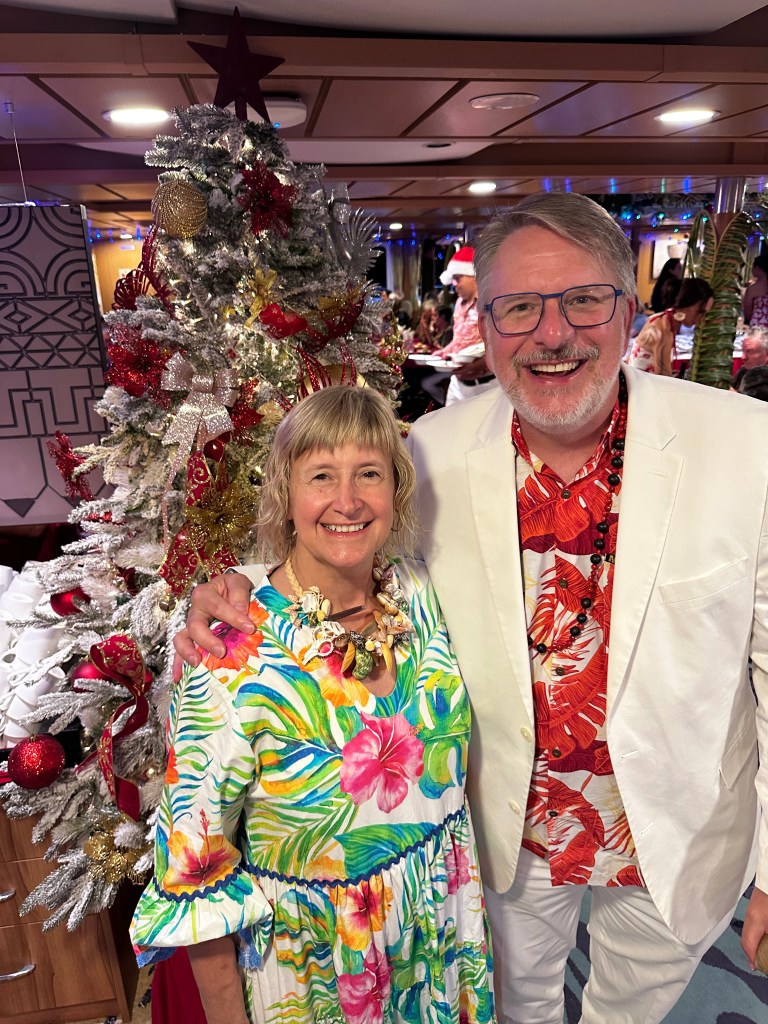
Despite my misgivings, we showed up to the room at the specified time as did ten other couples. Sure enough, the young folks in charge of entertainment explained that they were so in awe of the longevity of the marriages of those in the room, they wanted to celebrate it. They sang us Polynesian love songs and asked each couple to explain how long they had been married and what it was like. The length of time varied from 30 years (us) to over 50 years. That couple won the prize, which was cutting the “wedding cake.” The vow renewal came in the form of exchanging shell necklaces that they had provided to us. And that was really it. Just putting on a shell necklace. No recitals or vows. So that wasn’t so bad, I guess. Then we sat for photos. Make of it what you will.
For the last leg of the trip we left the Marquesas and headed south first to the island of Makatea in the Tuamotos and then to Bora Bora.
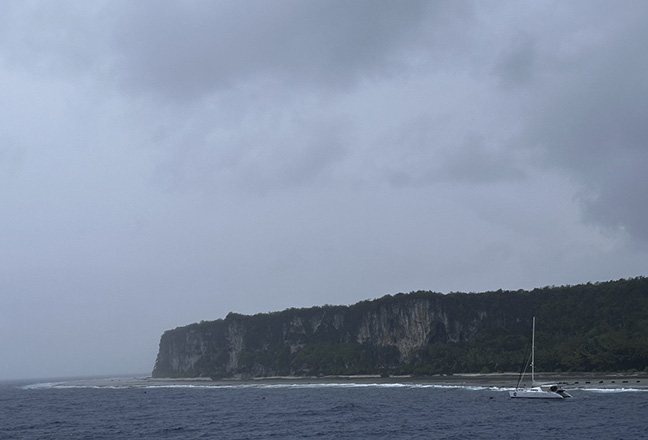
Christmas Eve and our visit to Makatea was a disaster from start to finish. This island, a coral atoll of massive white cliffs, was once an industrial powerhouse with a thriving phosphate mining industry. The island boasted a train, shops and a school. When the industry collapsed, the island was soon deserted. There are only about 60 people living there now. Not to be mean, but I am not sure why anyone would stay on this island.
The plan was to stop at a scenic look out, visit an underground cave with a natural pool to swim in, and then get to a picnic where the locals were to provide us with a feast and ukulele music. Everyone was invited to take the three-mile hike to the picnic spot. Those who could not make the walk would get a ride. That included us.
After days of sunshine, the weather turned and it was raining. Not showers, but tropical, drenching, pouring rain. We had on rain jackets but clearly not enough to withstand the fall. On the boat from the ship to the dock, the water was rough with cresting waves that slammed into us. We got off blessed by the sea water. And the rain continued. We found our SUV ride and got in. Then things fell apart.
For some reason, the driver of the SUV drove us a little way and then told us to exit the car. He was speaking French but since all of the French people started to walk, we gathered that he told us to walk. We thought maybe we were just going to a nearby building to wait. But there was nowhere to stop. We just kept walking…and walking…and walking on a dirt road through a jungle. We caught up with the people who were voluntarily hiking, which was concerning. No one in our group was prepared for a walk or a downpour. The hikers were unprepared for rain too. One guy had a golf umbrella and I was jealous, but for the most part, people were wearing fully inadequate rain jackets or no jackets at all. Everyone was wet through.
Now I would like to say, gee, this was fun. Indeed, afterward, some people on the boat proclaimed to us that it was such a fun time to walk in the rain. But honestly, I thought they were nuts. It was a cold rain, there was wind, and everyone was soaked. If that is your idea of fun, well, more power to you. It was not fun for us and for those who were not supposed to be walking to begin with, it was very unpleasant.
After we walked about a mile, we came upon some guides and I proceeded to lay into them. I asked why we were walking when we were supposed to be riding. They explained that the SUV had been going back and forth to the boat landing, and we were to have waited for the SUV to come and pick us up again if we did not want to walk. That was not what we were told and I was furious. They agreed to find us a ride to the picnic area. When we arrived, there were already many, many people from the boat who had been driven there, sitting under tents, dry as a bone. I guess, unlike us, they got the correct information. Eventually, the hikers straggled in, and we got ready for the food.
I have to say, we appreciated the locals who, despite the rain, provided the food and they kept us entertained with ukulele songs. The pork that came out of the barbecue was delicious. But nature did not care. We were tromping around in mud, trying to be positive but it was hard given we were cold, tired, and soaked. Even sitting under the tents was pretty miserable. There were not enough chairs. The rain kept pouring down. The tents roofs, weighted down with water, felt perilous. People worked to clear them but it was a difficult task.
After all that fun, it finally came time to get back to the ship. Everyone was lining up for first dibs on an SUV ride back to the dock. One of the guides who I had been having words with motioned for us to get in one of the trucks. The rain persisted and we continued to enjoy being drenched, waiting for the boat to come from the ship. I was shivering from the cold, and keep in mind, we were in the tropics! When we got back, I stood in the shower for a very long time, doing my best to empty the ship’s hot water tank .
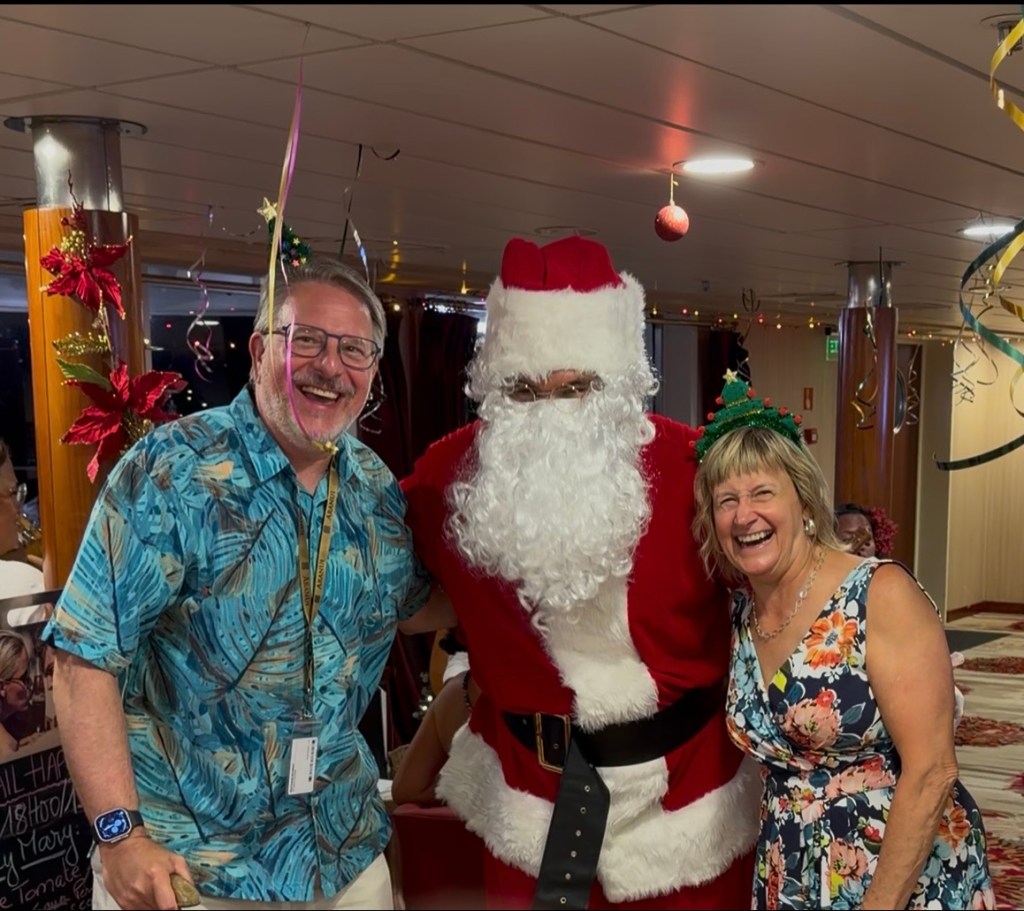
But all is well with a little Happy Hour cocktail and ukulele music. It was Christmas Eve and Santa came to visit us in the lounge.
Ho Ho Ho
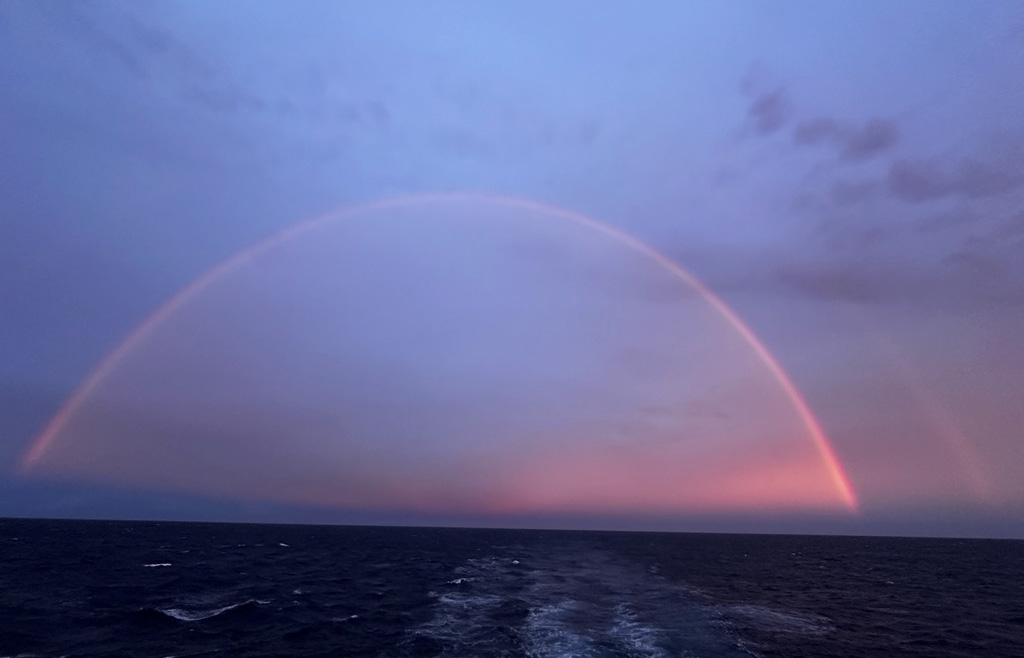
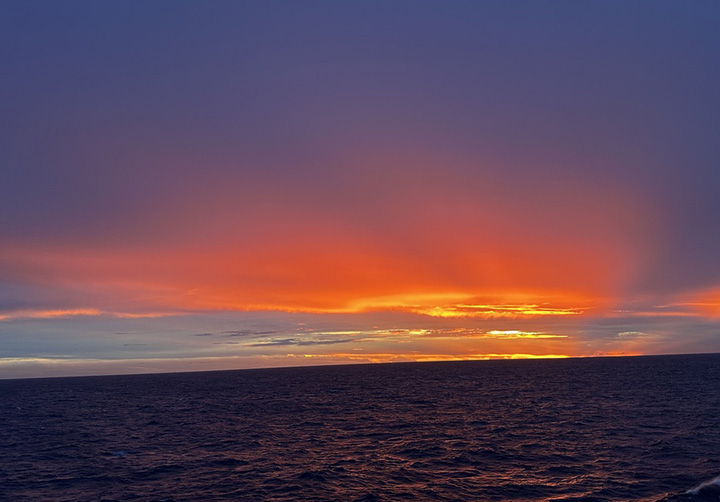
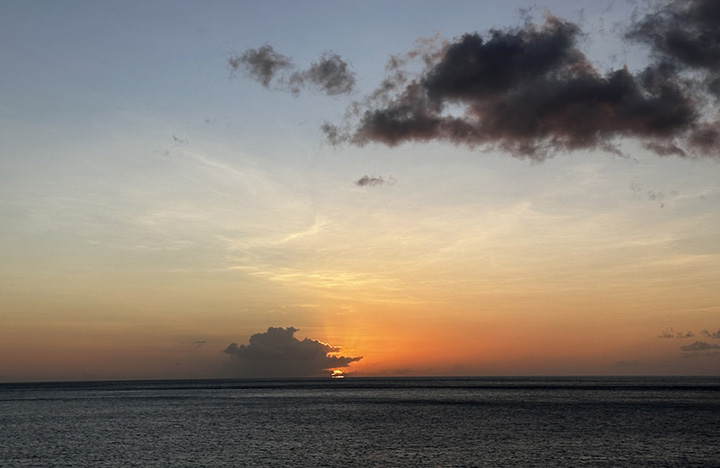
Then God granted us a gorgeous sunset and double rainbow. Check it out:
Double rainbowThe sunset causing all the fuss. Spectacular.
Christmas morning we woke up at Bora Bora, the volcanic atoll in the Tahitian Island chain. We had been to Bora Bora a few years before, so we were pretty familiar with it. The skies were dark and rain was again in the forecast. The morning was to be spent shopping in the village. We were concerned that the shops would be closed but no, there were too many cruise ships in the harbor to stay closed for Christmas. In fact, the cruise ships had landed so many people that it was actually crowded. We wandered around for a bit then returned to the ship.
There had been a beach lunch planned for our group, but those in charge allowed that we did not have to participate in another picnic in the rain. Smart move. It held off a mutiny.
In the afternoon, we were scheduled to go snorkeling. I had my doubts since it was raining but we figured if we are going to be in the water, what difference does it make? It turns out, it made a big difference. It was not just raining. It was storming. We stopped at a spot known for manta rays. As we started to swim, the seas began to swell, waves bobbing us up and down which made swimming difficult and snorkeling even more so as the water was topping over the breathing tube. The rain was coming down so hard it felt like sharp sleet on my back. The churning water became cloudy, which made snorkeling pointless.
I became concerned that if we went too far, returning back to the boat against the current in a storm would be difficult. I decided to turn us around. It was raining so hard we could not see the boat. I signaled to the guise and he led us back. Others quickly followed until there were only two people out. The rest of us stood on the boat with little cover waiting for their return. It was so cold that one woman went back in the water to wait. She was right: it was warmer in the water than on the boat. The captain finally returned and we went off to another snorkeling spot. The rain had eased and we all went in for a quick look around and to warm up. Sadly, in comparison to our last visit to the island, the coral did not look good and there were few fish. We were told that red algae blooms, and a cyclone had impacted much of the coral. All I can say is, this was not the most positive experience. Another hot shower helped me to recover from the chills.
That night was Christmas dinner. The dining room was packed, and the crew sang as we entered. What fun!
All in all, a Christmas I will not soon forget.
Farewell to French Polynesia
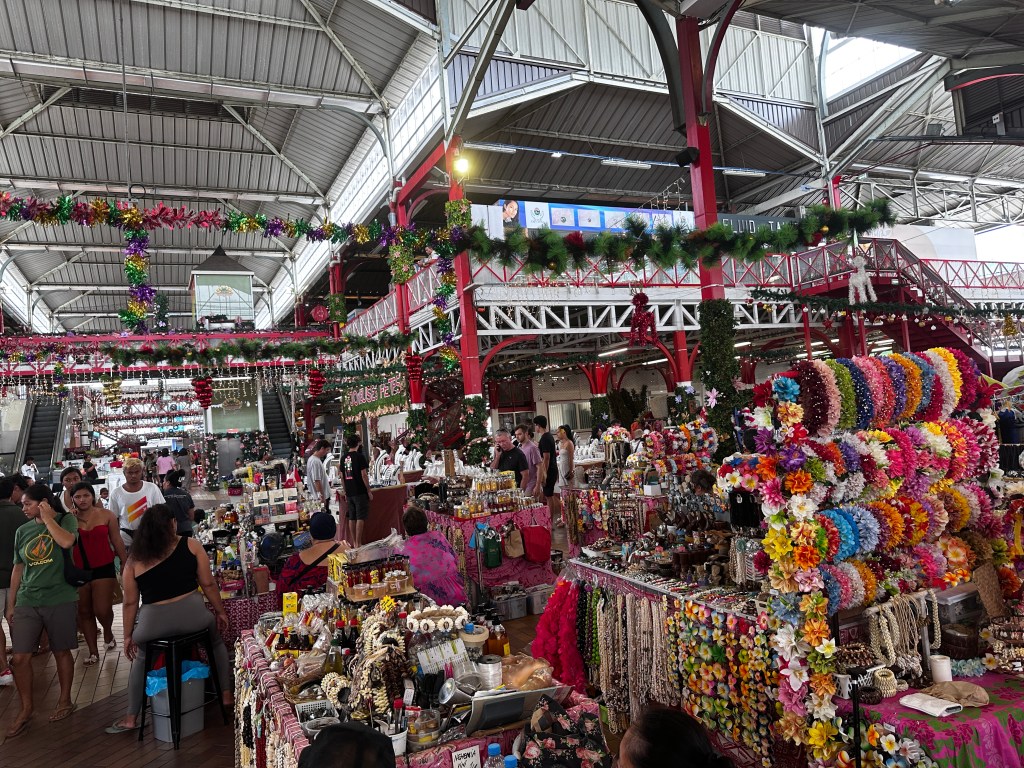
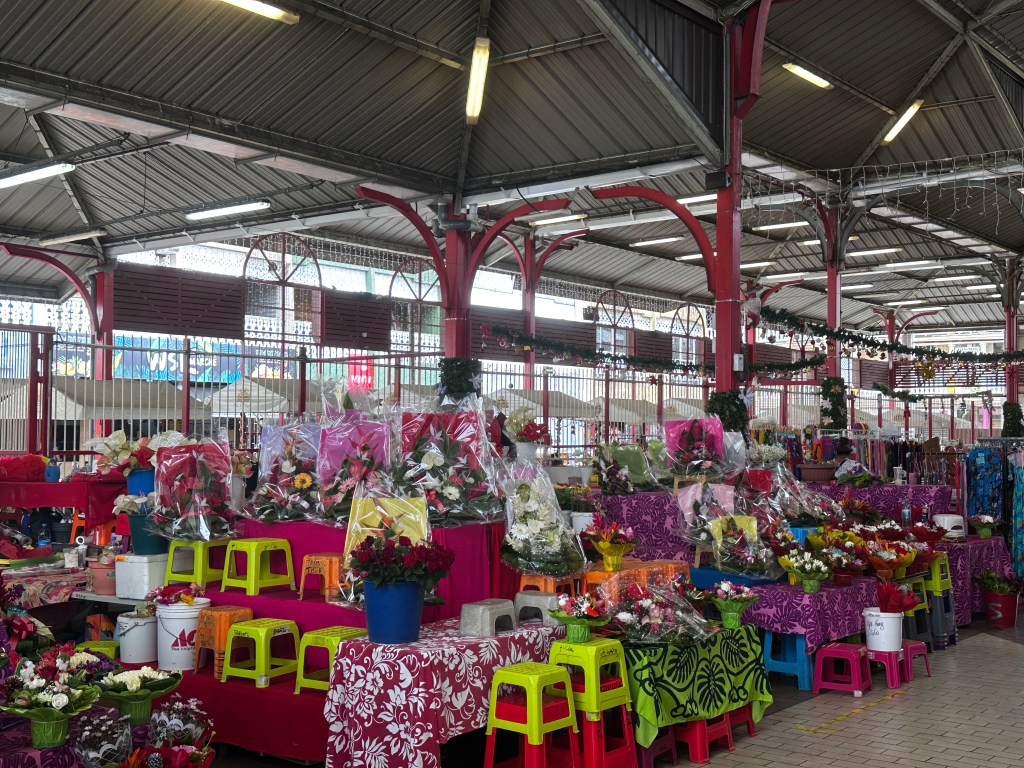
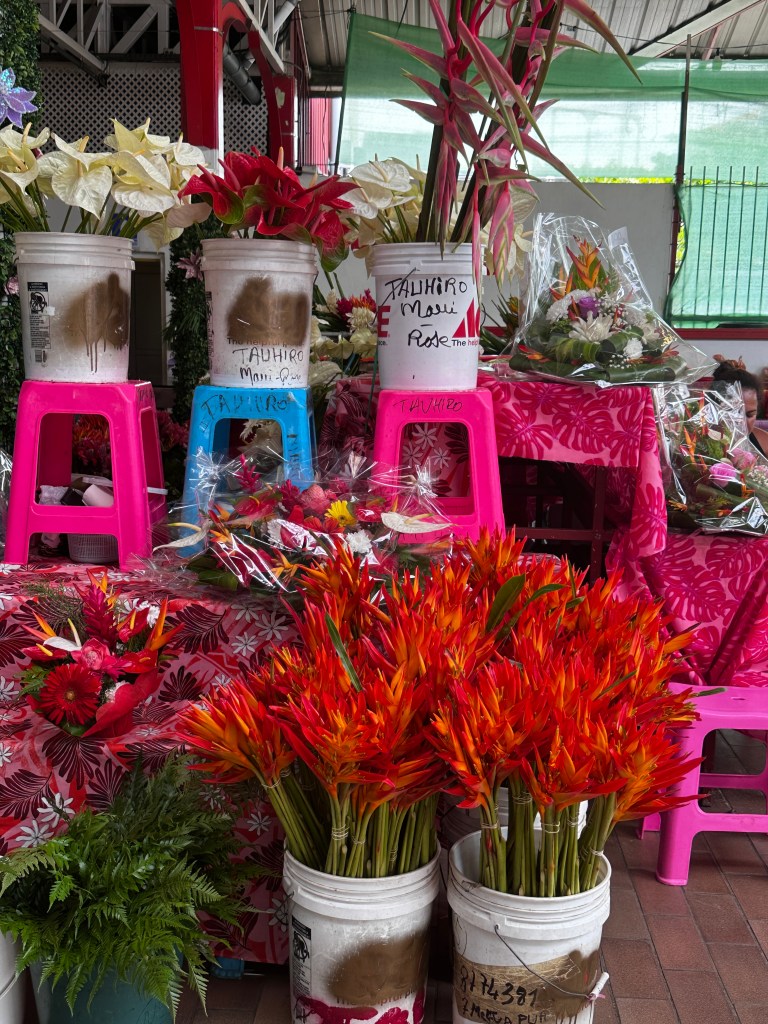
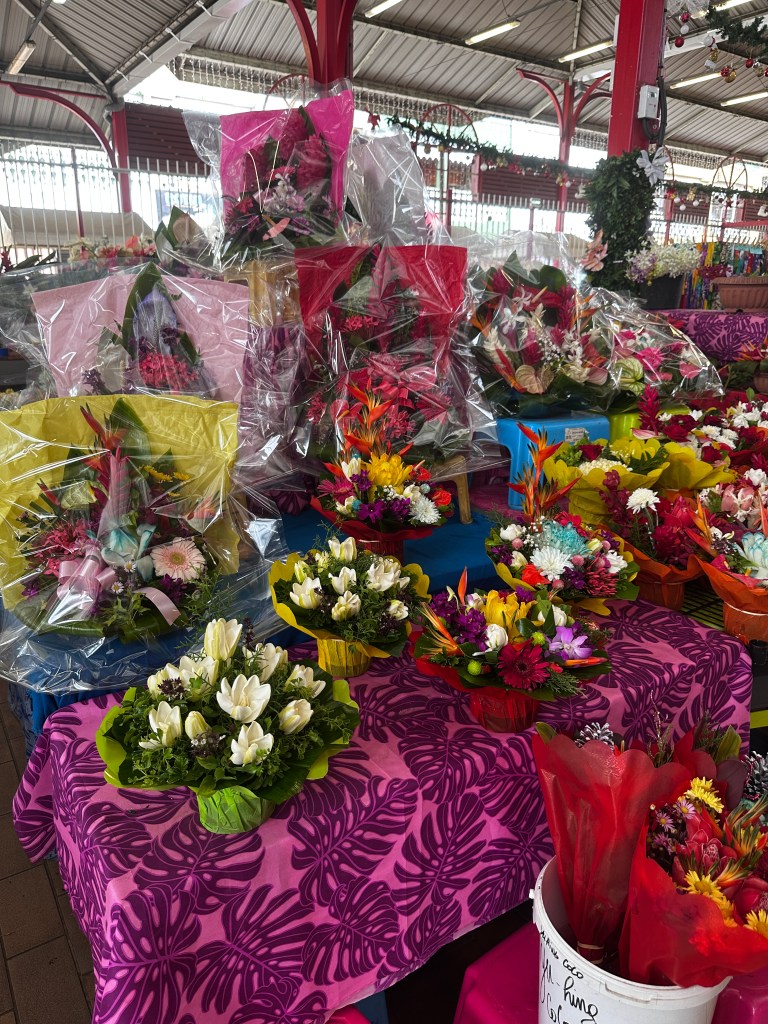
Our final day in Papeete Tahiti, I was pretty sick and Matt was starting to feel sick too. But we managed to check out the huge local market for after-Christmas shopping. Selling everything from food (fresh fruits, vegetables and seafood) to jewelry (lots of black pearls) to trinkets, my favorite part was the flower market section, an ikebanist’s dream.
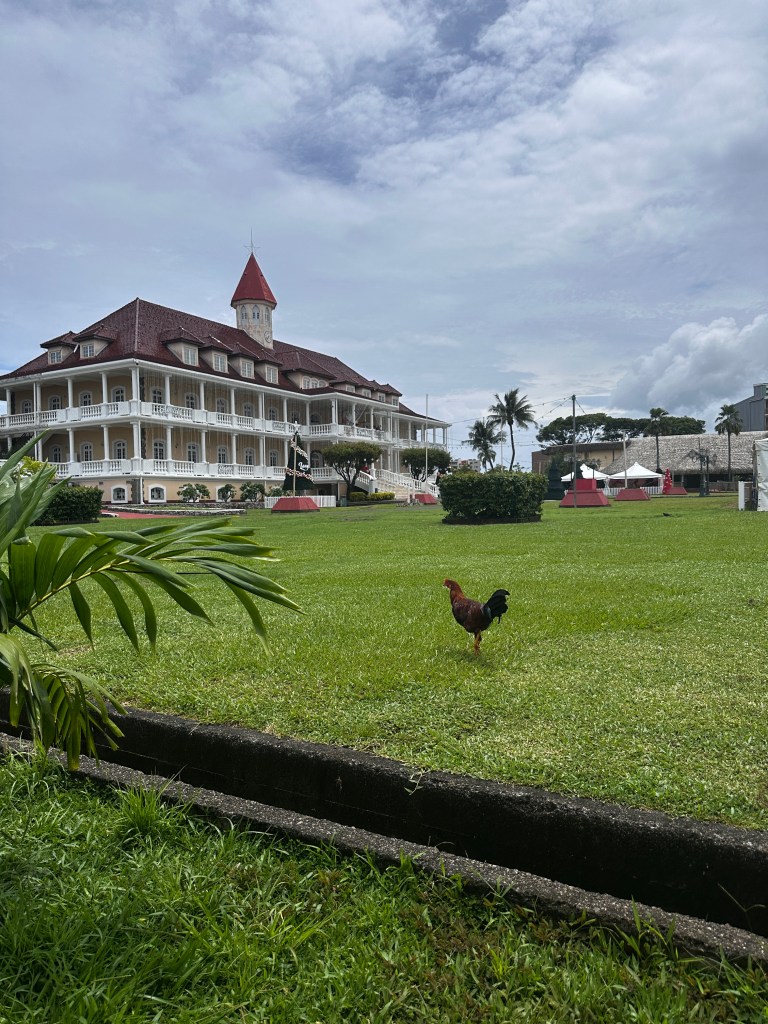
And just for fun, the Town Hall and Administrative building with jungle fowl.
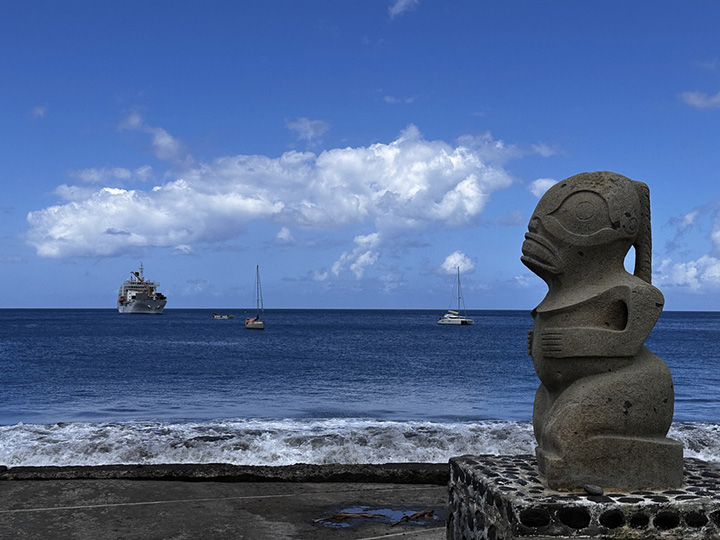
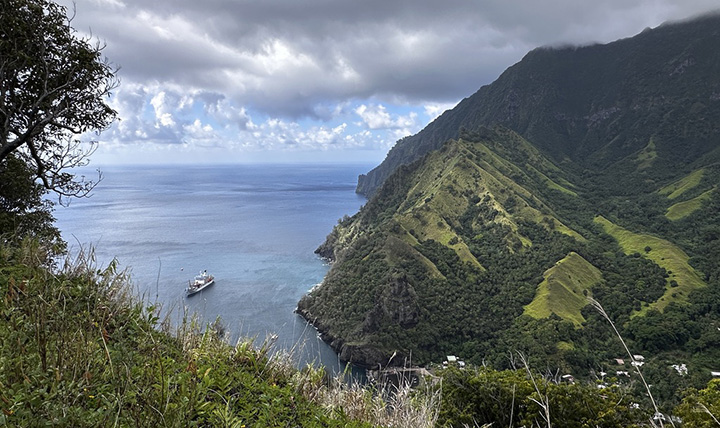
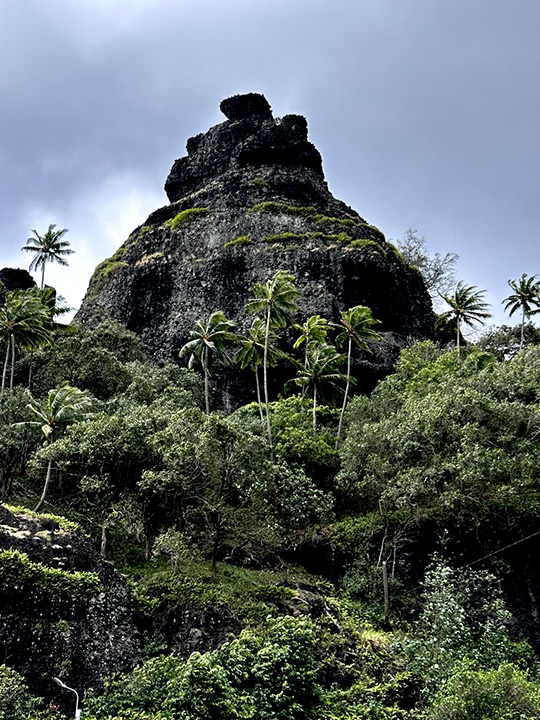
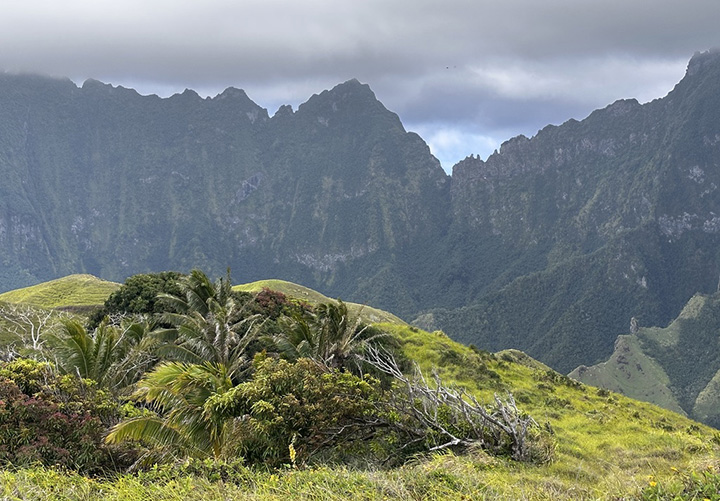
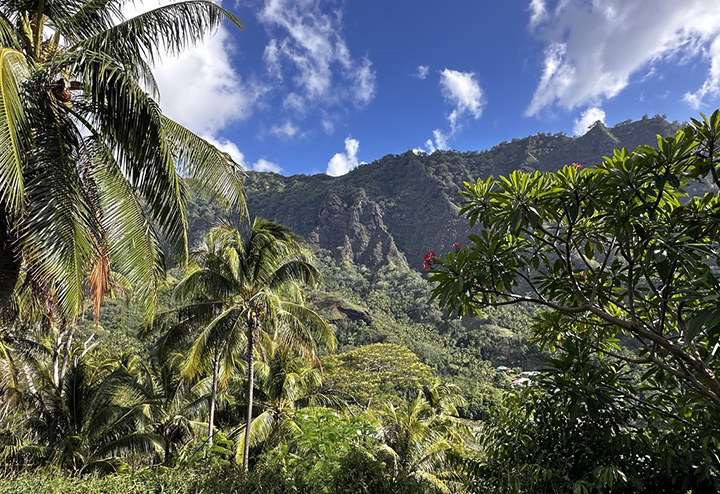
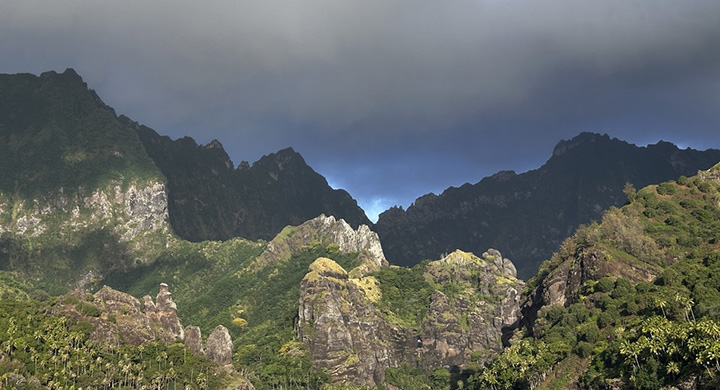
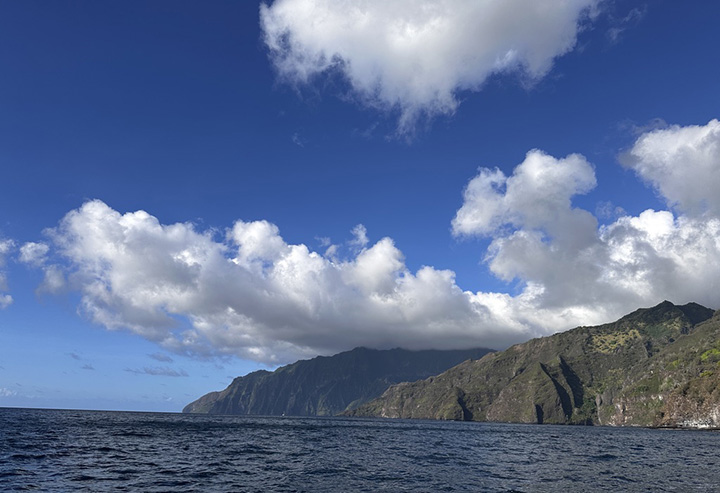
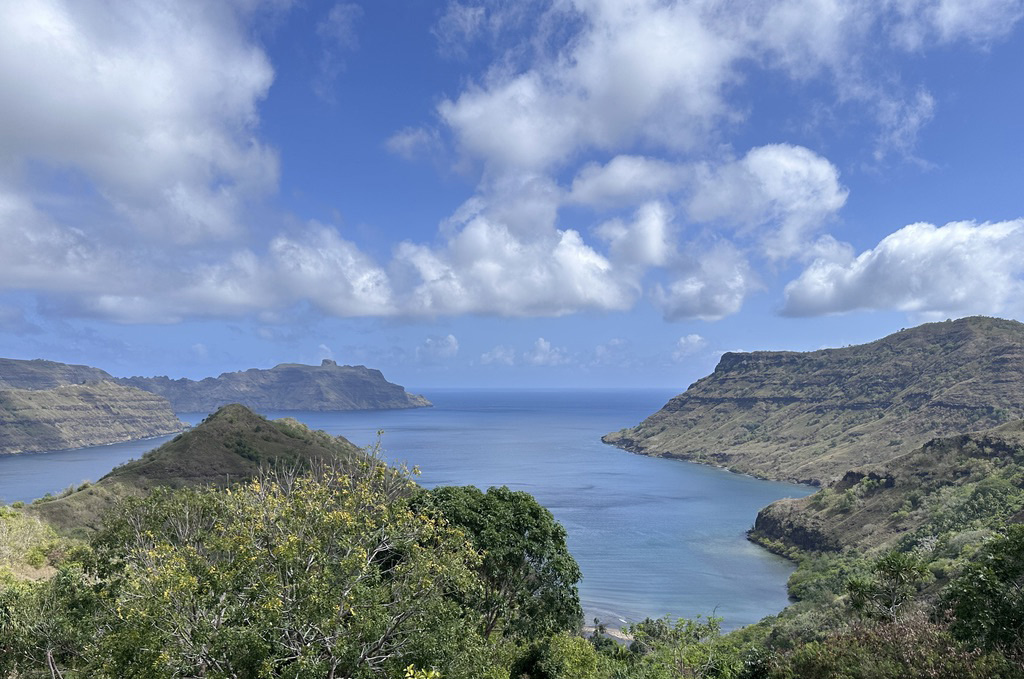
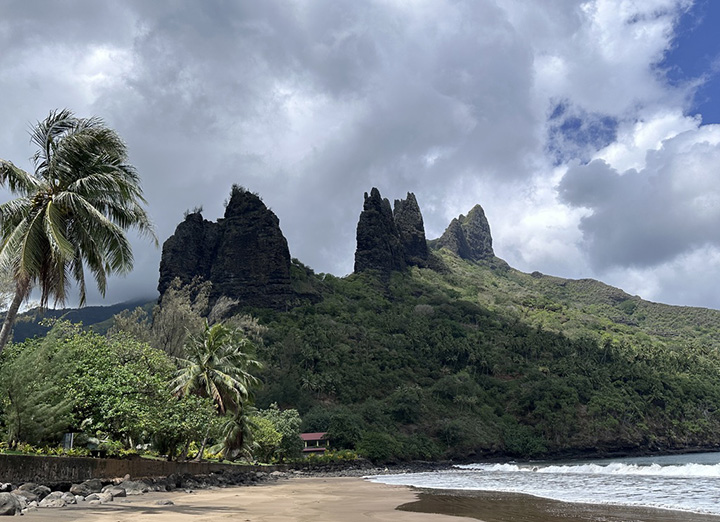
Fatu Hiva is the southern-most and most remote island in the Marquesas with a population of about 600 people. Matt noted that this was the first island that really looked like the ideal Polynesian island–the one you have in your mind–with few people, lush green, jungle covered valleys and cliffs, volcanic mountains, and a scenic coast.
There are two villages, one with a church and post office. There are no banks, no ATMs and no credit cards. There is no airstrip so the only way to visit is by boat. If you needed a doctor, that too would require a boat ride to another island. There was, however, cell phone coverage. (The French and Google managed to get a fiber cables to the islands.). So that is something. While there is an elementary school, secondary education can only be had by sending the children to another island and eventually to Papeete Tahiti. Having gone away for an education, most do not return to live.
This island is best known for its tapa cloth and its carvers. Tapa is a fiber cloth made from tree bark, usually mulberry which makes a white cloth, sometimes banyan which makes a brown cloth and sometimes other trees. It is a very dense and strong fiber that was once used to make clothing. Some dancers at the Arts Festival were wearing tapa cloth costumes.
Now it is used mostly as a print and paint canvas. Tapa paintings are available most everywhere in the South Pacific and greater Polynesia. But the artisans on Fatu Hiva are renowned for their skills.
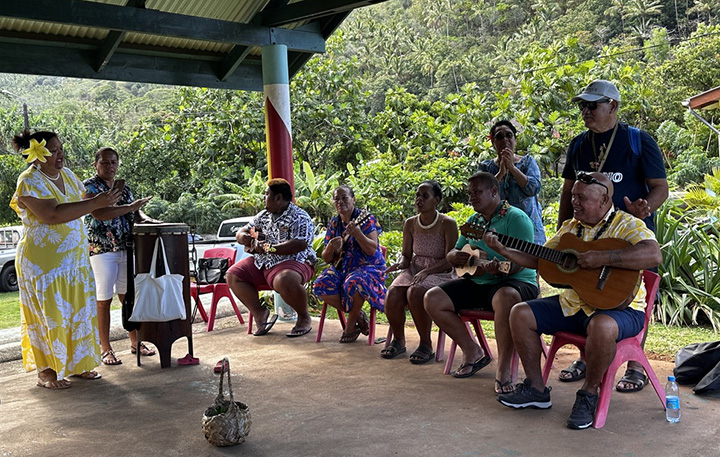
In the morning, we went to a craft market where we were welcomed by ukulele songs (love it!).
welcoming committeeVillage Market
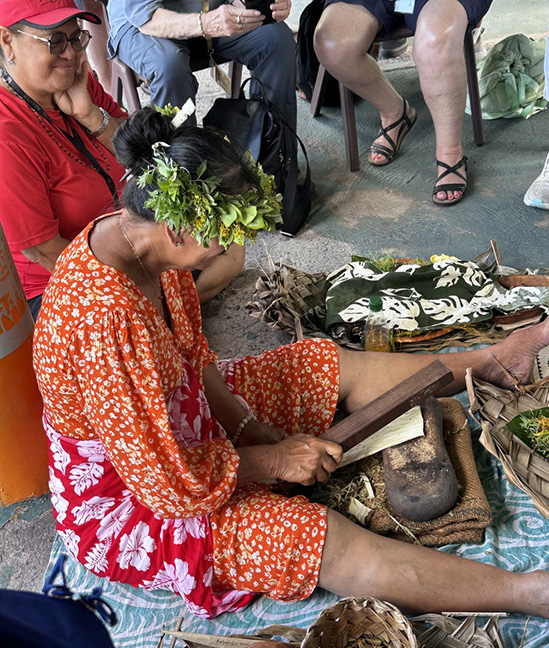
And it was in fact true about the art: the quality of the work was outstanding. I bought tapa earrings and a painting. Matt bought a map painted on tapa. There was a demonstration of how to make tapa, which involved beating together the wood fibers to create several ply layers.
Pounding mulberry flat to make tapa
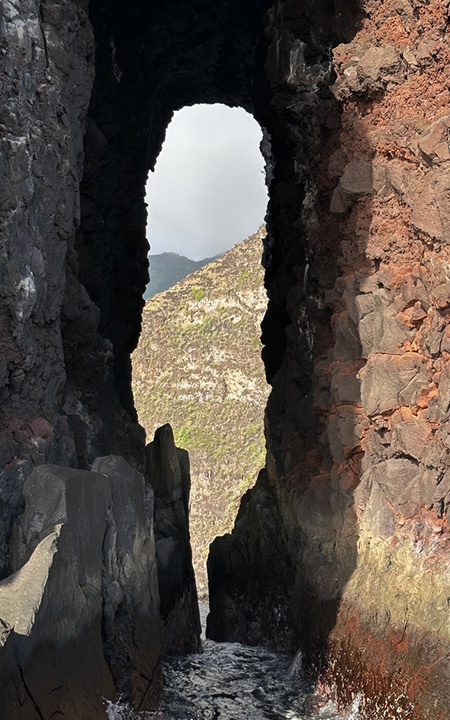
They explained that you can hear the sound of the pounding every morning as women get to work making tapa. It looked like a good way to de-stress. After the market we had a tour of the island from 4×4 SUVs. After ooing and aahing about the landscape, we were dropped off at the pier to catch a boat back to the ship. That gave us a wonderful scenic tour of the island from the sea. Rock formations, cliffs and palm trees led the way. Really just a beautiful spot, seemingly untouched by the heavy hand of civilization.
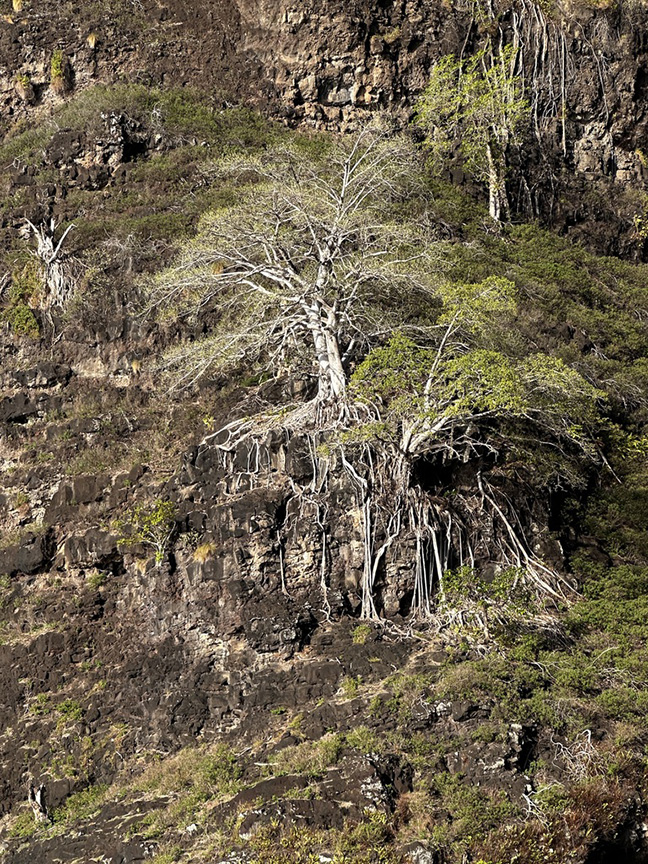
coastal viewssea caveThat is a survivor
As I walked around, I wondered how many people on the island may have never left it. Maybe they ventured to a nearby island for medical care. But if you wanted to get lost in this world, this would be a good place to do it. The ship we were on comes once every two weeks to bring supplies. Other than that, you would have to make money selling copra and live off of seafood, coconuts and the fruits growing all over the island—mangos and bananas mostly. Maybe you would find a random wild pig or goat. We did wander into what appeared to be the only grocery store and they had the necessities, but it was very small. This really did seem like the edge of the world.
Goodbye to Fatu Hiva
We always ended the day at Happy Hour and these folks will show you what “Happy Hour” means to them. Anyone with a uke or a voice to sing along can join in. Love it!
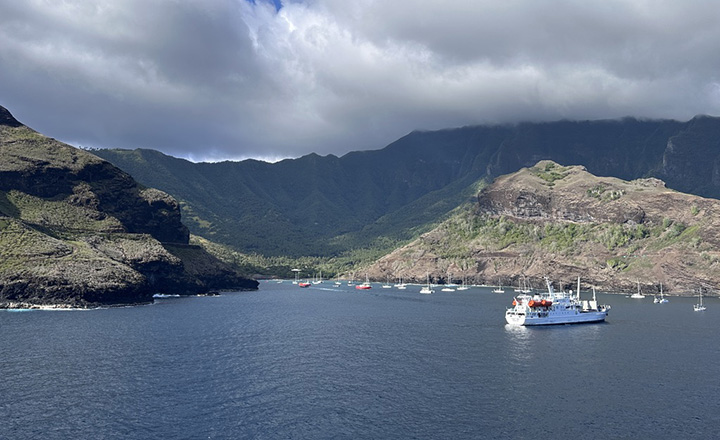
On to Hiva Oa, the island Paul Gaugin made famous.
Going to Hiva Oa was one of the main reasons for me to go on this trip. I was always fascinated by Gaugin’s story. If you don’t know it, here it is.
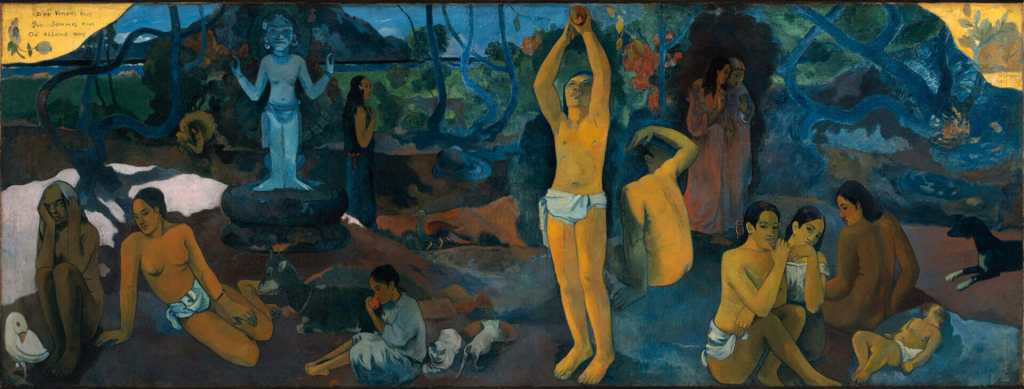
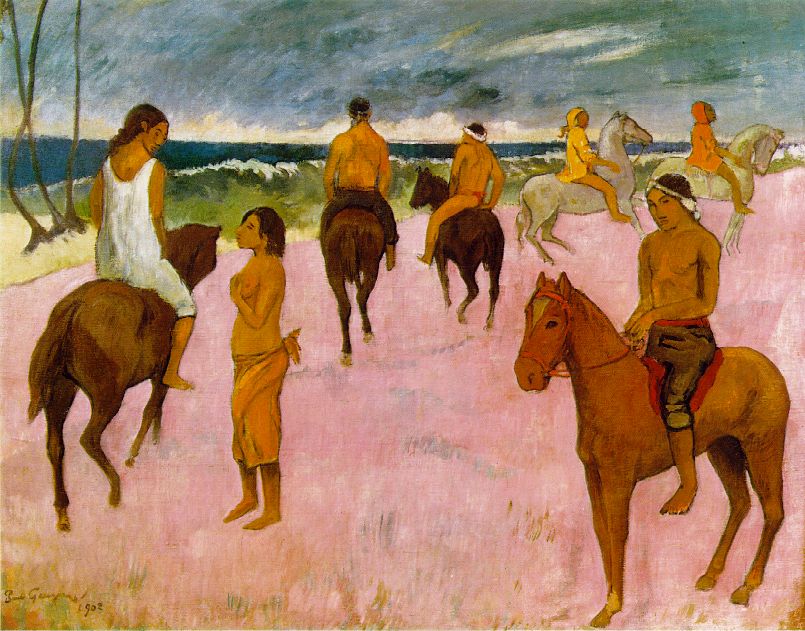
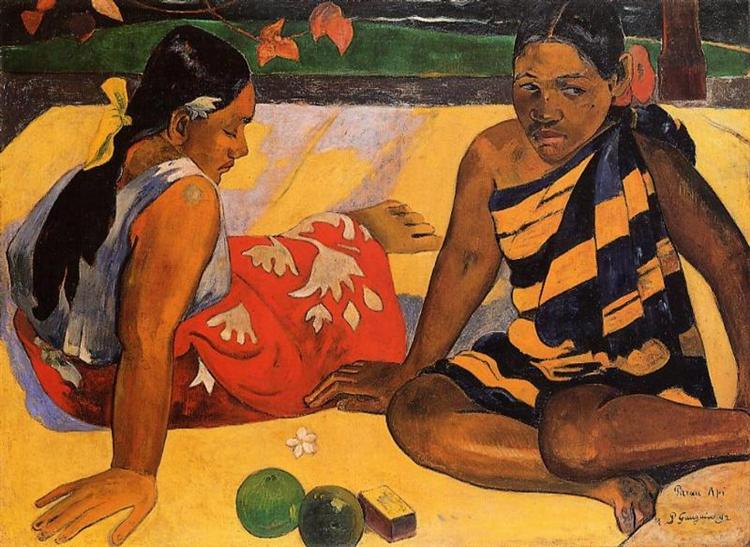
Gaugin had been a stockbroker in Paris. After a financial crisis in France, at the age of 34, he decided to paint full time. At that time the Impressionism movement of Renoir, Monet and Degas was at its peak and younger artists were starting to move away from Impressionism to bolder colors and stronger lines, He became a Post-Impressionist painter, much like Van Gogh who was a friend. He was a restless man, looking for places that would serve as inspiration and that would address his beliefs. After trips to South America, Latin America and the Caribbean, he decided to travel to Tahiti. Abandoning his wife and children he immersed himself in native culture living in a hut and taking a native wife. It answered his need for freedom spiritually and sexually. Several years later he returned to France, found it stifling, and returned to Tahiti where he continued to produce art which was sold in Paris. He expanded to sculpture, wood cut prints, and carvings. He finally decided that even Tahiti had too many rules and restrictions, so he moved to Hiva Oa where he took another native wife and continued to live in a native hut. He died in 1903.
Here is some of his art:
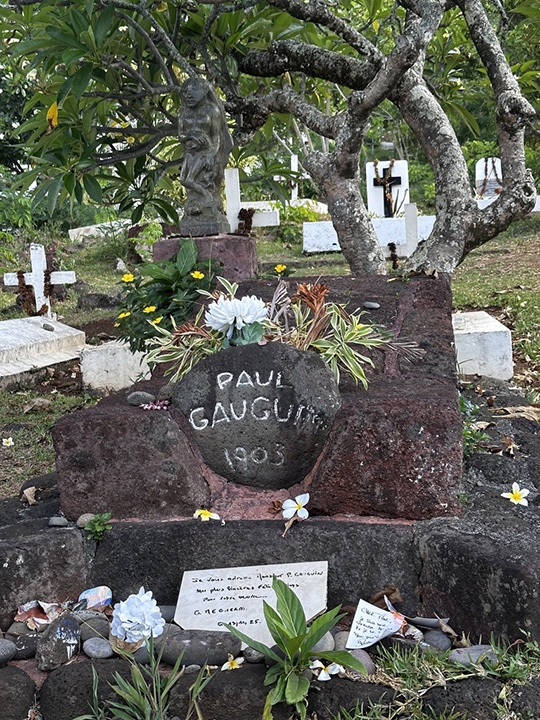
After all that, I expected to really get some sense of Hiva Oa. But we only spent the morning there. No SUV tours, no singing or dancing, barely a glimpse of the island. I assume the timing related to the ship’s delivery schedule, but still it was very disappointing. We did visit his grave and the Gaugin Museum where they have reproductions of his art but not one original. They also had a replica of his house. It was not a great experience.
Next stop was the Marquesas. The Marquesas are volcano-born islands far to the northeast of the Tahitian Islands. The ship sailed for an entire day to reach them. They are divided into northern and southern island groups. The northern islands tend to be arid, at least on one side, while the southern islands are much greener and, in some cases, rain forest-like. You will see horses on all of the islands, brought by settlers and explorers, some are wild, but most are claimed by locals and used to assist with agriculture. Yet, they seem to roam freely. There are also wild pigs and goats brought in by the outside world.
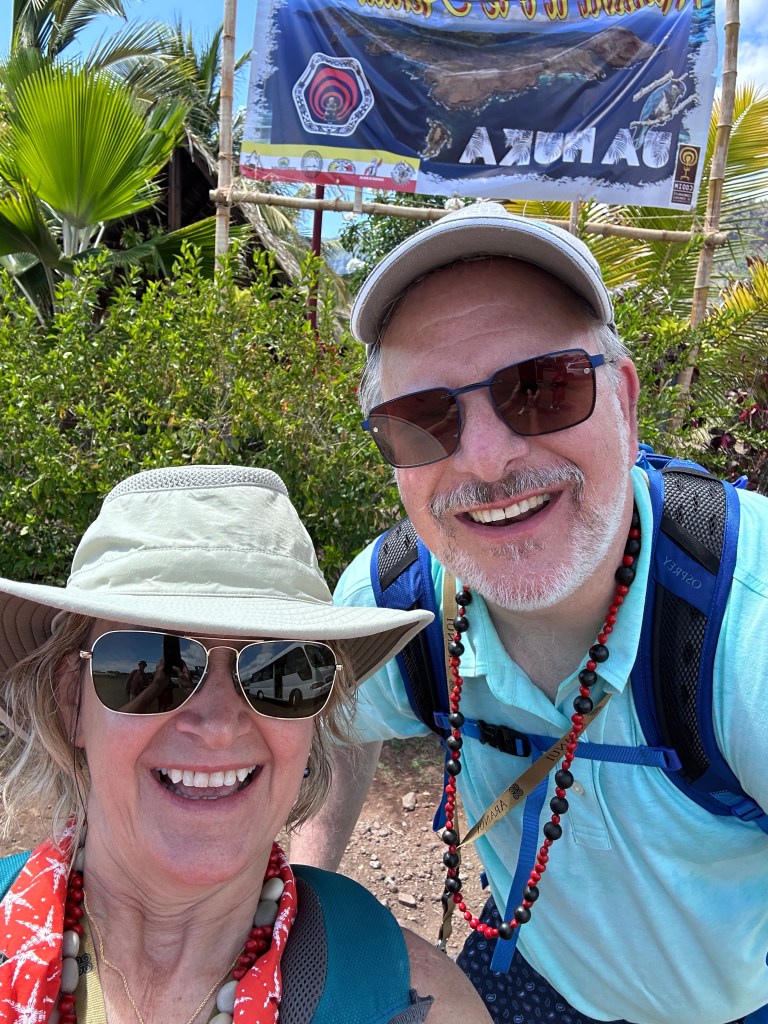
First stop was Ua Huka for the Marquesas Islands Festival of Arts or Matavaa Henua Enana.
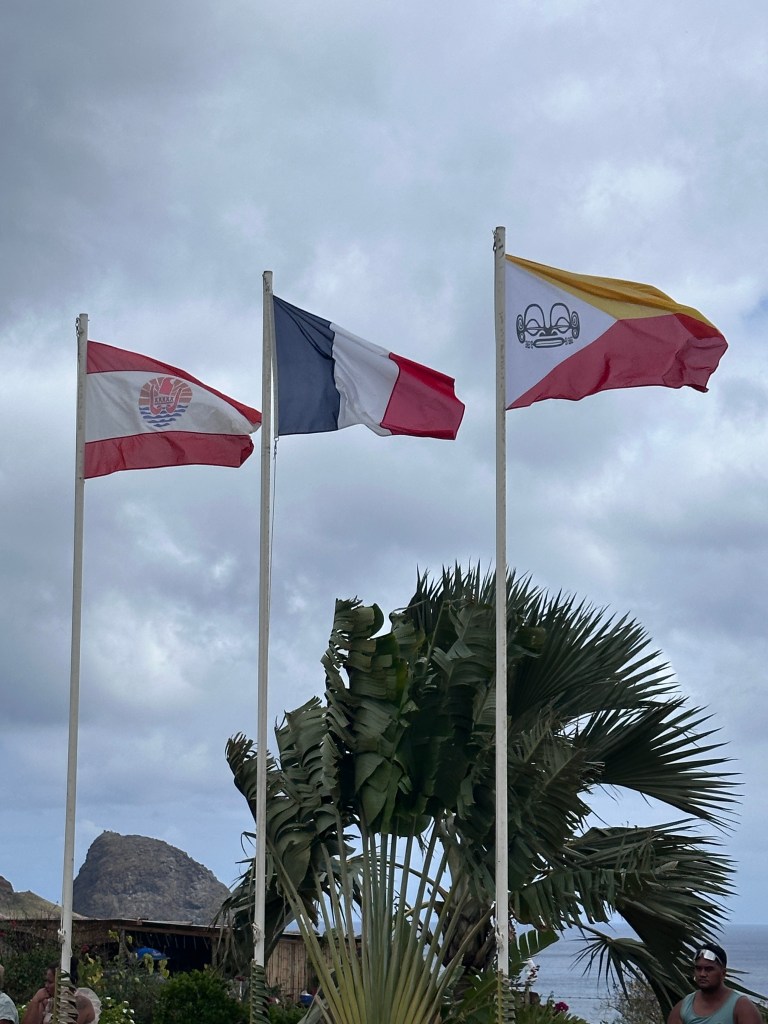
Ua Huka HarborFlags of French Polynesia, France, and The Marquesas
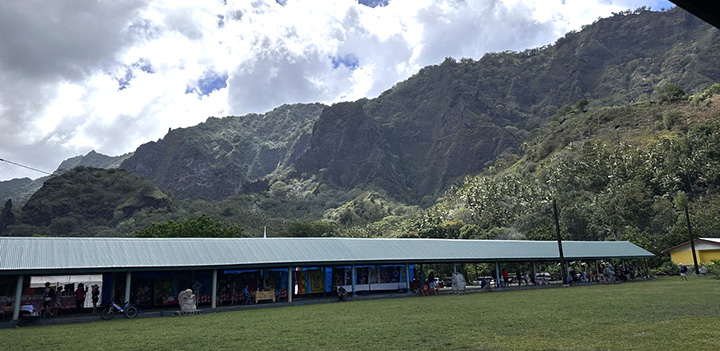
Every two years all of the islands get together to celebrate Marquesan culture through dance and song, crafts, and tattooing. People travel from all over French Polynesia to attend so our ability to be there was a treat. We arrived during the day, and the drought conditions were obvious. The hills were parched dirt. The sun was blasting us as we tried to sit and watch some young dancers (just learning) perform. It was so hot that they were spraying the dancers’ bare feet with water to keep them cool. There were hundreds of people, and the heat became so intolerable that we fled for cover under an open-air building.
The dancing and singing are fine but let’s be honest, the drumming is what makes it all worthwhile. Look at those drums! Watch:
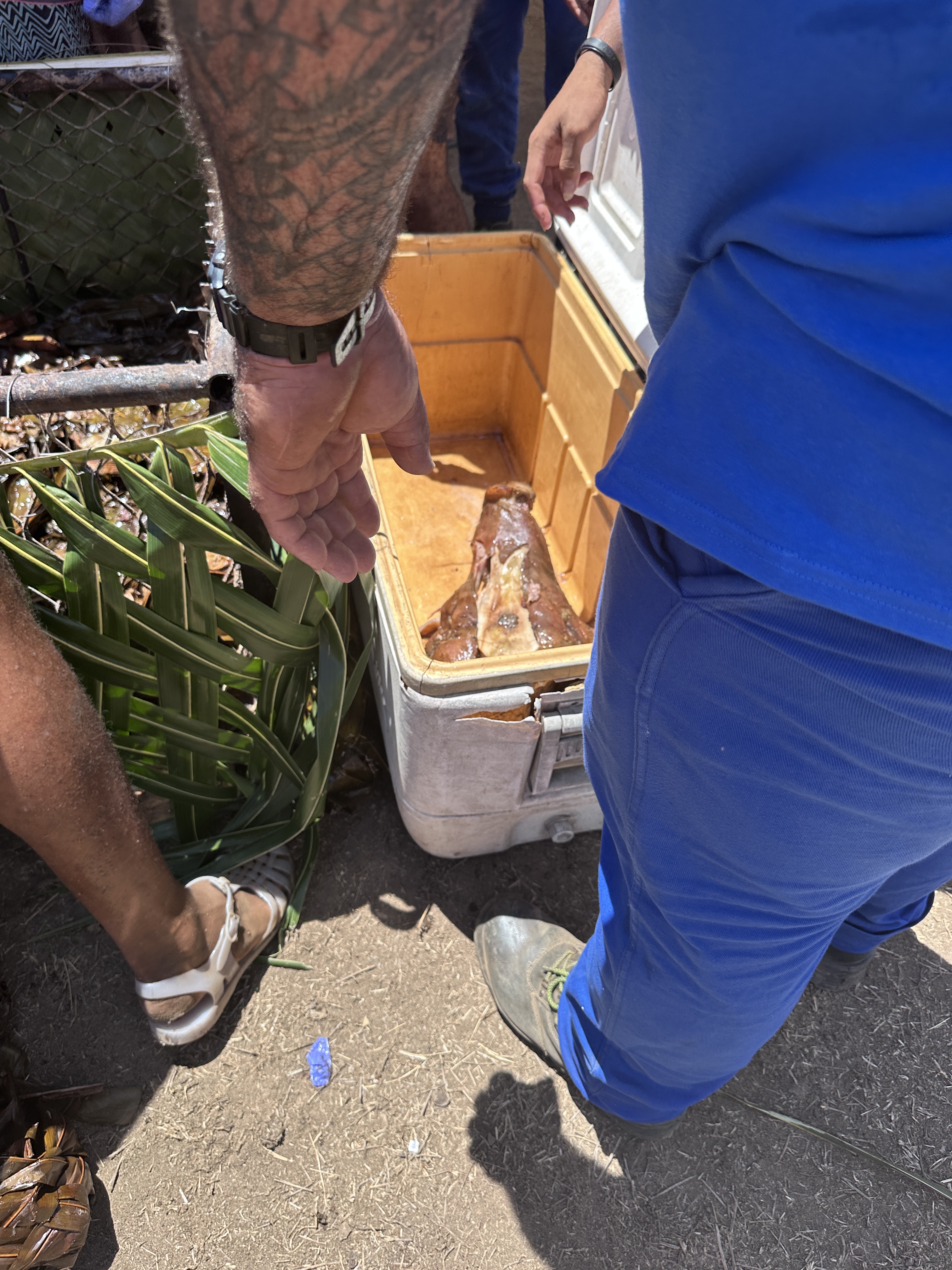
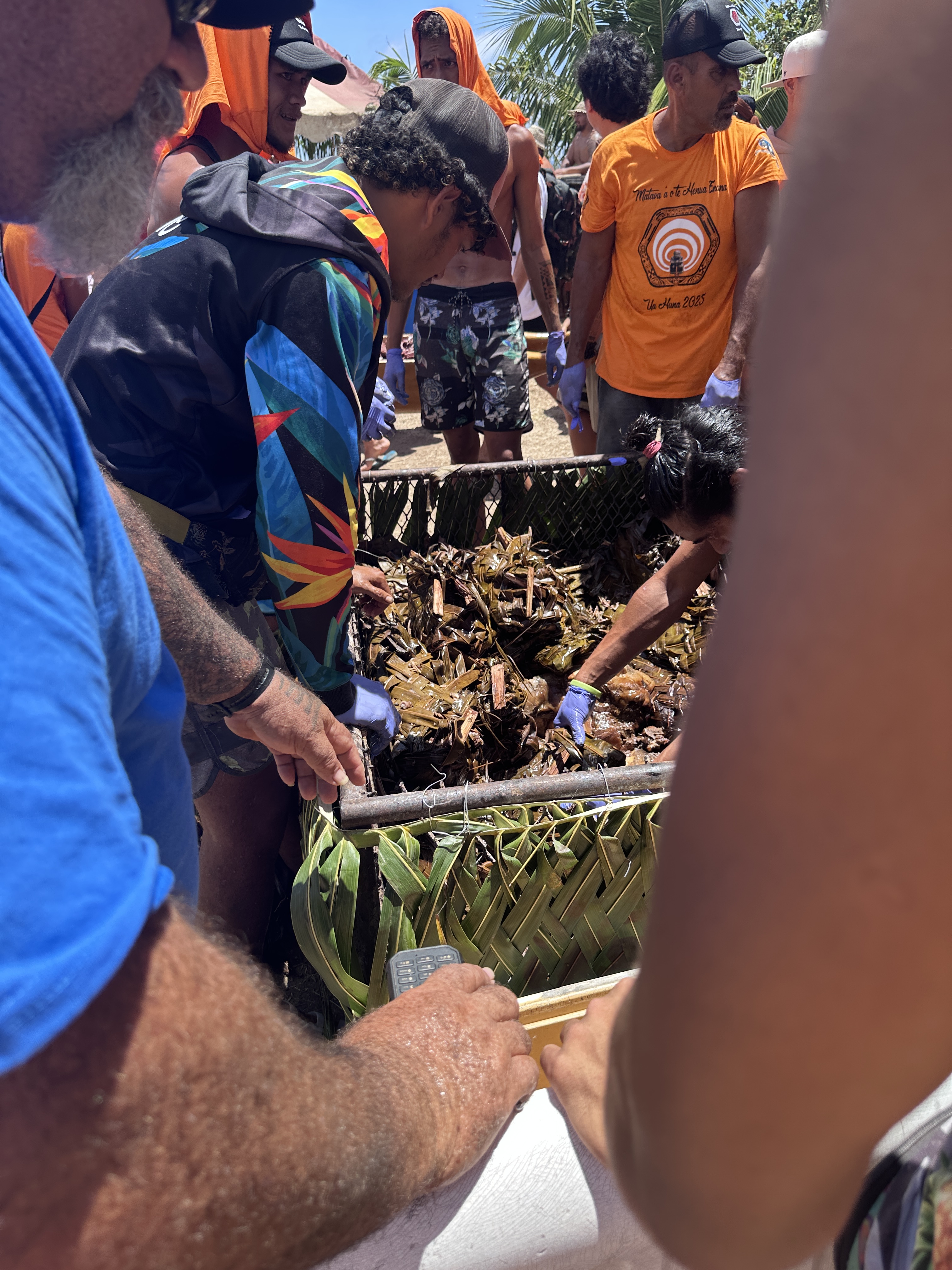
At the end of the performance, we were treated to a lunch of pork and fixings, the pig having been brought out of the underground oven. There is its head!
The other items on the buffet were raw fish salads (raw fish salads consisting of fish, and vegetables in a mayo dressing, were always available on every buffet), breadfruit, and bananas. Good stuff!
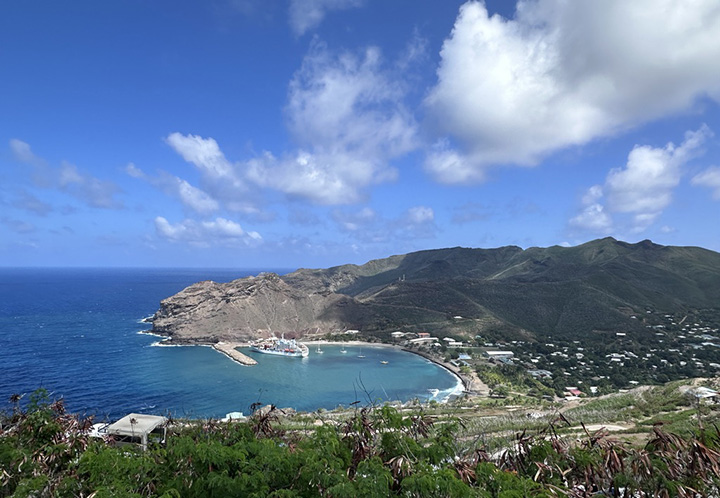
On to Nuka Hiva, the largest island in the Marquesas.
It was this island where Herman Melville jumped ship and fled into the jungle, leading him to write the book, Typee, about his adventure in and around the village of Taipivai. As a Melville fan, I was pumped. we were told that there was also a Survivor season filmed on the island.
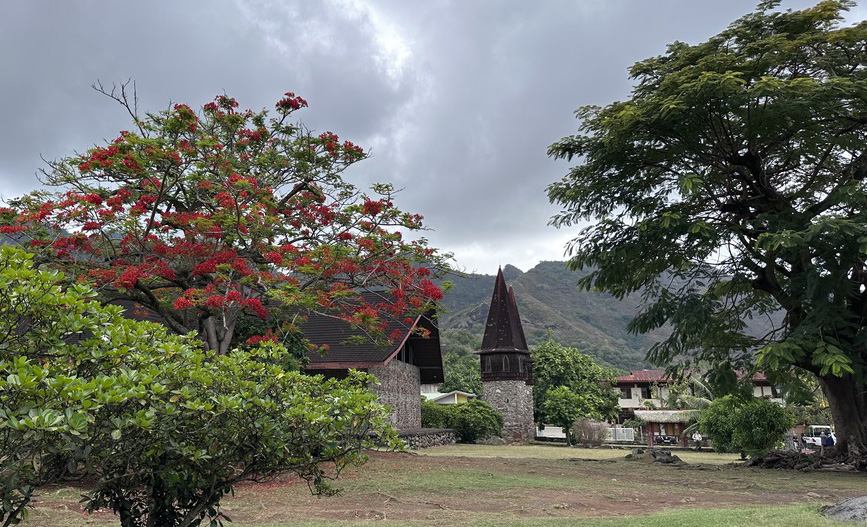
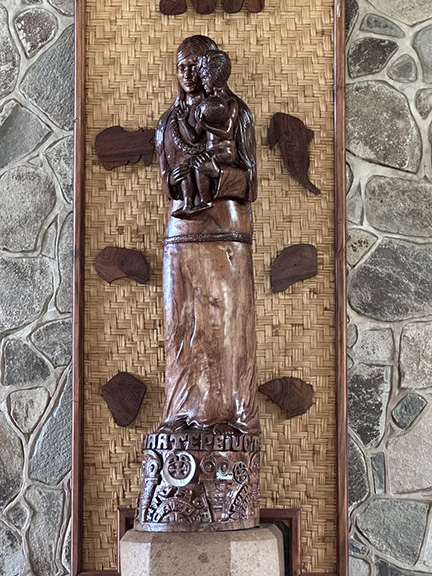
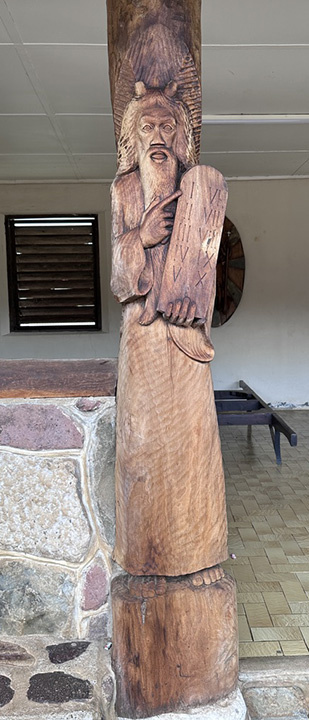
Here we got a taste of the incursion of Christianity into the islands, visiting a Catholic cathedral decorated with a distinctive island slant.
Virgin MaryMoses
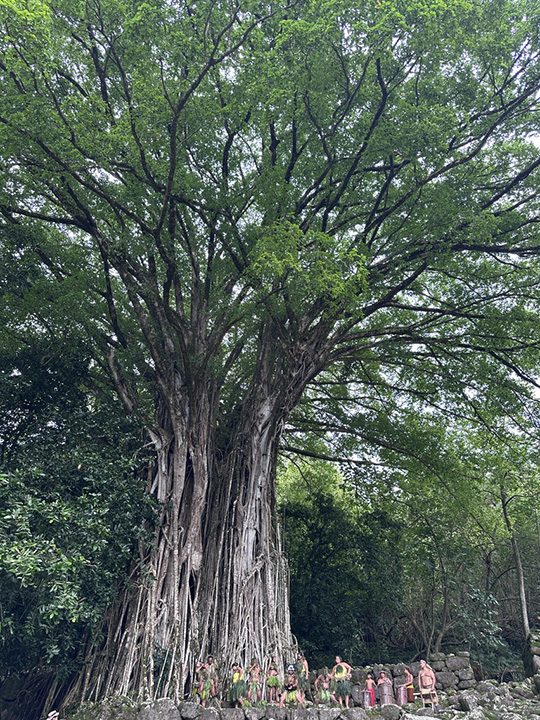
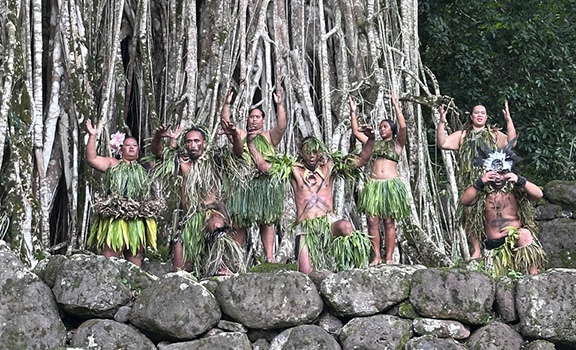
Then off to the jungle to learn about the heathen side—dancers performed under a great banyan tree which spread over a site where ritual killings occurred. It was part of a larger 300-year old archeological site, including a place where public festivals occurred with seating for chiefs and important people while the poor folks got the bleachers. Nothing has changed.
That evening we were treated to a Polynesian plancha (a buffet with lots of Polynesian foods, meat of all kinds, potatoes, rice and pasta salads and fruits) and a dance show. Here is a guy giving us a welcoming greeting!
Marquesan Haka
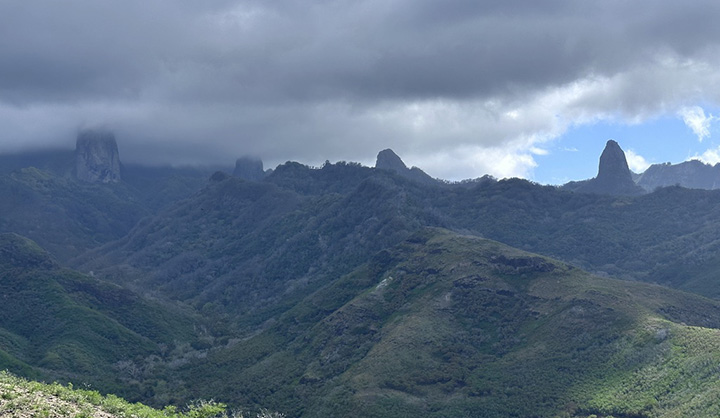
Next we traveled on to the island of Ua Pou.
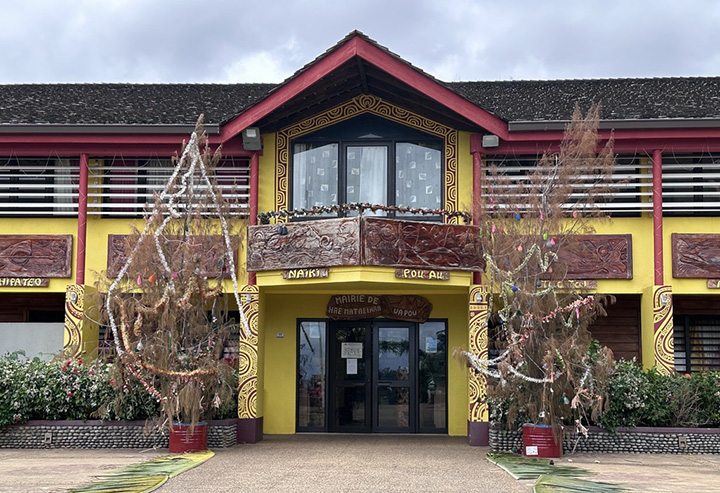
This is a lovely mountainous island that unfortunately, has been overtaken by invasive acacia trees, which have so taken root and spread so voraciously that they will never be rid of them. (Why can’t people learn!). While some people went hiking, we visited town. Christmas decorations were out and we found these sad trees in front of the town hall.
We shopped a bit at the local craft market and then attended a tasting of local fruits. On all of the islands, wild mango trees abound, the fruit ripe for the taking by anyone who cares to grab a bite. The bananas are sweet vanilla cream. Coconuts, specifically the copra or the dried coconut meat, are a main source of income for many islanders and you can witness them being collected by the locals. The tasting was followed by another dance show. Every island seems to have slightly different dress and slightly different dances.
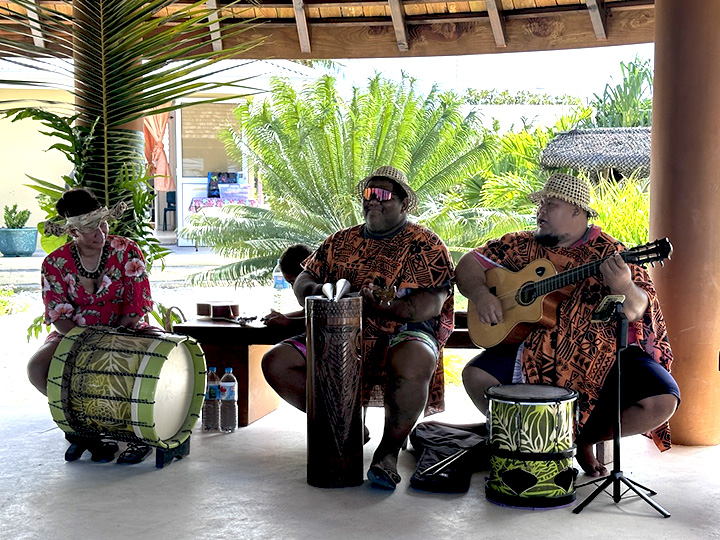
In the afternoon, we took a driving tour of the island and ended up in Hakatehau, a small town on the coast where we stopped for an afternoon snack. The drivers brought their ukes and serenaded us with fun songs including a lively rendition of “She’ll be Coming Round the Mountain When She Comes” sung in French. They were terrific. You cannot have a sad time listening to ukulele songs. These ukulele sessions, and there was one every night on the ship, were the highlight of the trip.
Another fun adventure occurred when we learned that a Swiss gentleman was making chocolate bars on the island. How he was managing this was not clear but we wanted to buy some so we could have chocolate from the Marquesas. Our driver tracked the chocolate down at friend’s house in town. There we found the friend’s husband waiting with chocolate wrapped in aluminum foil he had pulled out of the freezer. He spoke only French, but we made do. We arrived back to the ship very late, much to the consternation of the guides, but hey, we had our chocolate. It was delicious.
Now the details. The first stop was Papeete, Tahiti to board the ship. We have been to Tahiti before but usually just as a transit stop. We have never actually toured or stayed on the island. So we stayed downtown to enjoy the town, but alas, we arrived on a Sunday, and everything was closed. It was a ghost town.
We sailed on December 15 headed for the Tuamotu Archipelago, a different chain of islands that are also part of French Polynesia. It is made up of the largest chain of atolls in the world. Our first stop was the island of Fakarava where we were welcomed by a small group playing ukuleles and singing Polynesian songs. Love it!!! There was not really much going on except for the offer of a swim at the beach while the ship took care of business.
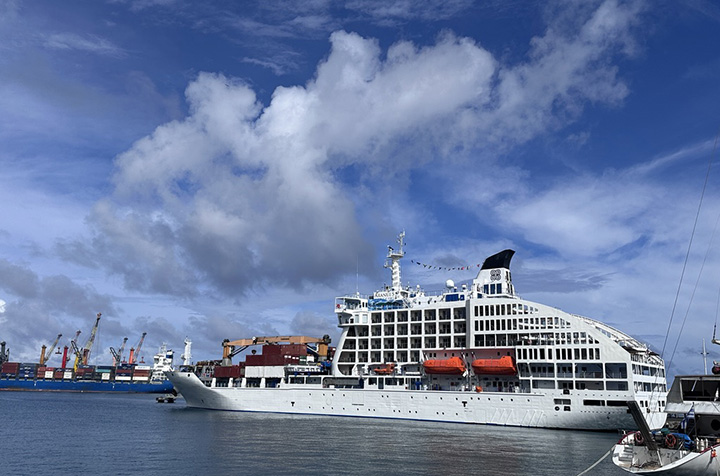
The Aranui – Note the cargo containers at the front of the ship.
New Zealand is in the middle of nowhere. It truly is far from everything. Even Australia is a few hours plane ride across an ocean. Fortunately, the area it is closest to happens to be the tropical countries in the South Pacific—among them Fiji, Cook Islands, Vanuatu, Samoa, and French Polynesia. Truth be told, this is pretty convenient when you want to a nice relaxing vacation.
We had always wanted to visit the Marquesas, a chain of islands that is part of French Polynesia. Why? First the exotic allure—remote islands populated with indigenous people. Plus the fact that this is where Paul Gaugin settled after leaving France in pursuit of the perfect place to express his vision and to live a life of the savage. His paintings of the native people of Hiva Oa captured my imagination. When I was a teenager, I would tell my mother I was going to live in Tahiti and maybe visit Marlon Brando. (I was very imaginative and a girl can dream).
French Polynesia is as its name suggests—a part of France. The population is a mix of French and indigenous Polynesians. As is true of any society with that mix, the non-Natives have the money. This leads to the desire by many Polynesians to be a bit more independent from the federal government, if not to become an independent country. The problem is several fold. The first is money. France provides over 50% of the funds necessary to run the country. Of course, France also makes a ton of money from tourist fees and taxes and does not want to give that up. The second is that the French population and even many Polynesians like it the way it is. The third issue is that France just does not want to talk about it. Not even a little. So it is doubtful that there will be any meaningful change anytime soon. Everyone just carries on and hopes for the best.
To visit the Marquesas is tricky. They are some of the most remote islands in the world. While they are part of French Polynesia, which is in the middle of the Pacific Ocean, they are very far from Tahiti and difficult to get to. Yes, some of the islands have airports, but they are small and getting a flight is not the easiest or in some cases the safest. You would also have to pick which islands to see. Island hopping would be difficult at best. The next best way to see more than one island is by boat of which there are few options.
When we say we went on a cruise, most people imagine those giant moving cities of 5000 passengers, with nightly entertainment, unlimited food buffets, pools and whatever you can imagine. That is not what we were on. There are many types of ocean cruises. Luxury cruises that no reasonable person can afford, the “cruise ship” cruise of thousands of people going port to port stopping at cities or tourist spots to look around, and then there are expedition cruises, which is what we usually go on. Expedition cruises are small, with a few hundred people whose goal in life is to see wildlife, to hike, to swim and dive and snorkel, and generally engage in nature activities. There is no entertainment on board but the ocean and nature, whatever that may be. There are usually lectures to keep people occupied for days at sea.
We found a company with a ship called the Aranui. This ship did not really fit into any other those definitions. It is a cargo ship/tourist ship hybrid. They deliver cargo around the islands and take about 200 guests along for the ride. While they load and unload, we go off to see the island. Because they are delivering cargo, they stop at many of the islands, meaning we didn’t have to pick and choose. This seemed to be the perfect answer. But it was not an expedition cruise and it was not a pure tourist cruise. So we had the odd circumstance of half the passengers acting like they were on a Royal Caribbean ship while the other half thought we would be going with National Geographic. It was neither and it was very confusing.
I can summarize the trip thusly – we ate too much (three course lunches and dinners) and we drank too much (happy hours cocktails while listening to ukulele music and, as the French do, wine with lunch and dinner). The guests on board were largely French, either from French Polynesia or from France. The crew was also French which made communication with guests and crew somewhat spotty. The food on board was okay, lots of meat, and fish but kind of bland. Given it was a French ship, we expected better. We did get crepes for breakfast so that was something favorable.
The islands were beautiful, they smell of tiare and vanilla. The people were extremely kind and sweet. We enjoyed visiting each island and getting our fill of island life. Listening to groups singing Polynesian ukulele songs is just heaven for me. We even took ukelele lessons and learned some Polynesian songs. We enjoyed it but there were issues.
We were completely over-scheduled from early morning excursions to dinner being over late in the evening. We had no time to ourselves, leading to sleep deprivation and sheer exhaustion. The on-shore excursions were a mix of cultural activities, like craft markets and dance shows, and simple driving tours around the island. Usually, the ship was docked in the harbor, and we had to take a boat to the island. From there we piled into SUVs driven by local guides, most of whom spoke only broken English. The cars were stuffed with three full grown adults in the back seat and one in the front. It was very uncomfortable as we drove up and down mountain roads with hairpin curves and little in the way of crash barriers.
For those who cared to there were short hikes. In the afternoon. if there were no excursions there were lectures and various activities. We started skipping these due to the need for at least a short nap. I kept asking the guides if they were trying to kill us. Of course, they had to have been sleep deprived too. Many people on board were sick, coughing and sneezing, which lead to my getting sick and then Matt getting sick. Ships are just giant petri dishes. By the time we got home, we were sick, exhausted and beaten, and were in need of a vacation from our “vacation.” But, hey, we still visited the Marquesas.
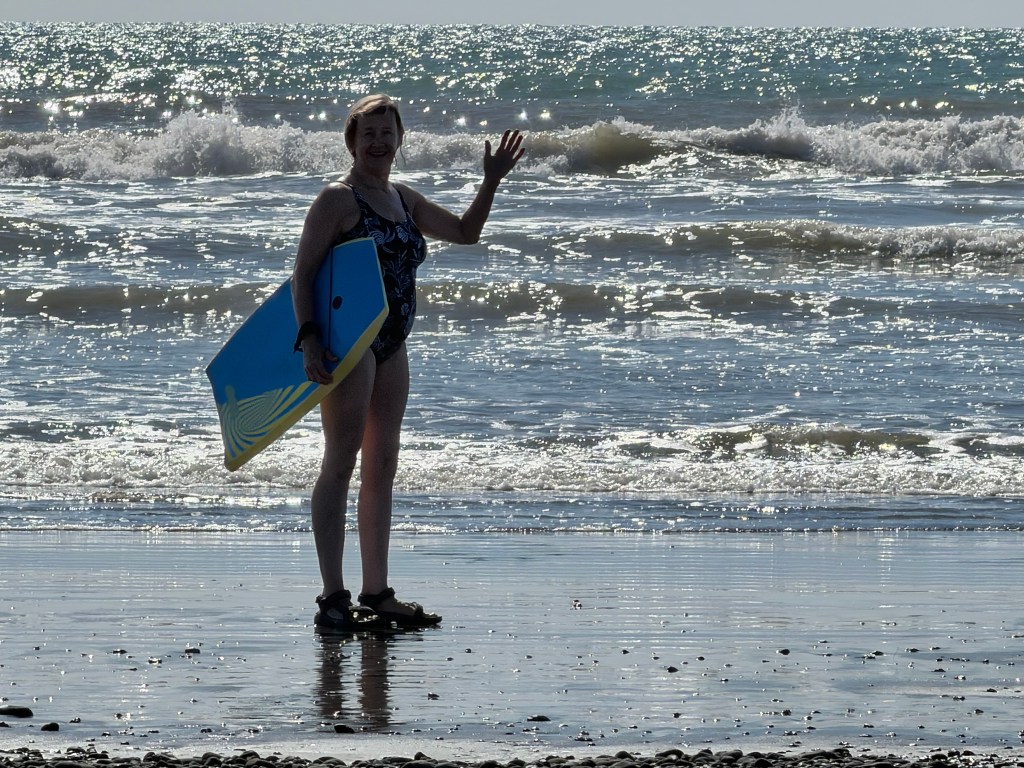
It has been a cold, wet Spring here in Aotearoa but the Gods of Summer finally let the warmth come. First day of boogie boarding. This is as close as I will ever get to surfing. Water Temp (57F, 14C). Cold? You get used to it. (Jesus, I look just like my mother. No, not the boogie board part.)
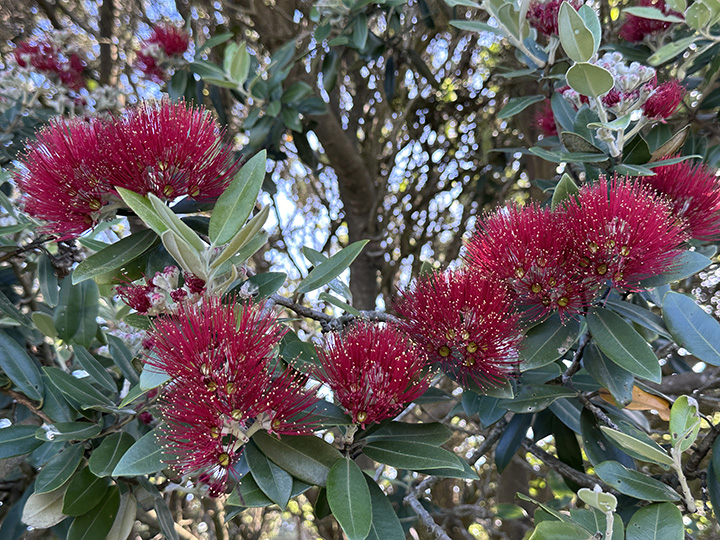
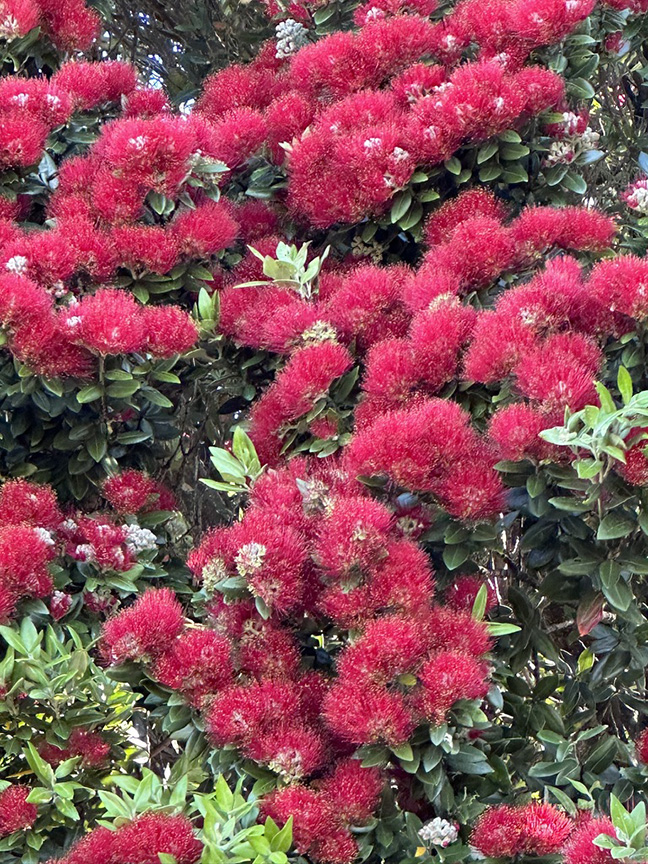
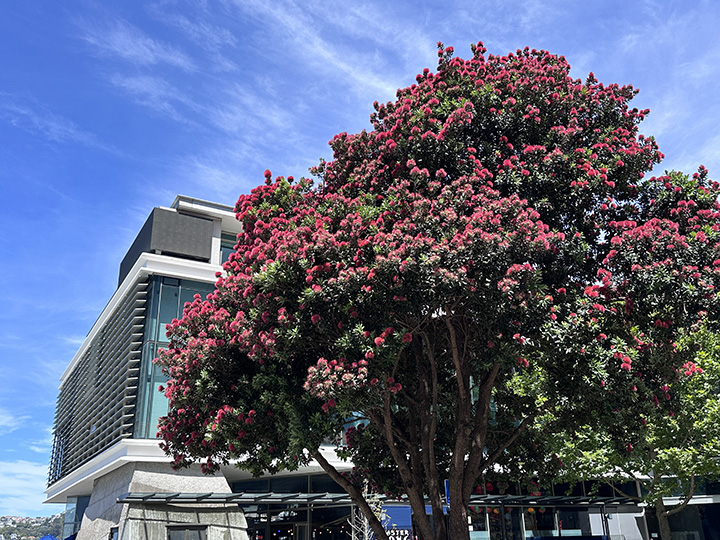
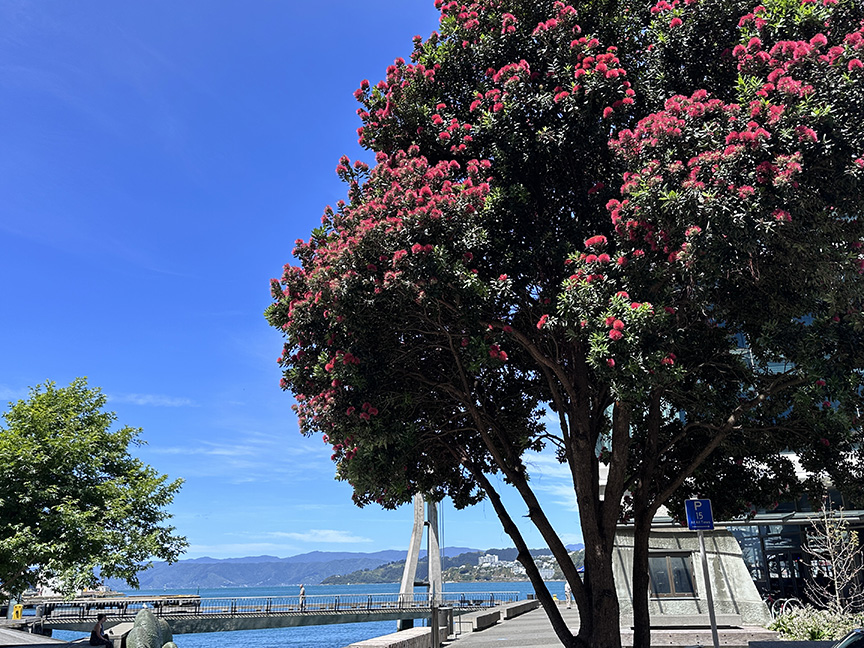
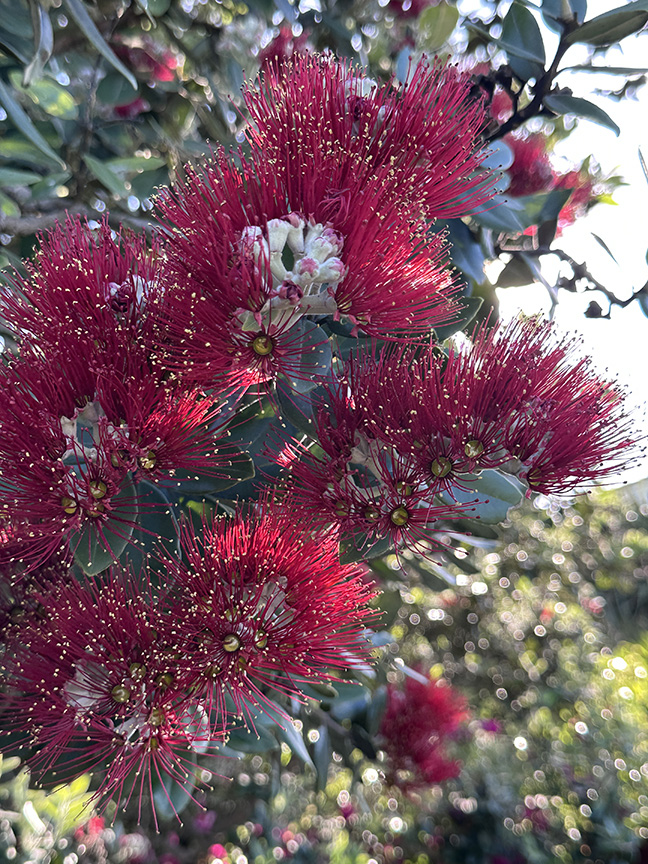
This gorgeous tree, endemic to New Zealand, shouts red and gold as Christmas nears. Hence it is called the New Zealand Christmas tree. Honestly, instead of fir trees, an artificial pohutukawa should be in every NZ home, decorated for the holidays. (I say artificial because unlike fir trees, I highly doubt you could keep this tree alive and blooming if you cut it down and stood it in a bucket of water. But I digress.) This year they are absolutely erupting in red. I just had to share photos:
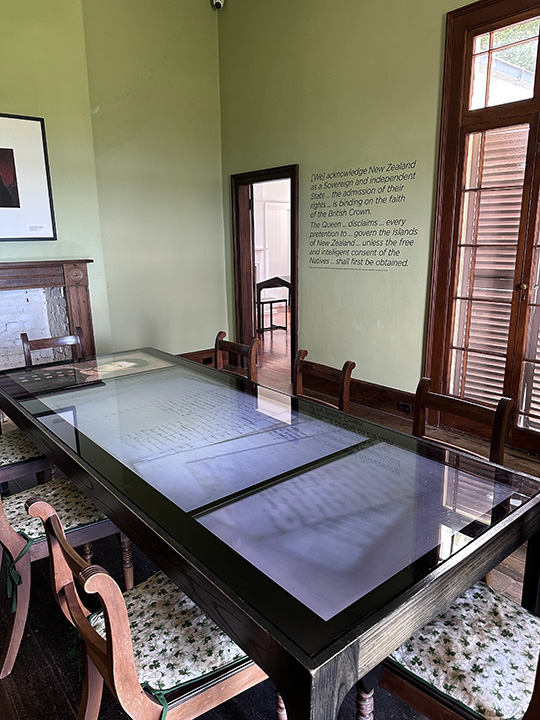
Bay of Islands is also home to the Waitangi Treaty Grounds, the place where the Treaty of Waitangi was originally accepted and signed by local tribes in 1840. The treaty is the foundational document of New Zealand because it sets out the rights of the Maori and the British in occupying and governing the islands. The agreement was necessary because the Maori were being harassed by the French and by sailors who brought trouble to the island. In addition, British settlers were coming. Trouble was all around and the Maori felt the need for protection. Some were convinced the British would keep the French out and they would use the white man’s laws to keep the Europeans coming to the islands under control. They were also convinced to sign a document that did not exactly state those terms.
The meaning of the Treaty, particularly the division and preservation of rights and powers, is still debated. The issue is that the treaty was written in English and translated into Maori. The meanings of several words differ so they don’t say the same thing. The Maori believed they would be left to govern themselves and that their interest in their lands would be preserved. The British version says the Maori essentially ceded sovereignty over the islands to the British. Disputes have raged ever since.
Interestingly, before that treaty, a missionary helped the tribes draft a Declaration of Independence, which is considered the Maori declaration of sovereignty over the islands. As explained on the website:
“By 1835 a growing desire for international recognition of New Zealand (and its governance) led to a meeting of chiefs at Waitangi. Concerned about the intentions of the growing number of Europeans, the chiefs put their signatures to a document which declared New Zealand a ‘whenua rangatira’, an independent country. He Whakaputanga o te Rangatiratanga o Niu Tireni (Declaration of Independence of New Zealand) was acknowledged and supported by the British Government and continued to make its way around New Zealand gathering signatures until 1839.“
The Maori tribes who created this declaration consider it to be the foundational document that undergirds their sovereignty and land rights under the Treaty. In other words, the agreements and deal making regarding land and governance as set out in the Treaty would be meaningless unless the Maori already possessed the rights in land and governance as asserted in the declaration. while true you can’t deal what your do not have, I think it is fair to say that to some extent the Treaty has overpowered this document.
In visiting the Treaty grounds museum, it appeared that the Maori had a strong voice in the presentation of the history and the facts, and it was clearly intended to assert the Maori point of view in terms of the impact of colonialism on the people and their culture. But it still seemed well balanced. No one was demonized outright. You were left to come to your own conclusions. (I did the demonizing in my head.)
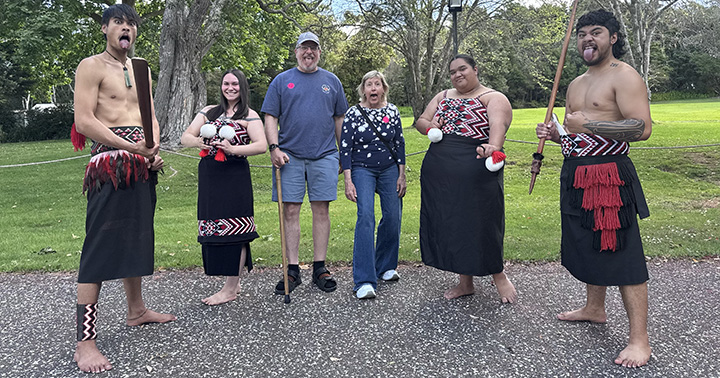
We took a historic tour and ended with a cultural performance by some young Maori. Here we are after the show practicing what we learned. I asked if women were permitted to stick their tongue out. The answers were inconclusive. Some tribes are okay with it, some not. I went with it.
Here are some more pics:
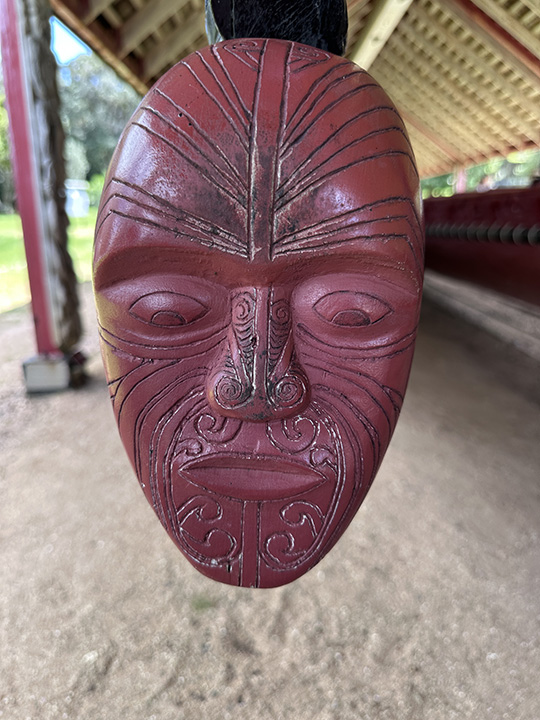
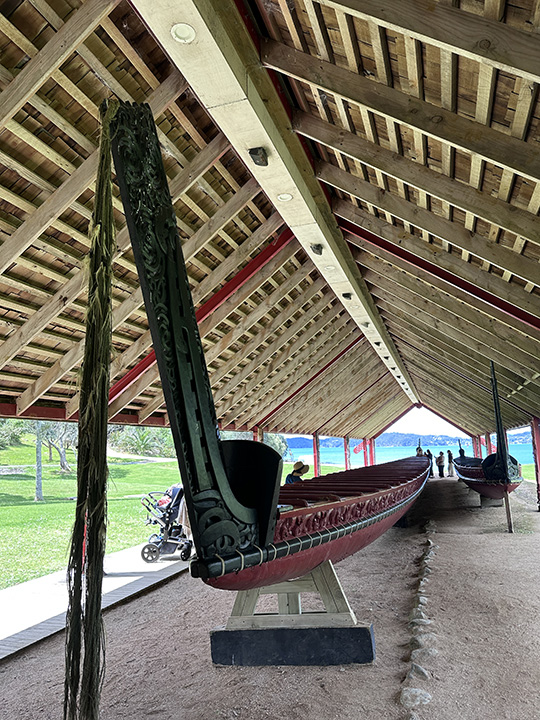
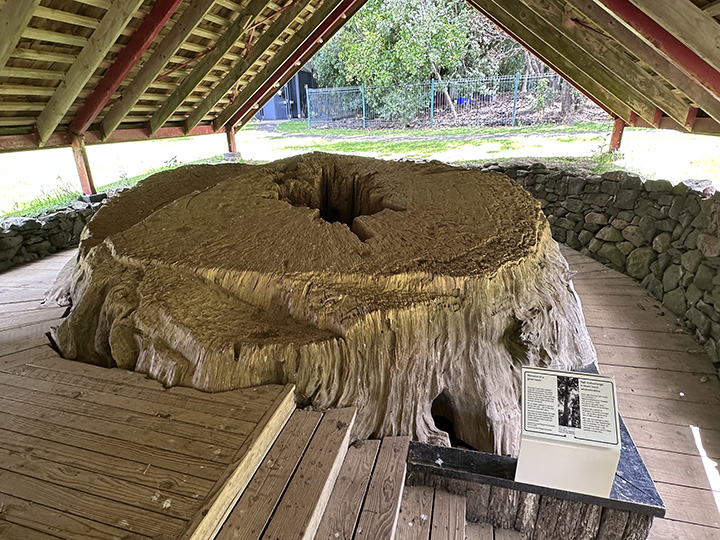
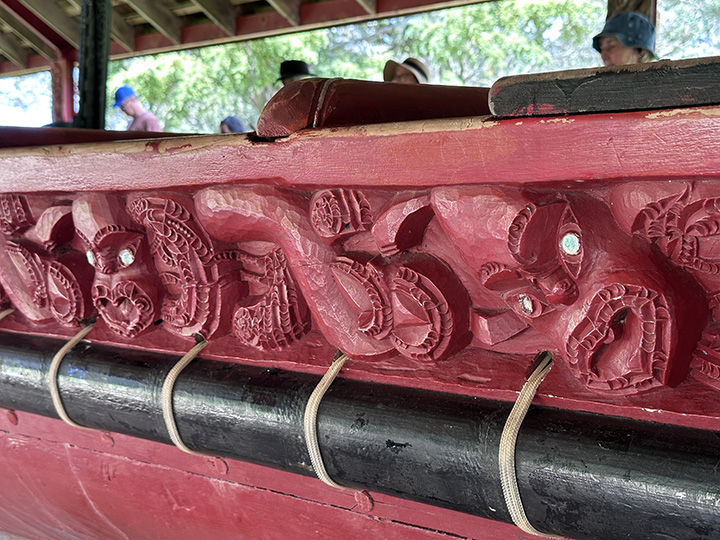
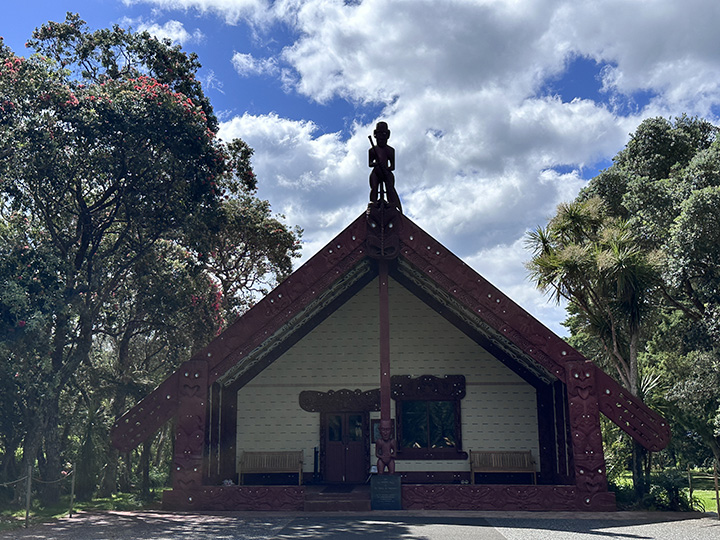
Treaty RoomCeremonial Waka (canoe) – used for the Waitangi Day celebration. It is carved from the Kauri Tree, one of the largest trees in the world. (Tough to get a photo of a ship this large and do it justice.)Kauri stump from which the Waka was carvedWaka detailTribal meeting house were we saw the performance
All in all, it was a good trip. We agreed that for us, it is not the most beautiful place in New Zealand. It was nice, but pretty touristy, and it just did not speak to us the way Kaikoura did.
On our continuing quest to see as much of New Zealand as possible, Matt and I flew to the Northland and the Bay of Islands, considered by many to be the most beautiful spot in New Zealand.
The further north you go in New Zealand the more tropical it becomes. It is warmer, sunnier, and has more of an island feel to it. Bay of Islands is just what its name suggests. Reminiscent of Caribbean island chains, Bay of Islands is dotted with small islets and bays, surrounded by calm blue waters that are home to many sail boats and the occasional dolphin pod. There are a few towns in the area, very tourist oriented, where sightseeing tours and fishing charters abound.
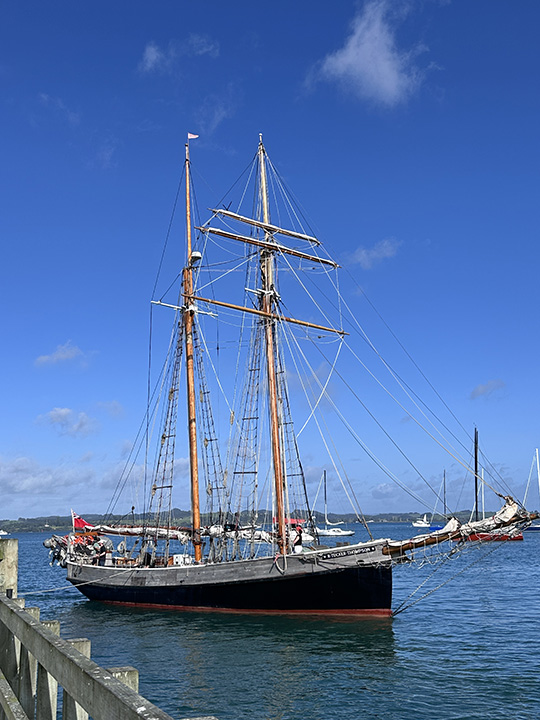
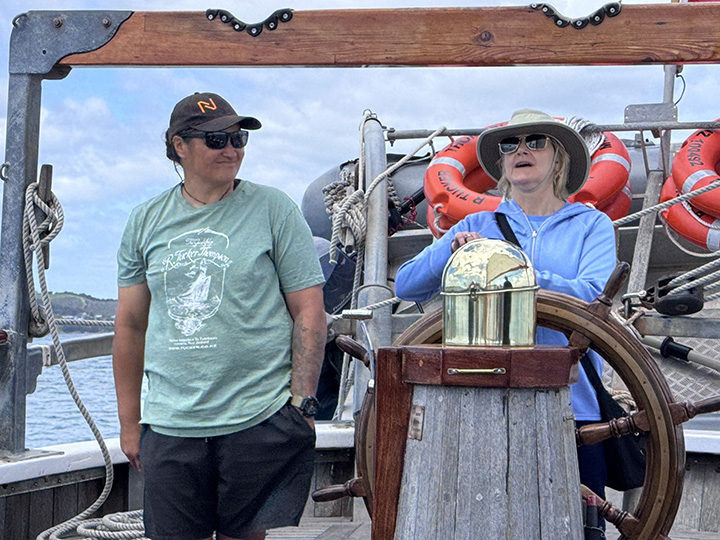
We signed up to go sailing around the Bay in a tall ship, the R. Tucker Thompson. I have never been on a tall ship and this looked like fun. They let us help to hoist the sails as we left and we were also offered the chance to take the helm. Good Lord, I had that boat zigzagging all over the place. They kept telling me the tiller took a while to respond so don’t over steer but I just kept turning that wheel like I was driving a car. I think the captain was relieved when I gave back the helm. I am no Mr. Sulu.
Two folks had the nerve to climb the rigging. To do this, you had to climb a a rat line. The rat line was made up of rope serving as “rungs” and the vertical structure. Ropes are called “lines” on a ship. I am not a sailor and they are ropes to me. It is attached to the tall mast on one end and at the railing on the other leaving it swinging in the wind on water side of the vessel. The ladder slowly tapers; so the higher you go, the less room for the rungs. You can see it in the photo.
Rat lines (rope ladders)
One young man climbed slowly but surely nearly to the crow’s nest. To do so that he had to climb over one sail and maneuver onto the next higher. The higher he went the smaller the rope ladder became and the further apart were the rope “rungs.” Those rungs were pretty unstable. It was making me nervous just watching his feet teeter. The second person, an older woman, went up a bit but her feet were shaking a lot. She said that was nerves and the instability of the rope ladder. Hooray for her though. My reaction was: Hell, no. I’m too old for that shit. There was also the option to climb out onto the bowsprit, which is the long pole extending off the prow that serves as an anchor for some of the sails. That too involved rope serving as a walking path of sorts. If you look at the photo of the ship, you can see the bowsprit and the ropes hanging off it.
The day was fine and we sailed to a small bay where we did a wet landing (when you have to wade to shore from the zodiac) which we were not expecting. After we dried off and got our shoes back on, we made a short hike up to the lookout. What a view.
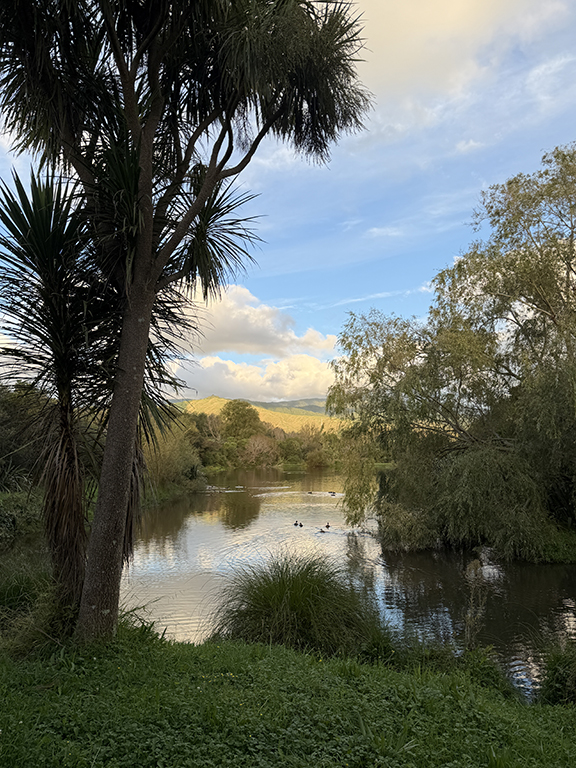
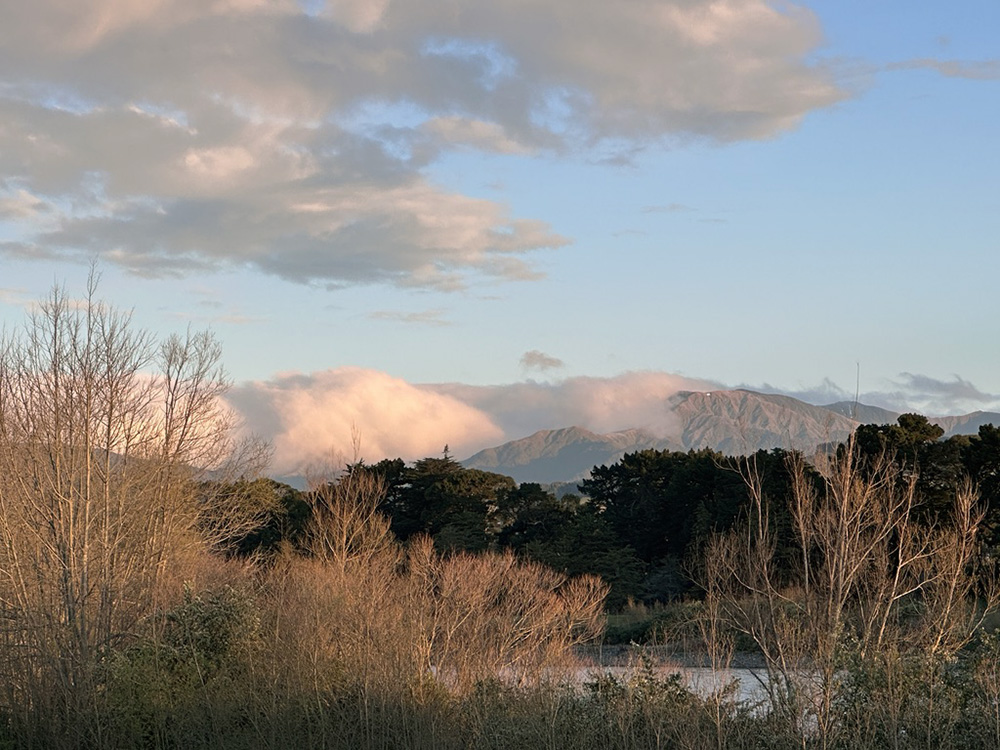
It was a lovely day and we took a walk along the Otaki River, which is very near to us. It is our fishing river.
We are also on the coastal side of a mountain range, the Tararuas. They are snow capped in the winter and are often shrouded in clouds. Today, they were wearing a low cloud blanket.
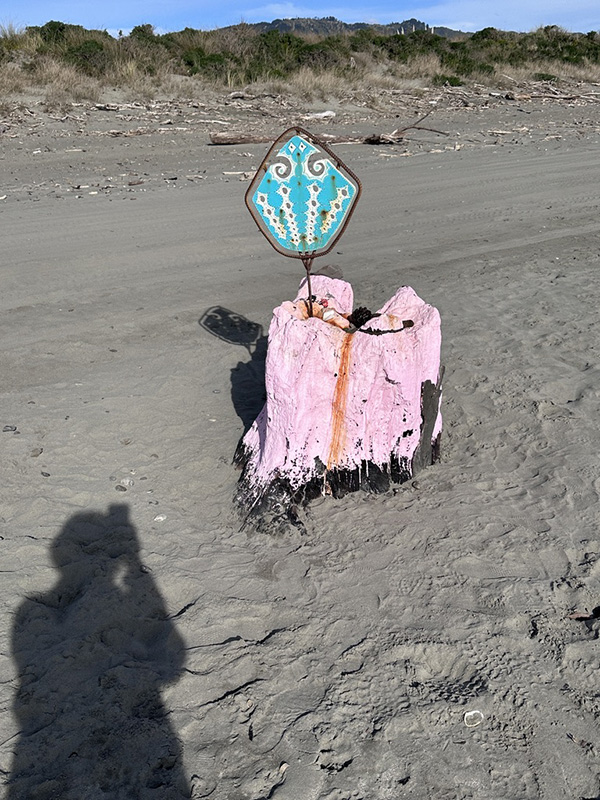
I may have written about the pink stump before but here it is again. This is a landmark on our beach. It even shows up on Google maps. About three months ago it got a fresh coat of paint and a stained glass marker. It is remarkable that this thing has not moved despite strong storms. I have asked people the history and no one really knows except that it has been here forever.
The All Blacks, New Zealand’s famous rugby team, is known as one of the best rugby teams in the world. Alas, they have fallen on hard times and are not quite the best any more. They get beat. Often. Right now it is the South African Springboks who are the top of the world and the current world champions. We went to see the famous All Blacks play South Africa in a critical game in the world championship pursuit.
Just to start off, here is their haka:
All Blacks haka
After the haka, the game went downhill for the All Blacks. Apparently, the Wellington stadium is not good luck for the team and they suffered the worst defeat in their history at the hands of the mighty Springboks, a 43-10 rout. Admittedly, I still do not know the rules of rugby. But when you have a guy sitting behind you that talks like a color commentator, well, I could follow along. I keep vowing to pay more attention to rugby because I do find it fun to watch. But that would require me to watch television and it just is not happening. Maybe someday….
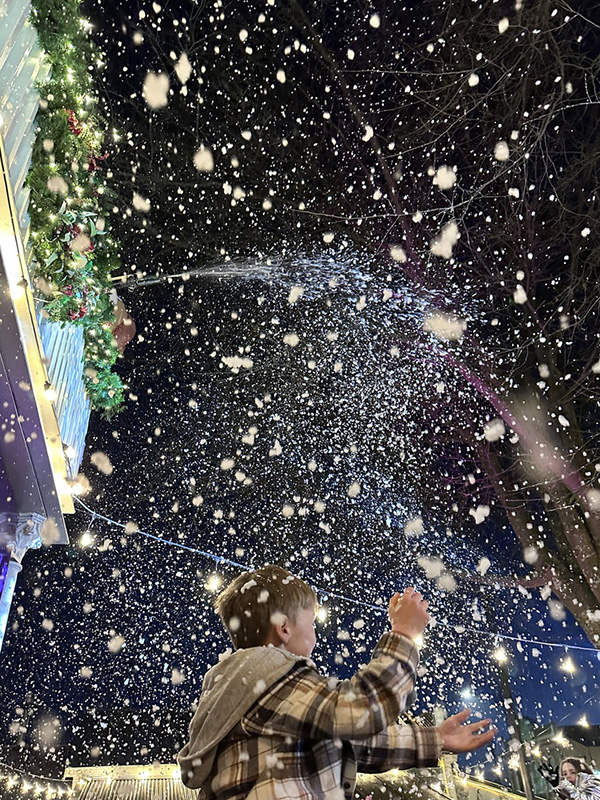
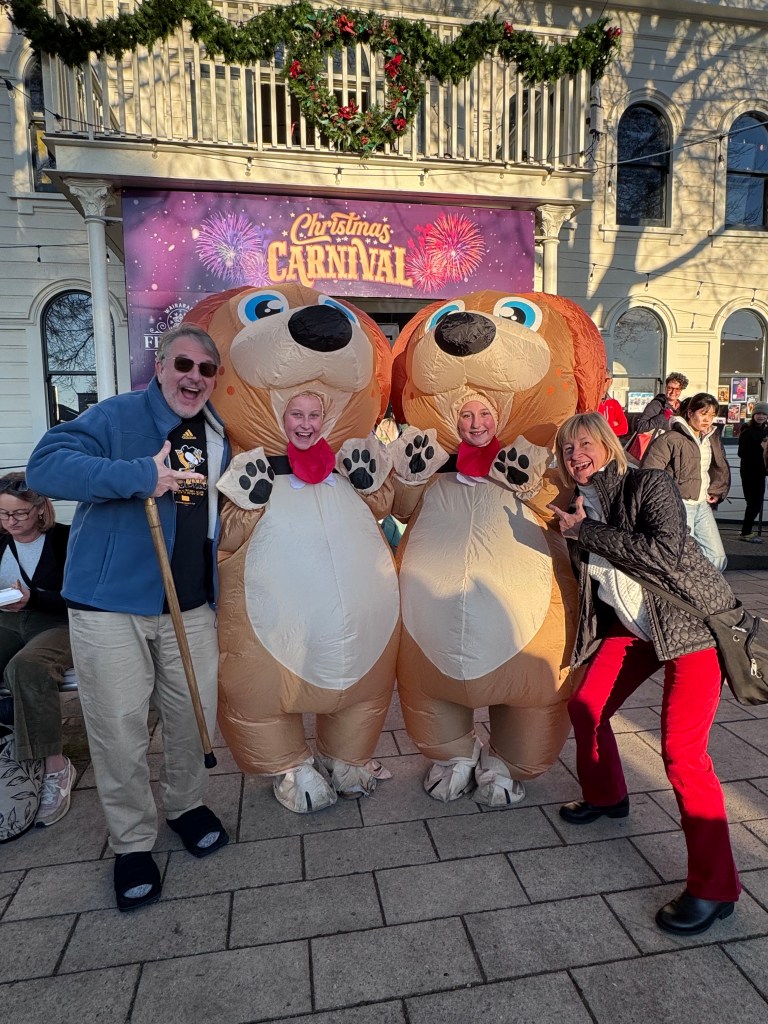
Christmas comes in the summer here so there is never a good reason to enjoy the Christmas winter traditions like warm fires, hot chocolate and snow. Greytown has a Christmas in July festival every year and we finally got our act together to take part in the celebration. It was a madhouse. The street was jammed with families, kids running, adults moving haphazardly. It was a rush-hour-on-the-subway crush of humanity. We were unable to find any information on the schedule or even a map. So, we wandered around aimlessly taking in the craft booths and the crowd energy. Here we are with the mascots:
We did manage to get into the area where they make it “snow.” Well, okay, it is soap bubbles but it is the thought that counts. Unfortunately, we did not act promptly enough to get food and by that time we were looking for dinner, all of the restaurants were full and the food trucks had nothing but crumbs. We drove over to Martinsburg for a nice dinner in a calm restaurant and vowed, boy, we will never do that again.
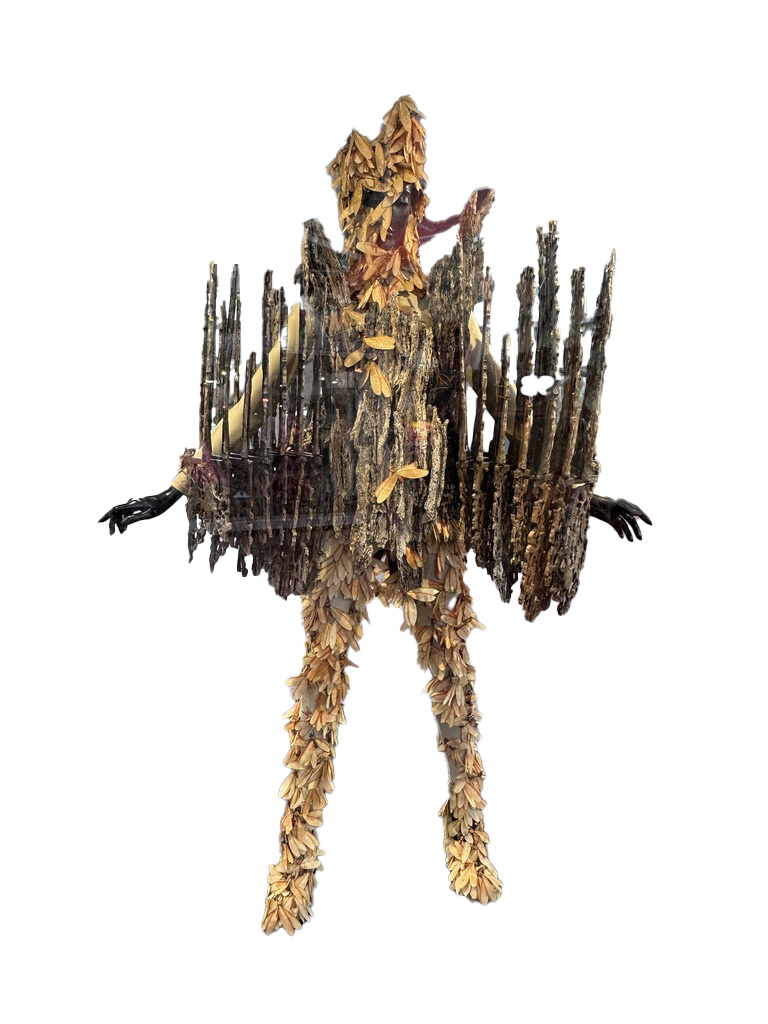
We went to the World of Wearable Art Show or WOW as it is known, a design competition. This was our third year. The idea is to have artists create wearable art-extremely complex costumes in answer to a specific theme. There is also an open competition where they can let their imaginations go wild. The designers come from all over the world. The pieces are often made of everyday materials that you would never think of as something to create from. For example, this year, there was a piece made completely from straws. It was spectacular. Unfortunately, we are not allowed to photograph the show but every year The Atlantic Magazine does a photo spread. What we are allowed to do is take pictures of wearable art from past seasons. Here are two examples.
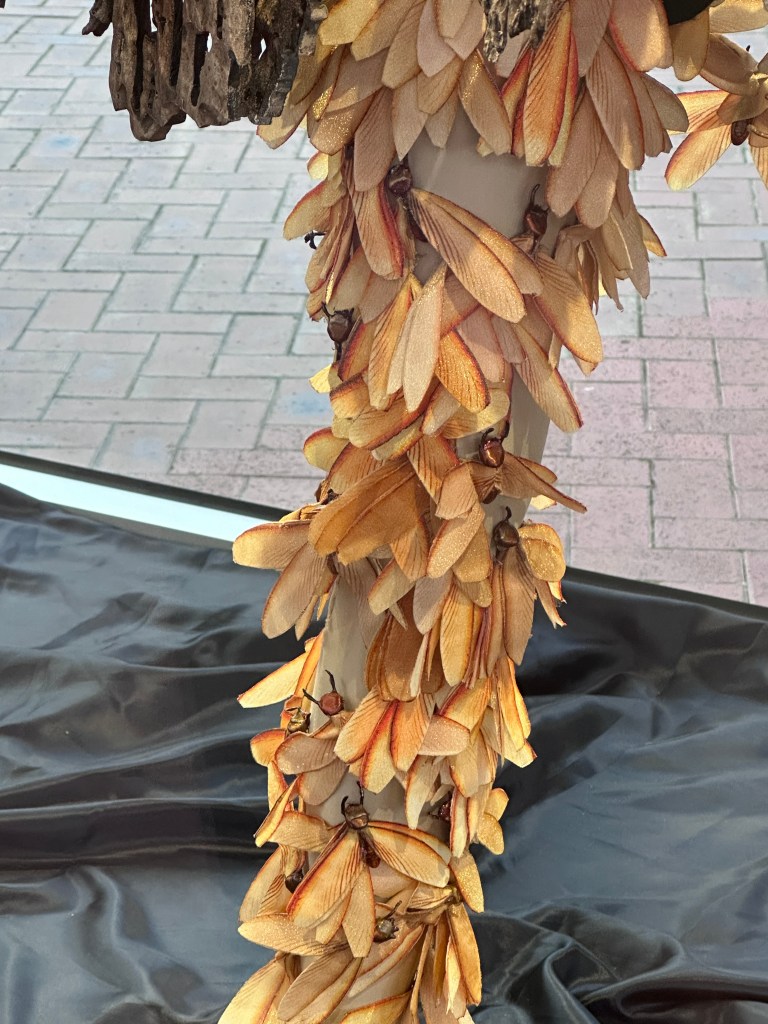
The first highlights one of the problems with the show. The audience cannot really get a sense of the incredible detail of the work. This particular piece was in response to an environmental theme. When we saw it in the show last year, we could not tell that the legs were covered with moths. But to look at the detail now, wow (no pun intended).
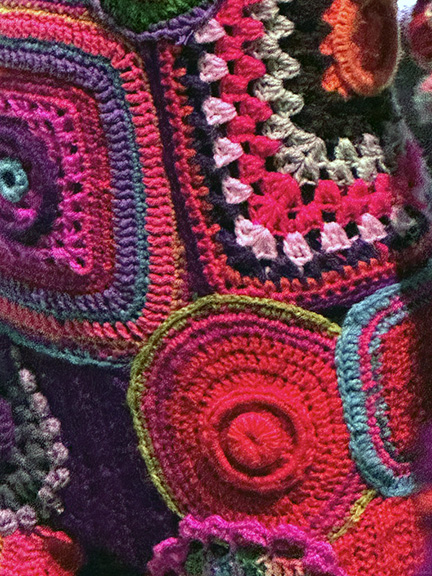
This second one was one of my favorites. This piece is made entirely of crocheted granny squares. Loved it!
This show is one of the few really interesting things to do in Wellington and we look forward to it every year.
New Zealand is in an area of the Earth known as the Roaring 40’s, a reference to the latitude of the islands. In this area of the planet, the winds roar. Sorry Chicago, but you have nothing on Wellington, which is considered the windiest city in the world. Located on the Cook Strait, a narrow body of water between the North and South Islands, the city gets pummeled by winds that are forced through that tunnel. Our house is located on the West Coast just north of Wellington. With Kapiti Island just across from us, we also have an added narrowing that gives the winds more lift. So if the winds come in, we get hammered. Usually, I don’t mind. I like listening to the ocean crashing. When it gets going, it really does sound like a freight train.
But this late winter early spring season has been particularly brutal, with days and days of strong or gale force winds. High ocean waves roll in, and rain pelts the windows. Out on the beach, the birds fly sideways, the wind impeding their progress. Trees are whipping and leaves are torn from the branches.
As I write this, the winds are tearing around the house. The gusts sound similar to a blizzard–the impatient roar as it tries to make its way around objects. Often it will blow all night, the house creaking.
The strangest phenomenon is how our mind is trained to interpret the sound. In the U.S., where I come from, when we hear wind like this, we are hearing a blizzard. Our natural instinct is to assume the air is going to be cold. Here it can be a warm wind from the tropics, or it can be an Antarctic wind from the south. And the direction can change in a moment, meaning it can be warm for a while and then freezing within minutes. Good luck figuring out what coat to put on or if you need one at all. Going out in it is not fun.
And then one day it stops and all is quiet. These are days when there is not a sound. The birds sing and the ocean sound is a calming whoosh.