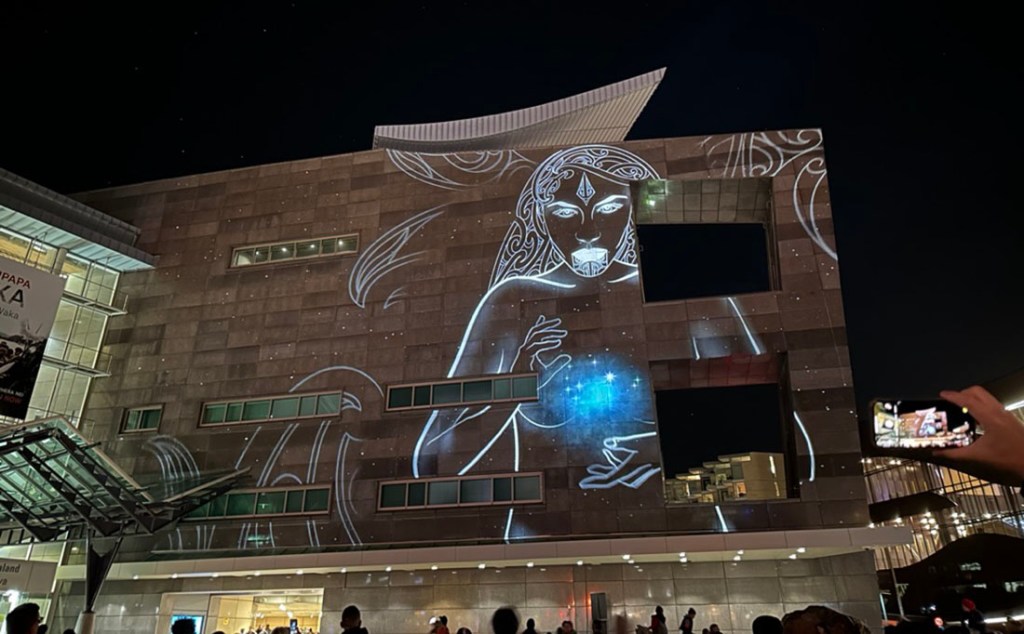
Video explaining Matariki on the side of the Museum of New Zealand Te Papa Tongarewa Holding the Pleides
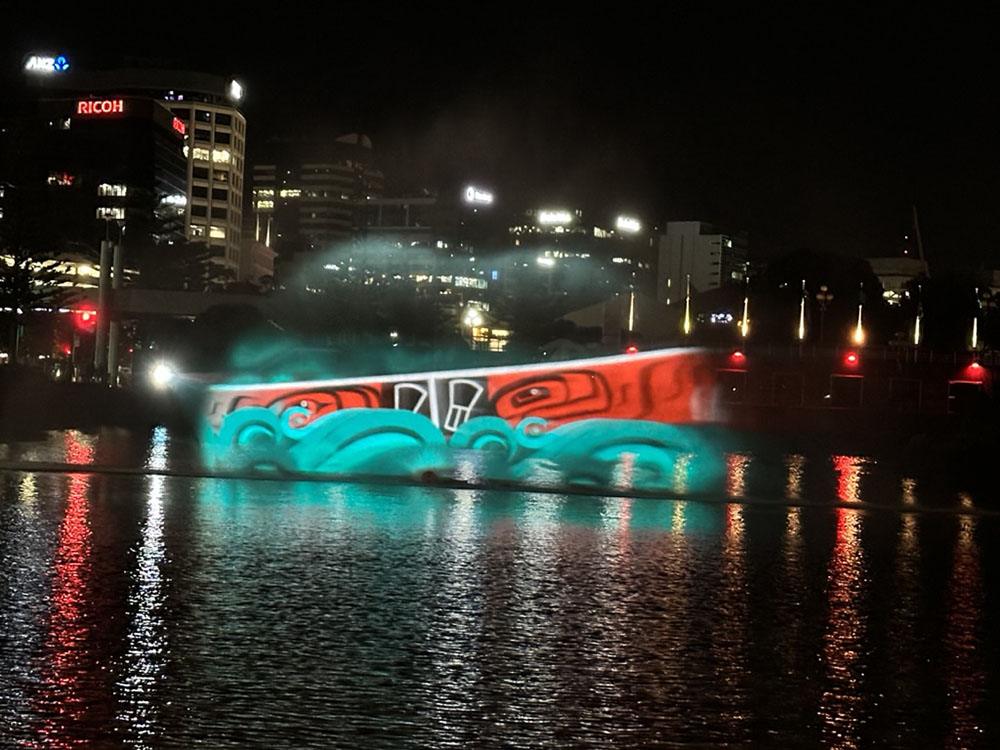
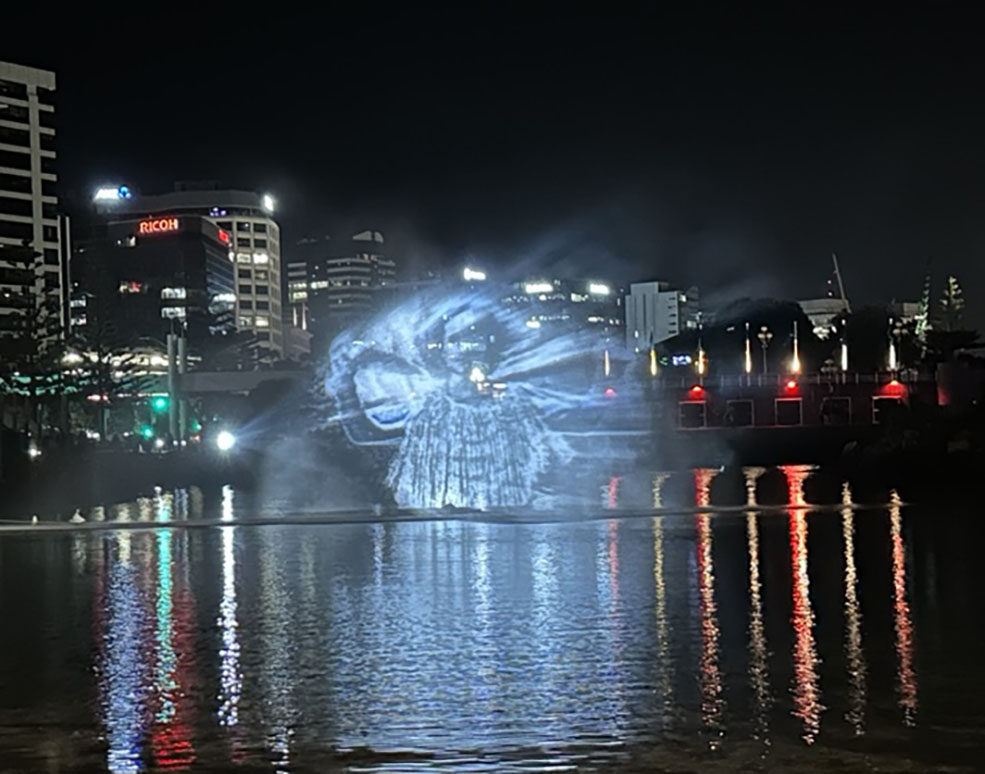
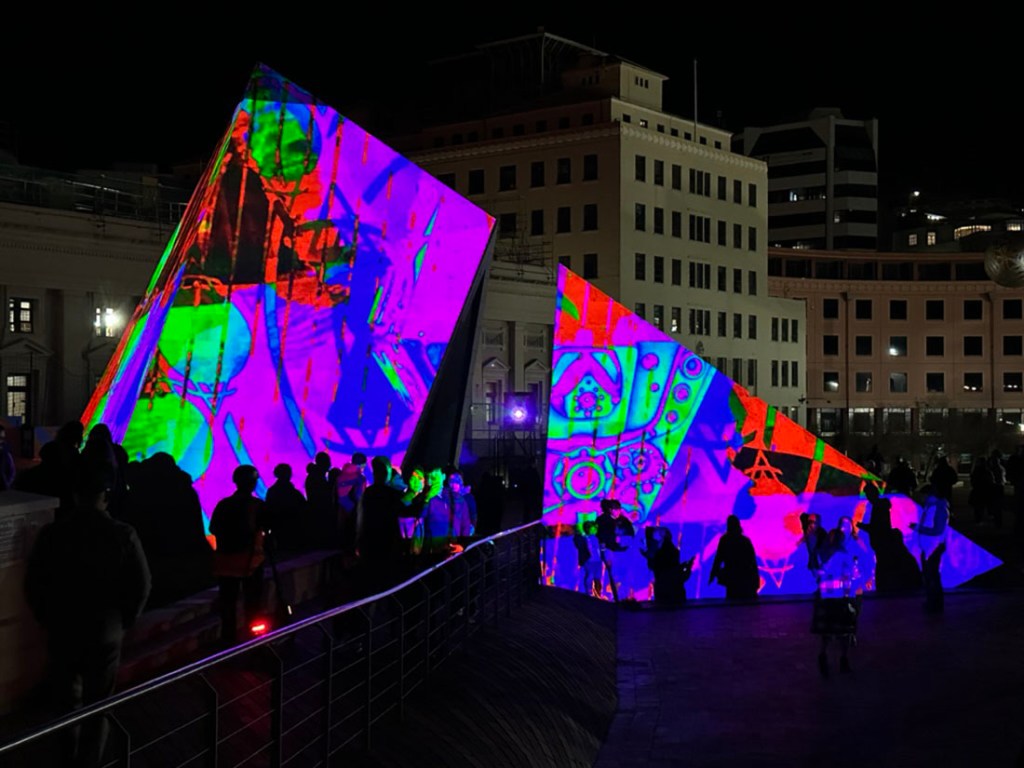
Matariki is the Maori New Year, which has been designated a public holiday in New Zealand. Matariki is the Maori word for the Pleides, the star cluster we know as the Seven Sisters. It rises in the morning of Matariki and is considered the start of the new year. Wellington had a week long celebration with evening light shows at the harbor. They had multiple art projects including the projection of videos on the buildings and on the water.
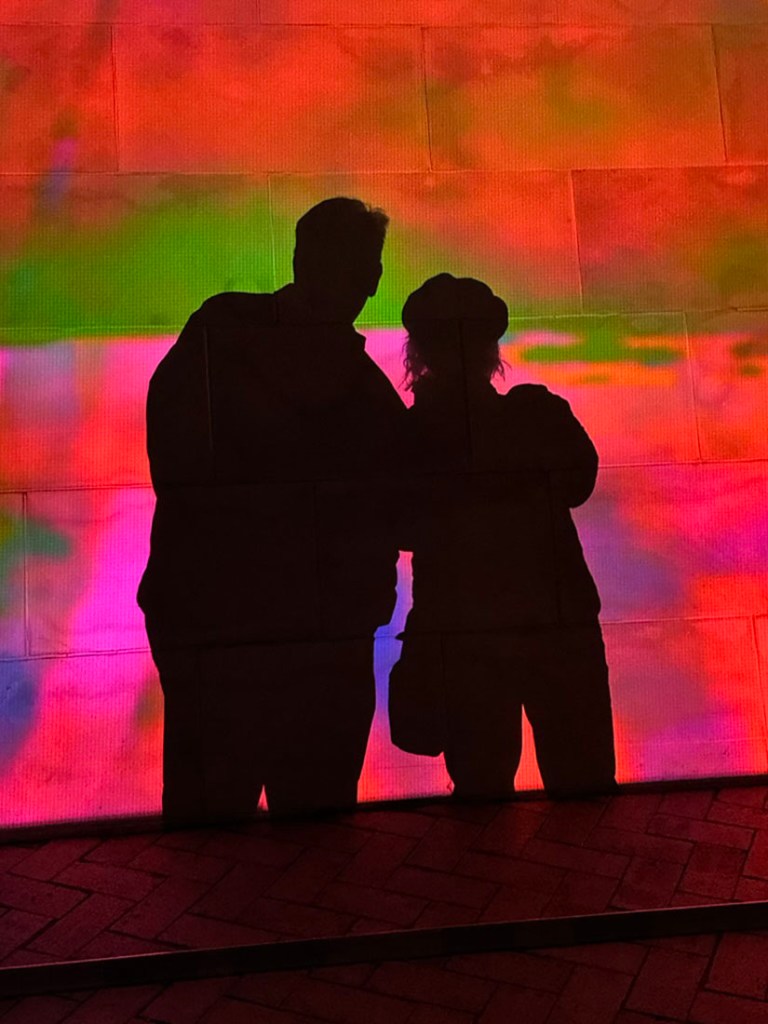
Video projected on a water spray in the harbor. Note the resemblance of the image to Pacific Northwest Indian art and designs.Another video projection on the water spray.Lights projected onto buildingIn front of the lights
To me, the interesting part of this celebration is the willingness of the Europeans, as non-Maoris are called here, to embrace the culture of the Maori. It began in the 1960’s and 70’s when the Maori began to protest their living conditions and place in society. By the 1970’s, there was a movement to have New Zealand live up to the promises of the Treaty of Waitangi, a treaty in which (no surprise) the British tricked the Maori into giving up their sovereignty and ceding their territory to the Crown. Since then New Zealand has been negotiating with tribes or “iwi” over land settlements and other issues related to that treaty. This has led to a renaissance of Maori culture and the incorporation of that culture into the mainstream.
This embrace includes recognizing the language and significant cultural events. Early in the 20th century, New Zealand had enacted a Maori Suppression law, that included forbidding the speaking of Maori. This has completely changed. The country is bilingual with Maori recognized as the official language and English as the de facto language. The stated purpose of this language law is to save the Maori language from extinction. All government signage is written first in Maori and then in English. Maori language and culture is taught in school. Many Maori words are used interchangeably. For example, the country is known as Aotearoa New Zealand. Aotearoa, which means “land of the long cloud,” is the Maori word for the country. Everyone says “Kia Ora,” which means hello. But it means much more than hello. It is the recognition of a person’s life force and spirit. Other words commonly used include the Maori word for “family” or “whānau,” “kai,” which is “food,” and “Haere rā,” which is “goodbye.”
You can make of this what you will. I am just an outsider looking in and I do not have the history or the background to judge any of it. I can only go with what I sense now. Ideally, it is the “Pākehā,” or Europeans making amends for the troubled history here and agreeing that the land is the home of the Maori as much as the European settlers. As such, their culture and heritage need to be considered part of and important to New Zealand. From what I have read, the majority of New Zealanders agree with that sentiment. A cynic would say this is just the Europeans allowing the Maori culture and language to be recognized as an act of benevolence, although they, the Europeans, are still in charge. And no doubt there are traditional Maori who think the Europeans have too much power and Europeans who think the Maoris have been granted too much input into New Zealand heritage. This is the dynamic that many countries with indigenous populations have. But still, I do think that the intention of the New Zealand government and people is to be welcoming and inclusive in a way that honors Maori culture by making sure it thrives.
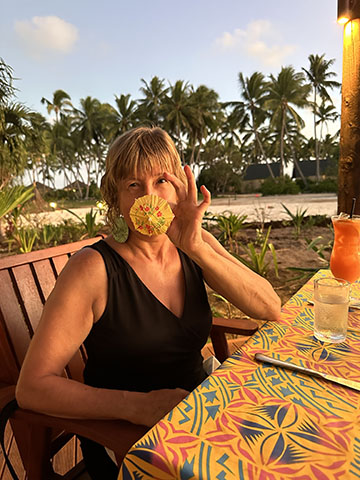
Matt and I took off for the Cook Islands for some R&R. I am exhausted from the past year, and we will be moving again soon to our permanent house once our stuff gets here. I needed a break before the next phase begins. Plus, we went from winter to winter. While the weather here has been warmer and more pleasant than normal (thanks climate change), it is still winter, and I am so over sweaters and coats, and the cold and dreariness. It would be nice to be in perfect 78º weather.
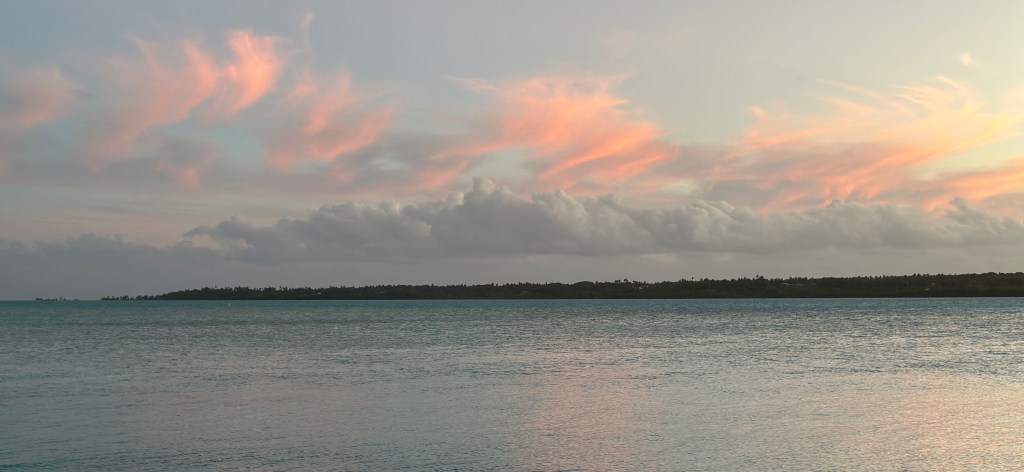
Cook Islands is a country made up of 15 islands in the Southern Pacific Ocean. It is “Polynesian,” which translates to islands, coconut trees, and beautiful blue water with coral reefs. Like most island chains, the Cook Islands were formed by ancient volcanos. As the volcano is swallowed by the earth and sinks, what is left is islands and an atoll from what was once the rim of the volcano. The atoll acts as a breaker and the ocean inside the breakers or reef becomes a lagoon.
About four hours flying time from New Zealand and far out in the Pacific, the Cook Islands were once a protectorate of New Zealand, but they gained their independence in 1974. New Zealand still sees to their protection in the sense that if needed, they will send in the troops/. Its main industry is tourism, and it serves as a vacation spot for Kiwis and Aussies.
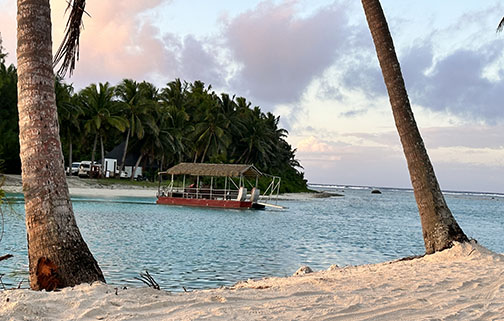
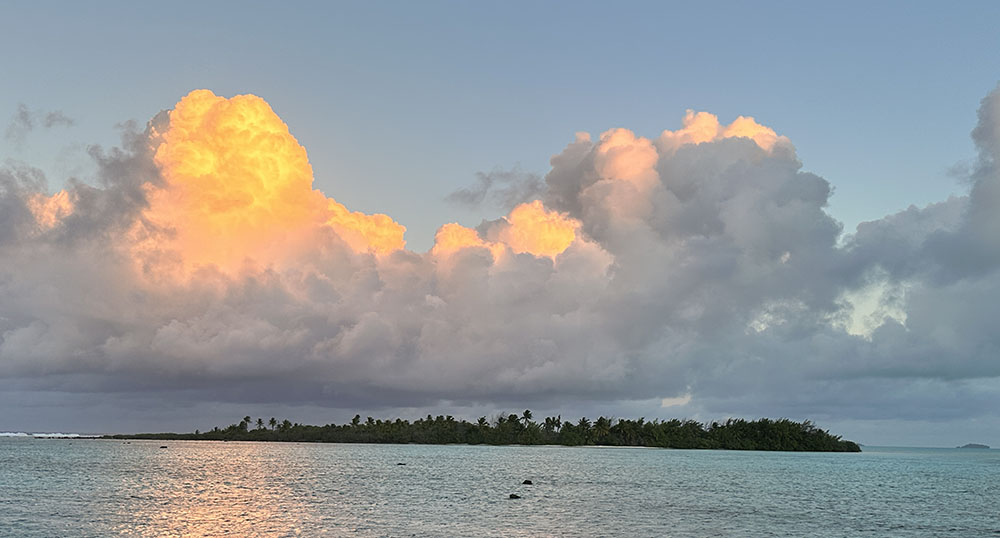
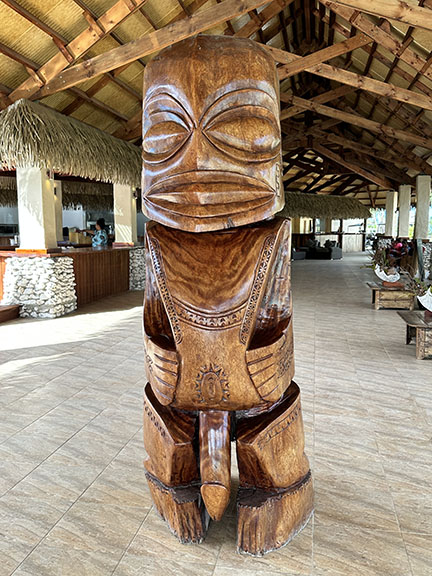
The largest and main island is Rarotonga. We booked an over-the-water bungalow on a smaller island, Aitutaki, that required another 40-minute plane hop from Rarotonga. The island is very rustic with no real town to speak of, just a few small stores and a harbor. But that did not matter since we were preoccupied with getting out in the water. Aitutaki is the ideal—one of several smaller islands surrounded by an atoll that forms a huge lagoon with very shallow water in the middle of the reef making for easy snorkeling and swimming. Our resort, the Aitutaki Lagoon Private Island Resort, was on an even smaller island separated by a channel from the main island of Aitutaki. A little ferry shuttled us over a channel to get to the island.
ferry to resort
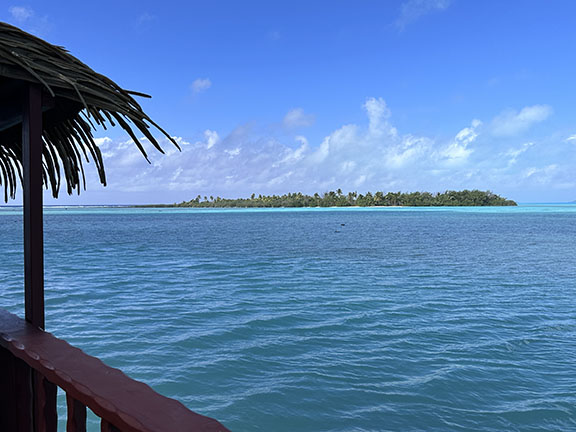
Our bungalow was at the end of the row leaving us with the water to ourselves.
View from the bungalow
We should have been able to jump in the water from the deck and go for a swim. Unfortunately, we were very near the ocean breakers at the reef and there was such a strong undercurrent in front of our cabin it was almost impossible to swim against it. I tried to snorkel but could not stay in one place long enough to see the fish. I either could not move forward, or I was pushed back. But we soon figured out that if we faced the right way we could just float with the current along the shoreline, no swimming necessary.
The food at the resort was excellent, much to our surprise. The only problem–and to call this a problem is ridiculous–the catch of the day, every day, was fresh tuna. I stopped eating fresh tuna years ago due to overfishing and general degradation of the fishery. But they had tuna in spades as their daily catch. We had no choice. It was delicious and cooked perfectly. We had seared tuna steaks, fish and chips made with tuna, tuna curry, and tuna steaks again. We ate so much fresh tuna I think tuna oil was coming out of my pores.
We did not have a car while on the island, so we had to rely on the local taxi service run by Auntie Rima. She would take you anywhere on the island for $10 per person. Auntie Rima was a kick. She talked a lot about the goings on in Aitutaki. She knew everyone and everyone knew her. Like Eva Gabor, she called everyone “darling,” and somehow that sounded right. In any other world, she would have been the mayor. As we drove along, she pointed out things of interest, the highest vantage point on the island, the local school, the new hospital, the 24-hour store. That store was a big deal. Yeah, there is not much doing on Aitutaki.
While we spent a lot of time doing nothing, we did go out on the water. Our first outing was whale watching. The tour offered a chance to swim with the whales, which meant getting into the water with our snorkel gear and watching the whales underwater. It did not work out that way. We did see whales, but they were not in the mood to play with us. Each time we spotted them, they took off, and we never did get to swim with them. That’s okay. It was fun being out on the water. The whales breached for us (sorry no pics) and one gave us a wave of his tail fin. We also spotted sea turtles bobbing along.
We signed up for a snorkeling trip with Kia Orana Cruises, a small boat with only eight passengers. When we started out the weather was not great, it was overcast with wind and periodic showers. The water was kicking up and there were some big swells. I don’t get seasick, and this was definitely a ride that would make a person seasick. Matt took some homeopathic drug that worked great. So even though the boat was bouncing like a bronco, we got through it soaked, but on one piece.
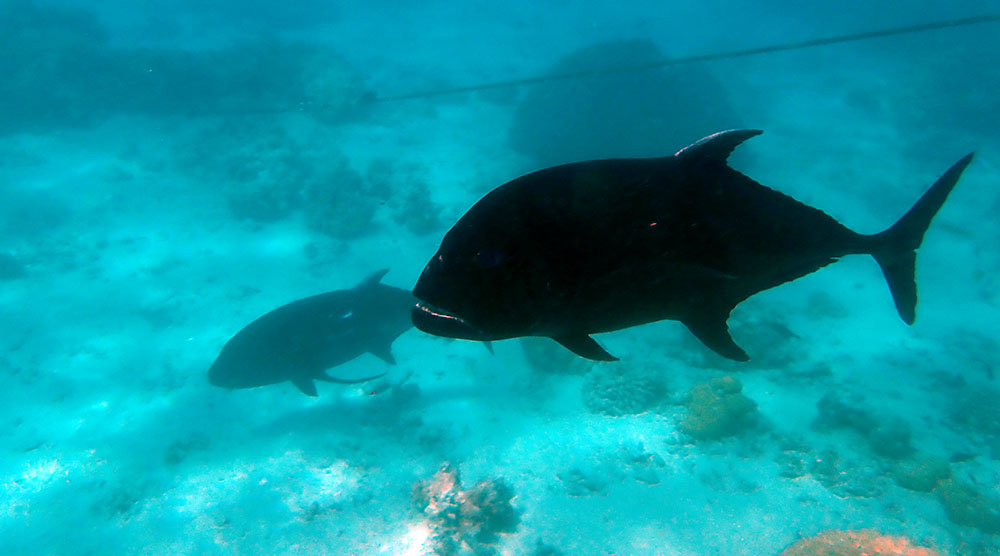
We visited four other islands, as well as a shipwreck for some excellent snorkeling with Giant Trevally, both black and blue fin. These are huge fish, some weighing up to 175 pounds and five feet long. They are also good eating when available.
Giant Trevally
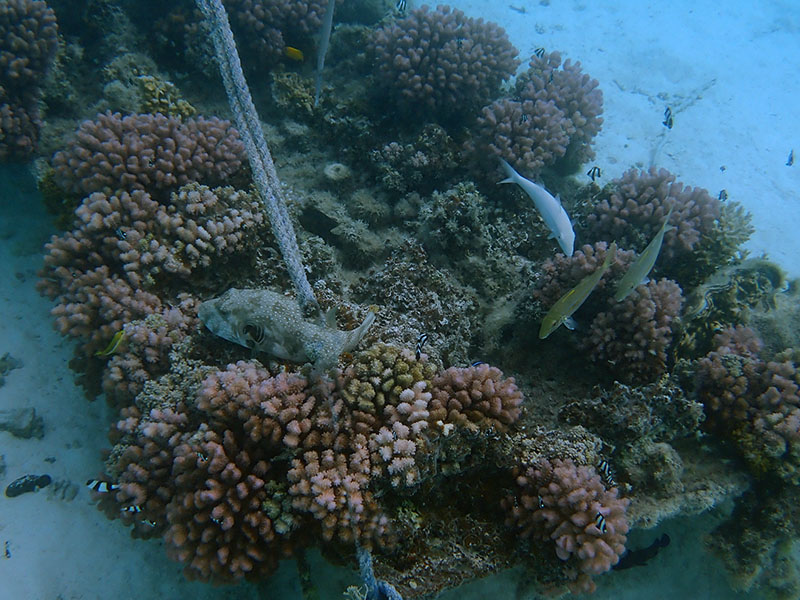
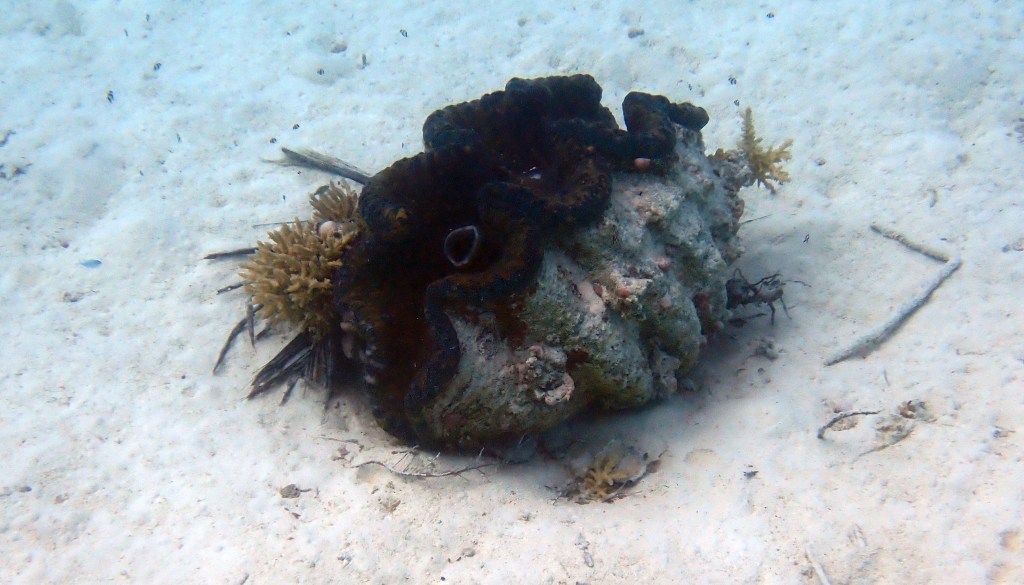
small coral reefGiant Clam
We stopped on Maina Island for lunch with traditional Cook Islands food prepared by the captain himself. He served us grilled fish. I asked what kind of fish he responded “eating fish.” That it was. It was delicious. We also had paw paw (papaya) salad, sauteed bread fruit, bananas, and sea grapes, which were deliciously salty with a pop. If you like eating seaweed, these were great. (Me, I love seaweed. Seaweed is a staple in Japanese food and I have developed a taste for it. I eat just about everything Japanese.) During lunch, we watched hermit crabs sidle along to wherever they seemed determined to go.
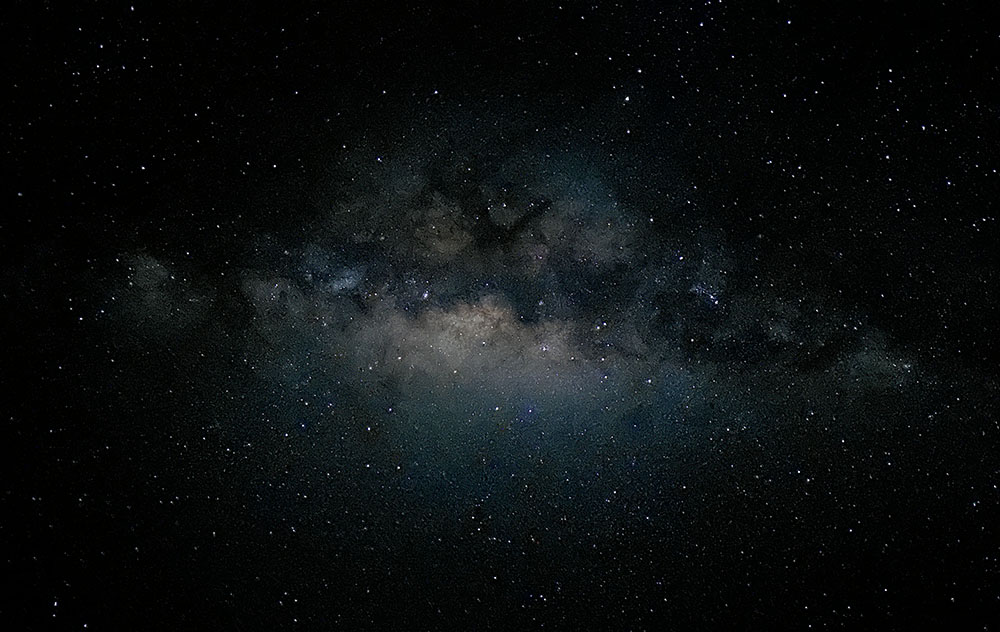
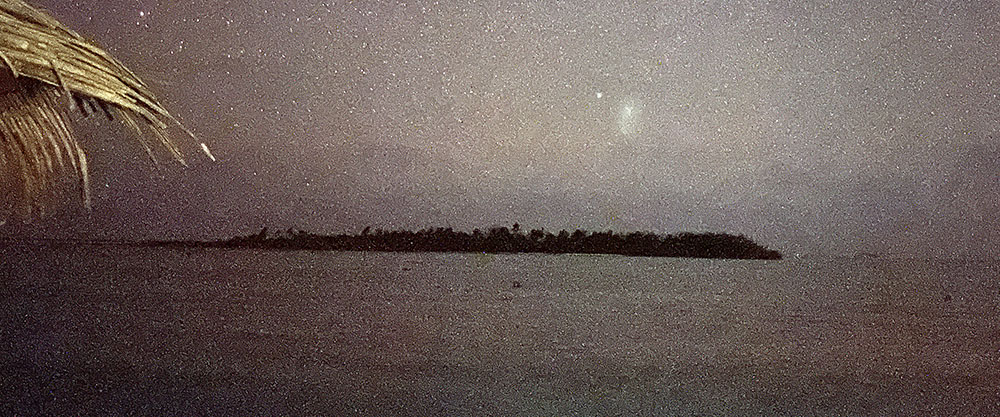
At night, we worked on our astrophotography from our cabin deck. It was gloriously dark, and I found out how good my iPhone camera is at taking pictures of the Milky Way. We have the core of the galaxy, in the second picture is another part of the Milky way with the Southern Cross and a dark nebula. And the final picture did strain my phone, but I got the Small Magellanic Cloud, a dwarf galaxy next to our Milky Way galaxy. [To think about all of the money and effort that people spend on this kind of photography and I did it with a simple phone is incredible. Once Apple figures out telephoto photography, I will never buy another DSLR.]
This is the galactic core, the center of our universe.More of the Universe. The Southern Cross, the main constellation in the Southern Hemisphere, used for navigation, is in the lower right next to the dark nebula.The iPhone captures the Small Magellanic Cloud, that fuzzy mass above the island.
All in all, the Cook Islands were beautiful and fun. I think it is a good bet we will go back and on our next trip there, we will stay on Rarotonga. I hope we will go fishing and play with sea turtles. I have a goal.
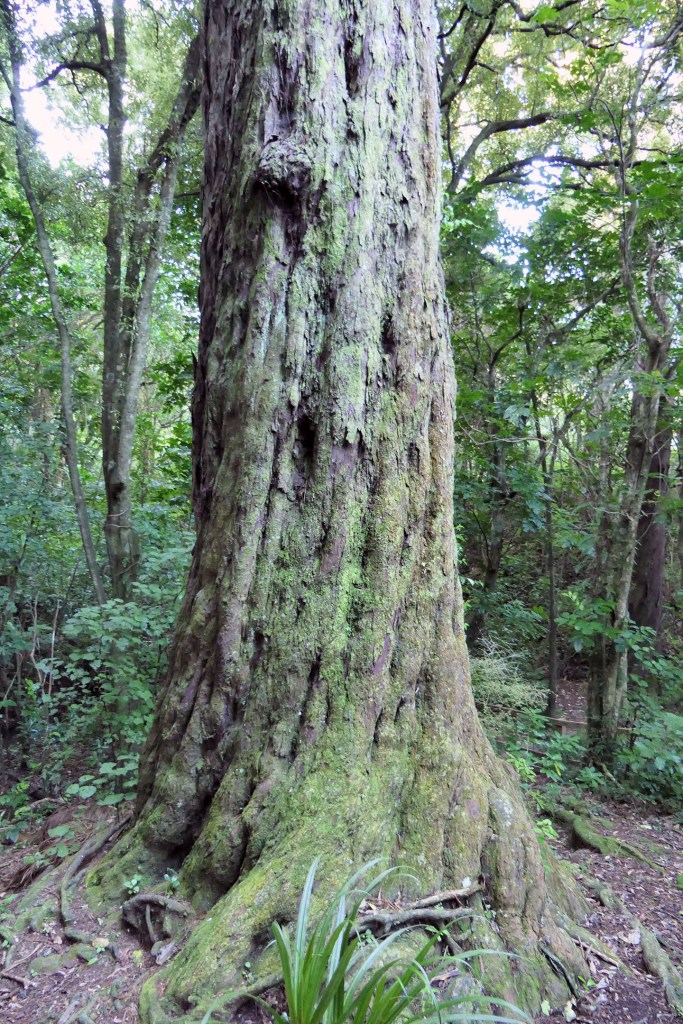
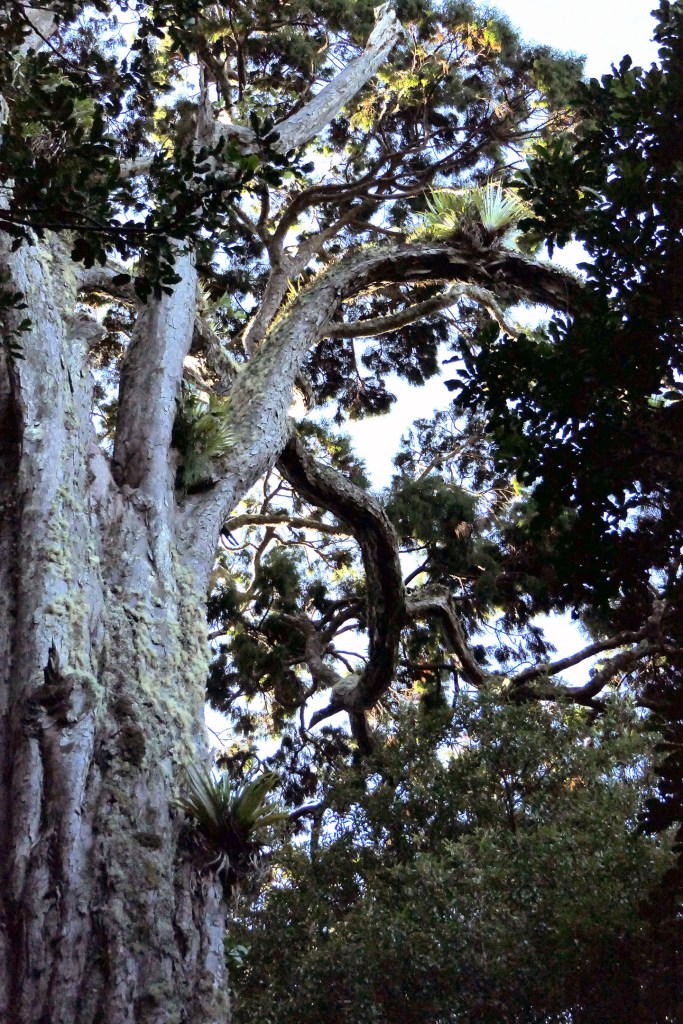
I went for a hike today in the Otari-Wilton’s Bush, a nature park in Wellington dedicated to restoring native plants and trees, that is pretty rugged and remote despite its being in the city. I had planned on hiking a loop trail that would have lasted two hours. But it seemed that some parts of the trail were closed off for repairs. I took a different path that led me to an 800-year old rimu tree (red pine), a tree native to New Zealand. This tree was already 400 years old when Captain Cook showed up in 1769 to claim New Zealand for Britain. (Why did they not kill him when they had the chance?) It was 500 years old when the Treaty of Waitangi was signed in 1840 in which the Maoris ceded to the Crown their sovereignty and their right to lands, but did not know it. The tree wept that day. The tree has seen the Maori regain their rights a little at a time and get compensation for and recognition of their losses. Who knows what it might see in the future if climate change does not kill it first?
Matt and I went to our first Wellington restaurant—Hiakai, serving Maori cooking inspired food. Hiakai means hungry, craving food, and boy were we. The chef, Monique Fiso, develops recipes using traditional Maori ingredients—foraged plants, usually leaves from trees and shrubs, garden grown vegetables like sweet potato and taro, seafood, and, of course, lamb. We even had a taste of tītī (aka mutton bird or the sooty shearwater), a Maori delicacy I tried the last time I was in NZ.
The dinner took three hours. Chef Monique came to our table, (and each diners’ table) to explain the dish and its meaning in Maori tradition. She gave us a better understanding of what was in the dish and why. That was a very interesting and personal touch. We discussed each taste and we got to ask questions. (Let me just say, never would a U.S. chef come to the table and explain each course in depth. That is left to the waiter.). We had eight tasting courses and the additional wine and drink menu which had some fun surprises. I think our favorite taste was the Pāua, or abalone, with a foraged marsh cress and lemon. If you like shellfish, it was the bomb. One course was a potato in the shape of a scallop topped with a bit of sea urchin to give it a sea flavor. We learned that scallops are endangered in NZ waters due to overfishing. This presentation was intended to remind us that this delicacy is not available in NZ. Plus it had sea urchin so that was a plus for us.
Our view is that if the food judges at Michelin went to New Zealand, and they do not, this restaurant would warrant at least one star.



 A Yank Among the Kiwis