I think it is pretty clear that we live out here in horse and sheep country, albeit, next to the beach. The beach is really a sleepy place with people walking dogs and people fishing. A crowded beach is seeing more than ten people looking in both directions at any given time.
I walk the beach from here to the next beach over, a little place called Peka Peka. It is about 2.5 miles up and back. On those walks I usually see maybe one or two people, usually walking their dogs.
But one day as I wandered along I thought I saw a naked butt. A man walked out of the ocean in front of me, he was about 25 yards away, and he was naked. I was perplexed. Here? On Te Horo Beach? A naked man? As I approached I did in fact confirm that, yes indeed standing in the dunes was a fully naked man.
Then I saw a woman pop up over the dune and she was totally naked too. Hmmm. Okay, I am guessing this is a nude bathing beach. But I had to find out if this was a one off or if this was truly a place where people went to swim naked.
And I have to say, the ocean here is fully facing the wide open ocean and it is not Bermuda. There is a lot of debris in the water, detritus from the nearby rivers which brings in logging debris, a lot of drift wood and smaller mulch size pieces. Then there is debris brought in by storms. Dead fish mostly. When I go into the water I wear, not only a bathing suit, but sandals because of the rocks and debris that tumble through the waves. There is stuff out there that you would definitely not want in your private parts.
So I asked a few people who live here about the naked people. Sure enough there is an “informal” nude beach that is accessed from a road that dead ends at the beach between Te Horo Beach and Peka Peka. I was warned not to venture into the dunes in that area because I might be surprised at what I saw.
In fact, I now see that this beach is quite the regular nude beach hang out. The other day I saw a guy who seemed to be a little unsure of whether he wanted to be naked. He stood in the dunes for a bit and then walked with purpose to the ocean. As I was coming back, I saw him in the dune again holding his clothes in front of him. Then he seemed to hurry back toward the road still holding his clothes in front of him. When I looked again, he had gotten dressed. Sorry no pictures although I was tempted.
I don’t really care that this exists. Hey, if you want to frolic in the water and dunes in your birthday suit and maybe get a little on the side, go for it. What is baffling to me is, why here? Given the rural area and the family and sport oriented nature of the beach, this does not seem like a place for dune hook ups and splashing around in the ocean buck naked. But there you are. Someone decided this was a great place for it.
New Zealand pretty much closes down for two weeks between Christmas and New Years. It is summertime, the kids are out of school, people are taking vacations, and it is the Christmas holiday season. I think the government and businesses just gave up trying to get anyone to work. So, except for essentials, for two weeks the country slows down to a near halt. We decided to join the party and take a vacation during the Christmas break. Destination = Subantarctic Islands in the Southern Ocean.
Matt has a dream. It is to see every species of penguin in the wild. My response is, sure, why not? Well, one problem is that they live in some pretty difficult (and expensive) places to reach. It just so happens that New Zealand and Australia have several species we can knock off the list but we have to travel to certain “subantarctic” islands in the Southern Ocean to see them. Well, poor, poor us had to get on a ship and sail south. Let’s get out the map and you can see these islands are on their way to Antarctica. We were heading for the Snares island chain (NZ), Auckland Islands (NZ), Campbell Island (NZ), and Macquarie Island (AU).
(You might ask why are they called Sub-Antarctic? I believe that means any island within the 40th and 60th latitudes. How can New Zealand and Australia lay claim to these islands that are far from their coasts? The answer is, I have no idea but the Falklands are in the same latitudes and Britain and Argentina have been fighting over ownership for years. So surely it has to do with planting flags and conquest. The Europeans were quite fond of claiming land on the basis of “discovery.”)
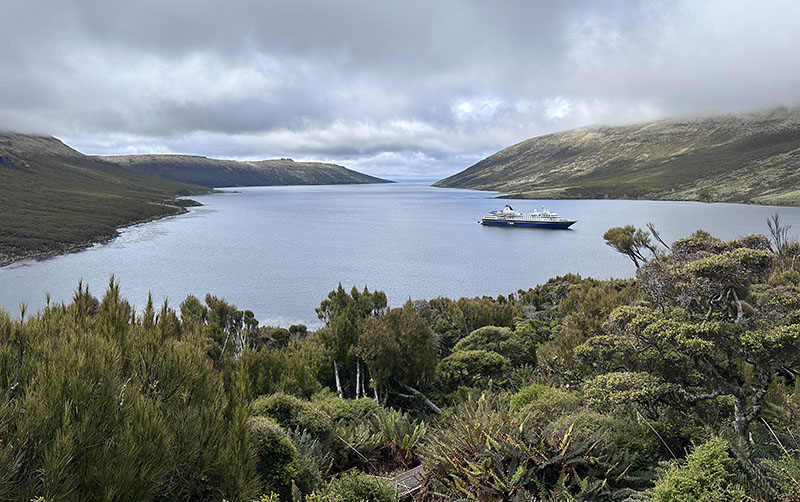
We were on an expedition ship with 120 other souls, spending Christmas looking for adventure and lots of pictures of penguins and albatross. Island landings would be handled by zodiac boats. We were under strict rules for engaging with the animals. No picking up and cuddling a penguin. Keep your distance and enjoy their adorable walk and their kooky and merry ways. Watch out for elephant seals who tend to have a bad attitude and when you see an albatross, just experience the joy of watching them glide along the air currents. And yes, there were days when it was cold and rainy and some very rough seas.
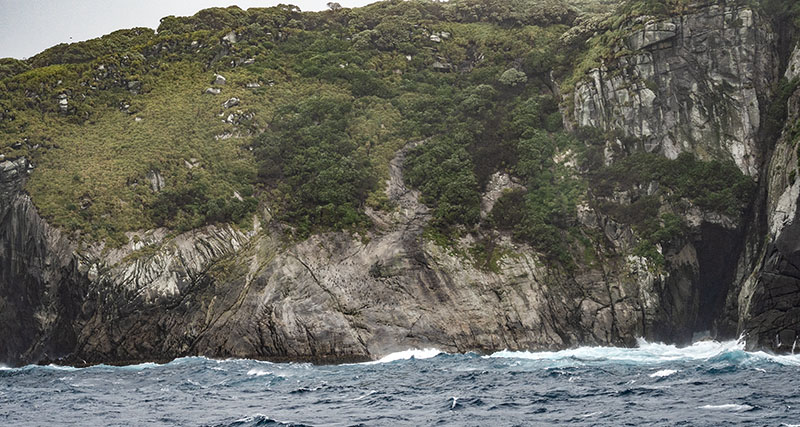
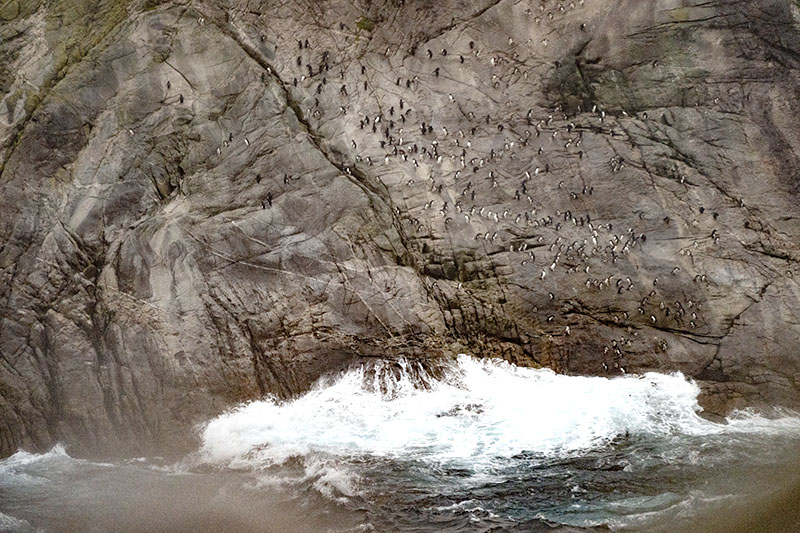
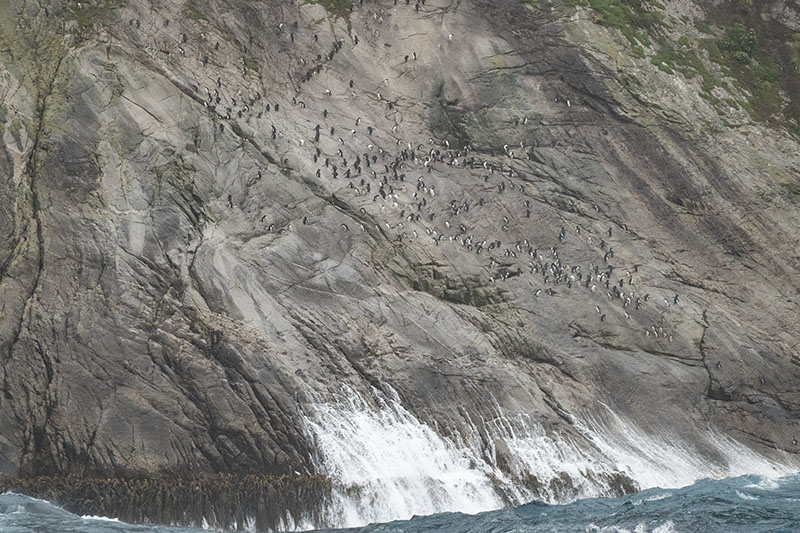
Every island was different. First stop, The Snares, a chain of islands and home to the elusive Snares Crested Penguin. Their favorite hangout is the penguin slide, a hill of bare faced rock rising from the sea which they had to climb to get home. The weather was so poor we could not land and had to watch the penguins coming and goings from the ship. We were pretty far off lest we crash, but we did see them. Check that penguin off the list.
Penguin slide is a sheer rock face. They jump onto it from the wave and then climb into the hill to nest.
Close up of rock face.
They ride the wave up onto the rock and then latch on with their claws. Up they go. Amazing little creatures.
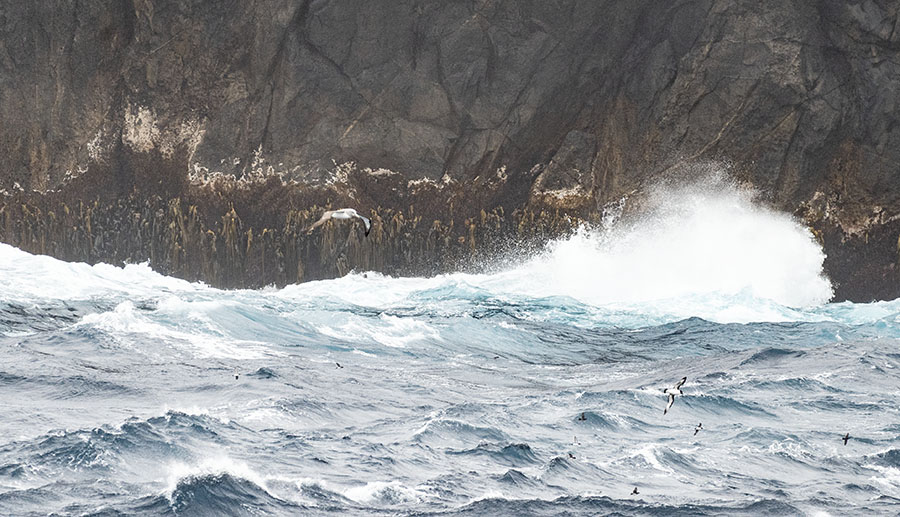
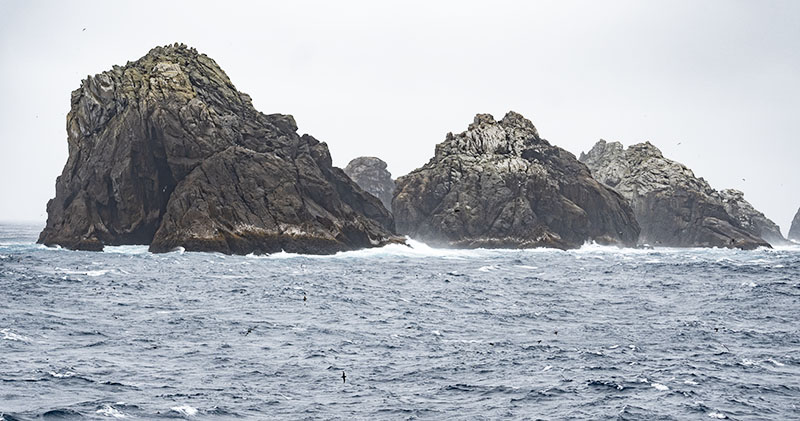
After the slide we cruised around the islands to see what we might see.
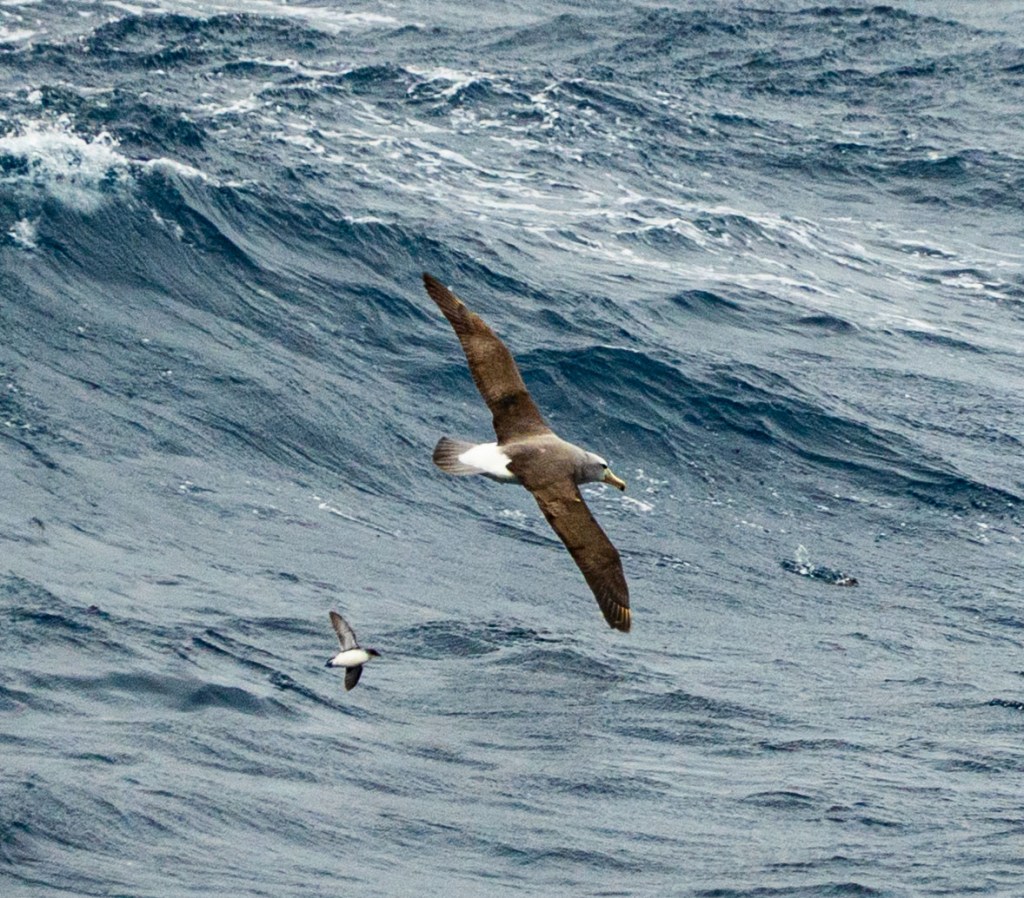
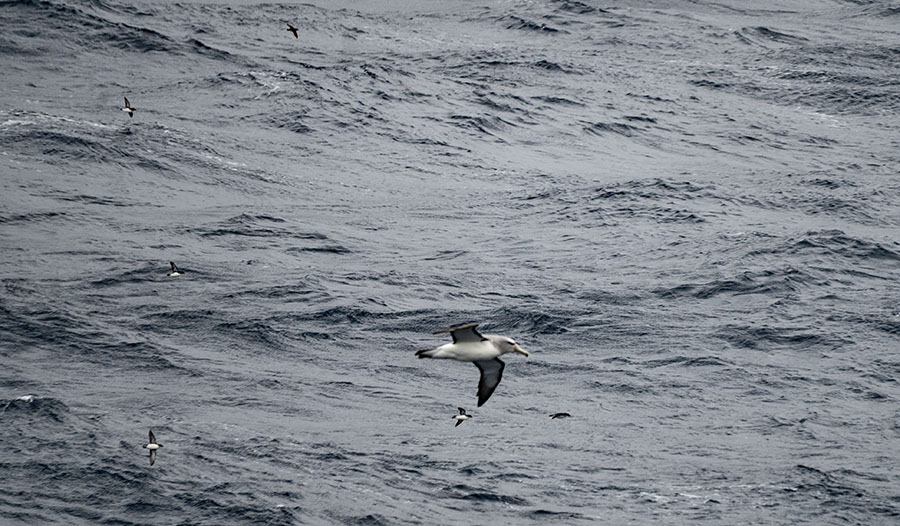
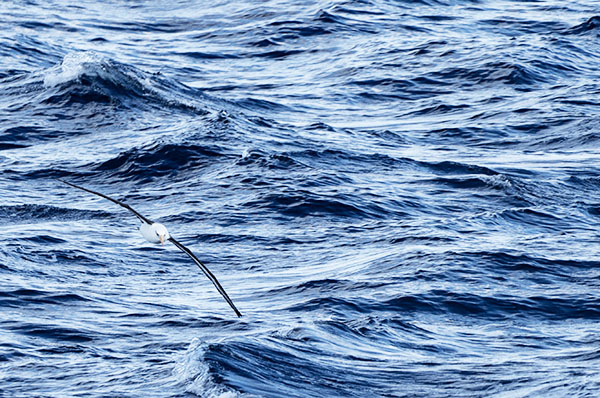
Bullers AlbatrossIf you look closely you can see Cape Petrels enjoying the foggy day around the rocks. One more albatross picture because I love them. Looks like a Salvin’s albatross being followed by Fairy Prions.
As you can see this was probably one of our worst weather days. The ship was rocking and people were not tolerating it too well. Lots of very green faces and lots of people not showing up for meals. (Matt took medicine and he was fine. I have sea legs and enjoy the rocking.)
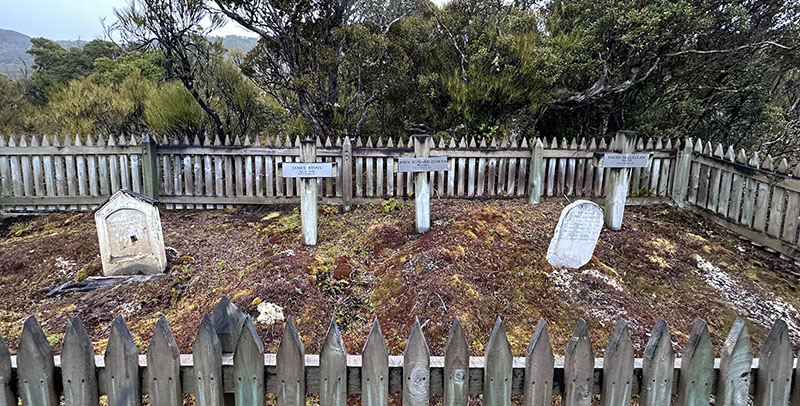
Next up was the Auckland Island. The Brits/Scots tried to settle this island. That effort failed because Auckland Island, like all the others, has a harsh environment, not prone to farming or ranching.
Settler Graveyard
The beauty of these islands is that, because they were never fully settled, they are largely untouched except for one gigantic problem: cats and rats, the predators left by whaling ships or other visitors. The inevitable result is a lot of dead birds. Add to that feral pigs who enjoy munching on vegetation and bird eggs and viola, a ruined island. But the New Zealand and Australian governments are methodically working to get rid of the invasive mammals—making the islands predator free–so the birds and flora can once again flourish. They have accomplished predator free status on Campbell Island.
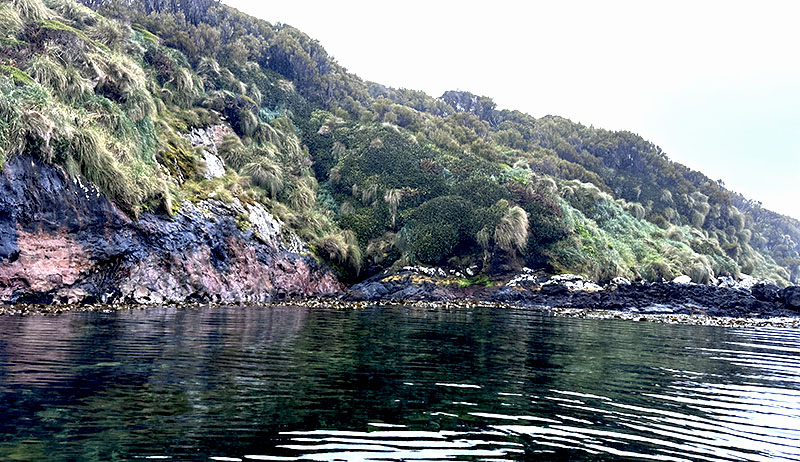
In the afternoon, we went out in the zodiacs to cruise along the coastline looking for birds mostly and to see what they refer to as mega herbs–basically, plants that are growing larger than normal.
We started out in a drizzle that soon turned into a driving rain. See how happy we are!
Finally, our zodiac guide decided we should head back to the ship. The air was so filled with rain and mist that we could not see very far. In fact, we could not see the ship. It is pretty unnerving to not be able to see the ship, especially troubling to hear the guide calmly radio the ship asking where it might be. It was far enough away that she could not make contact. She decided to head in the general direction up the coast. After a few miles we saw its outline and breathed a sigh of relief.
For dinner that evening we were treated to a barbecue on the ship deck. The weather turned out to be a bit cold but dry. The chef turned out an amazing feast of meats, veggies, and deserts. It was impressive.
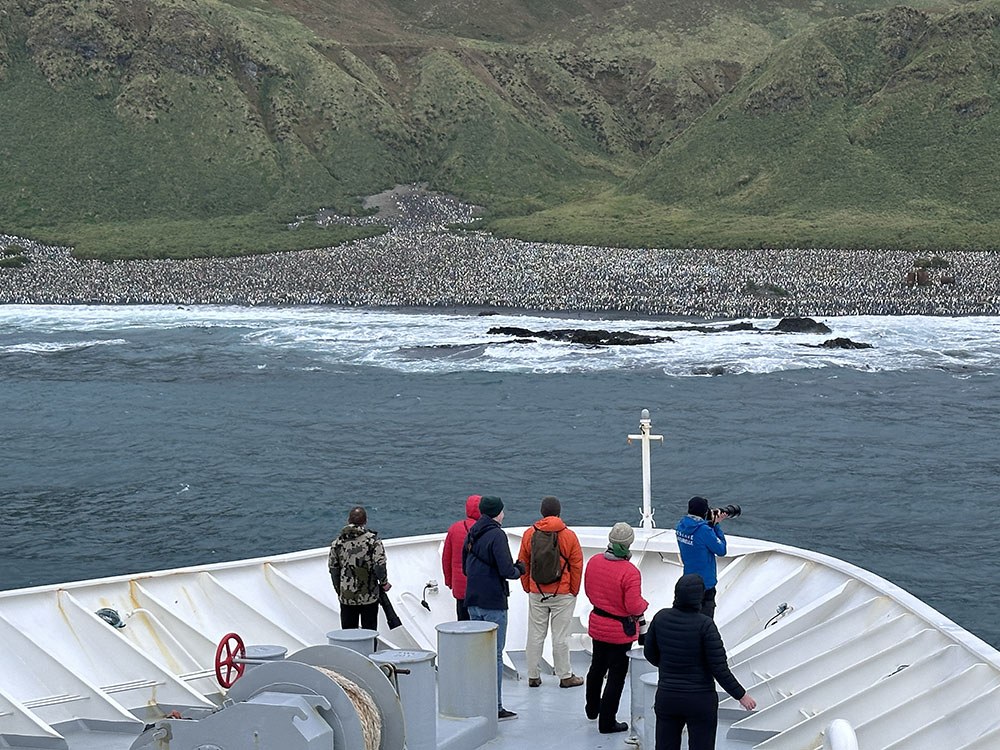
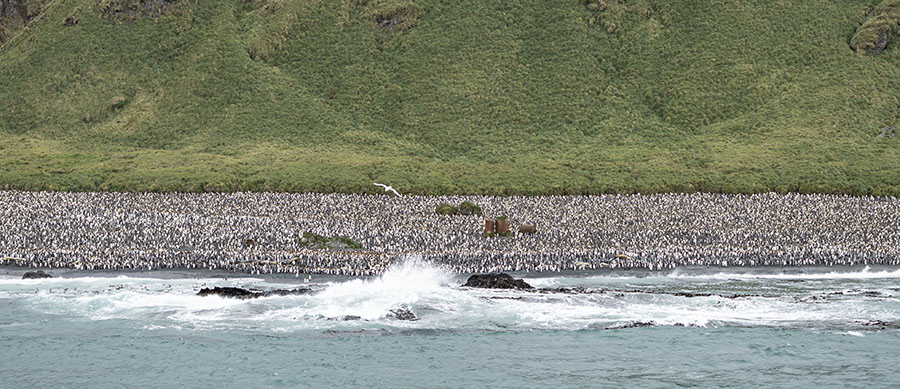
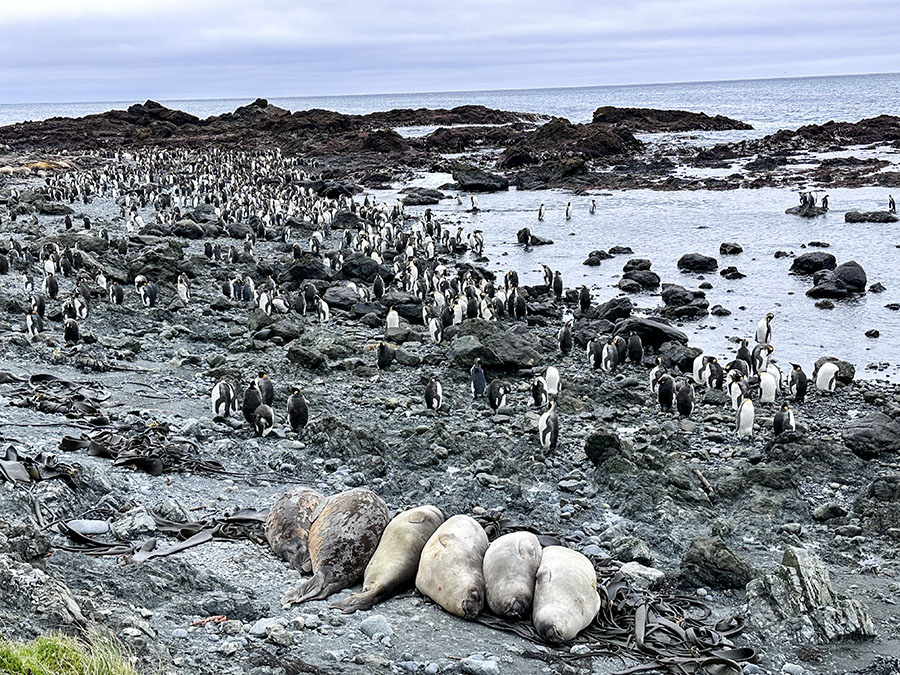
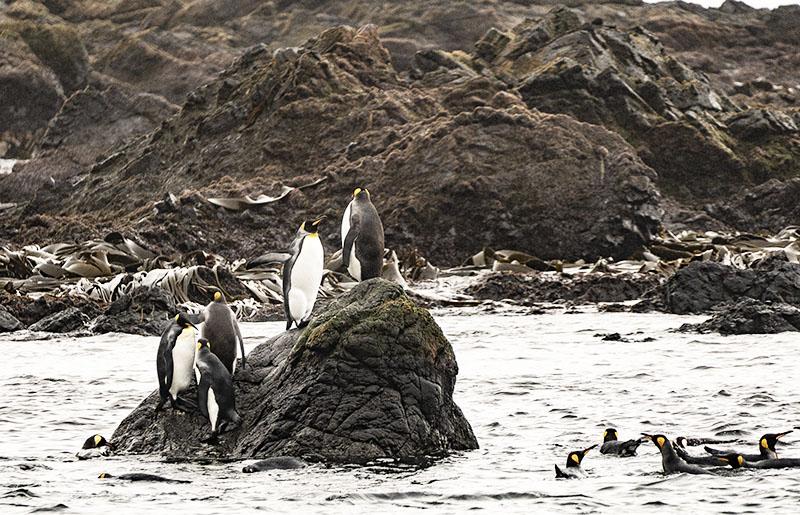
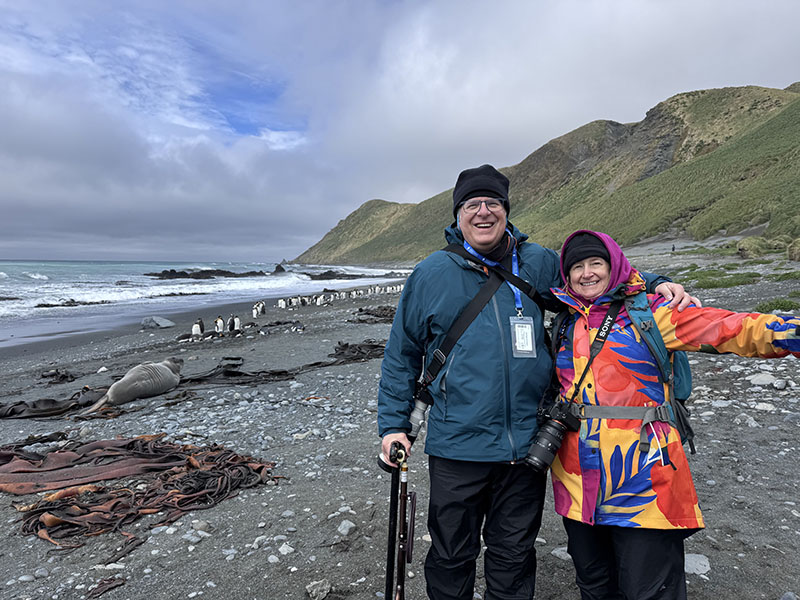
The next morning, we woke up at Macquarie Island where we would spend Christmas Eve. This is as far south as we would travel, much closer to Antarctica and the air temperature proved it. It was cold. But the penguins? Now we are talking! This island, part of Australia, is home to large colonies of Royal and King penguins, hundreds of thousands strong. The first landing was on the research station side and there were not that many penguins.
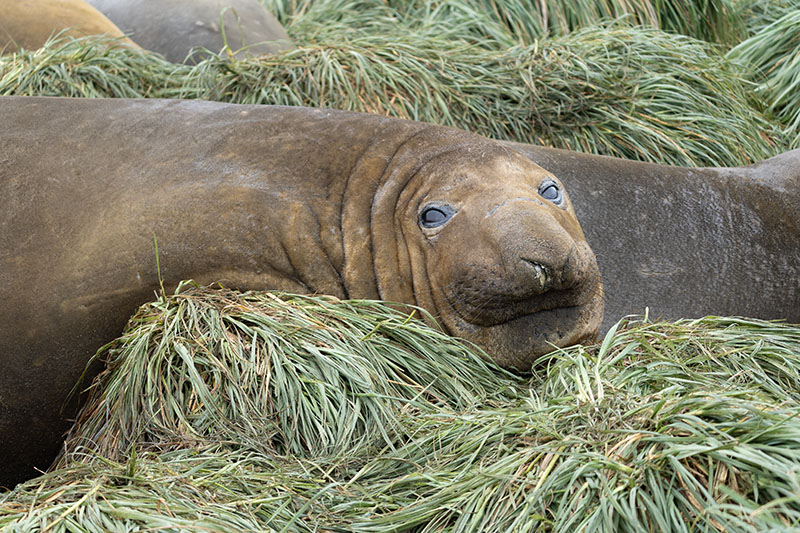
Huge and smelly elephant seals laid about the beaches and in the dunes, many were molting making them feel very itchy and cranky. Best to keep six feet away.
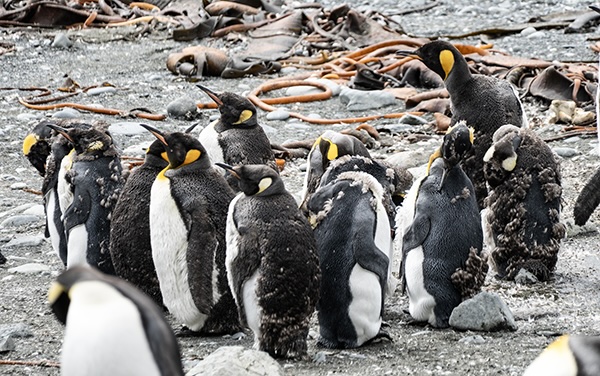
The King penguins were also molting, and it did not look fun. In fact, they looked miserable as they waited for their feathers to fall off, so that new ones could grow in.
Looks itchy
We next sailed to the other landing sight and boy, what a different view!
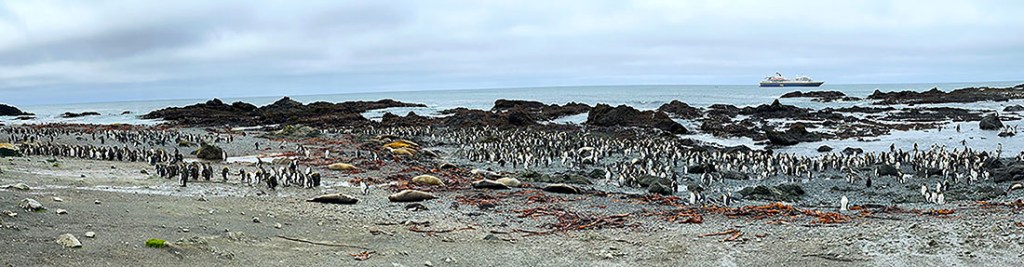
Those are all penguins
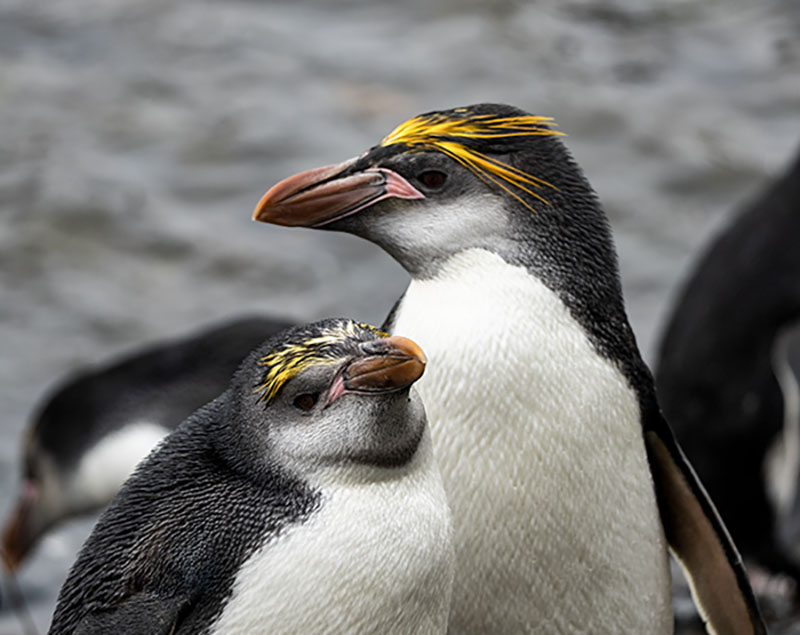
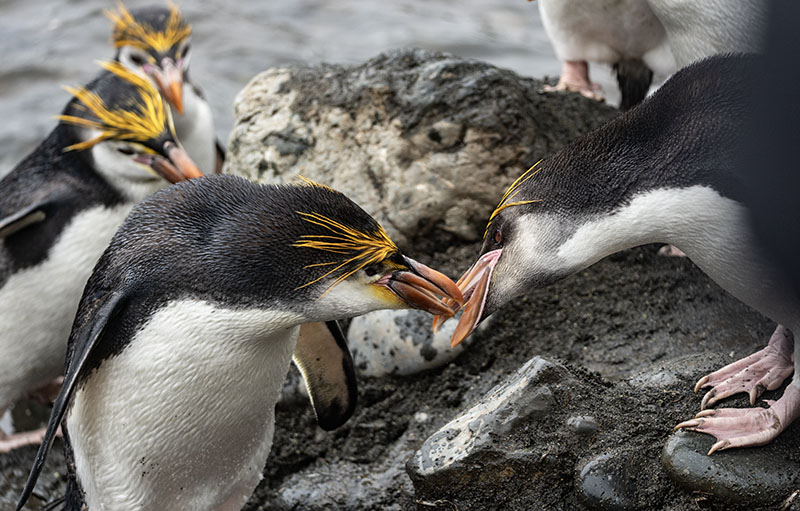
We did not land at this particular rookery. We went to a more sheltered cove for a zodiac landing. As we landed, a welcoming party of Royals waddled as fast as they could to see what was coming ashore. They were somewhat leery at first. But there is always one penguin, braver than the rest, ready to walk towards those very tall creatures coming out of the water (that would be us) to find out what the fuss was about. They posed for this close up.
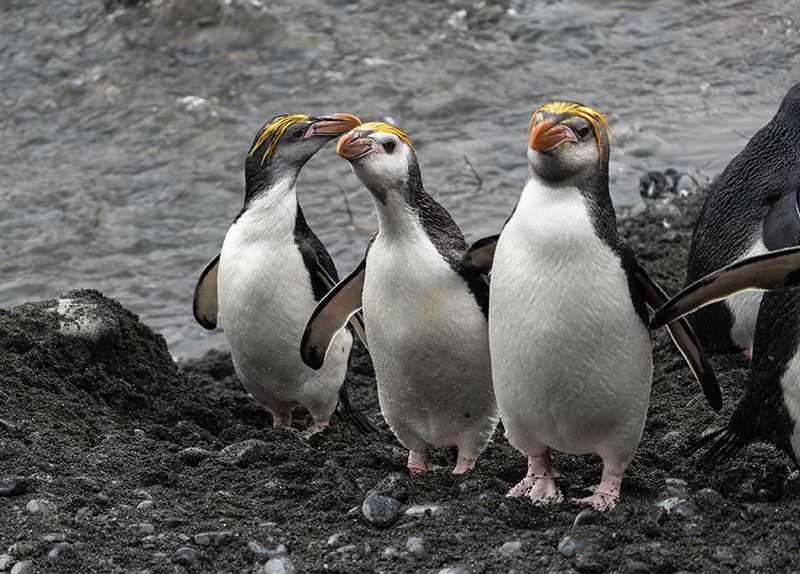
These are Royal penguins. My personal favorite. The Royal penguins sport yellow and orange crests, plumage that makes them look like they should be dressed in Hawaiian shirts because they are just out for fun. They are on the smaller side and very curious.
Gosh, I could have sat on that beach and watched those Royals all day. So much activity. They swim, nip at each other, scurry this way and that, talk and preen and generally fuss. Adorable.
No fighting!
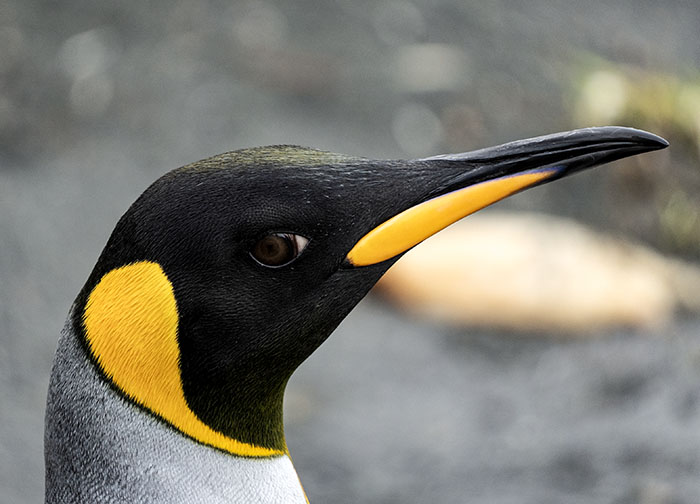
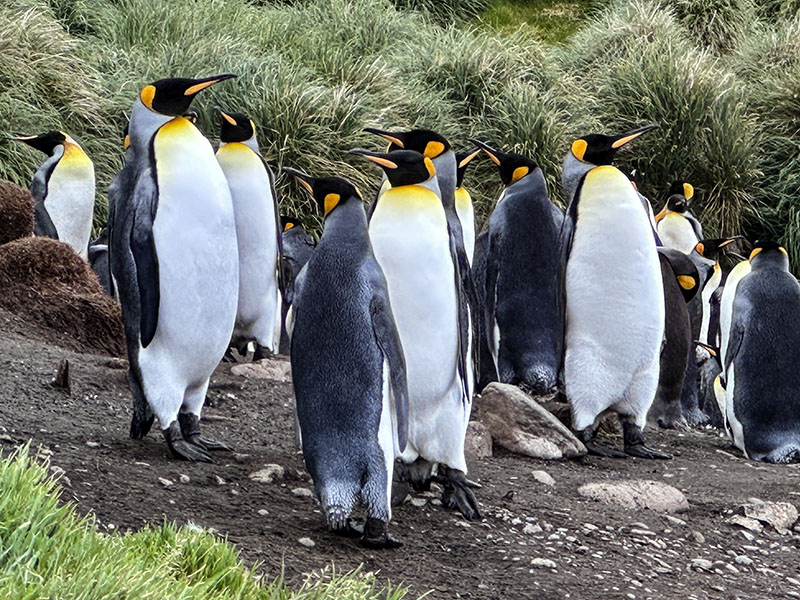
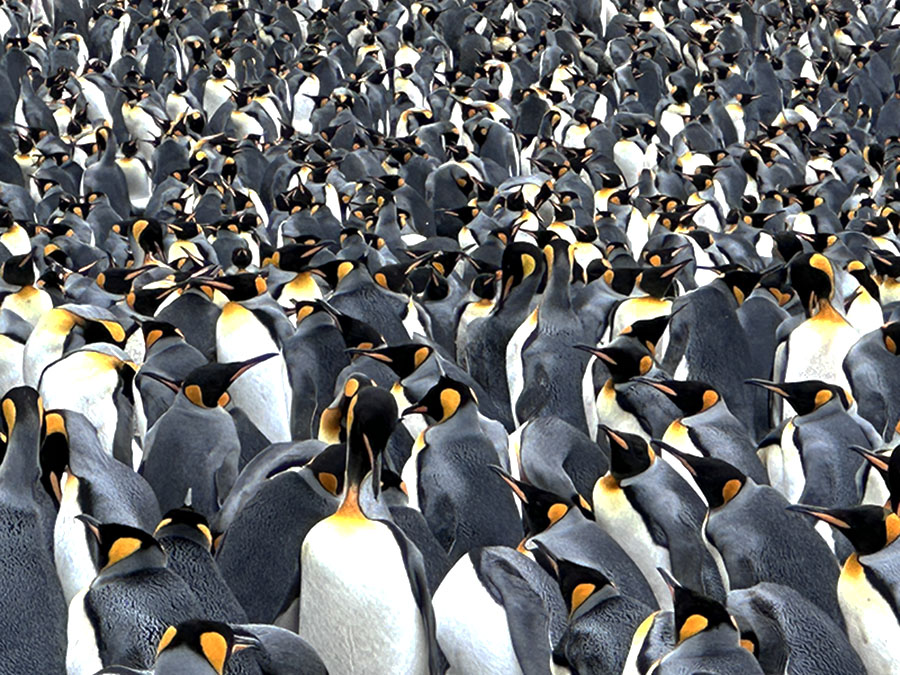
On the other side of the beach were the King penguins. Smaller than the Emperor penguin (the penguin you usually see in the documentaries), but very similar in coloring, the King penguins are much more reserved and stately. Interesting but not near as fun as the party boys on the other end of the beach.
That is a lot of penguins! As far as the eye could see.
Not sure what that elephant seal is up toGreat time on Macquarie Island!
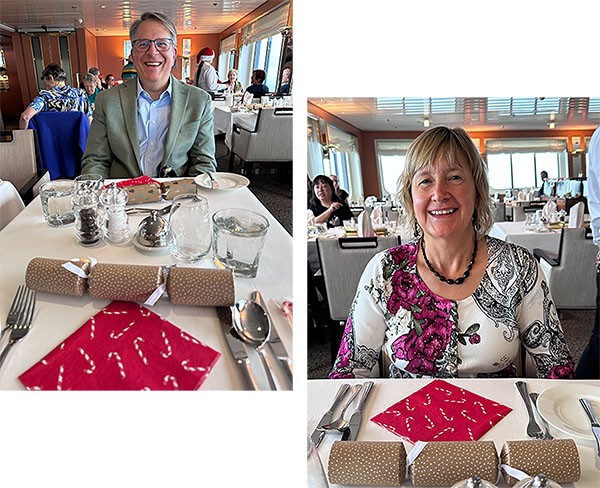
Christmas Day was spent at sea, eating and drinking way too much. A word about the chef. The food on the ship was equivalent to a four-star restaurant and I am not exaggerating. Every dinner was a three-course extravaganza. The chef, Jorg Lehmann, is Swedish and by the end of the trip I had to give him a hug. He gave us a Swedish twist for Christmas. On Christmas Eve, he served us Swedish pancakes with lingonberry sauce. He brought lingonberries to the end of the earth! Holy smokes that was unexpected. Christmas Brunch included herring and Swedish breads. Oh yes, please. Chef, you were terrific, and your staff was lovely. Cheers!
On to Campbell Island, where albatross were on the agenda.
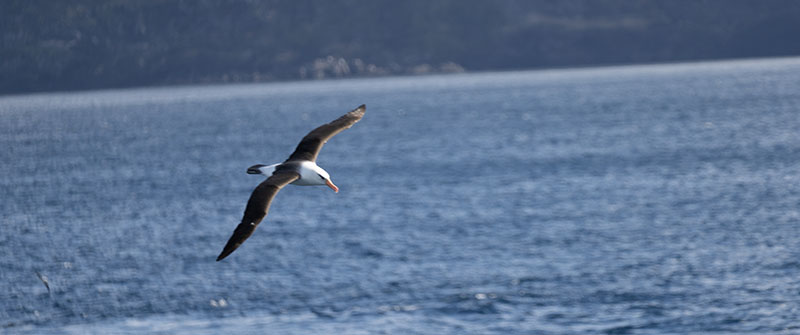
Albatross are fascinating to me. They are one of the largest birds on the planet. The wandering albatross can have a wingspan of up to eleven feet. They don’t flap. Their wings lock so they save energy when they fly. And they need it since they can fly for thousands of miles gliding on the air currents swirling around the earth. They sleep while flying and they sleep on the water. The only time they are on land is when they are nesting. They can live past 50 years.
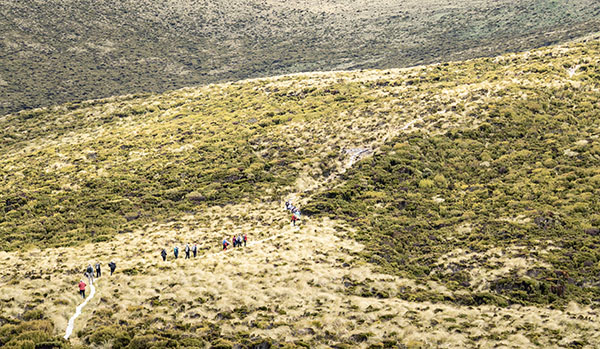
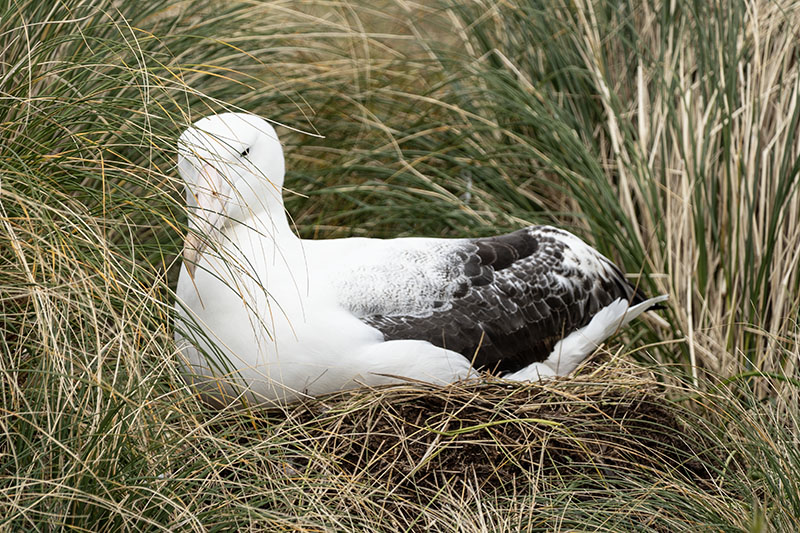
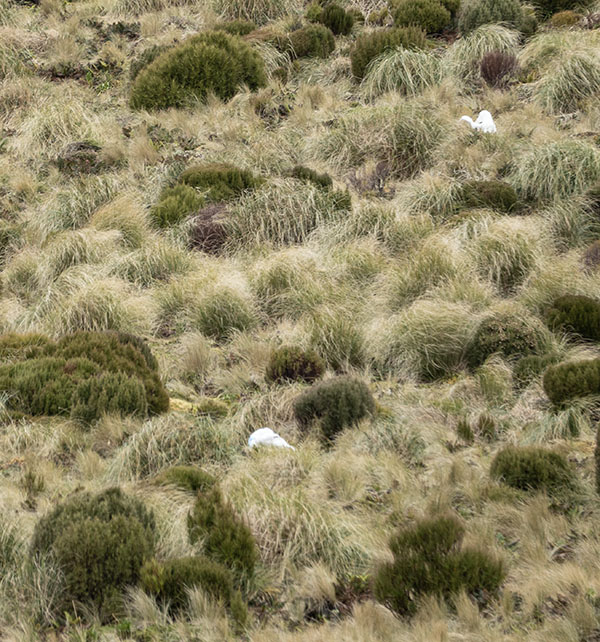
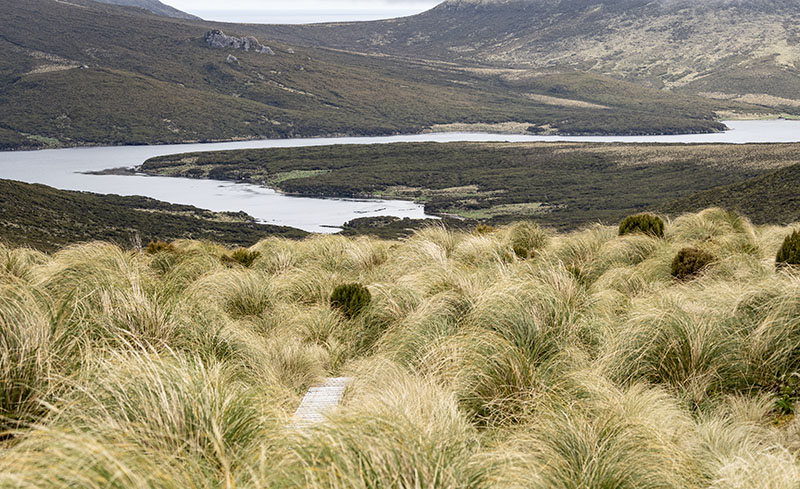
We climbed a rather large hill, it felt more like a mountain, to see the Southern Royal albatross nesting.
Trudging up the hill. This is a very long way from the top. We hiked about 3k total (2 miles)
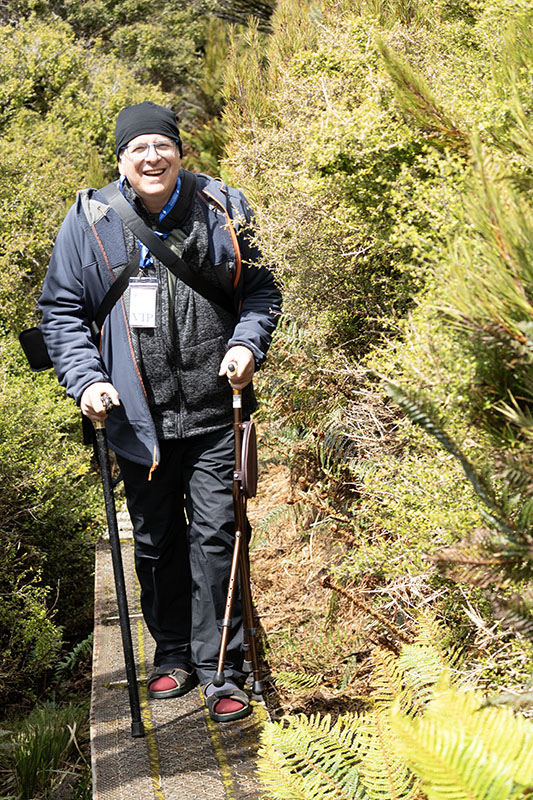
You may wonder how Matt is able to hike. Here is how:
He is carrying with him a folding cane chair. Along the way, he stops to take a break and get off his feet. He has traveled all over the world with that chair. He does have his distance limits and we don’t usually do more than about two miles. Note too that he is wearing sandals because that is the only shoe he can wear. He has fully water proof socks and in combination they are as good as hiking boots.
We finally made it to (kind of) the top and found this:
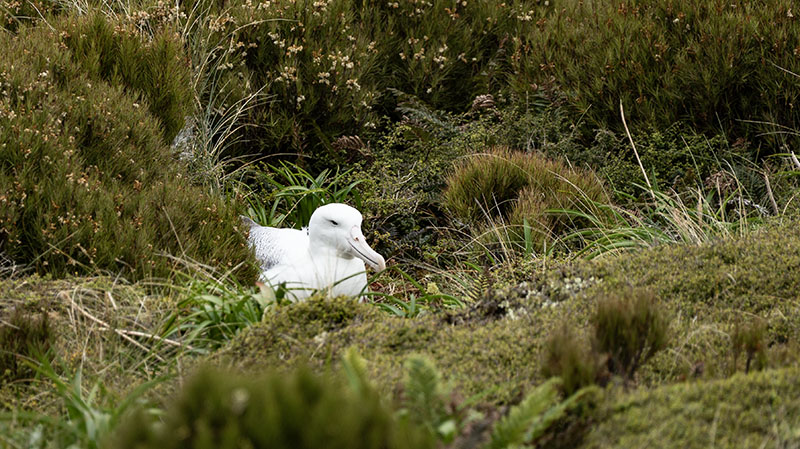
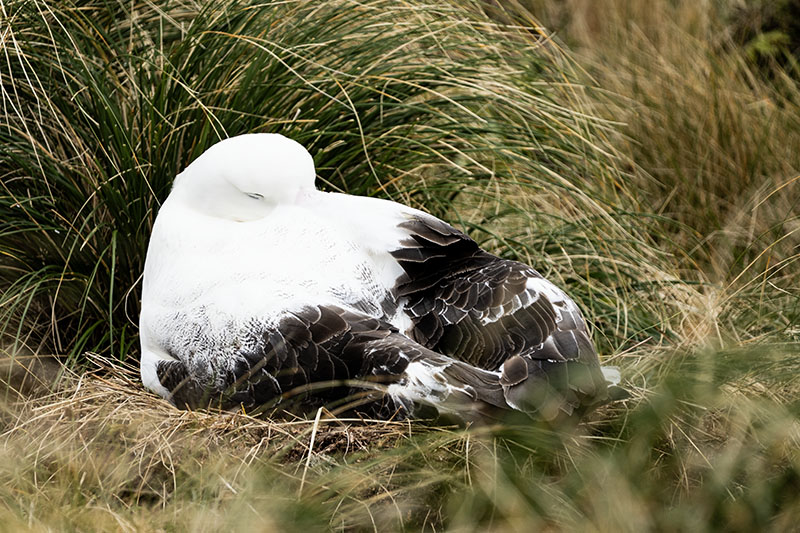
Hiding in the brushSleeping in the tussockCalm but wondering what all those animals were standing in front of her with long black objectsAlbatross nesting in the tussockSoaring
The hike up was worth it. Such beautiful birds. Albatross are only on land to nest so this was pretty special to see. Then of course we had to make our way down. It was a lot easier than going up.
Boardwalk through the tussock
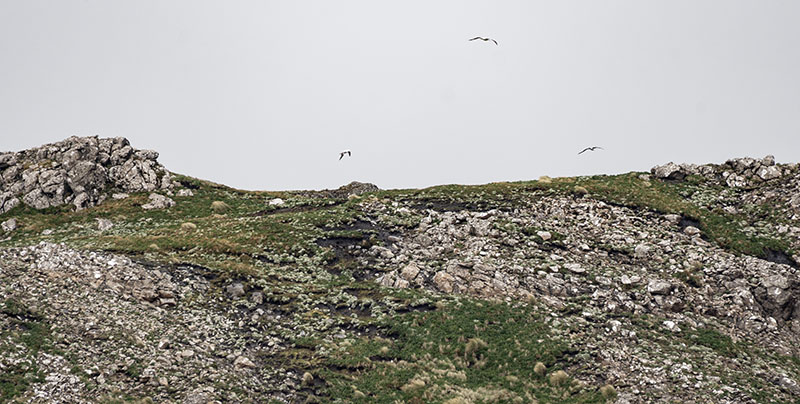
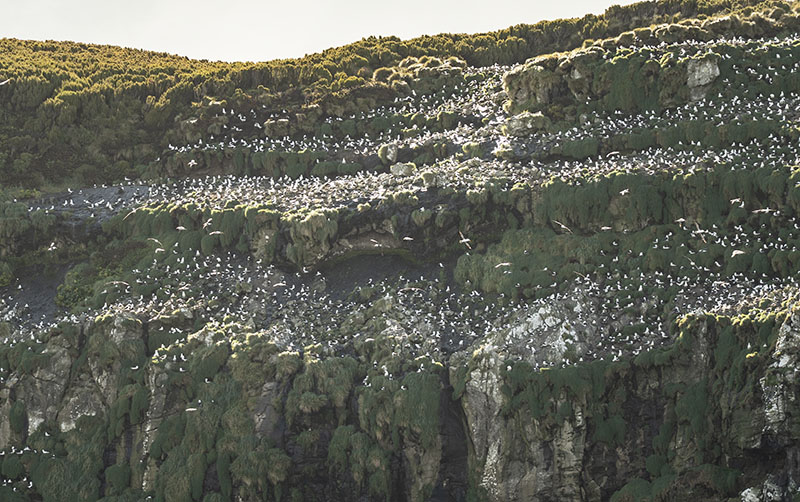
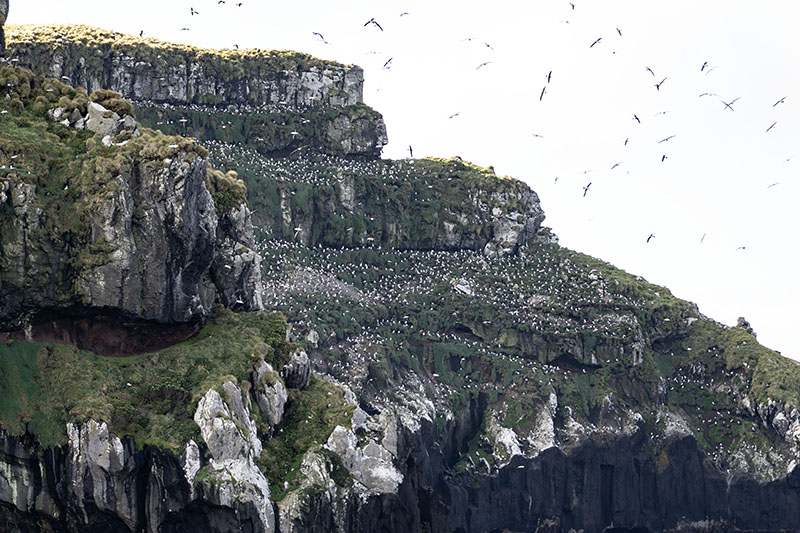
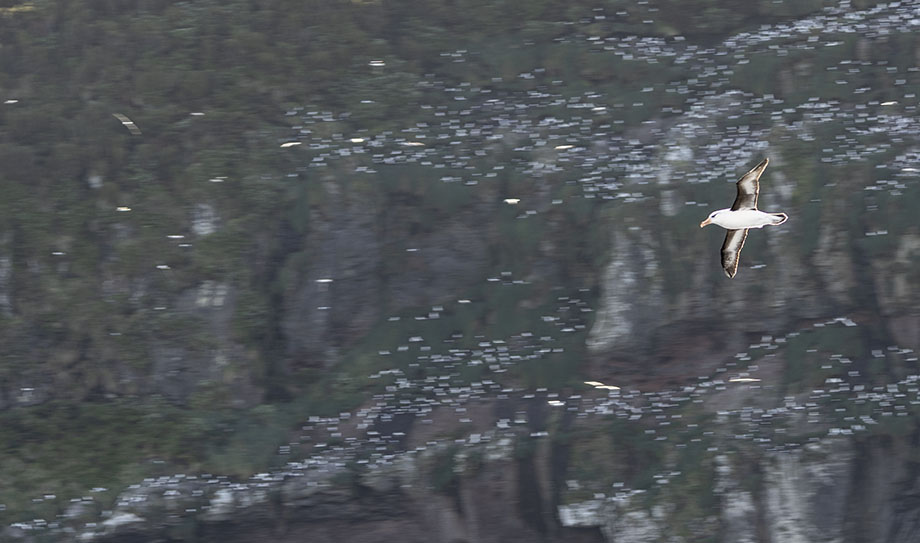
But the real drama was yet to come. During this trip, we often had albatross following the ship. But at Campbell Island, the sheer number of albatross was astounding. Rock cliffs on the Bull Rock held hundreds of thousands of nesting Campbell Island albatross, as well as Grey headed and Black Browed albatross. The sight was jaw dropping. The skies were filled with albatross and other smaller sea birds. The Captain slowed the ship to a crawl so we could get our fill of the sight and get some awesome pictures of the spectacle. It really was living a nature show.
So many birds!
I am not quite sure how I managed this one but the trip photographer was impressed.
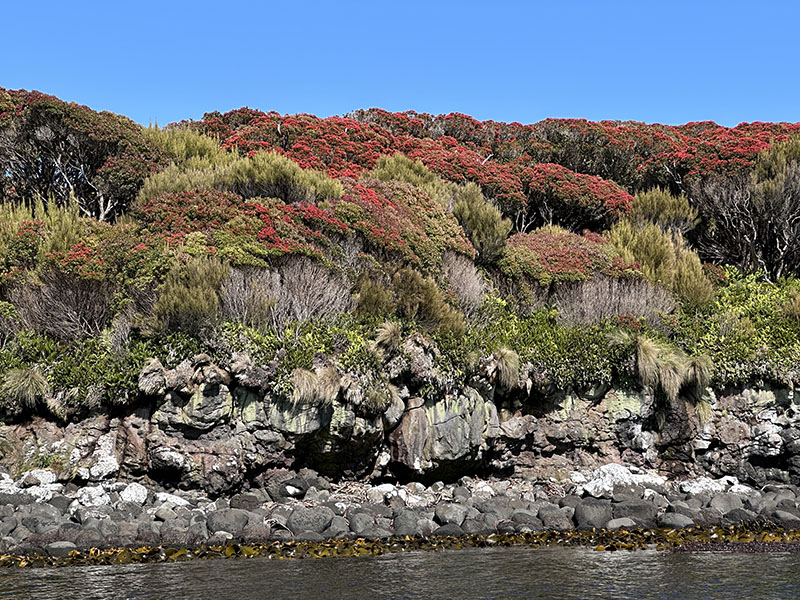
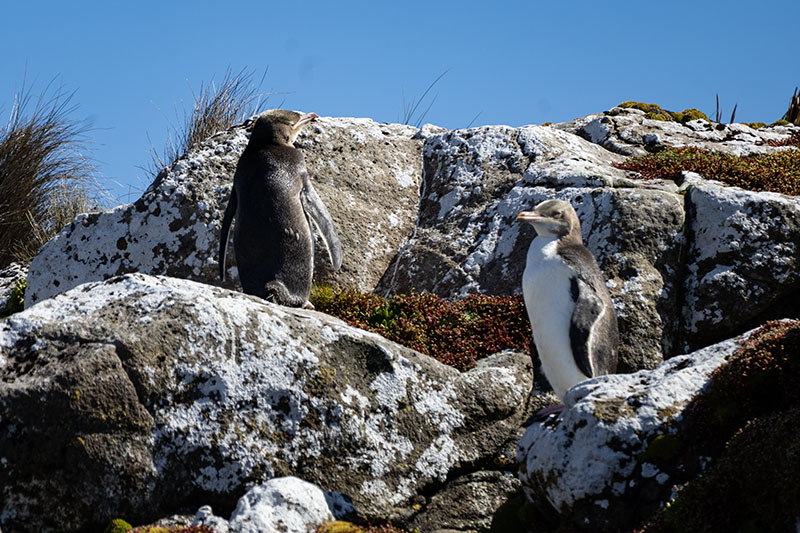
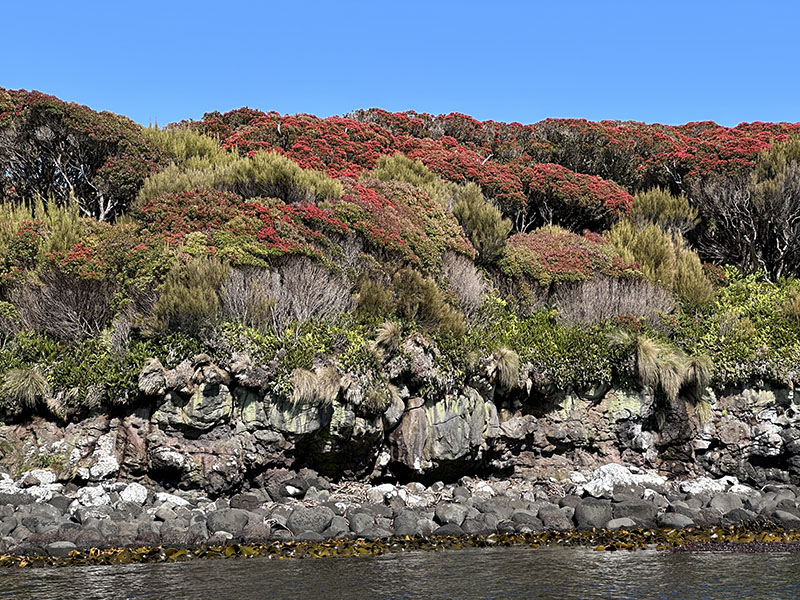
After that extravaganza, we started back toward the South Island. We stopped for another zodiac tour at Enderby island, part of the Auckland Island chain. Here we saw yellow eyed penguins up close and personal, and a nesting grey headed albatross. The Southern rata trees were in bloom as well.
Yellow eyed penguins. These are quite rare.Southern Rata trees, native to New Zealand.
Overall, if you love penguins and birds and nature of any kind, it was a fun trip. We actually met a couple on the boat who had no interest in penguins at all. But by the end, they were kind of warming up to them. How could you not? Look at these guys!
If New York is the city that never sleeps, then New Zealand is the country that is in bed by 10, for an early alarm tomorrow. I am a night owl, no news there. Unfortunately, I am now living in an entire country of early to bed, early to rise practitioners.
As someone who lived in a city for decades and grew used to having grocery stores with late hours, 24 hour pharmacies, and restaurants open until ten, the time line here just does not work for me. We learned the hard way that coffee shops and cafes close at 3 p.m. If you need caffeine in the afternoon, good luck. Restaurants are busiest between five and six and most close by nine. Five o’clock dinner out? Those are Pop Pop hours. Matt’s grandfather Pop Pop had to have dinner at five. Six was horribly late. Forget seven.
Shops and businesses are open only nine to five on weekdays. If people work from nine to five and shops are only open from nine to five, how does anyone get anything done? I guess people are expected to leave work if they need to run an errand. Even worse, waiting for the weekend to get anything done is also problematic since most businesses, aside from retail, are closed on weekends or are open only until noon.
Granted, the grocery stores are open a bit longer. One store makes it to 10 p.m. Another major grocery store has a sign that offers “late night” hours–on Thursday they are open until seven. Late night? Seven? That is just adorable. So far as I can tell, there are few if any 24 hour anythings in most of the country. (I can’t speak for Auckland, the largest city of one million. I am going to hope they have some kind of night life.)
This is a very rural country with a lot of people having grown up on farms or having lived in small towns where five is the time to close up shop. I often wonder if perhaps that is the cause of the general early bird syndrome. Whatever the reason, in order to get anything done here, you better set the alarm.
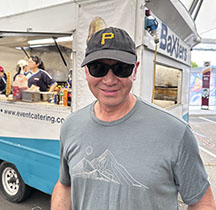
When we first moved here, we were walking on a beach and we saw a man with a Pittsburgh Pirates hat on. I ran up to him and asked what that was about. Turns out he was from Pittsburgh. He was married to a Kiwi and lived in New Zealand now. We had a nice chat.
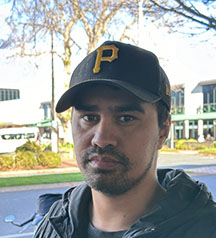
Then I saw another Pirates hat. And another. So I started taking pictures of folks wearing Pirate hats.
I always ask if they know what the “P” stands for. Most do not know. One man told me his daughter bought it for him because his name was Pete. Another told me he had no idea what it meant but he liked the hat. So he bought it.
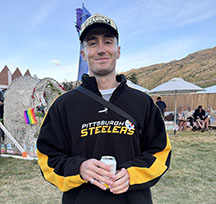
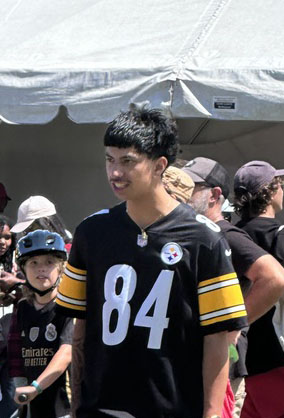
Then I started to notice Steeler wear. Not as much, but certainly there.
This guy is in full regalia
When I ask people if they have heard of Pittsburgh, some say yes, some no. The Steeler fans are more likely to know the team and the game they play.
Black and gold is the color of a local professional soccer team. The team made it to a playoff game and there were a lot of people in downtown Wellington dressed in black and gold team colors. I stopped a man and asked about the colors and said I was from a place in the U.S. where black and gold is the team colors. His friend said, “Yes, the Pittsburgh Steelers!”
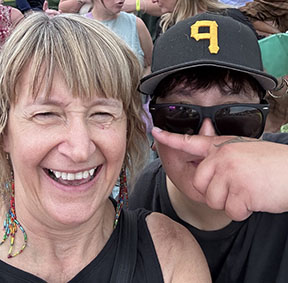
Enjoying the Pittsburgh revelry at a Fat Freddy’s Drop show– my picture with a Pirates fan above and she knew who the Pirates were–I was completely perplexed that a man was wearing a Phillies shirt.
I went up to him and asked him if he knew what the Phillies were. He said he had visited Philadelphia and bought the shirt. He was not sure what sport they played.
And then good Lord, there was a Phillies hat. I may have to draw the line on Philly teams. Sorry John and Michele.
Overall, Pennsylvania seems pretty popular in NZ. Alas, I have yet to see anyone in Penguins gear. And no Baltimore hats either. I will update this with more photos as I see them. It is kind of fun talking to people about that “P.”.
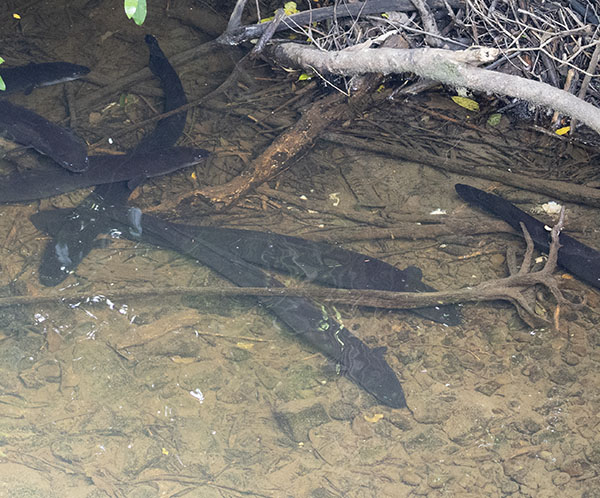
All I can say is yuck! Freshwater eels live in the creeks and streams here and it is just creepy. Look at the size of those things. I took this picture in a nature reserve. A big item on many tourist activities is to see the daily eel feeding. Yuck again! I have never seen a feeding and I am pretty sure I don’t want to see it.
If you wade in certain streams, there is a good chance they will swarm around your ankles. Just damn creepy. Eels were a favorite food of the Maori back in the day but I am not sure that is still true. Maori refer to eels as “tuna,” which is very confusing. But I certainly have never seen eel on any menu or for sale in the grocery stores. I have eaten smoked eel at the sushi bar but I try not to think about it.
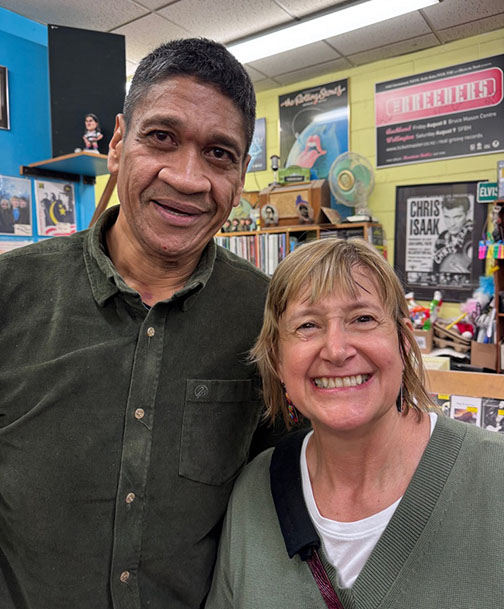
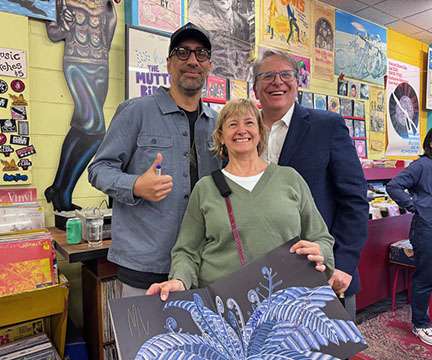
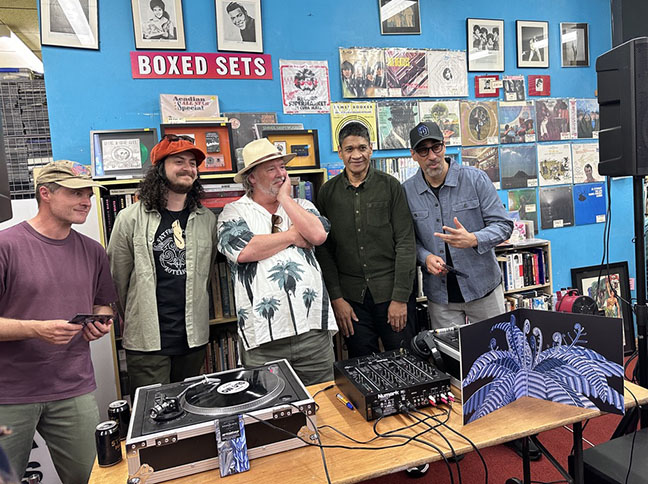
My favorite band had an in-store drop the needle event for the release of their new record—Slo Mo. Well, we were in heaven. Matt got there first and was talking to the band members who were there. So jealous. He was b.s.ing with the trombone player. By the time I got there, practically running to the store, I had worked up quite a sweat and the store was packed with people and stifling. So I was dripping. Never mind. I got to tell MC Mu that I absolutely adore him. Mu is the beats wizard, computer and sound boards churning out the rhythm. I felt like a teenager talking to her idol. Look at that grin. I don’t think I could have smiled any harder. We also gave some hero worship to the singer, Dallas Tamaira, aka Joe Dukie. He sounds like Bill Withers. Mellow and soothing. Now we have some concerts coming up. We are Fred Heads! Love them!!!
Yes, I said “toilet.” Americans are very delicate when it comes to referring to the facilities. We have ladies’ and men’s rooms, we have restrooms, we have bathrooms. In some places we have the “powder room.” We do not have “toilets.” But in New Zealand, they most assuredly have “toilets.” That is what the directional sign says and that is what they call it.
At first, I found it jarring to my delicate ears. Here is how it goes:
Me: “Can you tell me where the restroom is?”
Them: “Yes, the toilet is over there.”
Maybe this is my prudish side coming out but that sentence just bothers me. “Toilet” seems like such a strident word when spoken in a sentence. I was raised to say the much more indirect and genteel term, “restroom.” “Restroom” only vaguely suggests what might be going on in there. I’m resting. Leave me alone. But “toilet “expresses it loudly and clearly. And honestly, I just do not want to know what goes on in there other than resting, and I don’t want others to know what I might be doing in there besides resting.
Once you get over the word, there is a silver lining. New Zealand has the best and most available public toilets we have ever encountered. In the U.S., finding a public toilet is pretty much impossible. Usually, you have to find a fast food restaurant or some other business or building that has restrooms open to the public. And the maintenance can often be lacking.
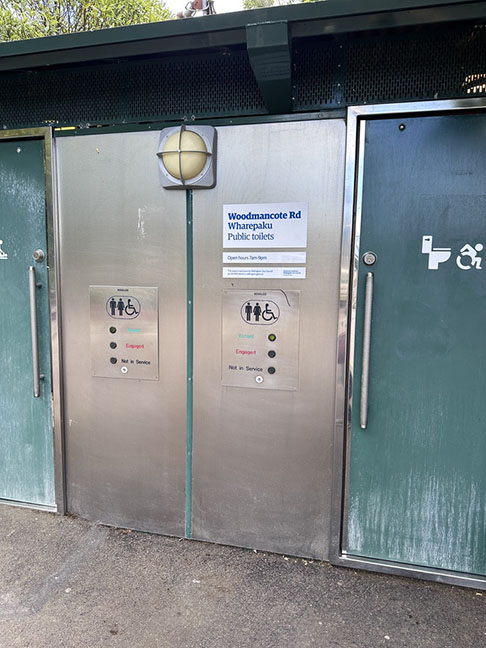
Here in New Zealand, every town or neighborhood seems to have a clean and bright public toilet. They are usually small buildings. Some are much like the facilities that you might find at any public park. But others are much newer with fancy chrome facades and doors which are opened with the push of a button. The door opens to a spacious room, with a toilet, sink, baby changing table, and a hand dryer. With the click of another button the door locks electronically and, in many of them, music begins to play and the fan kicks in. You then have ten minutes. The door will unlock after that time. No matter the style, the restrooms are always clean and stocked. The room has a tile floor and walls to prevent graffiti. You can tell someone cares.
So yes, they may use the cruder word, but the experience is anything but that. Hooray for New Zealand toilets!
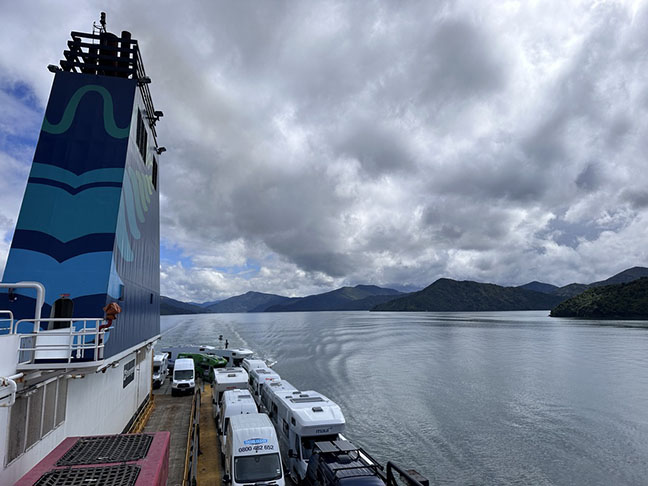
Kaikoura, located on the east coast of the South Island, is home to whale watching and bird encounters, both favorite past times. So off we went for a long weekend. To get to the South Island we have two options: take a plane or take the ferry. The ferry across Cook Strait is the best and most interesting option if you are headed to the northern part of the South Island. Drive your car on, have a seat, and watch the ocean go by for a few hours. Nearing the port of Picton, the ferry makes its way through tree covered islands, where a few houses sit and birds fly.
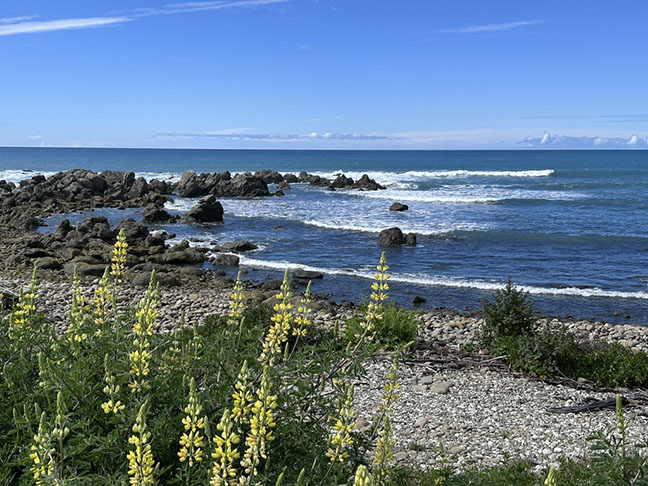
From Picton, the drive south to Kaikoura is another two hours along a picturesque, rugged coastline with crashing waves and bird colonies along the shore.
Kaikoura has an abundance of marine life supported by the cold nutrient rich water that rises up from the nearby deepwater Kaikoura Canyon. This water supports a large variety of fish, marine mammals, and seabirds. It makes Kaikoura a whale watchers paradise with a year-round pod of sperm whales and visits from humpback and blue whales in the right season. We have never seen sperm whales so that seemed like something to check off our unwritten list of things to do. They also had dolphin and albatross encounter tours. I am all about albatross, large, beautiful, and fascinating birds. We signed up for all of the tours and could not wait to get started.
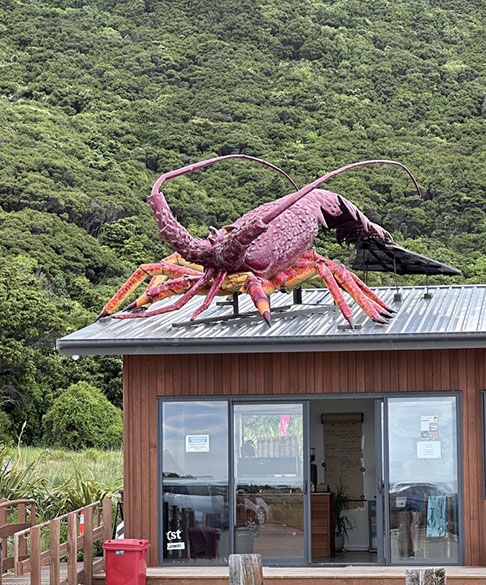
Lobster shack
But first we had to stop along the highway to eat crayfish. This is not your tiny Louisiana freshwater crawfish, but a type of lobster without the large claws. I could not find the reasoning behind it, but here in New Zealand, the lobsters are called crayfish. To avoid confusion, they are called rock lobster in the international seafood market. These crayfish are not only misnamed, they are wildly expensive. So we split a large one. No surprise that it tasted like a lobster. Having our fill of the large crustacean, we drove on.
In 2016, Kaikoura was the site of a major earthquake, 7.8 on the Richter scale. It involved movement along multiple fault lines and was felt all the way to the North Island. It was so dramatic that the town rose three feet and the adjacent seabed rose six feet, the uplift heaving fish and marine life above the water line. The town, sliding along the fault line, was moved three feet north. A major tsunami later flooded the coast, killing more marine and freshwater life along the coast. If you want to read more about the Kaikoura earthquake, go here.
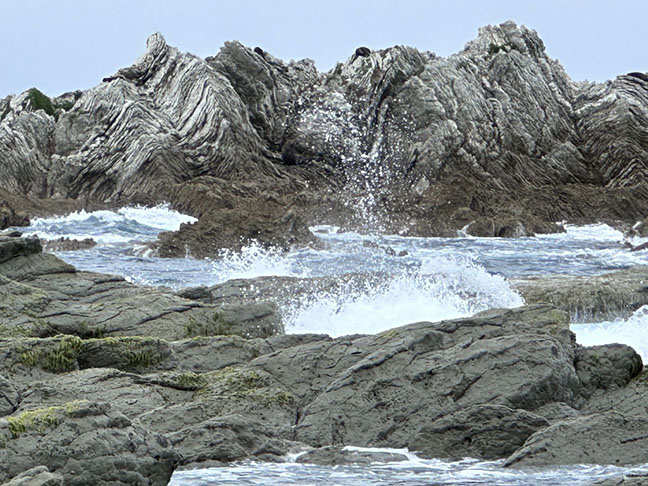
Rock upheaval
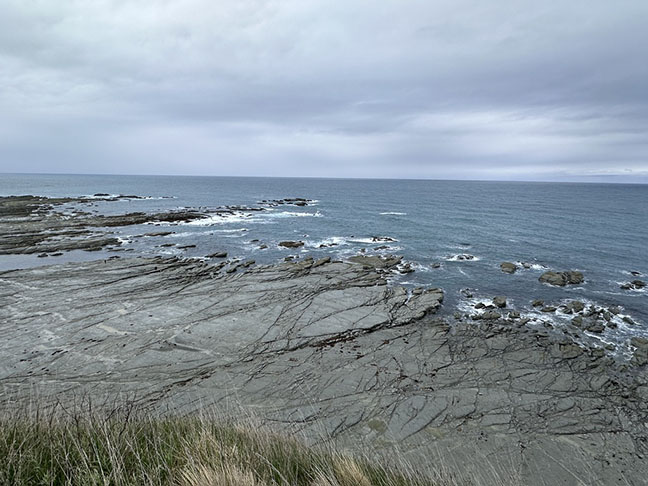
Only eight years later, the town seemed perfectly normal. The only apparent and visible aftermath was along the coast where seabed was clearly above the water surface and large boulders were thrust out of the earth.
While the earthquake would not disturb our trip, the weather had something else in mind. Once again, just like Fiji, we were thwarted by strong winds and rain. The winds were strong enough to force the cancellation of the tours we had signed up for—a dolphin encounter and albatross frolicking. The day was shot. We did not have any days to spare, and we had whale watching scheduled for the next day. But we worked the phones and figured out how to do at least one of the tours. We were in for the albatross if we were willing to go out at 6 a.m. Yikes! But hey, it involved a rare opportunity to see an endangered albatross and I love those beauties. We would have to swim with the dolphins another time.
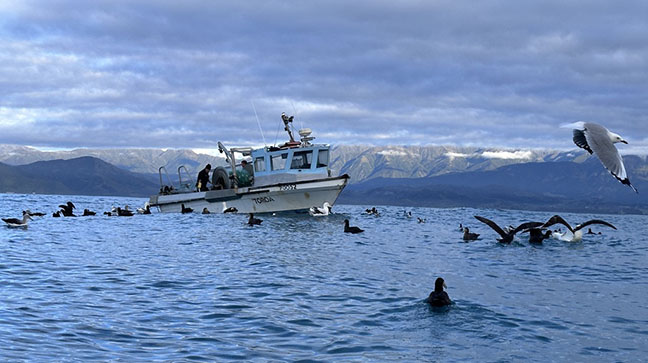
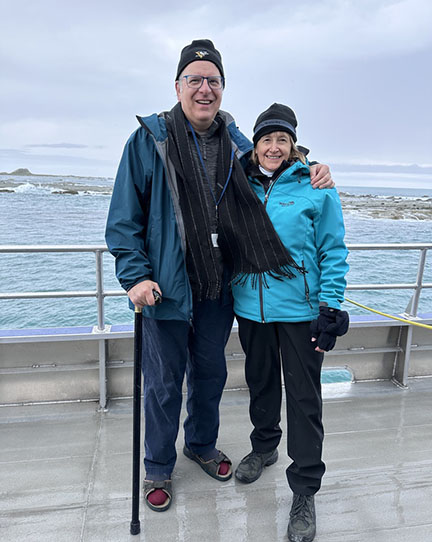
It was mighty cold at 6 a.m. so we dressed for winter. It was us and the boat captain. He was very knowledgeable and took us straight to the birds, which was easy since they follow fishing boats.
He tied a bag of fish to the back of our boat to lure them over. Yes, yes, that does not seem right. We should be watching birds in their natural state and not luring them with food. But the reality is that they were already following the fishing boat for the chance to grab some fish trash. Our boat was not teaching them anything different. It is called survival and adaptation.
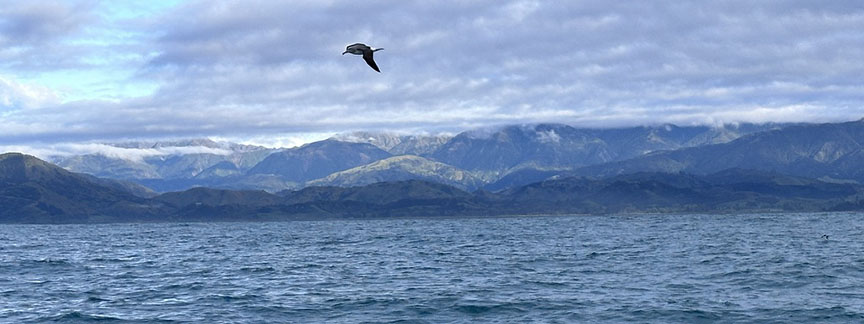
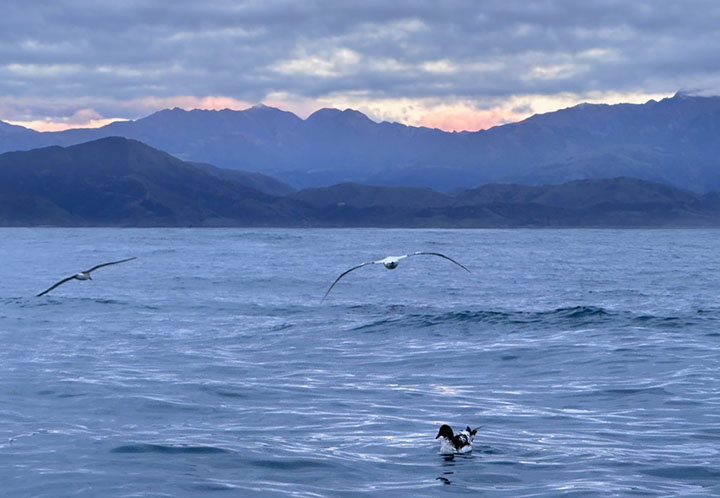
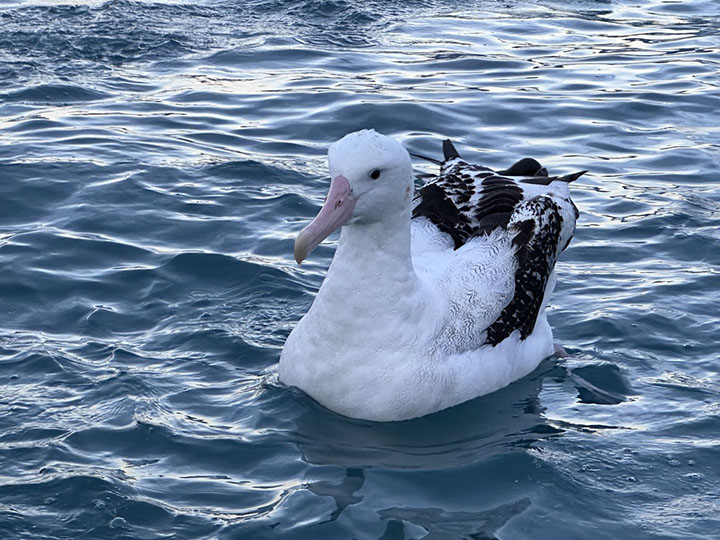
And here they come. Wandering albatross are large, gorgeous birds that dominate the sky when they fly. Their wingspan average about 12 feet. When they come in for a landing, they make an entrance. The other birds scatter.
Royal wandering albatross
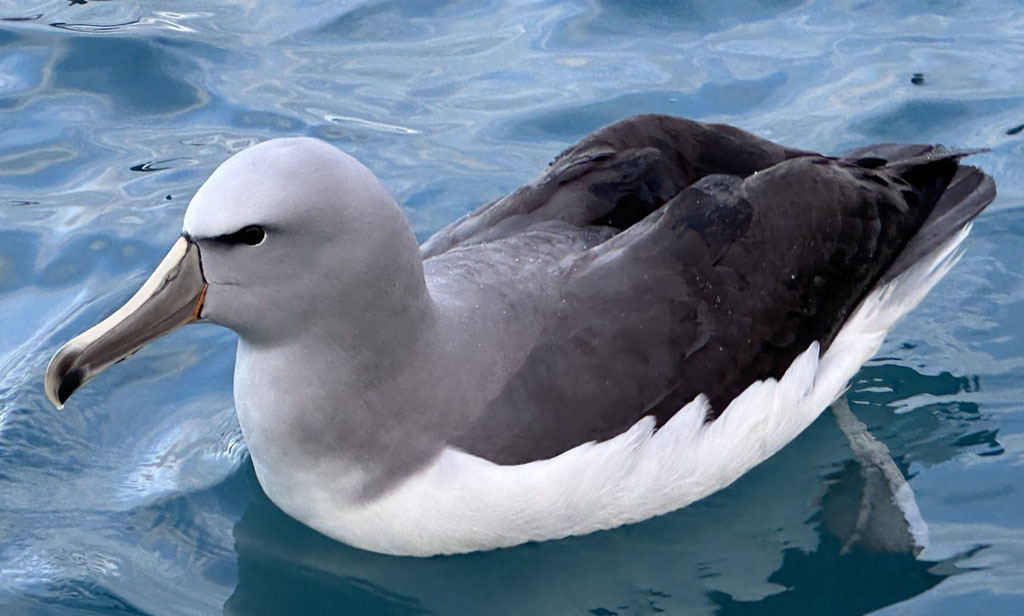
Among our visitors were royal albatross and the rare Salvin’s albatross or mollymawk. These birds are endemic to New Zealand and critically endangered. Smaller than the great albatross, they have a distinct grey head. Really quite beautiful.
Salvin’s albatross – rare
We also saw the endangered Hutton’s Shearwater, the only seabird to breed and nest in mountains happened to keep house in the mountains surrounding Kaikoura.
Then to our delight, the dusky dolphins showed up and gave us a short show:
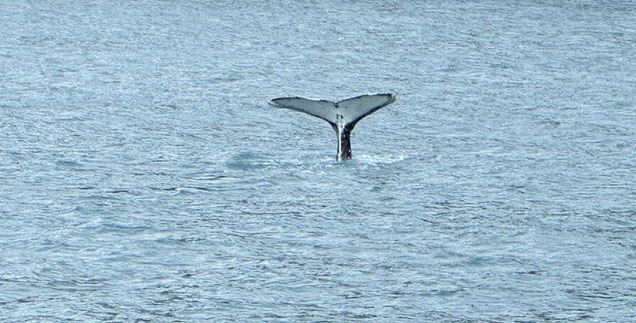
This was a well spent morning. Now we had to move on because we had whales to watch. We have been whale watching many times. Usually that involves humpback whales. We were hoping for sperm whales. No such luck. The weather was keeping us from going out to further toward the canyon. We had to settle for one lone humpback who did one roll and that was it. It was very disappointing.
Well, our time was up and we had to depart for the ferry back to the North Island. We will have to return to see the sperm whales and swim with the dolphins.
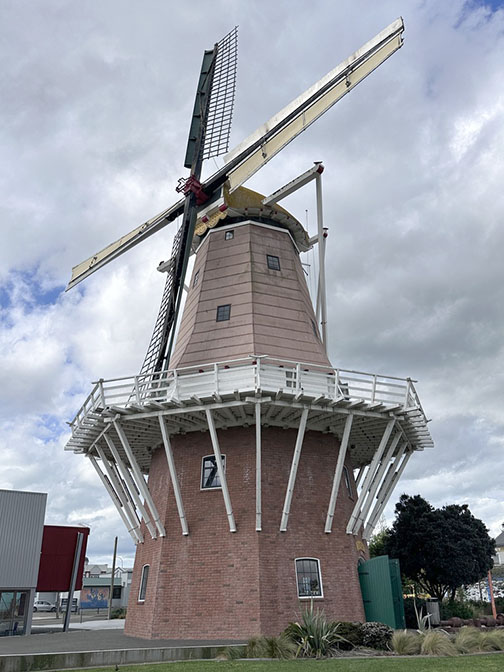
In New Zealand, there are few high speed, multi-lane highways. The two-lane highways go through towns. Foxton is a town about an hour north which we often pass through on our way to somewhere else. It is a beach town with large estuary and a very good bird watching site.
There is also a large windmill. We always promise ourselves we will stop for a tour but alas, they are usually closed when we drive by. It was a cloudy day, but it was not raining so we decided to drive to Foxton to take a look at the estuary. Lo and behold, the windmill was open when we arrived.
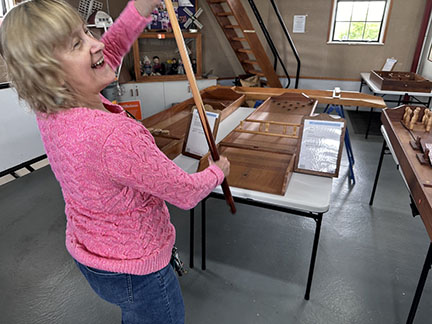
Inside was a Dutch wonderland. The first floor was the gift shop and, of course, I bought delft plates and windmill cookies. On the next floor was an array of old-time games, called Castle Games or Kasteel Spelen, provided by the local Dutch Club. Games with names like bowling billiards and shuffle billiards, each included elements of pool and shuffleboard. They were a lot harder to play then they looked. I immediately vowed I wanted to take one home.
Billiard cue and ball to knock down bowling pins.
Fifty points for me!
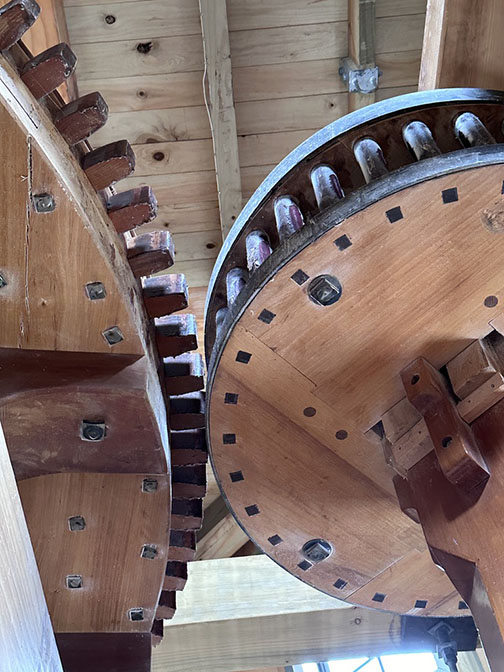
Then we went to the next floor where we discovered the most exciting part of the windmill. It is an actual working grain mill with wheels and gears and sifters. What fun! We bought buckwheat flour and corn meal (impossible to find in New Zealand).
So why is there a working windmill in Foxton? It seems that there is a long history of migration from the Netherlands to New Zealand and they have formed societies to keep up their traditions. There are numerous Netherlands Societies scattered across the country. There is even a Dutch Week, which we missed in 2024, but we are so taking part next year.
We vowed we would be back to visit and maybe play some more Kasteel Spelen.
Big name bands, and even many small name bands, do not play New Zealand and if anyone bothers, they go to Auckland and leave. (The exception to this rule is the Foo Fighters who love it here and even play the South Island.)
What we are left with is tribute bands. The Elton v. Billy Tribute Show? The Prince Tribute show? The Bee Gees Night Fever Tribute Band? Yes, yes, and yes. Matt wanted to see the ABBA approved tribute band, Bjorn Again. For you non-ABBA fans, ABBA stands for the first names of the band members, Benny, Bjorn, Agnetha and Anni-Frid. Hence, the play on the name Bjorn. Matt is a huge ABBA fan. When we went to Stockholm, he insisted we visit the ABBA Museum. Yes, there is indeed a museum dedicated to ABBA and I have to admit, it was a blast.
I am not a big ABBA fan. I like some of their songs, but I did not particularly care for them when they were popular, mostly because they were impossible to escape. How many times did they play “Fernando” on the radio? It felt like every five minutes. Same with “Dancing Queen.” Every song rotation it had to include an ABBA song. I just wanted them to go away.
But fast forward and here is my husband the ABBA fan. So I agreed we could go and see Bjorn Again. For me as an average human being, it was an okay experience. But there was just something weird about watching these people pretend to be ABBA. The weirdness came from the idea that this was not a cover band. This was full out reenactment and some people in the audience were weirdly enthralled. In the photo above are two young girls partially obscuring the picture. They were dressed in ABBA style and singing along with abandon. I have no problem with singing with abandon but they were acting as if Taylor Swift was standing in front of them.
I reasoned to myself that re-enactors play people all the time. If Hal Holbrooke can play Mark Twain in a one man show for decades (which I saw), and if I can enjoy actors who interpret Washington, Jefferson and Lincoln, well, then why not a band?
I have to admit I am still not convinced. But living in New Zealand with limited options for entertainment, I guess I better get used to tribute bands.
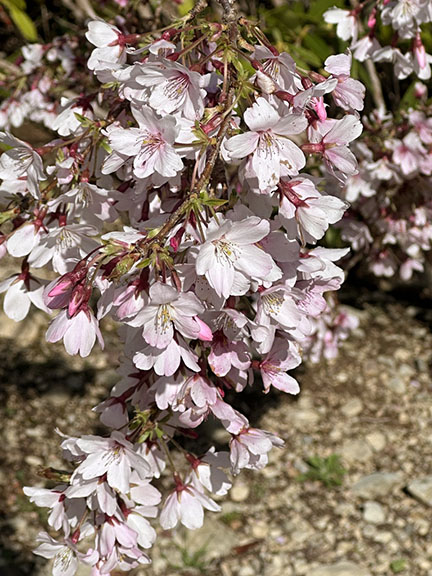
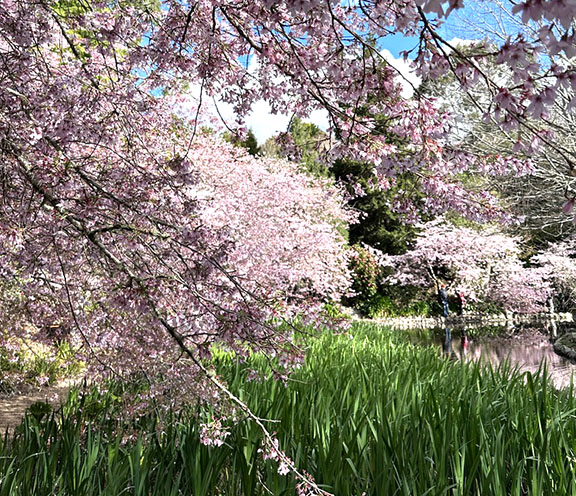
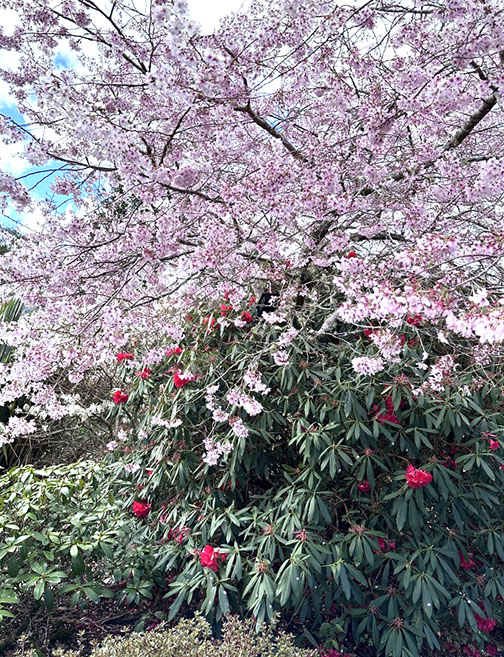
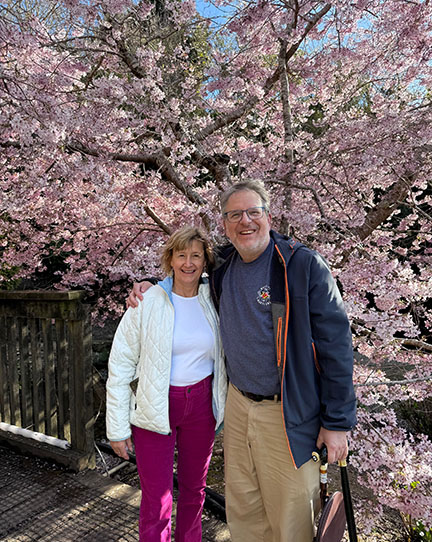
Everyone loves cherry blossoms and New Zealanders are no different. They have been in bloom everywhere. A couple here in Wellington travelled to Japan and fell in love with cherry blossoms. They decided to create their own blossoms paradise. We went off to their farm, which they had landscaped and into lovely garden. It was just like we were in D.C. again–too many people talking, too many kids running amok, and too many people climbing trees and stomping on roots when they shouldn’t, all while others were trying to enjoy trees that call for quiet meditation. It just proves that people are obnoxious no matter where in the world you are. Well, we didn’t let that spoil our forest bathing. Here are some pics:
They had a small pond with reeds.
Blossoms with Rhododendrons. So pretty.
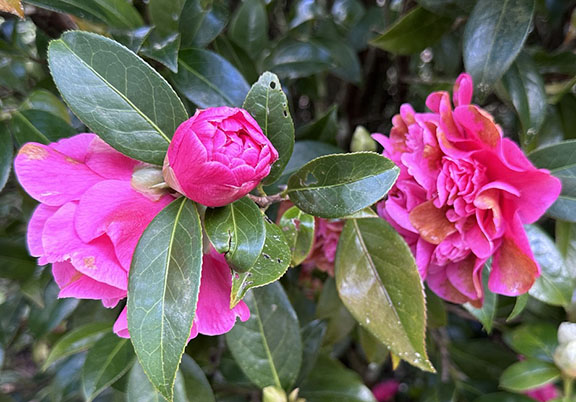
It is camelia time here too. You can see camellias growing in gardens all over the Wellington Kapiti Coast area.
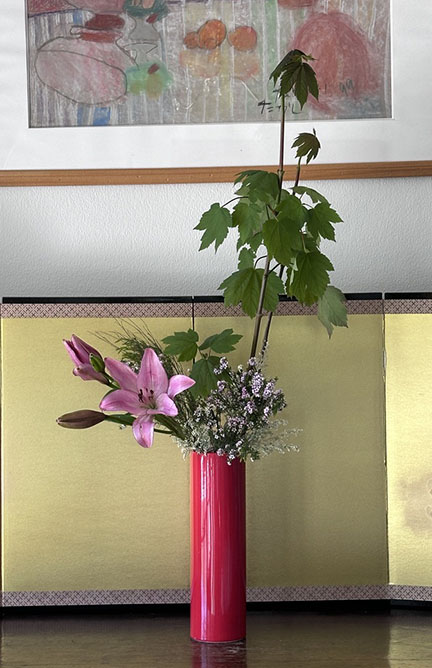
I have always wanted to learn ikebana, the art of Japanese flower arranging. There are many types of Ikebana. In Wellington, the Ikebana Society is of the Sogetsu style, which is considered a bit more bold and inventive. I signed up to learn with a Japanese teacher and we are having a lot of fun. She keeps asking me if I have ever had lessons because it seems like I know what I am doing. What I tell her is that I was born to arrange flowers. I started an Instagram page to share my progress. https://www.instagram.com/mk.schmidt/
Although it is generally temperate, winter here can be pretty cold and gloomy. There is no snow in our region but we are blessed with lots of clouds, rain and icy, brisk (often gale force) winds from the south, and by south I mean Antarctica. The gloomy, cold weather pushes most people to head for warmer climes come July and August.
We are not far from some tropical islands in the South Pacific, although, truth be told, New Zealand is not really close to anywhere. Our preference is French Polynesia with their over the water bungalows and good snorkeling. What is not to like? But those islands are quite a ways away, so we looked around and decided we would give Fiji a try. It is close by and we have never been.
I did a little research and concluded we should try one of the secondary islands just for a different experience. I found a resort that had partnered with Jean Michael Cousteau, (Jacque Cousteau’s son), to create a sustainable eco-resort. Located on the island of Savusavu, the second largest island in the Fijian chain, it is operated in cooperation with the local tribe, many of whom work at the resort. There were numerous activities offered for free and most importantly, it was located near some of the best coral reefs in the South Pacific including the Namena Marine Reserve. We were all in for this. A half day away, and a place we had never been, we packed up the flippers and snorkel masks and boarded a plane.
Unfortunately, the weather for the week was much like we had left behind–windy, rainy, cloudy. The only difference was that Fiji was warm. But with the strong winds, there was little opportunity to head out beyond the reef surrounding the island. Visiting the marine reserve or any of the other coral reef spots is entirely weather dependent and it was simply too rough to be out on a boat let alone snorkeling. The one day we did try to snorkel from a boat the water was so rough, I nearly lost my fins. We decided it was better all the way around to stay near the shore and snorkel the resort’s growing coral garden. It had some remarkably varied fish and we did not have to worry about being pulled away by strong currents.
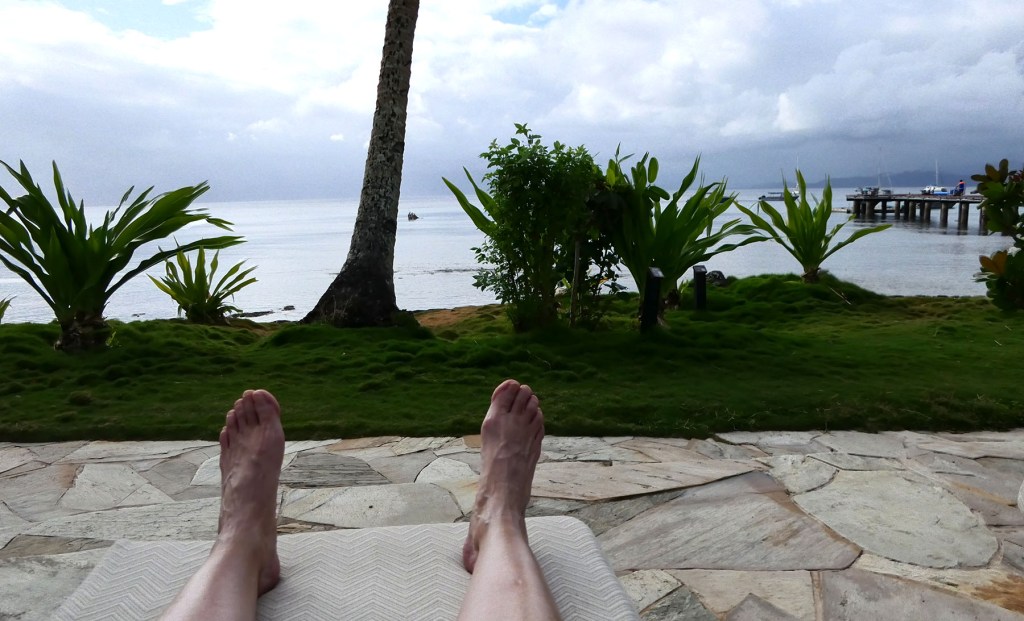
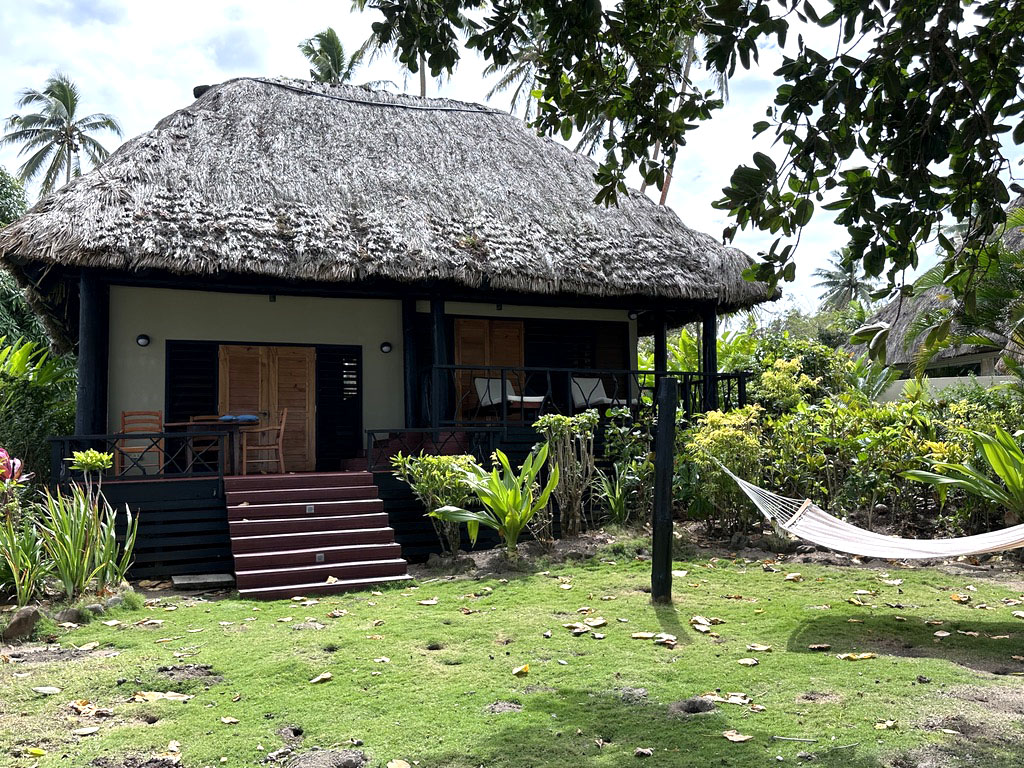
The resort guest rooms were bures or bungalows. When we arrived, we learned they had upgraded us to a bure on Breezy Point. This name had real meaning. While we had a good view, the strong winds kept us off the front porch.
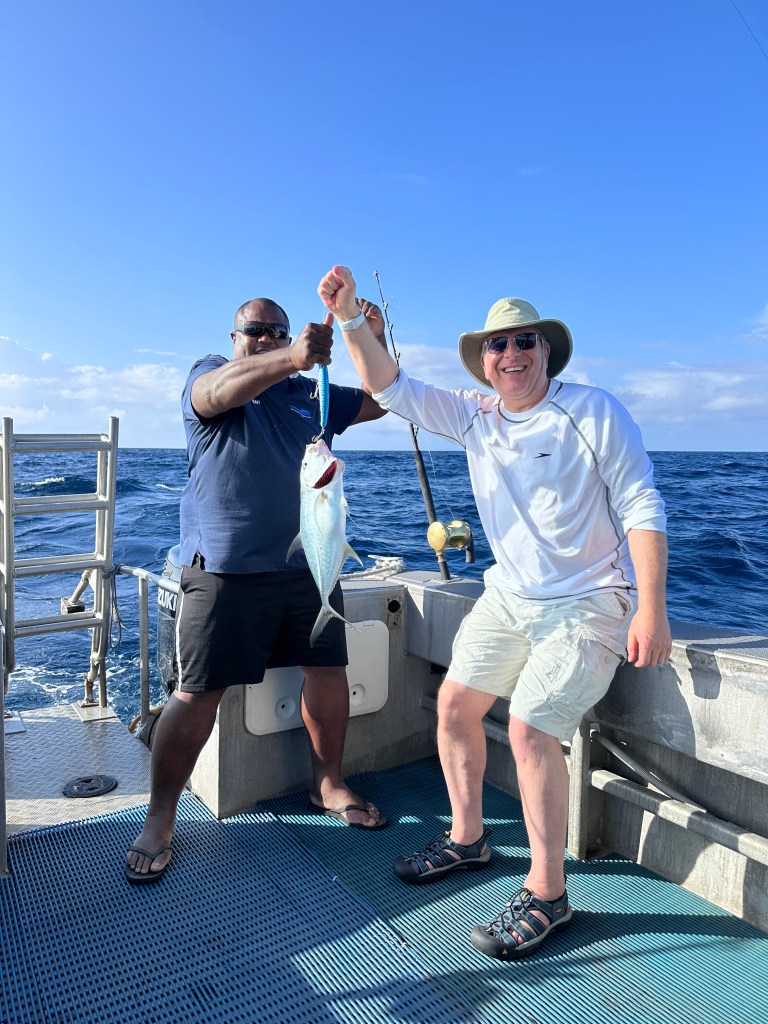
We did luck out with a fishing trip. The morning was forecast to be clear until noon when the rain showers would move in. We sped out, dropped our lines, and hoped for a catch. I got lucky and caught a yellow fin tuna, about eight pounds. Matt caught a trevally and we lost a mahi mahi as we were bringing it onto the boat. So we had a good day.
Matt with trevallyMarsha and yellow tail tuna
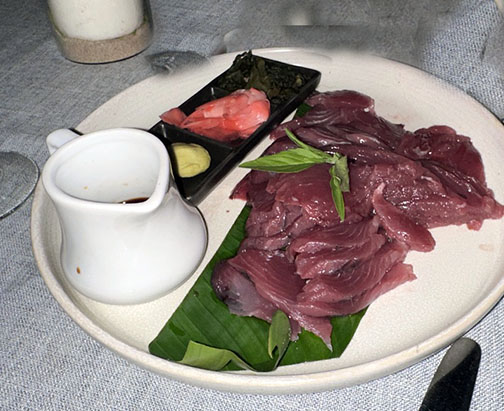
We left the trevally with the boat captain and took the tuna to the chef who agreed to prepare it for us. That is as fresh as fish can get. We got two dinners out of it, appetizers and dinner—sashimi and grilled tuna one night and ceviche and curry the next night. It was delicious. (There was no option to freeze the fish and ship it home. They had never heard of such a thing.)
Fresh tuna sashimi. Yep, that is raw tuna. And we ate it all.
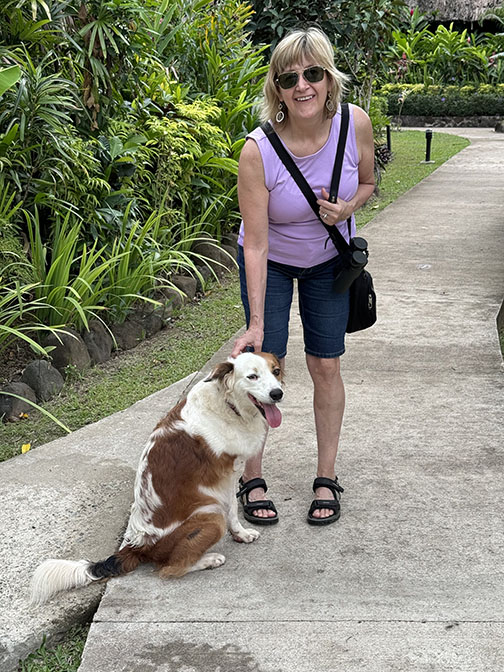
With the rain, we were left to find things to do. To bide our time, we did a lot of reading and bird watching. I made friends with a three legged dog. I named him Lucky. He was missing his right front leg but he hopped along pretty well. He followed me around the resort and stayed on our porch while we were there.
The resort did what it could to keep us engaged because there was not much to do on the island separate from the resort. The local town seemed pretty down and out, certainly not a tourist town. There were few shops or restaurants or businesses offering vacation activities. The only option seemed to be to take what the resort offered.
One excursion took us for a visit to the local tribal village. Here is how ignorant I am about Fiji. I had no idea they still had tribes. Well, they do. This village was governed by a hereditary chief. We were told that the national and local governments have to get his permission if they want to do any kind of development or construction in the Tribe’s territory. I know a few tribes in the U.S> who wish for the same thing.
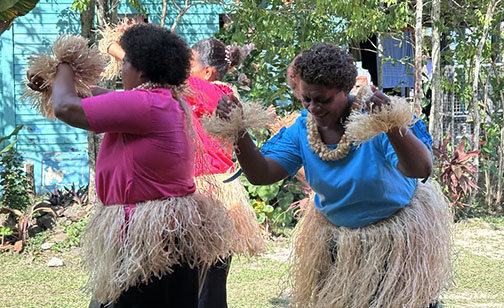
Here is the chief leading a welcome song, a cappella singing by the villagers was hard not to love.
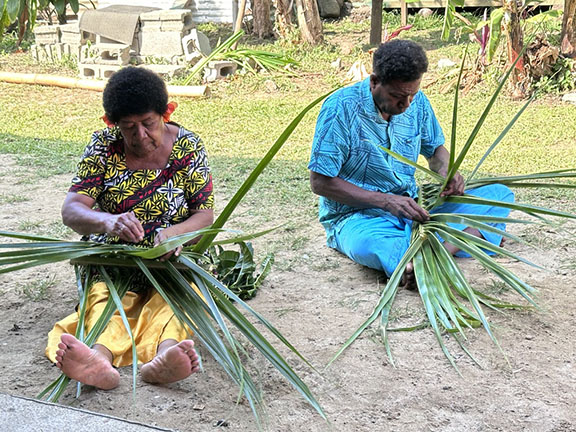
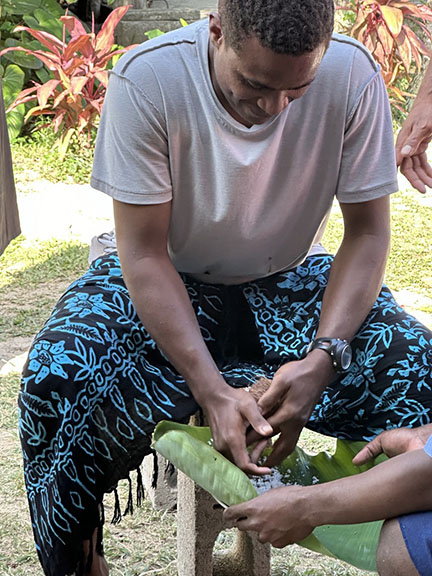
On our visit to the village, we learned about traditional Fijian crafts, dance and songs.
These ladies were having a great time.
He is making a male basket, she is making one used by the ladies. I was not clear why they had to be different.
Here they are showing us how to get the coconut meat out of the coconut using a sharpened bamboo pole. The coconut bowl is scrapped in a circular motion. I tried this at the resort and it was harder than it looked.
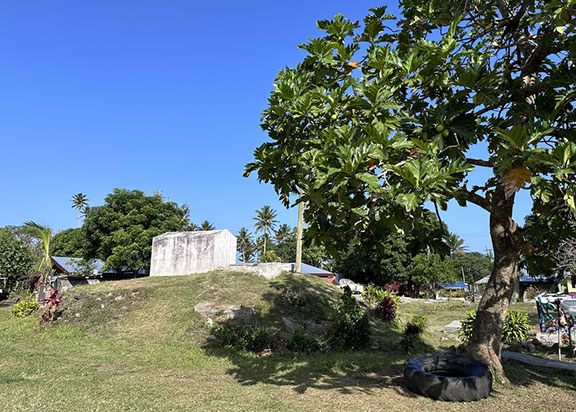
They took us for a walk around the village. Here is the cemetery and the hereditary chiefs’ burial crypt.
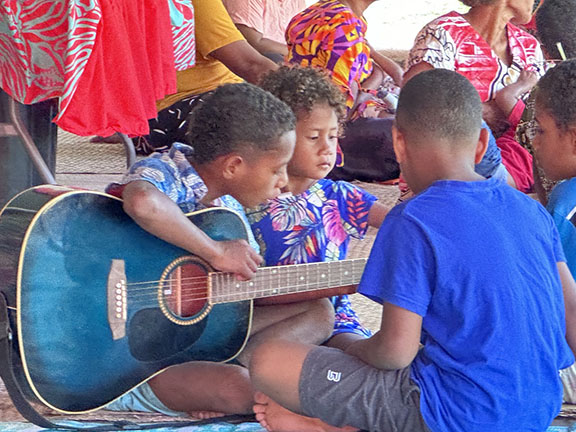
The guitar is bigger than him! I am thinking he is a future chief.
Back at the resort, the tourist entertainment factor was very high. I usually frown on this kind of stuff as exploitative, but when you have no other choice, you kind of go along with it. They seemed to be having fun showing us their culture.
Every night at dinner, they had a ceremony with one person playing a giant wooden drum (a hollowed-out tree trunk) while another person dressed as a traditional Fijian and lighted the tiki torches in a dramatic flame twirling dance.
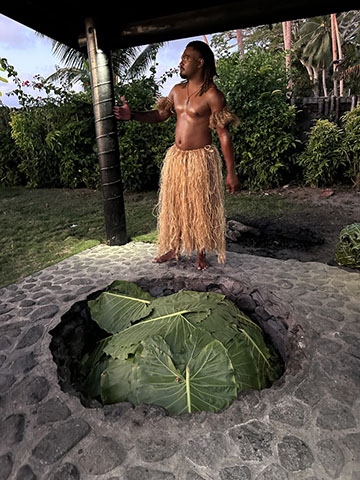
On another night the resort prepared a Fijian Barbecue in an underground oven called “lovo.”
the lovo
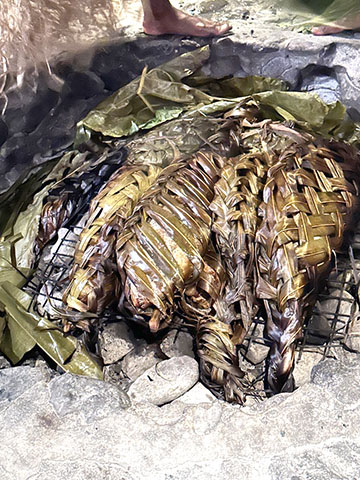
Similar to the Hawaiian imu used to make a feast for a barbecue, the food was cooked in a pit covered with hot coals and palm fronds and left to cook for hours. The result was tasty meat and root vegetables.
meat and chickens wrapped in palm leaves emerge from the oven
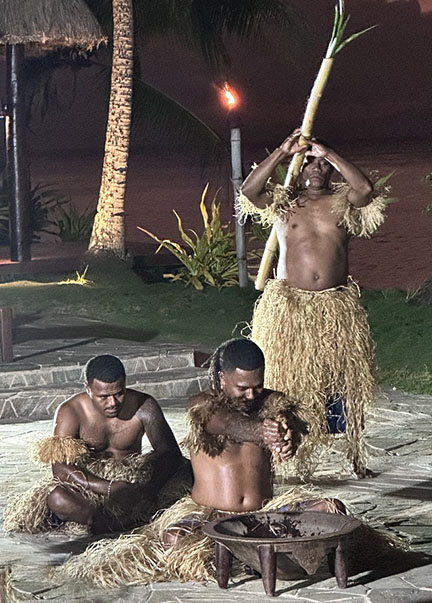
Then there was the kava ceremony. Usually, a tribal chief prepares kava for visitors to his village. Kava is an herbal plant used to make a drink that is claimed to be a calming and relaxing. It is very popular in the South Pacific and with herbalists worldwide. In the U.S., the advice is to drink it with caution because consuming too much can cause liver damage. In some states, it is a controlled substance.
The drink is prepared in an elaborate ritual that includes the offering of kava root to the chief and the chief using a round bowl known as a tanoa to prepare the drink. The local chief had given permission to the resort to depict the ritual. The kava root is soaked in water and then, after steeping, it is squeezed dry into the tanoa and cups are filled.
squeezing the kava root over the tanoa
The ceremony requires the visitor to clap once to announce an interest in sharing the drink. After drinking the kava, the visitor claps three times to say thank you (at least that is how I understood it). While we did not get to participate in the formal ceremony, we still had options to try it. Every night, the local musicians, who entertained while we dined, also prepared kava that you could try. The drink tasted like ground soil and root. It numbed my tongue. I felt a small sense of calm but nothing terribly dramatic. But the musicians, who had been drinking it all night, looked pretty stoned. I brought some home to try.
On our last night, they had a hermit crab race to raise money fora local charity. We were all in, betting good money on the crabs we had selected to win the race. We were the only adults participating. It made me wonder if parents avoid activities that they think are for their kids. It was weird. Well, we had fun even though my crab lost.
That was about it. The weather prevented us from venturing to some of the best coral reefs in the area so we made do.
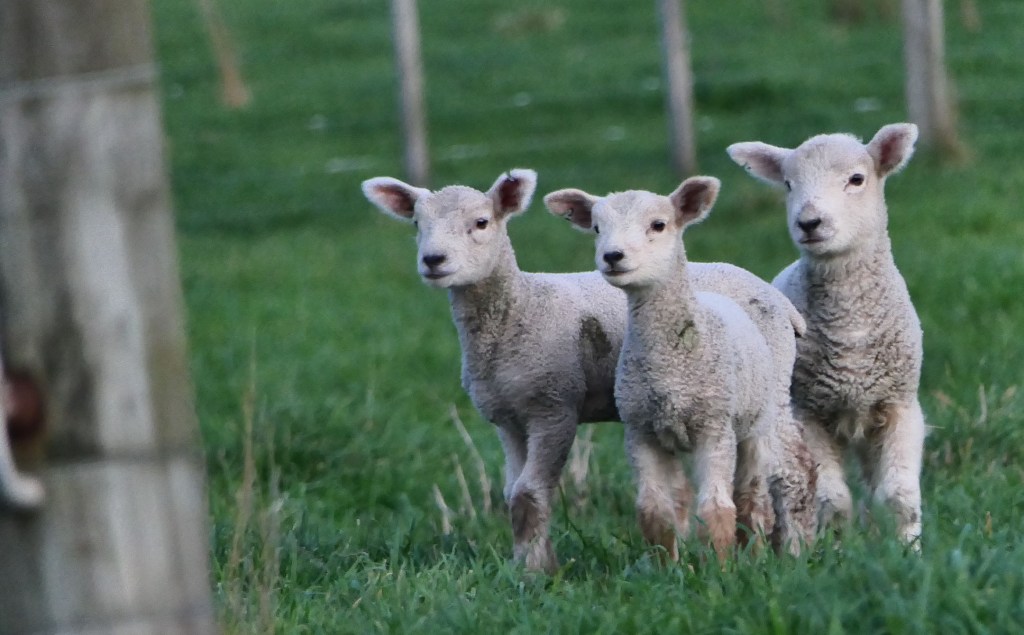
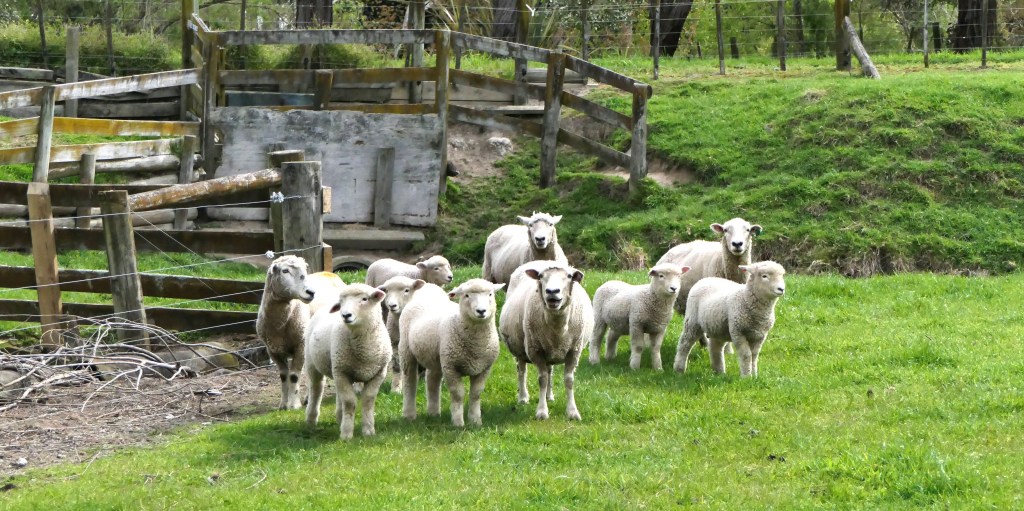
I have been trying to collect lamb pictures in the hopes that I can create some interesting cards to sell to tourists. It is lambing season so there are tiny lambs bounding around the pastures. They are just adorable. See?
Babies taking a rest from bounding and playing.
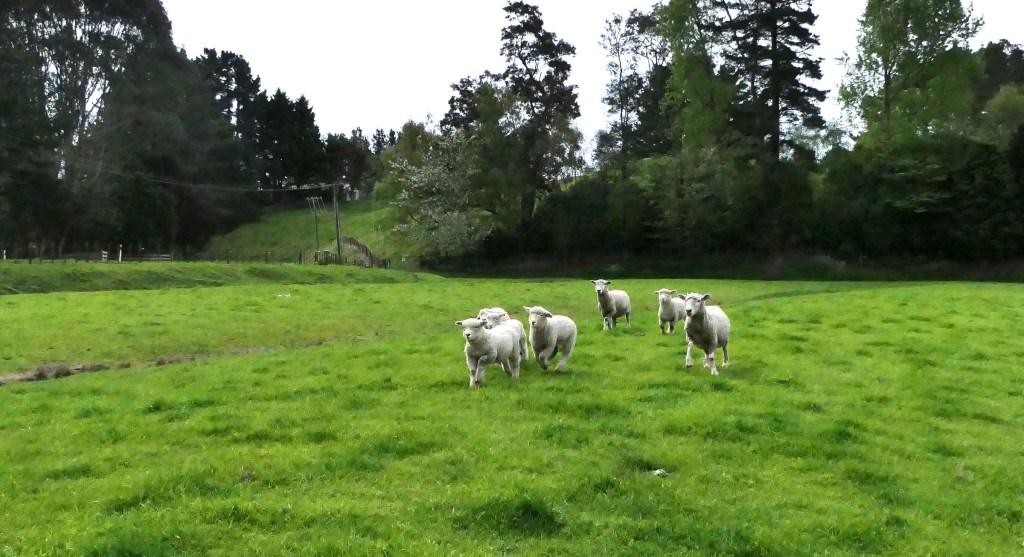
In a stroke of luck, as I was taking pictures from the side of the road, the family at a farm nearby saw me and suggested I go into their sheep pasture to take some photos up close and personal. Their daughter Olive led me into the pasture. She had a feed bucket and when she shook it, they came running.
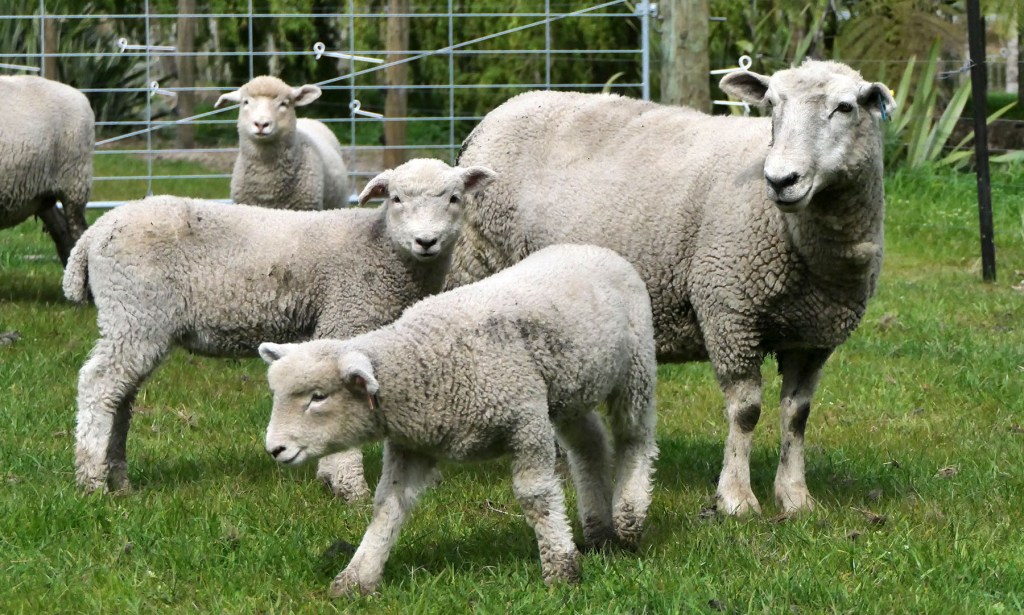
We had some poses and I petted some heads.
They were on the alert the entire time for more feed from the bucket.
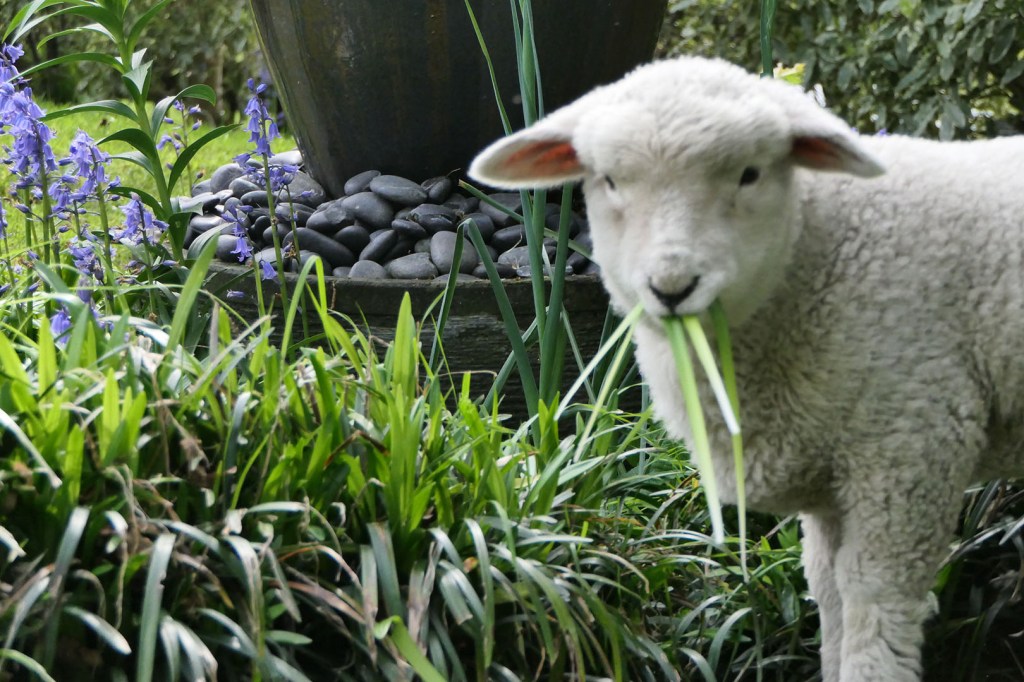
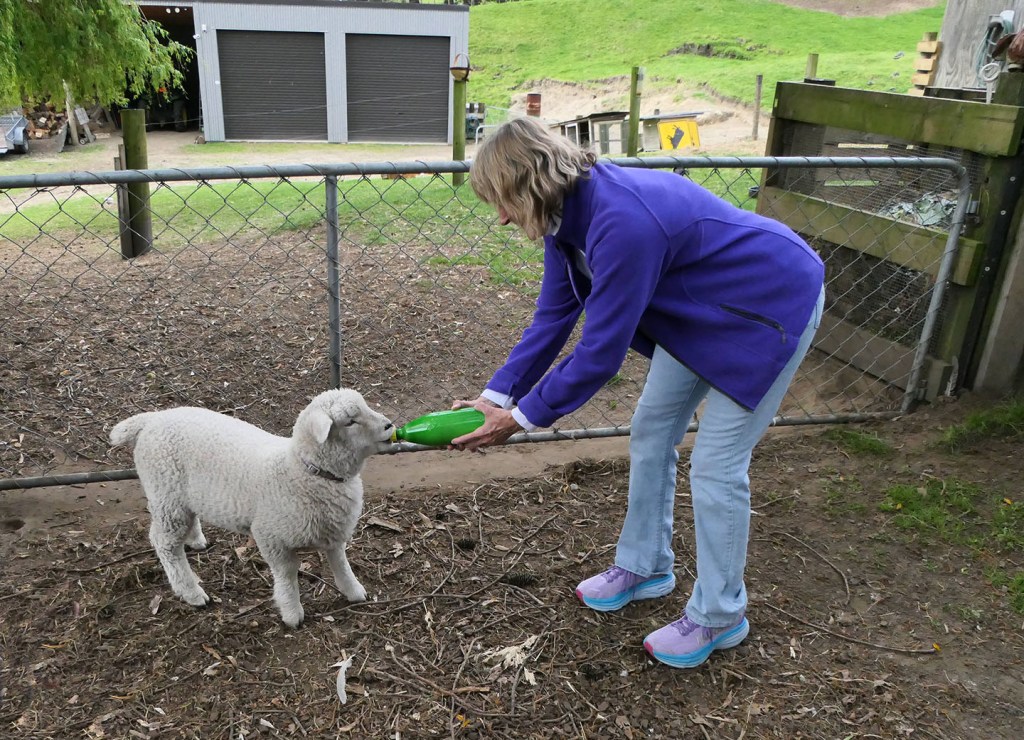
While I was there, they offered to let me feed a bottle to a little lamb the daughter was raising. This lamb liked to snack on flowers.
just adorable
He also liked the bottle. The daughter gave me some pointers on how to hold it.
How lucky am I? I live in sheep country and I love seeing sheep grazing in the green fields. It is so calming and it makes me smile. I never tire of it.
Look, I am a foodie. I think about food–preparing it and savoring it–all the time. I can’t help myself. I think of it as part of my creative repertoire and part of my curiosity. I love to try food from anywhere. Food has my attention. So, bear with me as I go on about food.
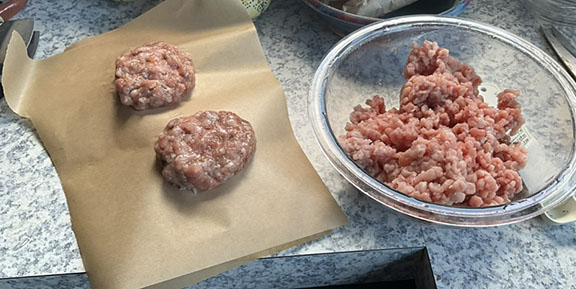
Sausage. Early on I posted a complaint about the terrible sausage they have in this country, which is ironic since it is one of their main food staples. They love their sausages. My issue is that they all have the consistency of hot dogs and lack vibrant seasoning.
Many of you suggested I just make my own sausage. Well, I heeded your advice, bought a meat grinder, and have been trying to work out Italian and breakfast sausage. I have the flavor down for sure. But I had a difficult time locating pork shoulder. I found legs (basically ham), loins, roasts, none with the right amount of fat. I think I finally located the right cut, and I will report back. The process is ongoing.
Biscuits and Pie Crust. I think I have discovered the two foods that they are missing here that truly makes me sad for them—buttermilk biscuits and flaky pie crusts. They have “biscuits” which are cookies. And they have scones, which are dense biscuits. But they do not have good old fashionedbuttermilk biscuits. They don’t even know what they are! We take them for granted in the U.S., but we sure do feel their absence here. My oven is entirely untrustworthy but I have been baking them from scratch because when I realize the absence of biscuits, I just want them even more. I think that the next time we are invited to a potluck, which they call “bring a plate,” I am going to bring biscuits and open some eyes.
As for pie crusts, mamma mia! How much time do we spend in the U.S. arguing about pie crust. Here there does not seem to be an argument. They eat a lot of pies. Pies are served for breakfast, lunch, and dinner. But their flaky crusts are made from puff pastry or a short bread which is kind of like pie crust but not. So far as I can tell, and I have not visited every bakery in the country, a flaky pie crust with layers of butter and flour that we savor as we fill them with cherries or pecans or apples, does not exist here. So sad.
Cereal. Good Lord, they need help on this one. There was actually an article in the paper about an American kid doing tik toks on NZ cereal and how awful it is. Kid, you are so right. Why are they awful? Well, let’s start with the comparison to cardboard. Just chewing and chewing a flavorless mess of nuts, oats and a lot of unidentifiable crumbs. The real crime is that they have “Cheerios” here. From what I understand, Cheerios licensed their manufacture to a company here in NZ. I think General Mills may have omitted a key ingredient. Otherwise, how can you get Cheerios wrong? How is that possible? I don’t know. But somehow they have managed to produce little tasteless Os. We finally stopped trying to like the cereal here and started to import all of our cereal.
Okay. Okay. We get it. You don’t like Kiwi food. But there has to be something they do well, isn’t there? Yes, there are a few things. Most of their dairy products are superb. New Zealand has a huge dairy industry, and they do it right. We live right next to the cows, so I can attest to their diet and treatment. Here are our neighbors. Look at her checking me out. She never stopped watching me.
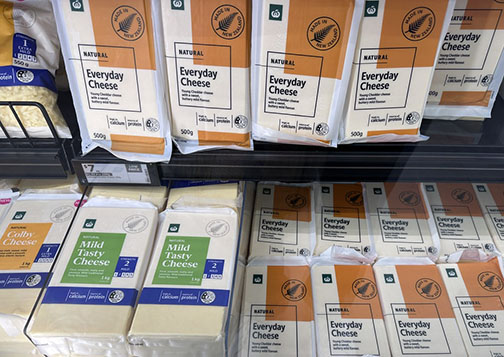
The milk is delicious, as is ice cream, yogurt, and butter. The cheese is good. My only complaint is that the selection is a bit limited. You are talking a million different versions of cheddar, havarti, and gouda. These are flavored with smoke or chilies or cumin, (an NZ favorite spice), or other spices. Then there is an entire cheese section made up of cheese called “tasty,” which I think is along the lines of American cheese/Velveeta. (I am afraid to try it.) Then there is “everyday cheese.” Oh, my. Call me suspicious. You might find a few other cheeses like mozzarella, blue and feta. But if you are looking for anything even a little out of the ordinary, that will take a trip to a specialty shop, which may or may not have what you want. To this day I have been unable to locate Monterey jack cheese for nachos. I am stuck with cheddar and havarti. Still, the dairy foods here are superb.
In the U.S., Meyer lemons are a thing—prized and available only in winter months. Here, everyone has a Meyer lemon tree in their backyard, including us. That is very convenient and fun. I love having a lemon tree. This means we have Meyer lemons very nearly year-round.
Of course, they know how to produce lamb and venison. These are big exports to the U.S. markets. If you like those meats, this is the place for it. Like the dairy cows, I know how the lamb is raised. I see sheep every day munching away in pastures.
My biggest shout out would be to their potato chips. I am a big fan of chips and they have them mastered with a perfect crunch and flavor. Really just so good.
For years I joked that I was going to move to New Zealand and help the Maori. Well, I moved to New Zealand and I have been helping the Maori. I am not qualified to be an attorney in New Zealand and I certainly don’t want to be. I am fine not working thank you. But somehow, I was sucked into helping with a case for a tribe located in a nearby town.
New Zealand’s founding document is the agreement known as the Treaty of Waitangi. Signed in 1846, the British Crown and the Native inhabitants, the Maori agreed that the Crown was there for good but the Maori would be left alone. To summarize, and this is a very unnuanced statement, this treaty gave the Crown the right to exercise sovereign rule over New Zealand with the proviso that the Maori would continue to have self-government over their own tribes. The problem is that the Maori, without really understanding it, gave away their land title and they gave the Crown the right to govern the country. I say “without understanding” because, as was true of all indigenous communities, the Maori concept of ownership and authority over land and the British understanding of those concepts were two very different things. As happened in any country that purported to engage in sincere treaty agreements, the ensuing settlement of Europeans onto indigenous land resulted in non-native dominance and the native population decimation.
New Zealand has sought to make some amends for the terrible history here and part if it is the Waitangi Tribunal—an entity where Maori tribes or iwi can make claims for lost land, breaches of the Treaty, and other harms caused by settlement and exploitation. The Tribunal then makes a report as to whether the claim is valid. The Tribunal can also be asked to look at remedies which can be recommended to the Crown. In some circumstances, the Tribunal can issue orders but that seems to be a last resort. Their goal is settlement of claims once they have been aired and examined.
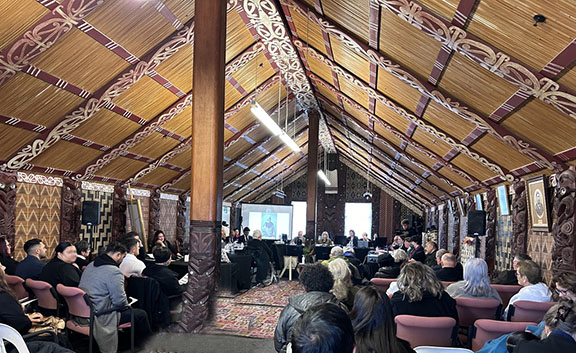
So how did I get involved? I was reading the local paper–they actually still have local newspapers here–and I saw a notice that a Tribunal hearing was going to take place nearby. I decided it might be fun to go and see what goes on. That is one of my traits. I really like to see what goes on. One early morning I set out for the marae, which is the tribe’s meeting house and communal center, to attend the hearing. I stopped to ask if it would be okay for me, not a tribal member and not a Maori, to attend the hearing inside the marae. Everyone said it was fine. I took off my shoes and entered. The marae was crowded with members of the iwi sitting on benches shoulder to shoulder. People were greeting each other with kisses on the cheek between women and the nose greeting or hongi with men. The space was decorated with carvings of Maori gods and painted in a scroll design known askōwhaiwhai.
I squeezed onto a bench in the back and watched the show. There were legal representatives of the New Zealand Government or Crown, three judges, and some experts. The claimants read their written testimony into the record and then answered questions presented by the Crown and the panel. It was not exciting, but hearings rarely are unless you are completely absorbed in the issue.
But there was one aspect of the hearing that was delightful. After testimony, and at breaks, the tribal members sang songs. It is often said that a day is court at least allows a person to be heard. By singing, they were making their voices heard. Everyone stood and clapped and sang full throated as if they were a church choir. I don’t know what the songs were about since they were singing in Maori. It struck me that they were singing of being together with a hopeful plea to the Gods to render a decision in their favor. Imagine this happening in a U.S. court of any kind–a family or group of claimants breaking out into song at the end of testimony. Order in the Court! would be the cry. Setting aside where this was happening, gosh, we as a culture have lost so much having moved away from informal sing alongs.
The hearing was stopped for tea at around 11a.m. and then again for lunch at around 12:30. At the break, I introduced myself to the attorney representing the claiming tribe explaining that I had worked in Indian law in the United States, particularly a land claim. The attorney nodded politely until I mentioned the land claim. Then she sprang to attention, her eyes focused on me. She asked for my number and said she would contact me. I did not think anything of it and assumed that maybe we would have lunch some time.
About a week later I received a call from the attorney. She asked if I could come to her office for a meeting. She wanted to discuss the claims with me. I agreed to come by. I learned that she was desperate for help because some attorneys she had working for her had gone off to other jobs leaving her short staffed. She figured that with my experience I would not need much in the way of education.
The assignment was to read three expert reports, amounting to hundreds of pages of text, absorb it and wring out of it a coherent factual narrative to support the claim for land and damages. Oh, and I had a week to do it. One week to learn everything I could about the history of a claim, and regurgitate it into a witness statement. By the time I learned the deadline, it was too late to say, I pass. In any case, I am pretty sure she was not going to take no for an answer. I took the reports and drove home.
I have not really worked hard in about two years and I had to absolutely crash into the texts, reading as fast as I could and making judgments about what was or was not important. I had a set of guidelines as to which facts were necessary, so I had some clue as to what I was looking for. But what made it harder was the use of Maori words in the text. I do not speak Maori, not even a little. But here were expert reports filled with Maori concepts that are embedded in the Maori language. So I did what any normal person would do. I located a Maori dictionary on the internet and started translating the document. In this project, I was not only learning the history of the area I live in—the Maori tribes who occupied the area, the uses of the land and river the actions of the British to take it all away—I was also learning Maori.
Even more challenging, once I had read the reports, I had to write a factual statement to be delivered by a Maori witness that had to include the concepts and the language. I made a cheat sheet of recurring words and forced my brain to incorporate the concepts into the narrative.
I have not busted my butt like that for a while and honestly, I did not like it. I had forgotten what it is like to have to sit at a desk and get something done on a deadline. I am anti-deadline at this point in my life. I am all about fluidity and serendipity. Whatever comes along. And if something comes along and I can’t take advantage of it because I have to sit at a desk and be responsible, oh, that just makes me irritated.
On the other hand, I was helping a Maori tribe get some vindication for the wrongful actions of the Brits oh so long ago. No surprise that they took Maori land by settlement and the assumption that the land title ultimately belonged to the conqueror. Maori fishing rights were significantly impacted by damages to the river and streams from which they gathered their food. It is the same old story no matter the country.
So I pushed on and pumped out a draft statement in four days. I explained that the area was conquered by a mighty chief who brought his people from the north to settle along the river. I explained that eel was a very important part of the Maori diet but that river dredging had damaged the fishery. I explained that flax, which grows everywhere here, was an important trading good. The Europeans wanted it for linen. Gathering flax was done communally and it was important to the tribe’s cohesion. But it soon became an industry with the Europeans, and the Tribe lost that connection to the plant and to each other.
I learned a lot and I found it very interesting. I think it met the goal of establishing the Tribe’s connection to the land and river. About a month later, I attended the hearing at which the witness read the statement into the record. I was happy I could get it done for them and I hope they win something.
Am I finished with the Maori claim work? I have no idea.
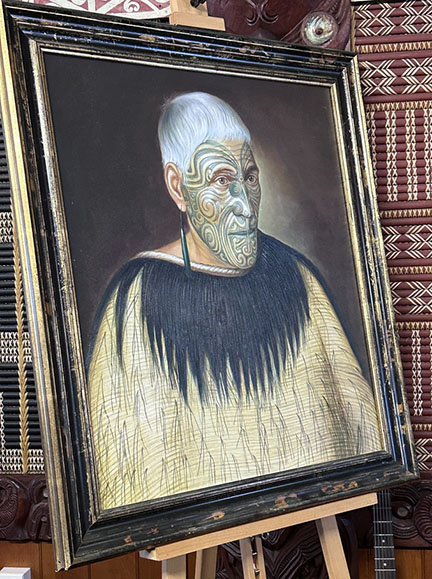
The Tribe’s long ago spiritual leader. Now that is a tattoo.
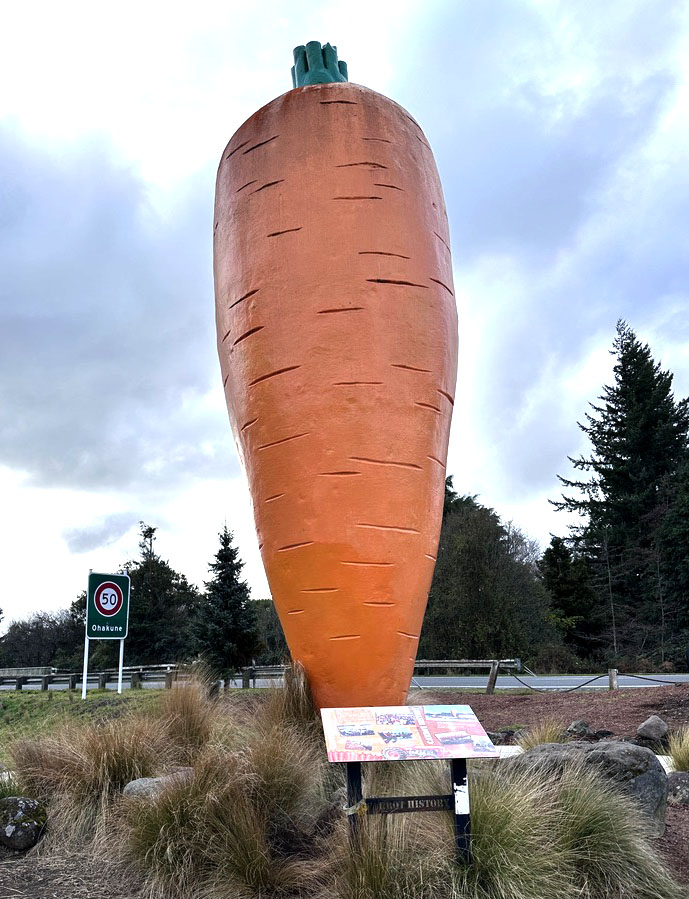
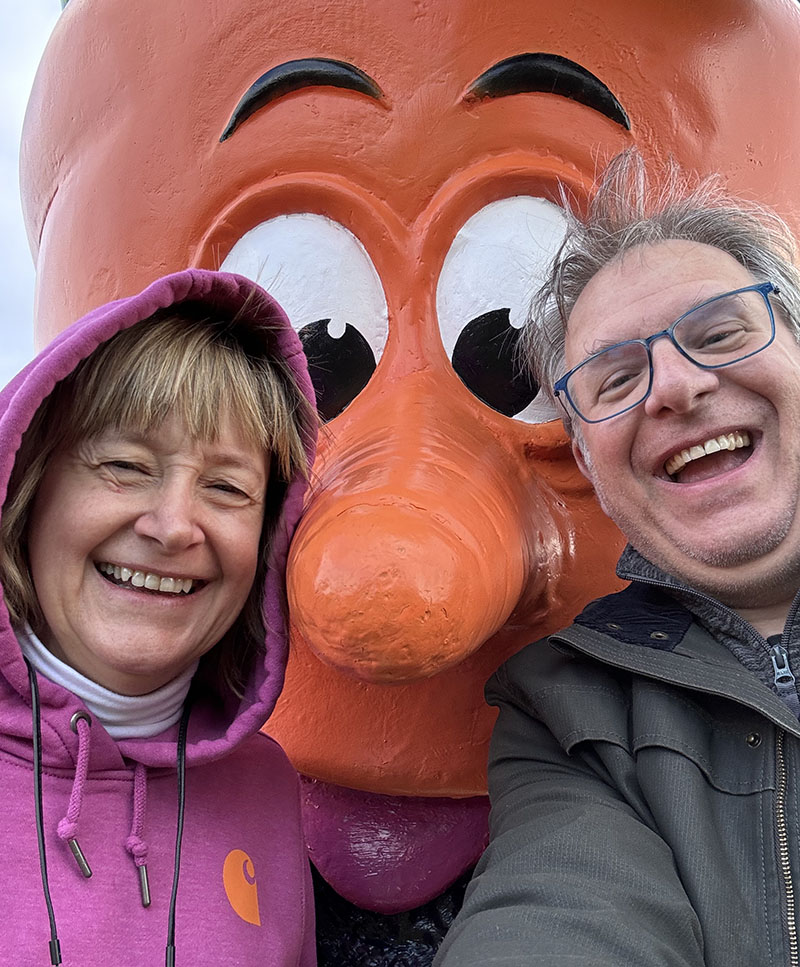
Then came the Giant Carrot. Drum roll please, here it is:
Driving around the volcanoes, we headed into Ohakune, a small town that serves as an access point to the park and the Ruapehu ski fields. We stopped at a local café for coffee and noticed the café had a lot of carrot-related stuff–carrot trinkets, carrot cake, carrot smoothies. I had noticed a sign coming into town about a carrot carnival, so I asked if this was carrot country. The waiter said, yes it is. Go see the giant carrot. It is just down the street. We hurried back into the car. If there was a giant carrot, I had gaze upon it.
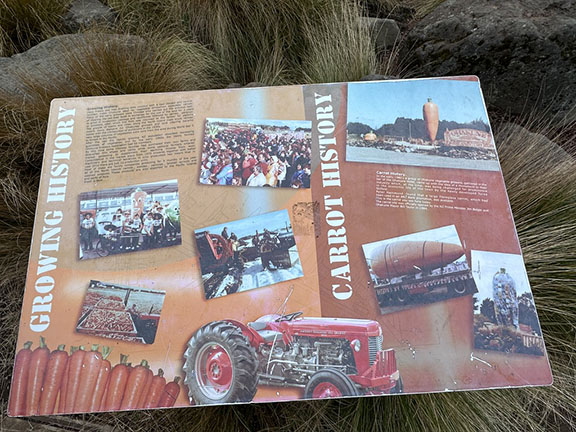
The story goes: in 1984, a giant carrot was built for a bank commercial. The locals decided their efforts as the beta carotene source for the country should be recognized, so they asked the bank if they could have the carrot. After it had served its purpose, the bank donated it to Ohakune. The town welcomed the largest vegetable in New Zealand with a parade and a park, making it a centerpiece of their town. It is now one of the biggest tourists draws in the area. There is even a Carrot Carnival in June to celebrate the town’s heritage. We might have to attend that one.
After that excitement, it was time to focus on getting home. What a trip!
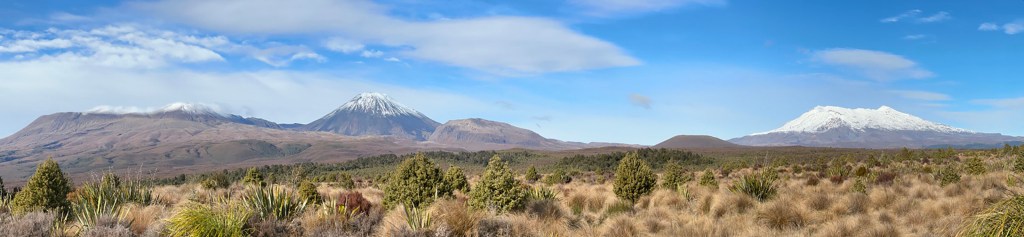
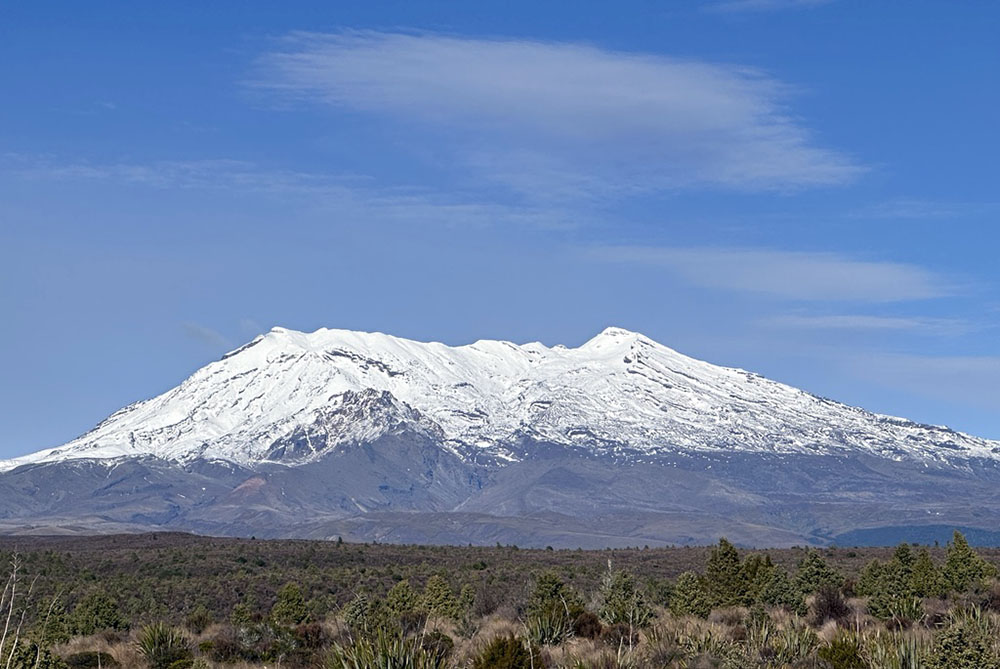
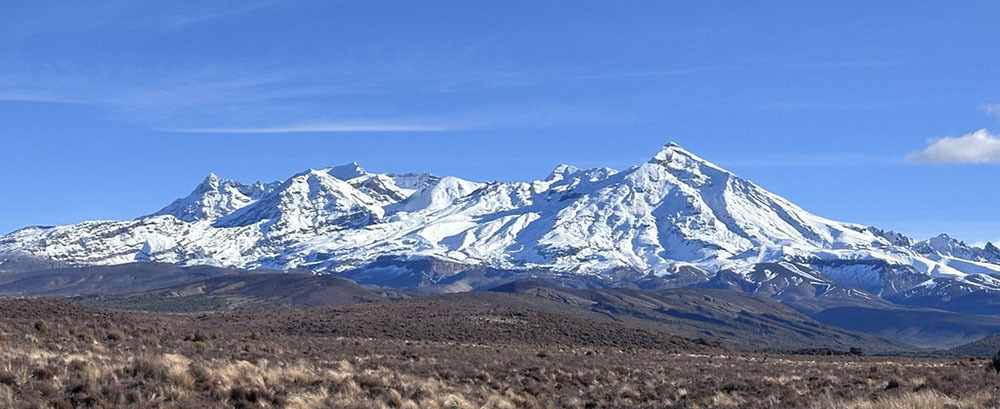
Three volcanoes – left to right Tongariro, Ngauruhoe, Ruapehu
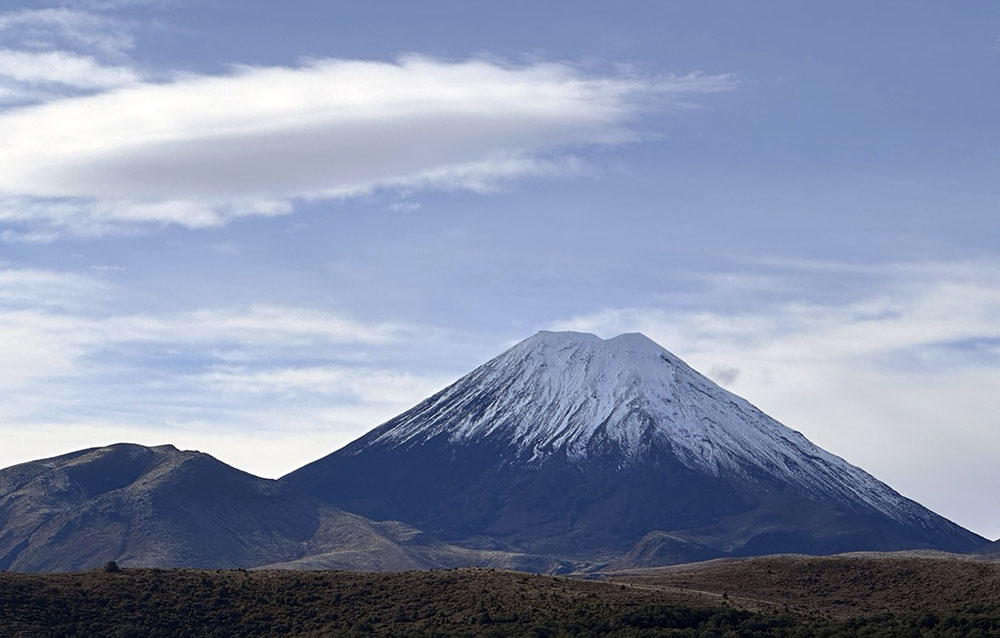
Now it was time to head back home. With Rotorua behind us, we veered off to drive through Tongariro National Park, the oldest National Park in New Zealand. It is home to three volcanoes Tongariro, Ngauruhoe (pronounced Nah-ru-ho-ā) and Ruapehu (Roo-a-pay-hoo). Ruapehu is an active volcano, last erupting in 2012. It is also the location of a popular ski resort.
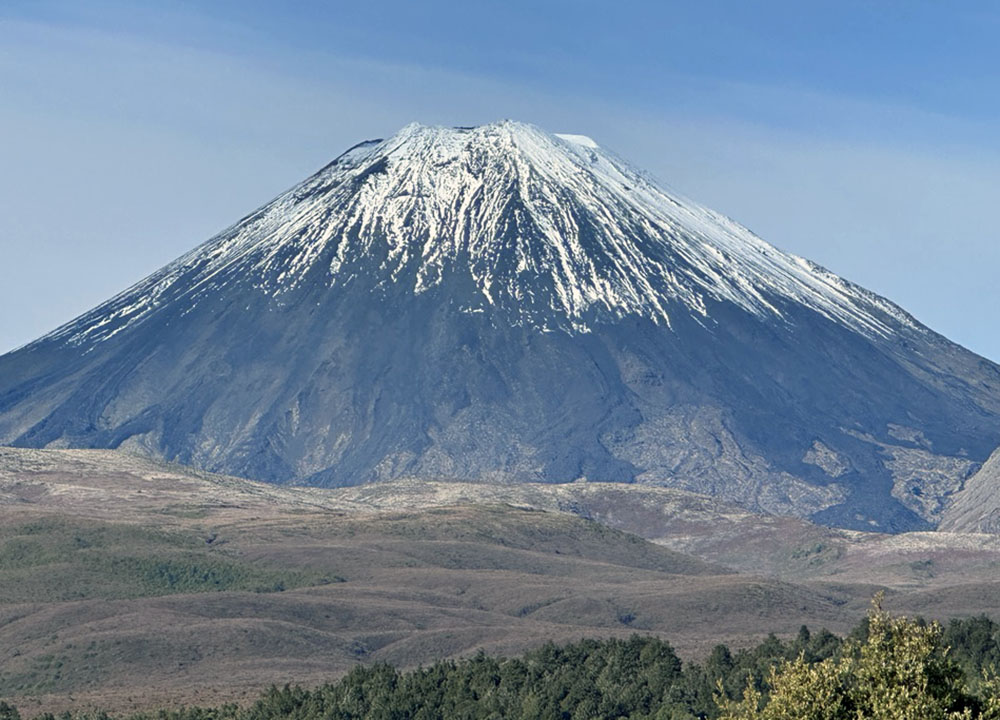
On the way to Rotorua, we passed on the southeast side. On the way home we decided to do a circumnavigation and see them from all sides. What a joy! I could take pictures of volcanoes all day. At this time of the year, they have the bright white snow-cap that sets off the always amazing New Zealand blue sky. For me, they are the supermodels of landscape photography because they are not just mountains. They are stories of the earth’s formation and the underlying forces that made them. I yelled Stop! every two minutes to get yet another shot until we finally had them out of our view.
If this looks familiar that’s because this is Mount Doom LOTRRuapehu Ruapehu other side
Ngauruhoe with forming lenticular cloud. You can see why these may be mistaken for UFOs
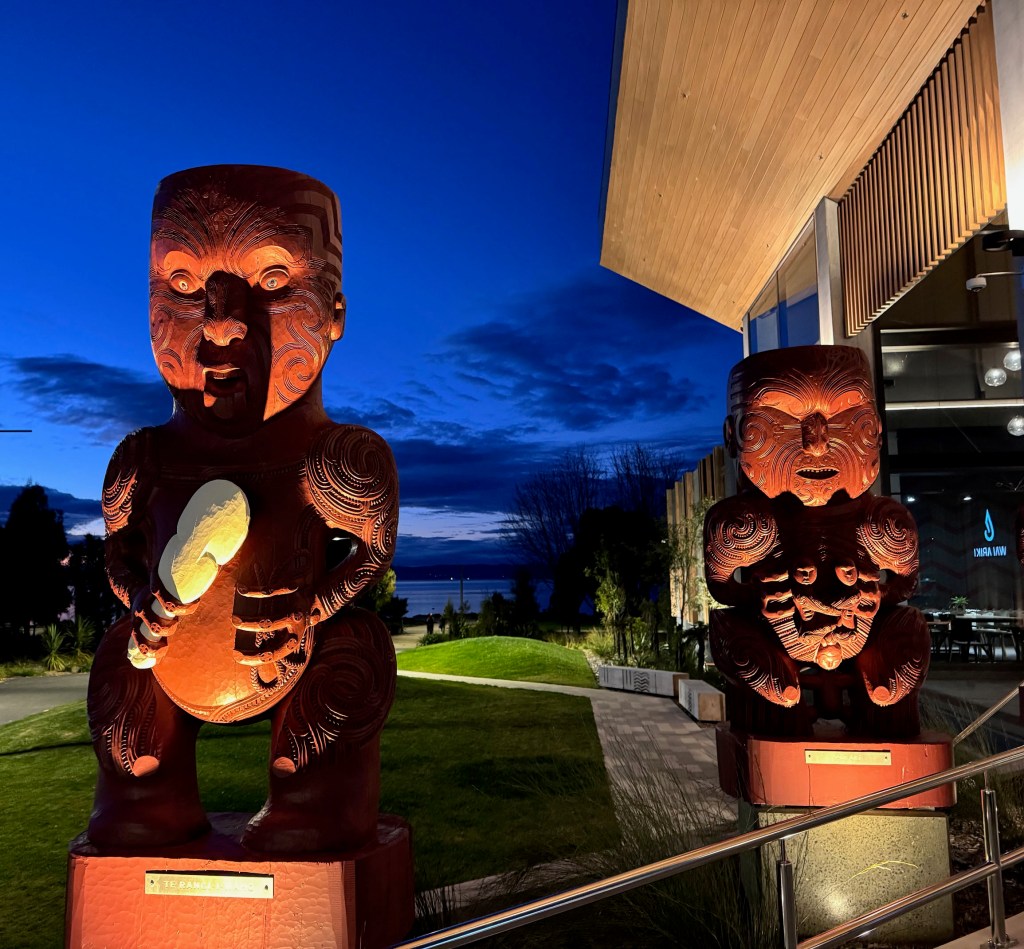
Next on the agenda was spa day at Wai Ariki, a new spa built by the local iwi (tribe). We booked the works. First the “restorative journey”—a series of pools, showers, saunas, ice baths, herbal baths, and mud. At the fire and ice room, we went back and forth from the hot saunas to cold dips, including an ice room where ice chips were offered as rub. Even better, buckets filled with ice water were hanging from the ceiling. With one yank of a rope, frigid water poured over your head. There was a lot of screaming involved in that one. But it really is invigorating to go from hot to cold.
The water menu continued to the natural geothermal pools. The pools were located in an open pavilion and, being winter, the air was crisp. There were different pools with different temperatures and different mineral contents. One pool had jets and waterfalls and others had calm still waters. An herbal pool was suffused with traditional Maori healing herbs. A separate room offered the joys of mud. Matt skipped the mud bath. I went for it and rubbed it all over. It felt good but it was really messy and hard to wash off.
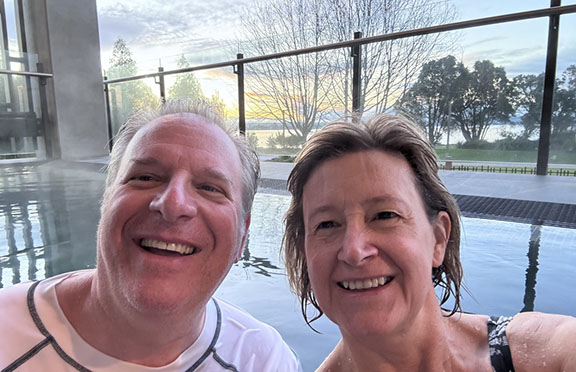
All of this took about 90 minutes. Then another 90 minutes for massages and voila, relaxation, soft muscles, and calm mind. We ended the day in another set of pools while we watched the sunset.
Beet red from the to water.
What a great day. And it was only getting started. We had a forest to visit.
Redwoods Tree Walk
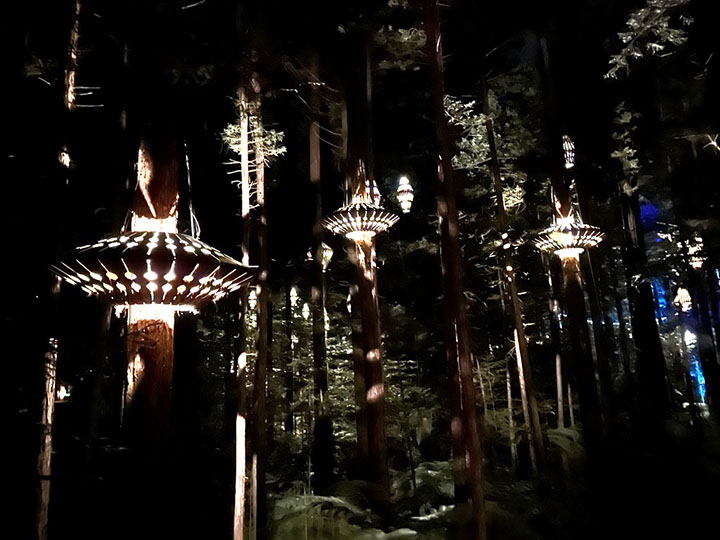
After dinner at Atticus Finch (yes, the name of a restaurant serving an eclectic mix of pretty good food) we drove to the Redwood Forest for the night light show and canopy walk. The forest was lit up with lanterns and lights strung through the branches giving the trees a subtle colorful glow.
Why are there redwoods in New Zealand? Well, there are all sorts of flora and fauna that are here because, in the days before understanding invasive species and protecting a native environment, someone thought it would be a good idea to plant various exotic trees to see which would survive and flourish. This redwood stand was part of that effort. Originally planted around 1900 as a source for timber, the trees are now protected and are not harvested. Instead, they have been recruited into giving tourists as amazing tree walk, a series of suspension bridges passing through the forest canopy.
I have to admit, walking on the bridges was difficult for me. I don’t like being on exposed heights. Even worse, the bridges were very narrow, and I was bounced up and down by the steps of people walking in front and behind. I hung on to the “railing,” and went as fast as I could from platform to platform. I made it but I was glad to be out of the swinging bridges and on solid ground.
Whew, that was the grand tour of Rotorua. We will certainly go back for more spa time and maybe a revisit to the thermal area.

















 A Yank Among the Kiwis