We took a trip to the West Coast of the South Island to see the Fiordland crested penguin. This is an endangered penguin that lives only on the West Coast. The West Coast itself, an unlogged rain forest that is intended to represent what New Zealand looked like before it was settled and the forest were mowed down for timber and farming, is itself designated as a U.N World Heritage site. Here there are fjords, glaciers, mountains and crystal clear rivers and lakes. Despite its remoteness, it is big on any tourist list of things to see and do when visiting the South Island.
Our goal was to see the penguins, which we missed when we visited New Zealand in 2005. We did come to this part of the country, visiting Milford Sound and flying to the top of Mount Cook and landing on a glacier. But we did not drive the coastal highway. We were so distracted after we bungy jumped from the Kawarau Gorge Bridge, we could not even think about a rain forest.
So this was our chance to tick this bird off our list.
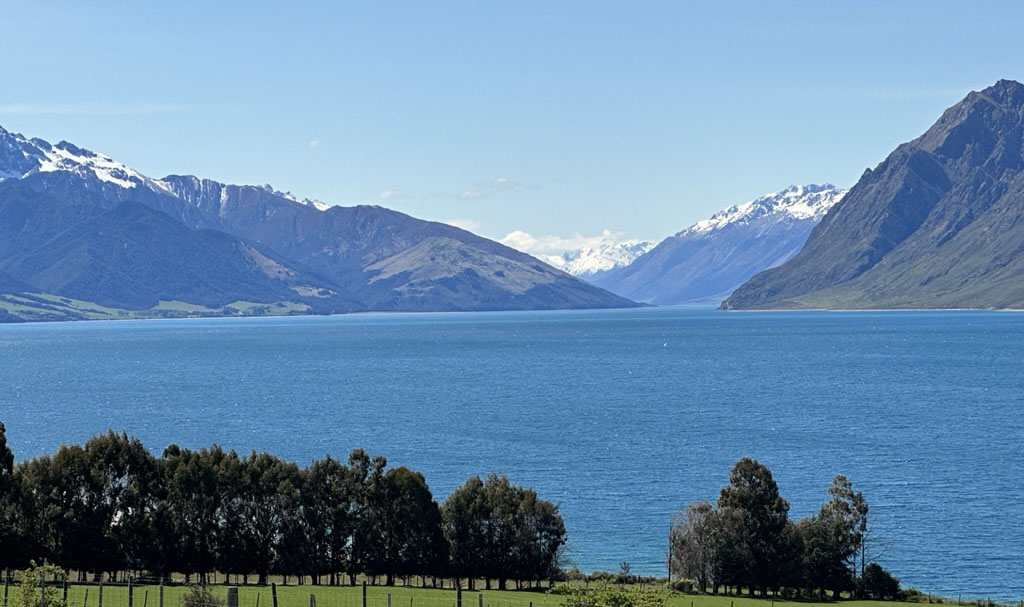
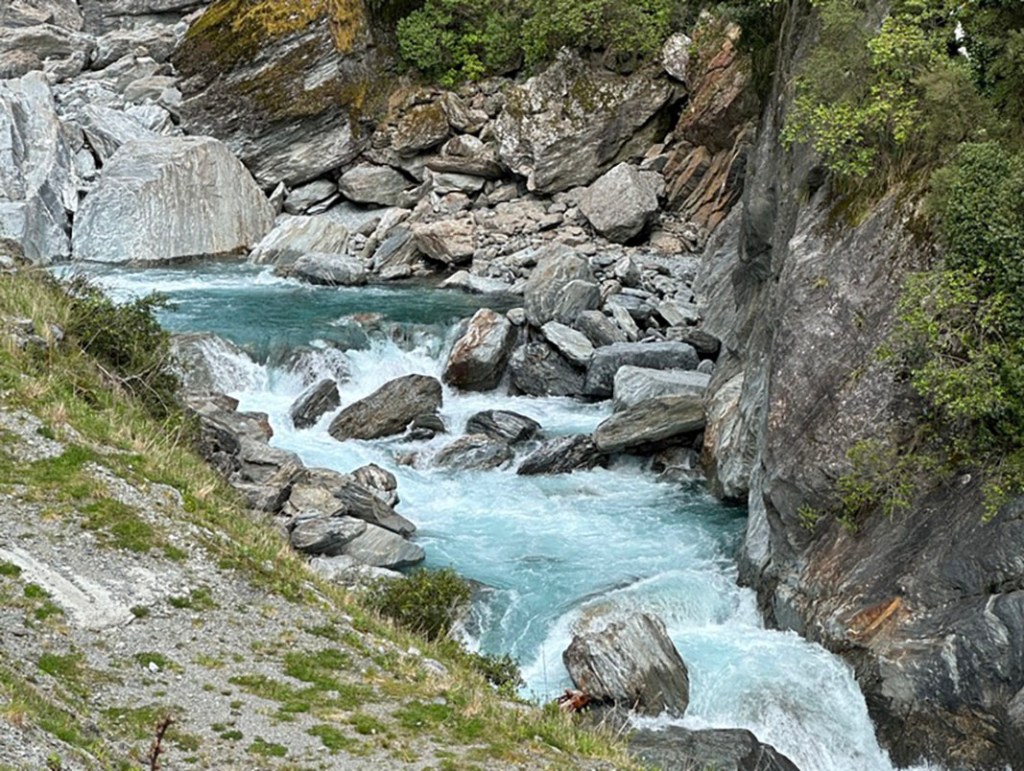
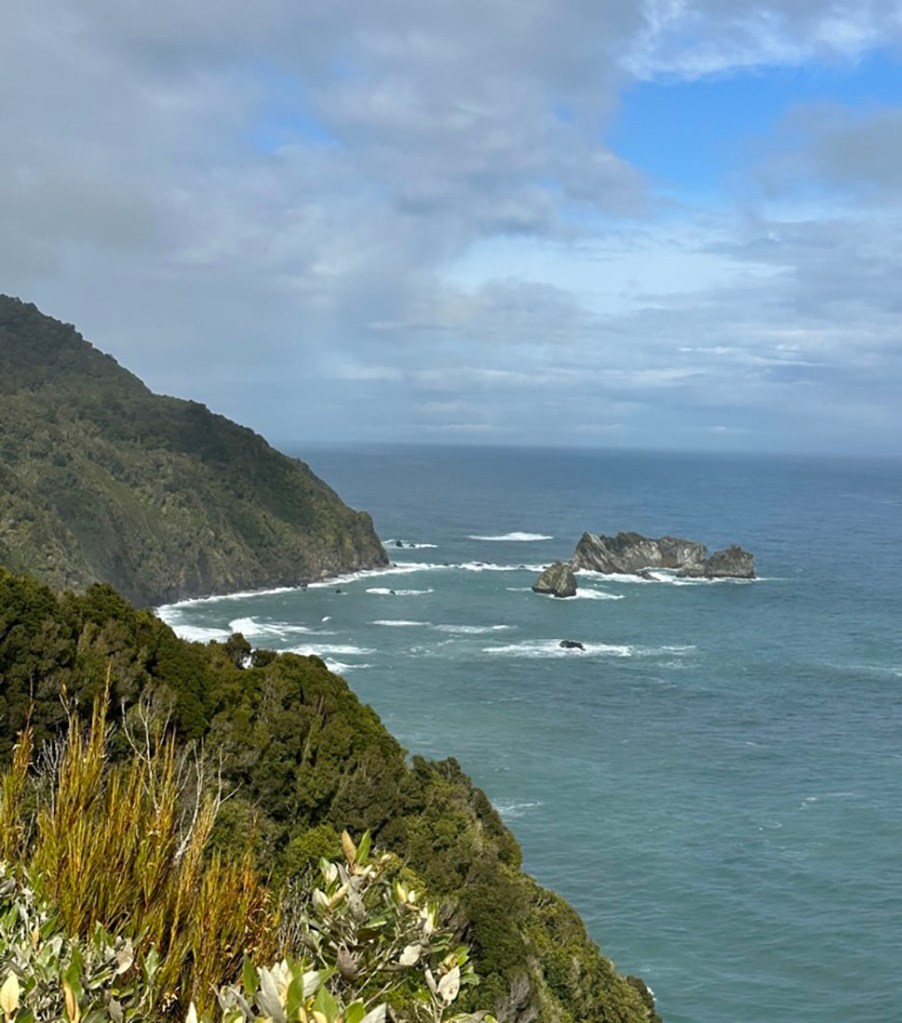
We stayed at the Wilderness Lodge at Lake Moeraki, a remote lodge, located in a rain forest, hours from any town, about as far from civilization as you can get while still driving a car. To get to the Lodge, we had to Drive Route 6, from Queenstown to the Coast, a four-hour drive on winding roads, over mountain passes, and along stop-the-car clear blue lakes, waterfalls, and rivers.
Here are some pics.
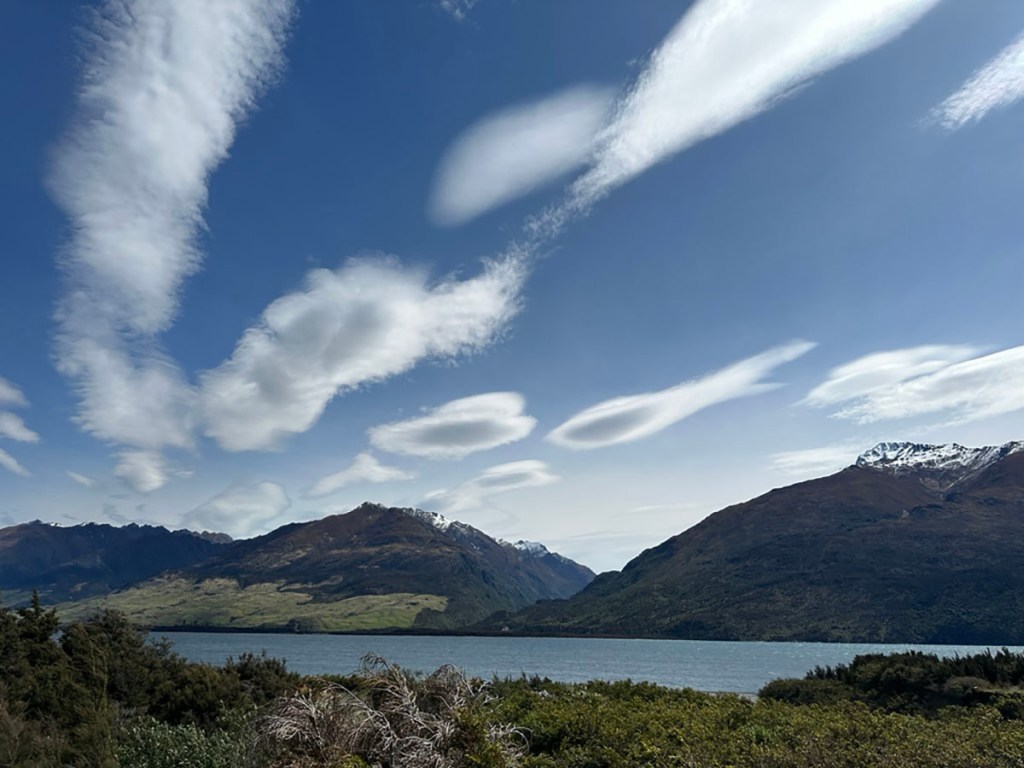
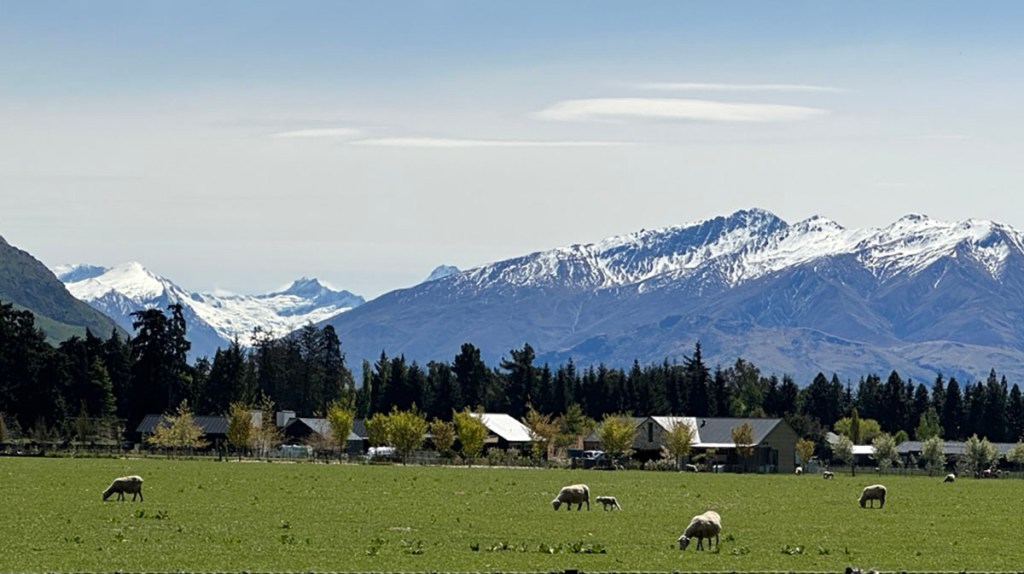
Sheep! I never tire of this kind of scenery.Lake HaweaThis color is typical of streams and rivers. Crystal clear blue aquaAlong Highway 6Ship Creek. Just look at those clouds.
The lodge owners, Gerry and Anne, were quite nice and helpful. Gerry and Anne, both lifelong conservationists and very willing to make good trouble, were instrumental in having this part of New Zealand protected from development, with five national parks, and also helping to establish it as a World Heritage site. Gerry would take us into the bush to see the penguins in a protected area he helped to create.
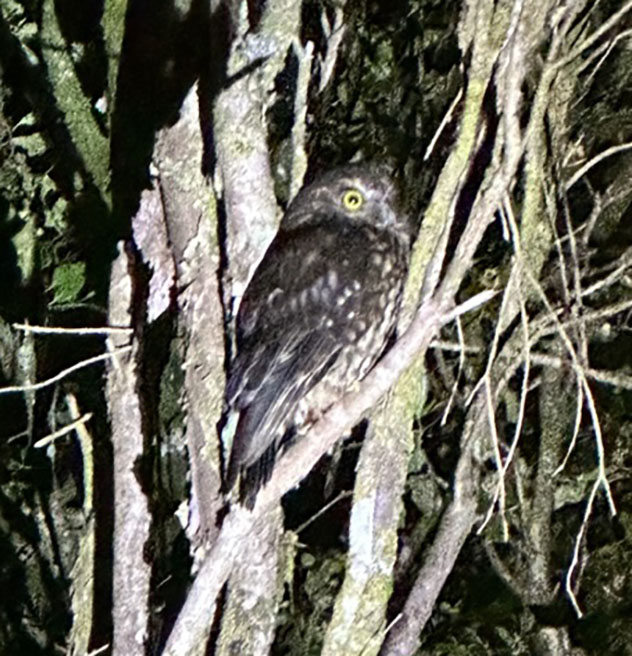
But first we had to see a Morepork Owl. I love owls and New Zealand has two. They are hard to see but being in an isolated place, the birds were plentiful and not shy at all. We could hear the owl, but it took Gerry to lead us to it. It was right there in a tree next to our room. Here it is. Gorgeous darling.
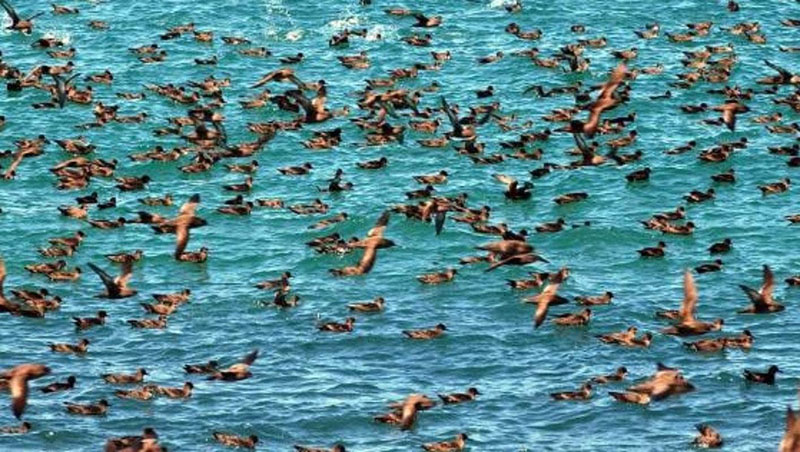
Sooty shearwater gather at the Titi Islands, which are located off Stewart Island, the southern most island in New Zealand and a fun place to visit.
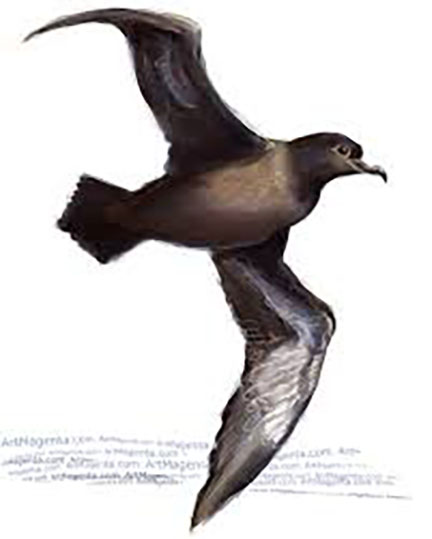
The Maori eat the titi or mutton bird. A titi is a sooty shearwater, a sea bird that nests on certain islands off shore of New Zealand, known as Titi Islands. Maori are permitted to harvest the shearwater chicks, which are considered a delicacy, and the birds can be bought at certain grocery stores.
I had eaten titi on our trip here in 2005 when we were on Stewart Island. I recall that it tasted like fishy chicken. I saw one for sale at the grocery store so I decided I would try it again, cooking it the New Zealand way, just to see if that was right. I looked up recipes for cooking mutton bird, as the white New Zealanders call it. They all seemed to be pretty similar, so I picked one and then riffed on it.
There are a few issues with mutton bird. First it is a very oily bird, much like duck. Second, it is also a very salty bird. The salt comes, not from the ocean, but from the fact that the Maori harvesting the birds do not have refrigeration on their small boats. So they salt the birds to preserve them. This means the preparation of the bird is primarily about getting rid of the salt and fat.
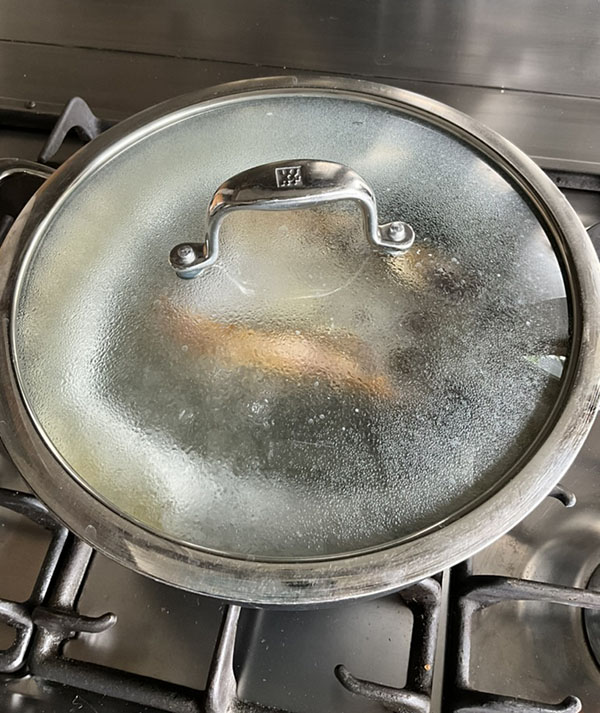
The first step is to boil the crap out of the bird. Put it in a large pot, cover it with water, add a bay leaf, and boil. Boiling this bird is a challenge largely because they stink to high heaven. If you can boil it outside, that would be ideal. Absent that, open every window in the house. After an hour, there will be a mound of fat on the water. Drain it off taking the salt with it. Start again. Fresh water covers the bird. Boil it for another hour. More fat, more salt. Drain it again. By this time, it should be completely tender and while not completely salt and fat free, at least edible.
Boiling the bird
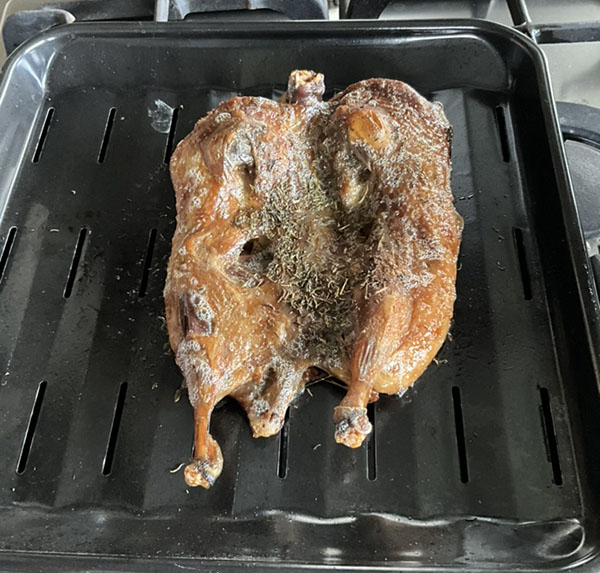
The next step is to broil the bird. The idea here is to crisp up the skin.
Broiled crispy
Once it is broiled, the bird is ready to eat. Some people stop right there and eat it. That did not seem right to me. First, the bird was so tiny, it was not enough for two people. Second, after all that effort, my feeling was that it needed to be given some special treatment.
So I made a titi bird risotto with shredded titi, watercress and feta cheese. It was actually quite good. I used a standard risotto recipe and mixed in the watercress and bird at the end, topping with feta. The titi is a strong flavor and it is called a mutton bird because it supposedly tastes like mutton. Not having ever eaten mutton, I have idea if that comparison is true. I do know that the way I prepared it did cook most of the fishiness out of it. But like any strongly flavored food, it is only for the adventurous.
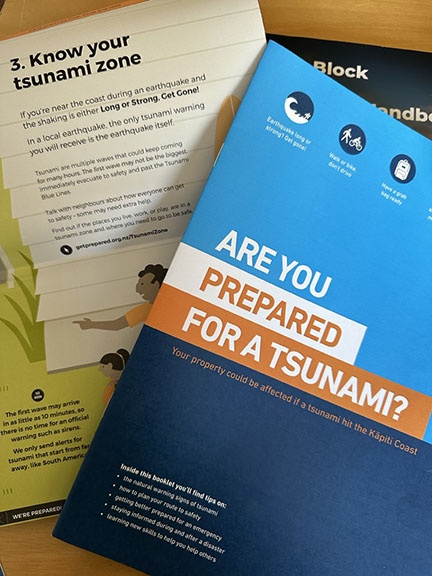
Well, there you have it. We are living in a tsunami danger zone. We live in New Zealand. They are on top of two continental plates, the Australian plate and the Pacific plate and they are trying to pass each other. Unfortunately, it results in one plate being pushed down while the other pushes over the top. (Look up plate tectonics if you want to know more.) As they crash into each other earthquakes occur. Tsunamis are caused by earthquakes. Generally the quakes occur offshore and then through a change in the floor level of the ocean, there is a rippling dispersal of water that causes the sea level to rise dramatically.
New Zealand has started to get serious about tsunamis. An earthquake off the coast of Japan caused a tsunami that took out the nuclear power plant in Fukushima Japan in 2011. In 2022, their neighbor Tonga, was nearly wiped out by a tsunami caused by the eruption of an underwater volcano. So the danger is real.
We received a flyer in our mailbox alerting us to an evacuation planning meeting. Matt is very focused on disasters and by that I mean, he worries about them. A lot. Me, well, I just can’t think too hard about it. But he wanted to go to the meeting. So, there we sat with our neighbors while scientists tried to bring home the fact that this kind of event can come at any time and with little notice. And it can kill you.
I certainly believe them. But the advice is to have a go bag and get ready to evacuate at a moment’s notice. If you feel a strong and long earthquake, go. The goal is to clear out of the danger zone. For us, being at sea level, that zone is a good mile out. It is hard to imagine outrunning a tsunami without sufficient time. I think it is virtually impossible. It depends on where the earthquake occurs. If it is close by, as happened in Tonga, well, forget it. Imagine if you are on the road walking/running away and the earthquake was close by. That wave is coming fast. You can hope is dissipates quickly so you don’t have to travel all that far to get out of its way. But there is no way to know what is going to happen. The best you might do is the vertical escape–climb a tree and hope the wave is not as high as the tree. From stories on the news, that seems to be how most people survive.
If the earthquake is far enough away and there is advance warning, you might have a chance to get out.
There is only one road in and out of this community. We are surrounded by farms. So we spent some part of the meeting looking at potential alternatives, possibly across farm land, possibly along paths leading away from shore. This is just the planning phase and they government civil disaster reps are going to see what they can do based on input from people who have lived around here much longer than us.
This is all so new to us. We are Atlantic Ocean people. Tsunamis are not our thing. Hurricanes, yes. Giant waves from earthquakes? Not so much. Well, I guess we need to learn.
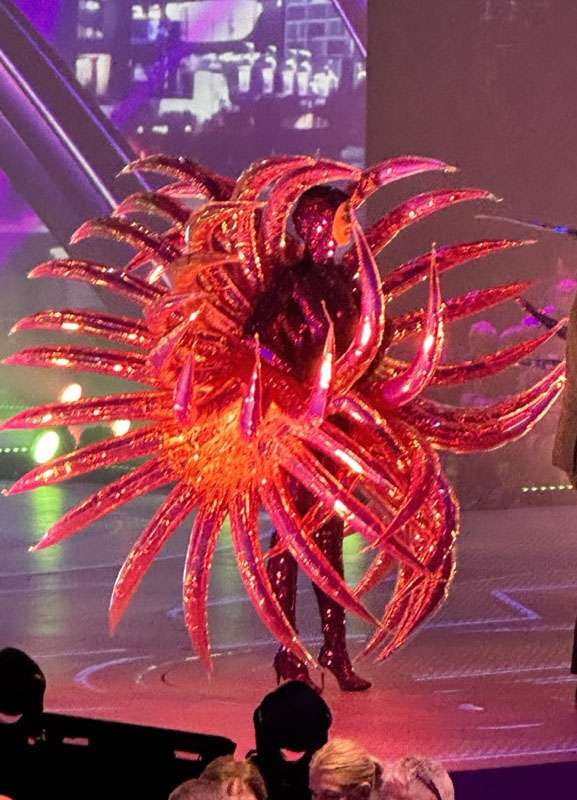
There is a competition here every year called the World of Wearable Art. We decided to take a night off from unpacking and fussing and get out on the town.
Artists from all over the world create costumes/clothing the idea to see who is the most creative with not just the ideas, but with the artistic work itself. There are theme categories as well as open and avantgarde. This year they had a bizarre bra competition.
The costumes are modeled like a fashion show with mostly women, some men, parading down a catwalk and around a stage. We were not allowed to take photos during the show. We could only take photos of the preshow warm up. The Atlantic Magazine had an article about it here. There are photos there. Here is another.
We had pretty good seats but it was hard to appreciate the work involved in creating the costumes/art. You have to be up close to see the fine details. The photos published by The Atlantic show that.
I am going to think very hard about whether I can try this. It might be fun and there is no real pain involved so, why not?
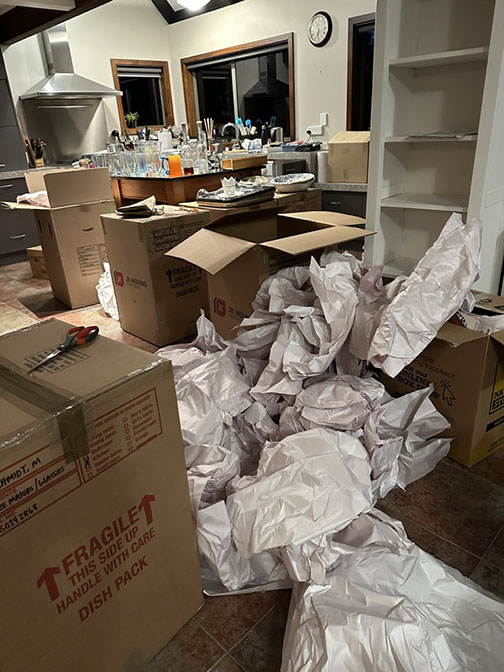
On August 31, our containers were moved to the house in Te Horo Beach. We had two containers that were jam packed full. Think a semi-trailer moving van. They brought in about ten people to heft the stuff across two stories and eight room. Our job was to direct traffic, telling them where to take the boxes or furniture. It took an exhausting and mind numbing six hours. They unpacked some things for us, like the furniture and art, although I told them to leave the boxes alone. They placed the furniture and got the rugs down, and that was helpful. But now we have to work through the boxes and figure out where everything goes. I am giving it three months. I just cannot do this eight hours a day.
Losing my mind with unpacking
We moved a lot of stuff. Our plan was this—we move what we can, most of it is furniture we bought at IKEA or from Wayfair. When we leave New Zealand, we just leave everything but the antique furniture behind. And honestly, it was the right thing to do. Why? Because stuff is expensive here. I talked this over with the moving supervisor before we were packed up in the U.S. and he basically said, bring everything you can because it will cost a lot of money to replace it. He was right. Not only is it expensive, the options are very limited.
I did not bring all of our bookshelves and or smaller cabinets figuring I could buy them here. Wrong. There are two main furniture stores and no IKEA or Wayfair or Overstock or any other option you can think of that saves you money. The furniture is generally manufactured here, which is great until you look at the prices. I left behind our overstuffed recliners. A standard recliner here runs around $2200 NZD, or around $1300. Books shelves can cost upwards of $1500 NZD, sometimes more. Even antique dressers can run into the hundreds of dollars depending on the wood. You might find less expensive items, but you get what you pay for.
Electronics are just crazy expensive. I could not bring my small appliances because of the difference in electrical outlets and power. Wow, they have been expensive to replace. I paid nearly $400 for a food processor, and it is not even a very good one. But I brought the rest of my kitchen. I brought it all—cookbooks, pots, pans, dishes, you name it. It was worth it to have my tools with me.
The things we brought that we now realize we do not need? For one, winter clothes. They do not have four seasons here. My snow boots and down parkas were not required (unless we go to the South Island where they have winter). Also, any kind of more formal clothes—for Matt things like suits and ties are completely unnecessary. I have no need for fancy dresses. But alas, we brought all of these things. I am now packing up boxes with clothes we will never use and storing them away.
What about the cats? How did they take the move?
While our stuff was moved into the house on August 31, we decided we needed to get some bit of order in it before we brought the cats. Cats do not like change and so far they took a plane ride from Maryland to a stop over at a boarding place in L.A. for quarantine, then another plane to another quarantine facility in New Zealand then to the house in Wellington. Now we are moving them again. I was worried most about Boo. She is 17 and has been a trooper but still, it is hard. She spent most of her time on Wellington in a little kitty tent. She never seemed quite comfortable.
So on September 2, we made the final move out of Wellington with the rest of our stuff and two cats on board.
JoJo is a howler. He will cry and cry and cry when he is in a car. I had to listen to him for the whole hour. Boo is usually quiet but he got her going and she started crying, albeit not continuously, until we arrived.
I let them out in the main bedroom and closed the door. Our furniture was in the room as were boxes full of our stuff. Boo seemed downright overjoyed. She sniffed everything and trotted from the bed to the dresser to my slippers. She seemed to say, “Yes, yes, this is our house! This is our stuff!” I have never seen a cat so visibly happy. She jumped on the bed with the energy of a kitten. She rubbed on everything. This is mine. This is mine. This is mine. She has been trotting around, tail up, ever since. She just knew this was home. (I can relate. I feel so much better when I am around my stuff.)
JoJo, on the other hand, has been completely freaked out by it all. He just cannot take the constant opening of boxes, tearing of tape and paper, and the noise, noise, noise! He is very curious, but the sensations and the exploration just seem to overwhelm him so that I often find him tucked into a corner or hiding under a piece of furniture. He seems lost as if he does not know what to do with himself. I keep reassuring him that we will get the boxes emptied soon.
How has it been going since?
It has been six weeks , we have been unpacking boxes, arranging things, sorting and storing and just generally trying to get settled. It is exhausting. I am so over this but we are still not done. Matt is working and there is only so much time in the day for me. Unpacking and putting things away grows old quick. We figured it would take a long time but boy, this is getting ridiculous. I do not want to be looking at unpacked boxes six months from now. Honestly, I’ve got nowhere to put them. There is no storage here. We are creating it.
We have to deal lots of broken stuff. I have been working on the insurance claim. We are also trying to deal with getting services in order. Nothing seems easy here.
The cats have adjusted fairly well. We are still opening boxes and moving things around and JoJo hates that part. But there are plenty of places for him to sleep and get into trouble so He is good. Boo does not like that it is cold so we find her sleeping under the heaters a lot.
So what about the house?
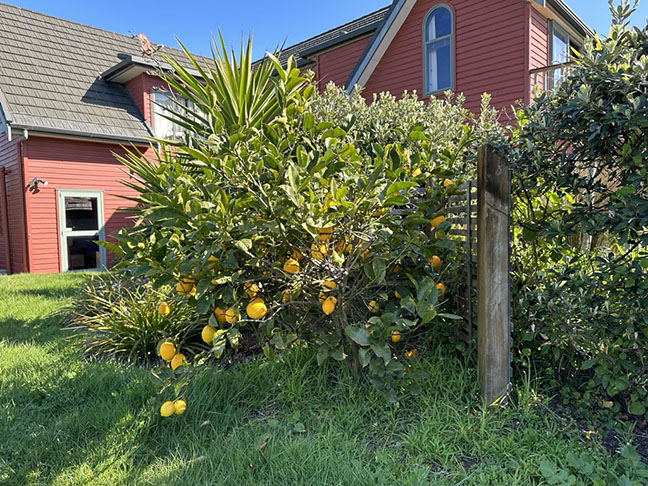
We have a lemon tree. I love being able to pick lemons.
Meyer lemon tree
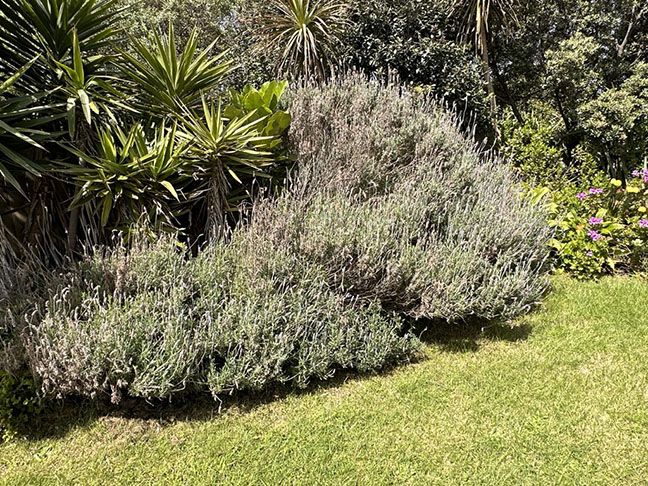
The yard is really quite wonderful. Whoever lived here before did a lot. There are lavender bushes that are a good six feet high. I have never seen lavender grow like this.
Lavender
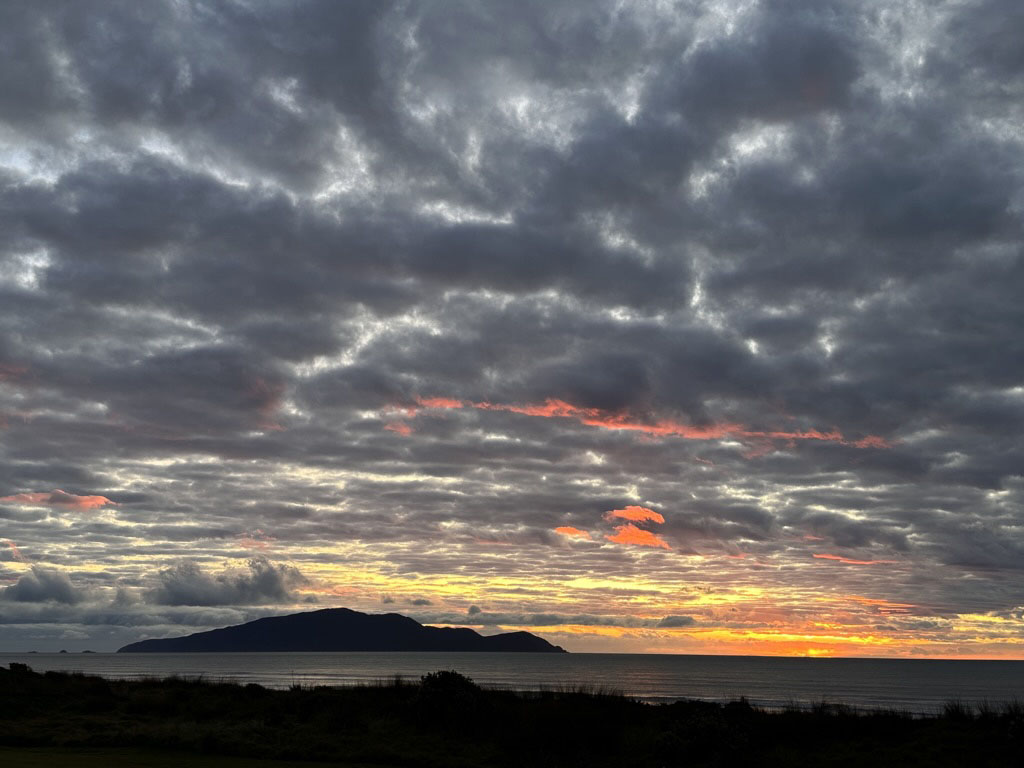
We have a great view of the ocean and sunsets.
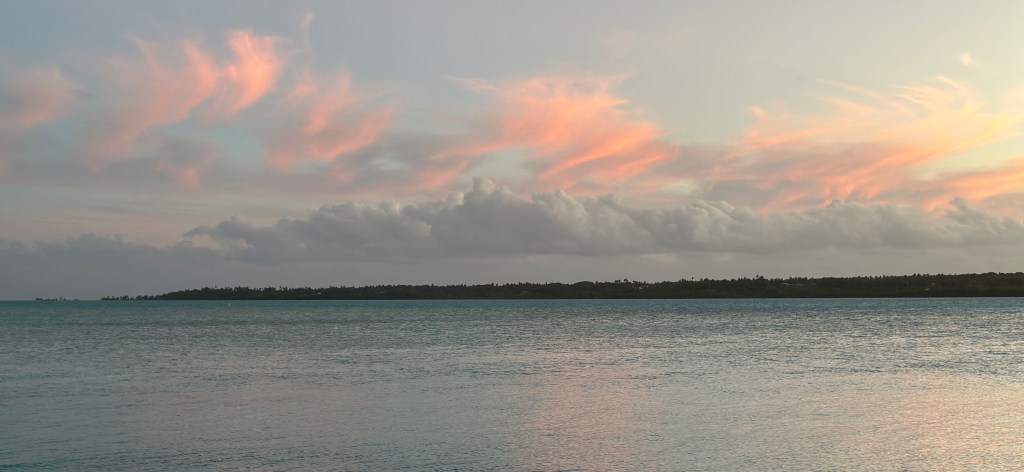
This was a pretty dramatic sunset
There is nowhere near enough storage or space so we are turning the garage into what would be a basement in a U.S. house. I am putting together a gym, a crafting area, a gardening area and a tool area. I’d say we are getting close to settled.
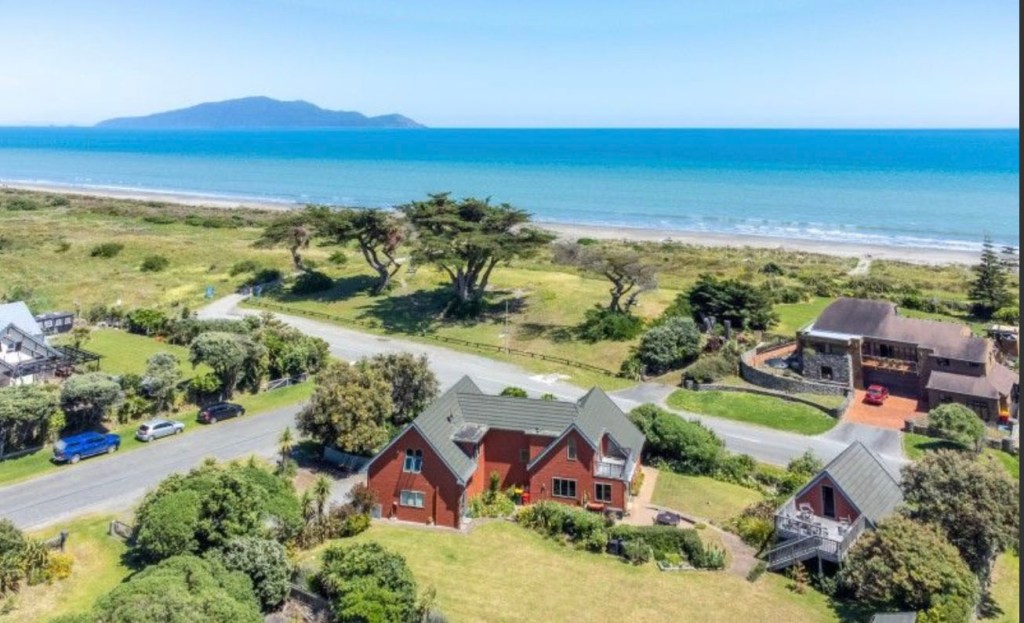
This is where we live. The red house in the center. The island in the distance is Kapiti Island. We live on the Kapiti Coast.
Finally a place to call home. What does this have to do with Arnold Schwarzenegger? Matt and I recently watched the Netflix series about Arnold Schwarzenegger. I really found him inspiring! The guy needs to be a self-help guru. (Turns out he just put out a self-help book. I am prescient.)
His outlook is ridiculously positive. He contends that he gets a vision in his head, and he just pursues it until he achieves what he wants to achieve. He is lucky as hell no doubt. People take to him because of his positivity and good nature, and he had a lot of help from a lot of people over the years. He took advantage of every opportunity. But he is also determined and seemingly unfazed if he has a setback. He just works harder and keeps his eye on the ball. Another lesson– he never second guessed his decisions. He figured out what he needed to do, and he did what he had to do to succeed.
He wanted to be a body builder. Check. He thought he belonged in America. Check. Having won just about every body building prize several times over he decided hey, I want to be a movie star. Not “I want to act.” I want to be a star. He set out to do it and he did it. What is next? I’m going to be Governor of California. Seriously, Arnold? Yes, and he did it. He wasn’t a bad governor. He just exudes a can-do spirit that is infectious.
He kept quoting his Dad who, when Arnold was young, instructed him to be useful. Arnold said you can find meaning in life by being useful. When I was growing up, my Dad used to say, “If you don’t have anything to do, find something to do.” It is the same principle. Don’t just sit around. Make yourself useful. And it works.
So, what does Arnold have to do with our finally locating and moving to a rental property at the beach in New Zealand? Like Arnold, I have always envisioned myself living in New Zealand. I have also always envisioned myself living at the beach. The sound of the ocean just makes me happy. Many people think that I can’t sit still. Not true. I can go to the beach, sit in a chair, and watch the waves for hours. I’ll take a book and never read it. The ocean just speaks to me.
But unfortunately, my life was directed to an entirely different place, and I lived with longing. Here is where Arnold comes in. Without knowing it, I followed his advice. I created a vision. Upon retirement, I would figure out a way to live at the beach. I just kept saying it. I am going to live at the beach when I retire. I was going to figure it out because I wanted to watch the ocean, breath in salt air, and listen to the heartbeat of water. So my mantra has been: I am going to live at the beach before I die. And ocean front if possible. It would be nice to just walk the beach every day. But I really wanted to be able to see the waves from my house.
Most people would say, Marsha, that’s easy. Just move to Florida with everyone else. No, that was not the answer. Put simply, forget the politics, it is the “everyone else” that is the problem. There are just way too many people in Florida or in most seaside towns. Too many people means having to put up with them. Having lived in the city for 40 years, I am done with putting up with people. My goal was a different kind of beach. One not populated with too many people making too much noise.
These beaches do exist. You just have to find them. There is one in North Carolina we like. And there is one in New Zealand. Te Horo Beach, about an hour’s drive north of Wellington. To get to Te Horo Beach you have to drive back roads through farmland populated with sheep, dairy cows, and horses. It is just a sleepy little place with houses. There are no restaurants or cafes or a boardwalk or anything really. Just the ocean and houses. If we need something, there are larger towns in both directions or, if need be, we can drive into the city. It is an easy, beautiful drive through green hills dotted with sheep.
The house has a wide-open view to the ocean from the deck. We are facing due west and we get to see the sunset every day. There is a small park in front of our house which provides beach access. On most days, the biggest activity is when people drive up, park, and go for a walk. Some folks bring their horses and go for a ride on the beach. It really does not get better than this.
Arnold was right. Have a vision and pursue it. For us, it took moving across the world but, by golly, I am living at the beach with a fine view. I can hear the waves crashing. I can see the sky–all of it. The stars thrive out here. The Milky Way shines.
We fretted about the distance. It is considered rural. RD 1. And Matt still has to commute to Wellington. But the house, though not quite big enough, is situated exactly as we wanted. Once we get settled and the internet is up and running, Matt will be commuting to Wellington three days a week. Right now, he is going every day and it sucks. I thank him every day for letting me live out my vision.
I’m an American. I drive everywhere. I am not really into taking three busses to get someplace so I had to buy a car. I did not want to spend a lot of money on a car I would probably only have for a few years, so I decided to go the used car route. I’m sorry, “pre-owned.”
There is a website here called Trademe. It is a super selling website that everyone uses. If it is for sale or lease, it is on Trademe. Companies advertise real estate on Trademe. Car dealers sell cars on Trademe. People sell used furniture on Trademe. It really is the source of all buying and selling in New Zealand.
Being so ubiquitous, I turned to Trademe to search for a car. I thought I would buy a hybrid. I was finding incredibly inexpensive cars, think Prius and Nissan Leaf. I set up some appointments and Matt and I spent a Saturday afternoon going from used car dealer to used car dealer.
At the first stop, I was looking at a Prius. My first question is always, does it have Apple Car Play? I ask because it is convenient for me to have and because it is an indication of how up to date the electronics package is. The salesman takes me to see the Prius and when I ask about Apple Car Play he tells me it does not have it. But more importantly, he explains that their company does not replace the car’s stereo and navigation systems with New Zealand standard tech.
At first, I do not understand what he was telling me. Then he shows me the dashboard and radio. The text is written in Japanese. I am trying to understand what is going on. What is he telling me again? What do you mean it is in Japanese? It is a Japanese car he says. He is selling an actual Japanese import. And by that I mean, a used Japanese made car imported from Japan that was used in Japan and so is outfitted with Japanese systems. So I ask, if the dashboard is telling me something important like, your tire air pressure is low, I would not know that because it would be written in Japanese characters, right? He offers that I can handle this by aiming my phone camera at the car navigation screen and use Google Translate to get the words in English.
Can we all contemplate that for a minute?
I say, whoa, no. That is way, way too complicated for me. I am not going to struggle with a car that is speaking Japanese. As I walk away, he shouts that all of the used cars would be like this. Um, okay. What a nut job. On to the next dealer.
I am scheduled to see a Nissan X-Trail hybrid , and this is where I learn what the hell is going on. I did not know this but apparently, it is quite the thing for New Zealand (and I understand many other countries) to import thousands of Japanese used cars to sell on the resale market. There are several reasons for this. Japan produces cars and to support car manufacturers, they pass regulations that will make a car obsolete thus encouraging turnover. Imagine if the Congress passed a law that said all cars must now have a certain kind of exhaust system. Then everyone has to get a new car to meet the standard. It would be a boon to car companies. This is what Japan does. They force turnover.
As for the New Zealand import market, getting a new car in New Zealand comes with limitations. They have a limited number of dealers, a limited variety of cars, and they are expensive. They are the last in line for new car models and not all car companies are here. It is also a small country and the opportunity for used cars is not great.
Put it all together and there are not enough New Zealand specific cars to generate a big used car market. By importing cars from Japan, New Zealand gets a shot at cars that might not otherwise be sold in New Zealand. But by importing these cars, the New Zealander has to accept the Japanese character of the car unless the dealer fixes it or the car buyer pays for it to be fixed. This means who imports the car, how the car is handled, and whether they are trustworthy is an entirely different matter.
The dealer selling the Nissan had an approach that was completely different from the Prius seller. The Prius dealer kept saying, we don’t change out the radio because a lot of people don’t want to pay for it. If I wanted it to be changed out, they would do it, but it would be extra. Fair enough.
The Nissan seller, on the other hand, had taken the initiative to swap out the electronics and upgrade software to the extent possible to make their cars more like a New Zealand car. It is not 100% English, but it is enough to get by.
When the Japanese cars are imported, they are dirt cheap. This can be true for a few reasons. The obvious reason is that Japan needs to get rid of the car so they auction them off as rapidly as possible. The buyer may not get that much information about the car. Many of the cars have suspect pasts, perhaps it is a lemon, or it has been in an accident. In the case of the first dealer, he was not offering anything in the way of knowledge about the car’s past. The second dealer provided a detailed independent inspection report.
But alas, for various reasons, the salesman told me, the Nissan X-Trail I came to see could not be upgraded to New Zealand standards. If I wanted that car, I would have to accept the Japanese version of it. I passed.
It slowly dawned on me that all of the Japanese imports were going to be a problem. The salesman suggested a better option for me would be to look at European cars. They come from the Japanese used car market, but they are easily converted to English and are easily upgraded if necessary. He pointed me to a used Mercedes-Benz, a 2017 with only 13,000 miles. It looked brand new, like someone had bought it and left it in a garage. It was loaded with features, sunroof, heated seats, CarPlay, you name it. But a Mercedes? I never in my life would pay for an expensive car like a Mercedes. I hate spending money on fancy cars. I just don’t do it. But did I mention that when they come from Japan, they are dirt cheap?
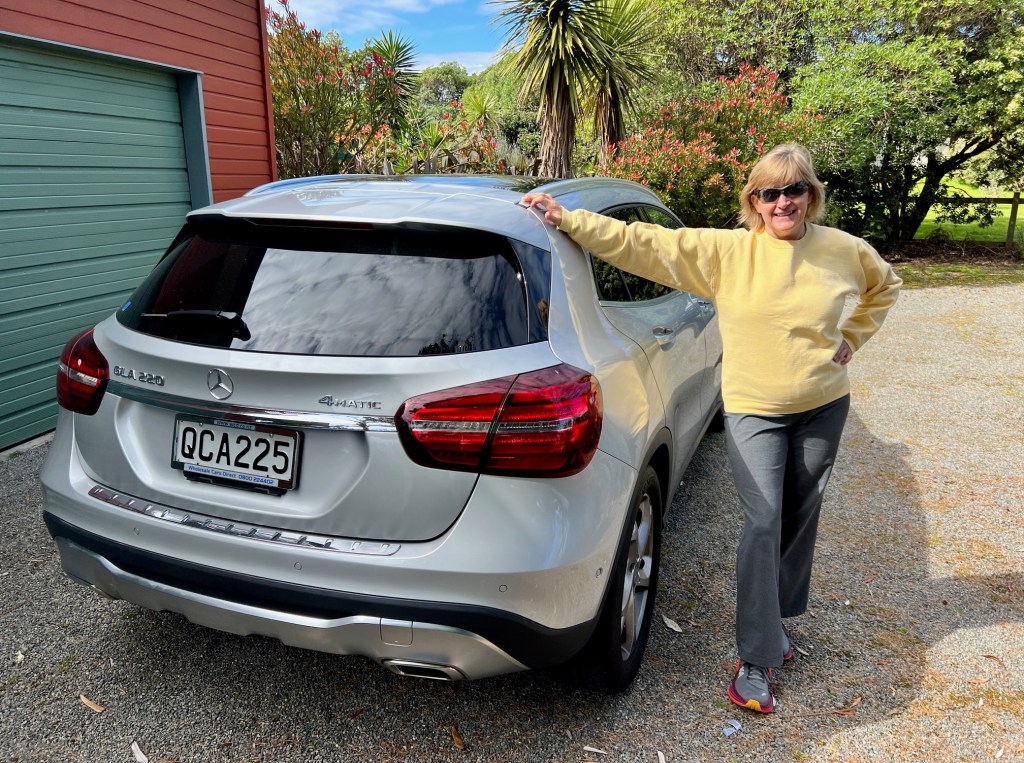
I avoided it for a while and I looked at several other cars at different dealers but none of them worked. I am Goldilocks when it comes to major purchases. I decided to give the Mercedes a test drive. The salesman assured me that once I drove it, I would love it. He was right and the price of the car in U.S. dollars was so inexpensive that I would have been a fool not to buy it. So, I am now a proud owner of a Mercedes-Benz. I hope this does not mess up my brand.
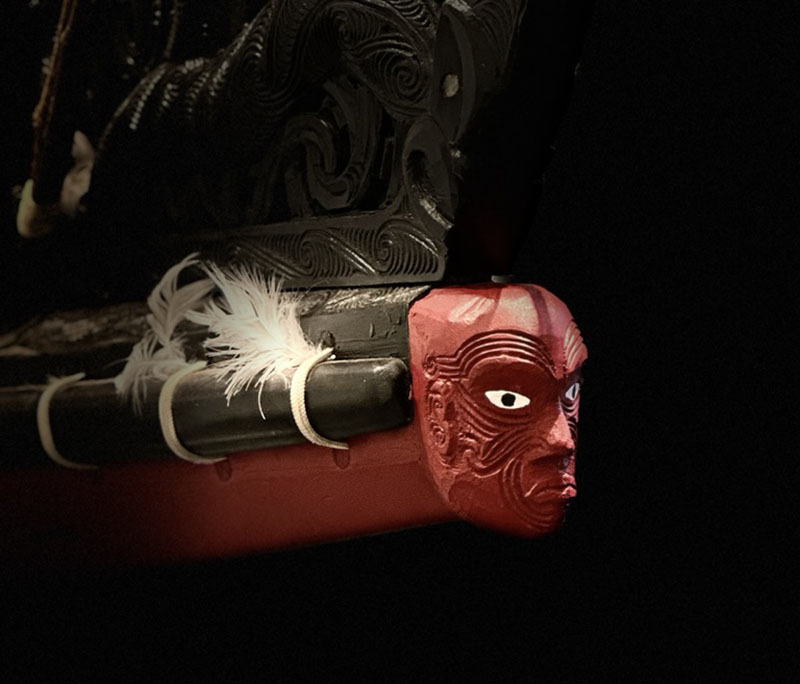
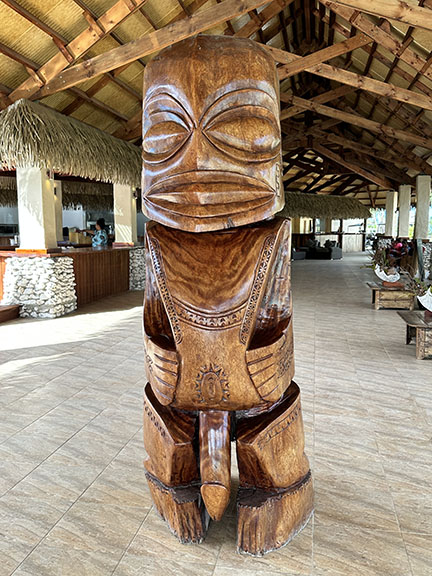
Prow of Maori waka (boat) carved from fragrant Kauri wood
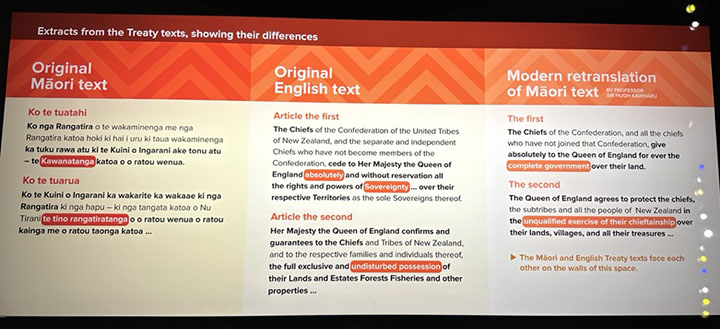
When Matt and I were here 20 years ago, we did all the tourist things but that was a very long time ago. So we are going back to places we visited before. This time it was the Te Papa Tongarewa Museum. The museum houses art and artifacts from New Zealand’s history. For me, the most interesting exhibit concerns the 1840 Treaty of Waitangi, in which the British obtained a cession of all land in Aotearoa from the Maori, the indigenous tribes on the islands. This is considered the founding document of New Zealand.
With surprising honesty, the exhibit explains that the British version of the Treaty and the Maori translation of the Treaty are not the same. The words used by the English in explaining the agreement to the Maori were interpreted differently when put into writing.
As was true in every other country they visited, the British intended to assert their sovereignty over the land and they sought a cession of sovereignty from the tribes. This was a foreign concept in Aotearoa, which was governed by individual tribes. There was no central government. Even so, the British version of the Treaty states the Maori ceded their sovereignty to the Crown. In fact, Maori understood in their language, that they were giving up governance over the land generally, but they would be free to govern themselves, their affairs and their “treasures,” meaning not just land but intangibles.
The British version gives the Maori the right to enjoy their land, forests, fish, and estates, but the Crown retained the full right to control the land in what is known as the right of preemption. The right of preemption, which was also used by the British in the United States, means that tribes may occupy the land, but the European Crown holds underlying authority and is in control of the purchase and sale of lands. In other words, the Crown has preempted the right of the Maori to control their land and the potential for foreign interests to buy it. Unless the Crown approves, the Maori cannot sell their land to anyone. This was how the British kept other countries at bay. It would be illegal under international law for the French to try to buy up property to challenge the Brits if preemption was granted.
But, as in the U.S., the necessity of obtaining consent from the Crown became an issue with settlers who wanted the land. So the New Zealand government started buying up land to dole out to settlers. They also worked to assimilate the Maori into society, which naturally led to the Maori being marginalized. War broke out pretty quickly (1860-1870), and the British used that war as an excuse to confiscate more land from the tribes. The promise to the Maori that they be permitted to govern their own affairs, i.e., to continue their tribal existence, was never met.
I could go on. The history of New Zealand mirrors the U.S. history of Indian wars, taking land for settlers, and trying to assimilate tribes into society, all in violation of treaties. Nothing is new.
These failures led to the protests on the 1960’s and 1970’s. The tribal people wanted control over their land and its resources, they wanted to be recognized as tribes and they wanted their land back. A tribunal was set up and Treaty claims have been in process for decades with compensation, land return and fairer treatment of the tribes as the goal. It is a slow process, but it seems to be working.
Governments in the D.C. area have been trying for years to get cars to stop for pedestrians crossing the road. They have put up signs, marked walks, installed speed bumps but it really does not work. Cars don’t always stop, and you are taking your life in your hands to expect that they will.
Here, it works. They mean it. Pedestrians rule here. The crosswalks where cars are required to stop are extravagantly marked with road stripes and lights. And if a pedestrian even approaches it, cars slow down and stop. It is like a miracle. I am leery enough that when I am walking, I always stop and look both ways to make sure the cars are actually going to stop. But there are some people who assume cars are going to stop and charge right into the road. It makes me nervous because I am not completely trained to be on the lookout when I approach one of these stops. I admit that a few times I scared the bejeezus out of a pedestrian who just strutted on into the crosswalk without even glancing and I did not see them approaching. I’m getting better but it is a new way of driving.
I was sitting on the couch reading when suddenly, the house started to rumble and shake. Dishes clattered a bit, things were vibrating. It was a 4.6 earthquake centered about a half hour up the road from here. Pretty cool. I did experience the earthquake we had in D.C., so it was not completely new. But it was my first in this country. Huzzah!
I had to buy the anti-Captain Cook pin. They should have cooked him.
Much to Matt’s dismay, I am not really good at keeping to a schedule or to a plan. I might suggest today that tomorrow we go for a walk. But when tomorrow arrives, I have a completely different plan in mind.
This weekend we were supposed to go to a movie (yikes, I have not been in a movie theater in years) and to dinner at a fancy restaurant. But on Saturday, after much hemming and hawing on my part, I said forget it, let’s go shopping in Newtown and see where we get. Newtown is the part of Wellington where mostly students and immigrants live. The streets are packed with funky and fun stores and restaurants of every variety. Concert posters are pasted on lamp posts and panhandlers dot the sidewalks.
I had a list of a few Middle Eastern stores I wanted to visit and naturally I had to stop at Mediterranean Foods, the Italian food store. In the Middle Eastern stores, I stocked up on some Greek spinach and feta triangles, some dates from Palestine, Indian curry powder, and pomegranate molasses. At the Italian store, I bought everything that looked good including some Italian wine. We stopped at a self-proclaimed anarchist bookstore where I bought some pins.
As we wandered by an Indian restaurant called Curry Heaven, we examined their menu very closely and decided that, in fact, this would be heaven if they could pull it off. We ordered too much food to go and went on our way home where we stuffed ourselves with curries and dal. It was heaven. The curries were spicy but not too, and there were deep complex flavors of curry, coconut and almonds. The dal makhani was glorious with black lentils in a rich sauce also spicy but not too. We are sure to return.
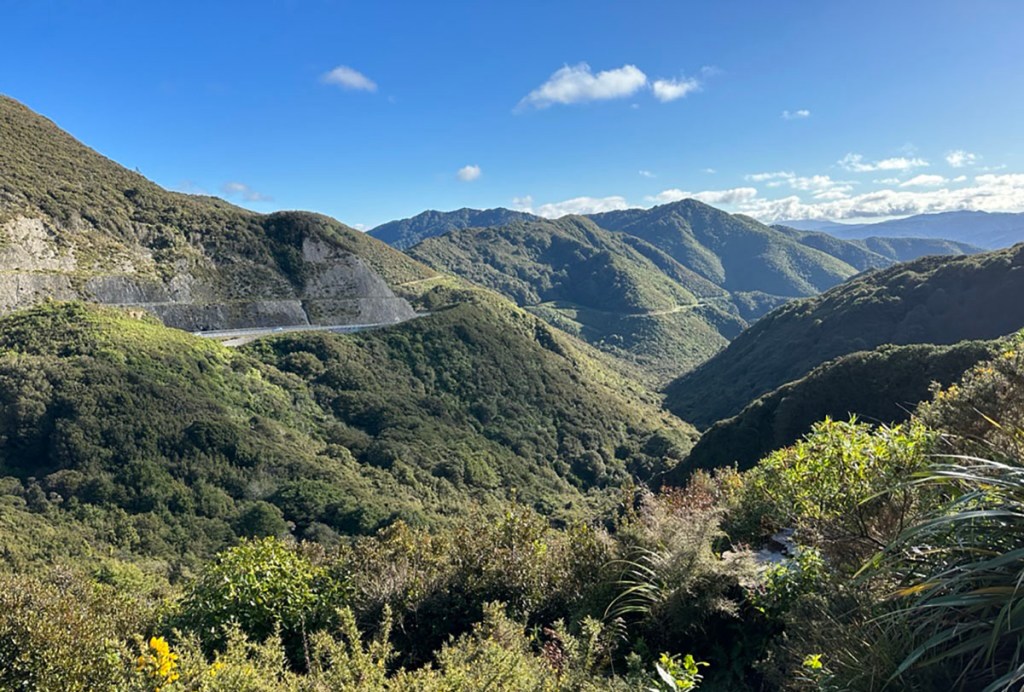
The next day we aimed to drive to Castlepoint, a light house on the furthest point on the east coast of the North Island. According to the car map, the trip would take two hours. Yeah. No. The only road out of Wellington led into the mountains and over Remutaka Pass.
The highway traversing Remutaka Pass
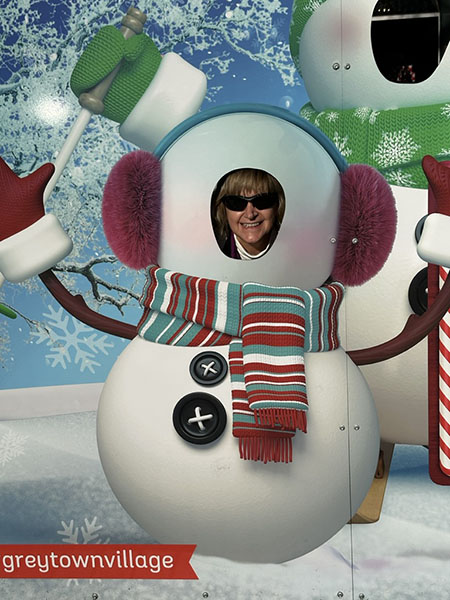
It was a harrowing road, with about 20 miles of winding curves, carved along the edge of the mountain. Being the only road over the mountain, traffic was heavy, making it even scarier. But it was worth it because on the other side of the mountain we drove into The Wairarapa, a rural area to the east, where we found quaint small towns including the quaintest town in New Zealand, Greytown. It really is a place you want to stop and walk, with lots of Victorian style homes and storefronts with gingerbread trims, spindles, and finials galore.
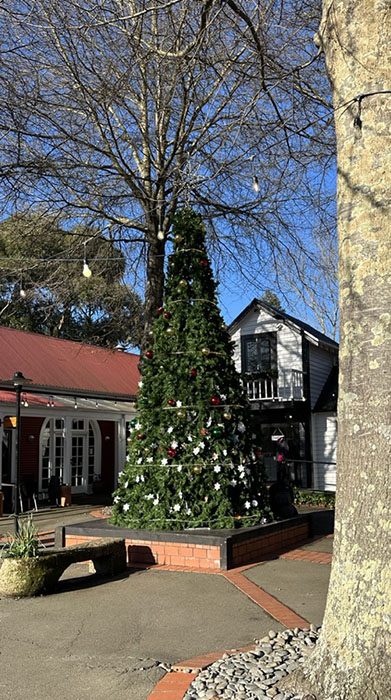
We happened upon the last day of the Greytown Christmas festival. Yes, Christmas in July. Remember, it is winter here. In New Zealand and the southern hemisphere in general, Christmas in December means it is at the height of summer. To fend off the boredom of winter and to use winter to actually enjoy a cold Christmas, some places celebrate Christmas in July as well. We played along and bought a few Christmas ornaments. We stopped in the local bookstore and bought too many books that were put in a bag that said, “I might just keep these for myself.” Amen.
We never did make it to Castlepoint. The car’s prediction of two hours was completely inaccurate. It will surely take the entire day to get there and back. Next time, we will go early and plan on stopping at Greytown again.
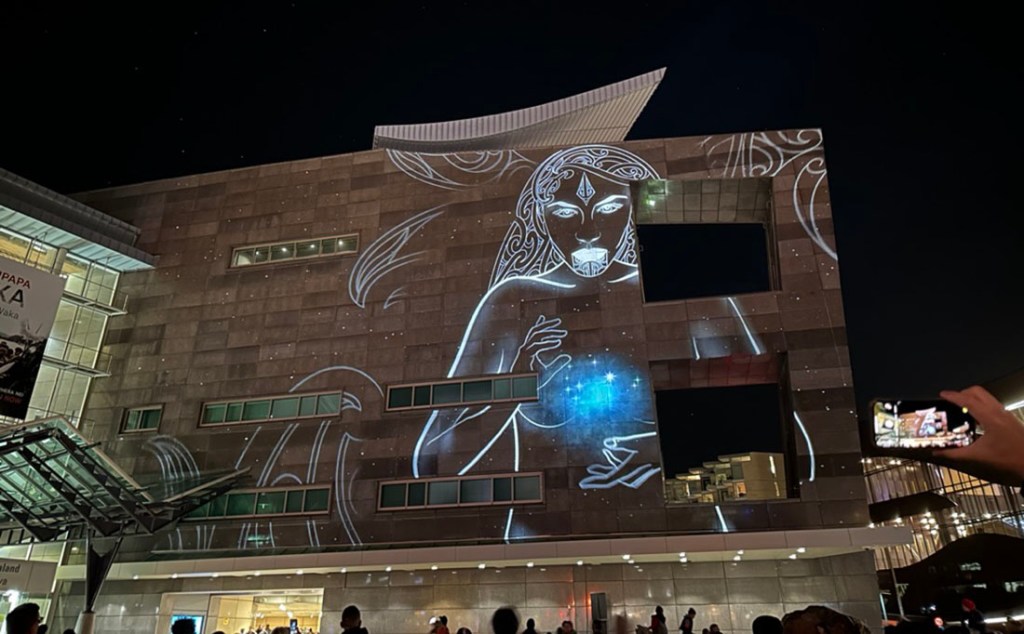
Video explaining Matariki on the side of the Museum of New Zealand Te Papa Tongarewa Holding the Pleides
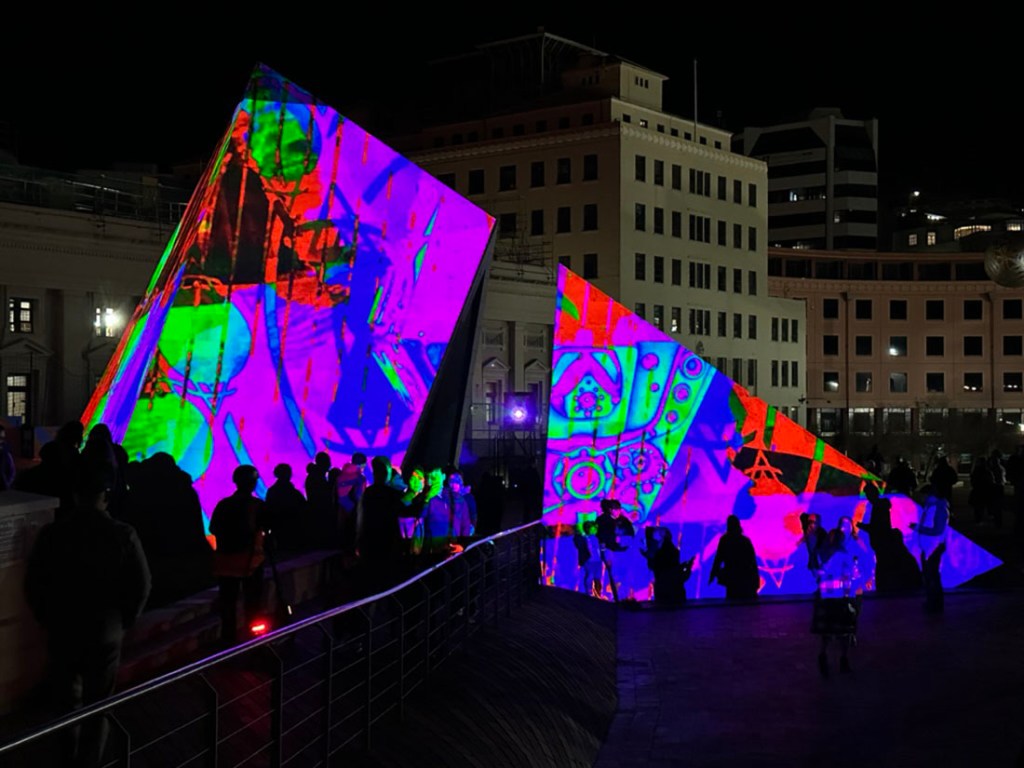
Matariki is the Maori New Year, which has been designated a public holiday in New Zealand. Matariki is the Maori word for the Pleides, the star cluster we know as the Seven Sisters. It rises in the morning of Matariki and is considered the start of the new year. Wellington had a week long celebration with evening light shows at the harbor. They had multiple art projects including the projection of videos on the buildings and on the water.
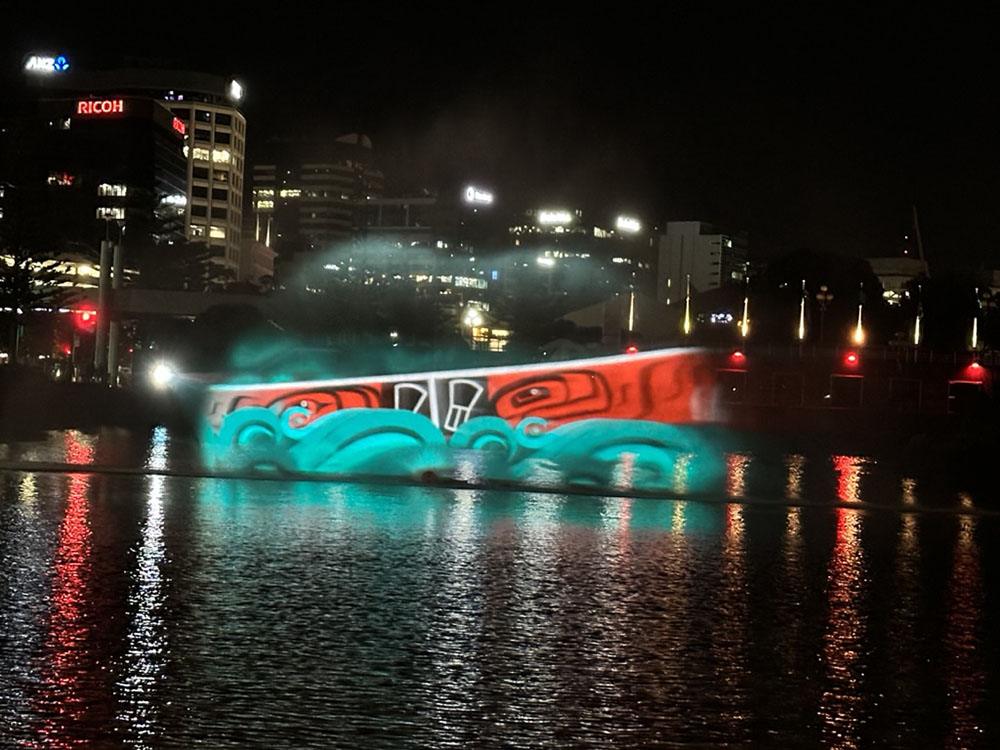
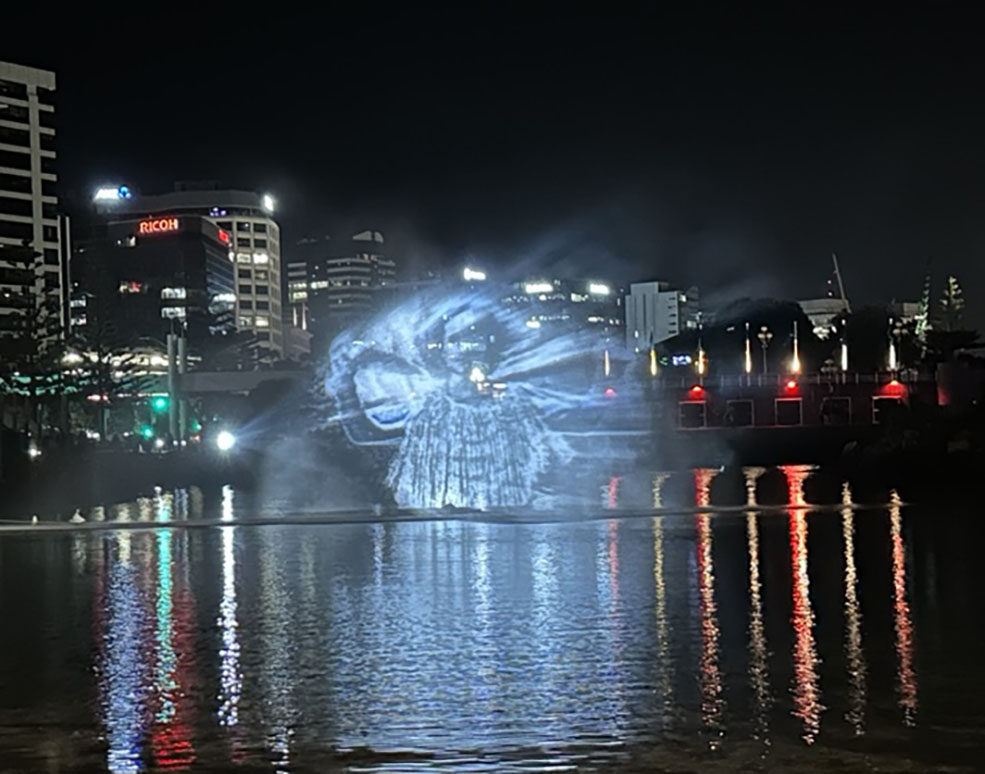
Video projected on a water spray in the harbor. Note the resemblance of the image to Pacific Northwest Indian art and designs.Another video projection on the water spray.Lights projected onto buildingIn front of the lights
To me, the interesting part of this celebration is the willingness of the Europeans, as non-Maoris are called here, to embrace the culture of the Maori. It began in the 1960’s and 70’s when the Maori began to protest their living conditions and place in society. By the 1970’s, there was a movement to have New Zealand live up to the promises of the Treaty of Waitangi, a treaty in which (no surprise) the British tricked the Maori into giving up their sovereignty and ceding their territory to the Crown. Since then New Zealand has been negotiating with tribes or “iwi” over land settlements and other issues related to that treaty. This has led to a renaissance of Maori culture and the incorporation of that culture into the mainstream.
This embrace includes recognizing the language and significant cultural events. Early in the 20th century, New Zealand had enacted a Maori Suppression law, that included forbidding the speaking of Maori. This has completely changed. The country is bilingual with Maori recognized as the official language and English as the de facto language. The stated purpose of this language law is to save the Maori language from extinction. All government signage is written first in Maori and then in English. Maori language and culture is taught in school. Many Maori words are used interchangeably. For example, the country is known as Aotearoa New Zealand. Aotearoa, which means “land of the long cloud,” is the Maori word for the country. Everyone says “Kia Ora,” which means hello. But it means much more than hello. It is the recognition of a person’s life force and spirit. Other words commonly used include the Maori word for “family” or “whānau,” “kai,” which is “food,” and “Haere rā,” which is “goodbye.”
You can make of this what you will. I am just an outsider looking in and I do not have the history or the background to judge any of it. I can only go with what I sense now. Ideally, it is the “Pākehā,” or Europeans making amends for the troubled history here and agreeing that the land is the home of the Maori as much as the European settlers. As such, their culture and heritage need to be considered part of and important to New Zealand. From what I have read, the majority of New Zealanders agree with that sentiment. A cynic would say this is just the Europeans allowing the Maori culture and language to be recognized as an act of benevolence, although they, the Europeans, are still in charge. And no doubt there are traditional Maori who think the Europeans have too much power and Europeans who think the Maoris have been granted too much input into New Zealand heritage. This is the dynamic that many countries with indigenous populations have. But still, I do think that the intention of the New Zealand government and people is to be welcoming and inclusive in a way that honors Maori culture by making sure it thrives.
Matt and I took off for the Cook Islands for some R&R. I am exhausted from the past year, and we will be moving again soon to our permanent house once our stuff gets here. I needed a break before the next phase begins. Plus, we went from winter to winter. While the weather here has been warmer and more pleasant than normal (thanks climate change), it is still winter, and I am so over sweaters and coats, and the cold and dreariness. It would be nice to be in perfect 78º weather.
Cook Islands is a country made up of 15 islands in the Southern Pacific Ocean. It is “Polynesian,” which translates to islands, coconut trees, and beautiful blue water with coral reefs. Like most island chains, the Cook Islands were formed by ancient volcanos. As the volcano is swallowed by the earth and sinks, what is left is islands and an atoll from what was once the rim of the volcano. The atoll acts as a breaker and the ocean inside the breakers or reef becomes a lagoon.
About four hours flying time from New Zealand and far out in the Pacific, the Cook Islands were once a protectorate of New Zealand, but they gained their independence in 1974. New Zealand still sees to their protection in the sense that if needed, they will send in the troops/. Its main industry is tourism, and it serves as a vacation spot for Kiwis and Aussies.
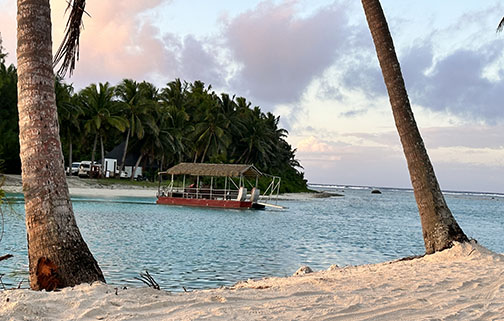
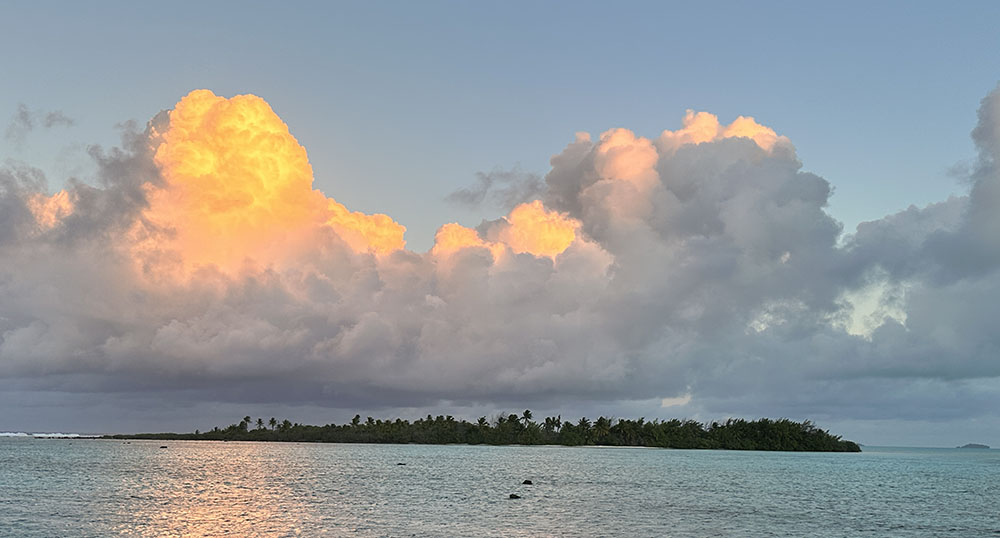
The largest and main island is Rarotonga. We booked an over-the-water bungalow on a smaller island, Aitutaki, that required another 40-minute plane hop from Rarotonga. The island is very rustic with no real town to speak of, just a few small stores and a harbor. But that did not matter since we were preoccupied with getting out in the water. Aitutaki is the ideal—one of several smaller islands surrounded by an atoll that forms a huge lagoon with very shallow water in the middle of the reef making for easy snorkeling and swimming. Our resort, the Aitutaki Lagoon Private Island Resort, was on an even smaller island separated by a channel from the main island of Aitutaki. A little ferry shuttled us over a channel to get to the island.
ferry to resort
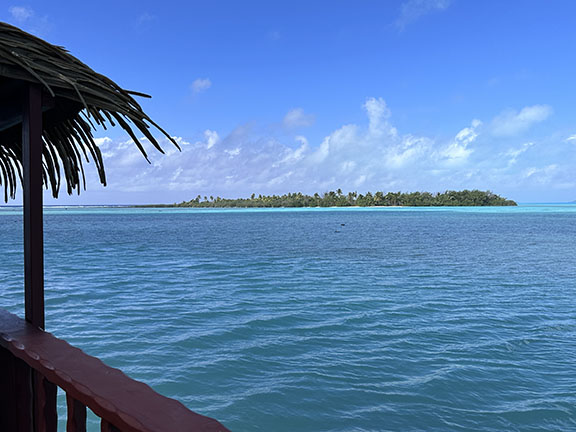
Our bungalow was at the end of the row leaving us with the water to ourselves.
View from the bungalow
We should have been able to jump in the water from the deck and go for a swim. Unfortunately, we were very near the ocean breakers at the reef and there was such a strong undercurrent in front of our cabin it was almost impossible to swim against it. I tried to snorkel but could not stay in one place long enough to see the fish. I either could not move forward, or I was pushed back. But we soon figured out that if we faced the right way we could just float with the current along the shoreline, no swimming necessary.
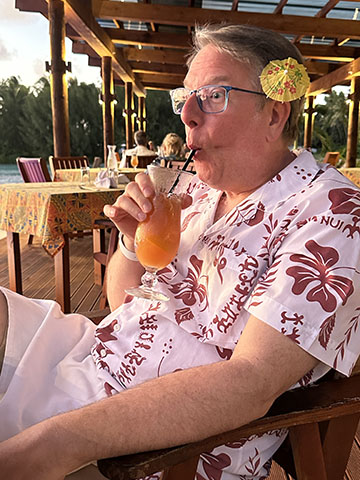
The food at the resort was excellent, much to our surprise. The only problem–and to call this a problem is ridiculous–the catch of the day, every day, was fresh tuna. I stopped eating fresh tuna years ago due to overfishing and general degradation of the fishery. But they had tuna in spades as their daily catch. We had no choice. It was delicious and cooked perfectly. We had seared tuna steaks, fish and chips made with tuna, tuna curry, and tuna steaks again. We ate so much fresh tuna I think tuna oil was coming out of my pores.
We did not have a car while on the island, so we had to rely on the local taxi service run by Auntie Rima. She would take you anywhere on the island for $10 per person. Auntie Rima was a kick. She talked a lot about the goings on in Aitutaki. She knew everyone and everyone knew her. Like Eva Gabor, she called everyone “darling,” and somehow that sounded right. In any other world, she would have been the mayor. As we drove along, she pointed out things of interest, the highest vantage point on the island, the local school, the new hospital, the 24-hour store. That store was a big deal. Yeah, there is not much doing on Aitutaki.
While we spent a lot of time doing nothing, we did go out on the water. Our first outing was whale watching. The tour offered a chance to swim with the whales, which meant getting into the water with our snorkel gear and watching the whales underwater. It did not work out that way. We did see whales, but they were not in the mood to play with us. Each time we spotted them, they took off, and we never did get to swim with them. That’s okay. It was fun being out on the water. The whales breached for us (sorry no pics) and one gave us a wave of his tail fin. We also spotted sea turtles bobbing along.
We signed up for a snorkeling trip with Kia Orana Cruises, a small boat with only eight passengers. When we started out the weather was not great, it was overcast with wind and periodic showers. The water was kicking up and there were some big swells. I don’t get seasick, and this was definitely a ride that would make a person seasick. Matt took some homeopathic drug that worked great. So even though the boat was bouncing like a bronco, we got through it soaked, but on one piece.
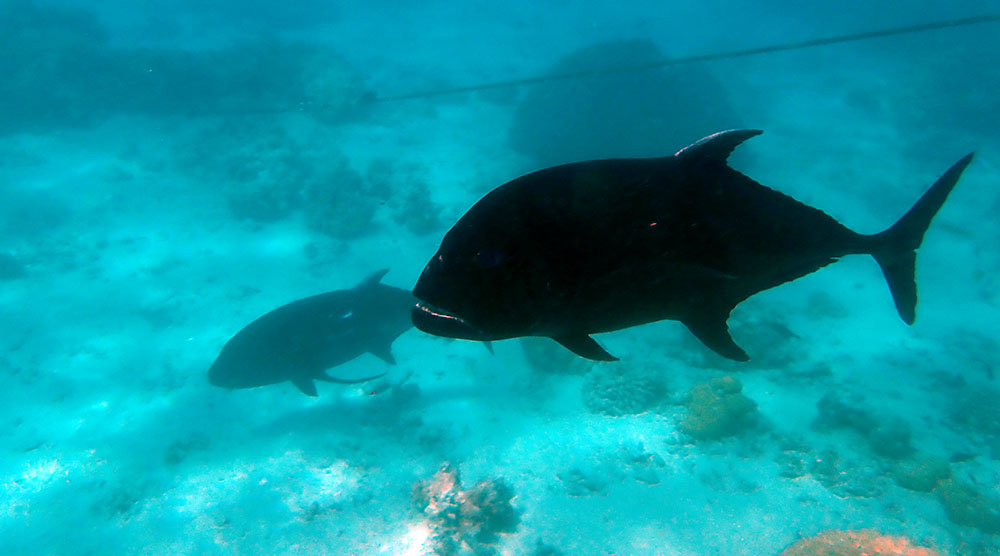
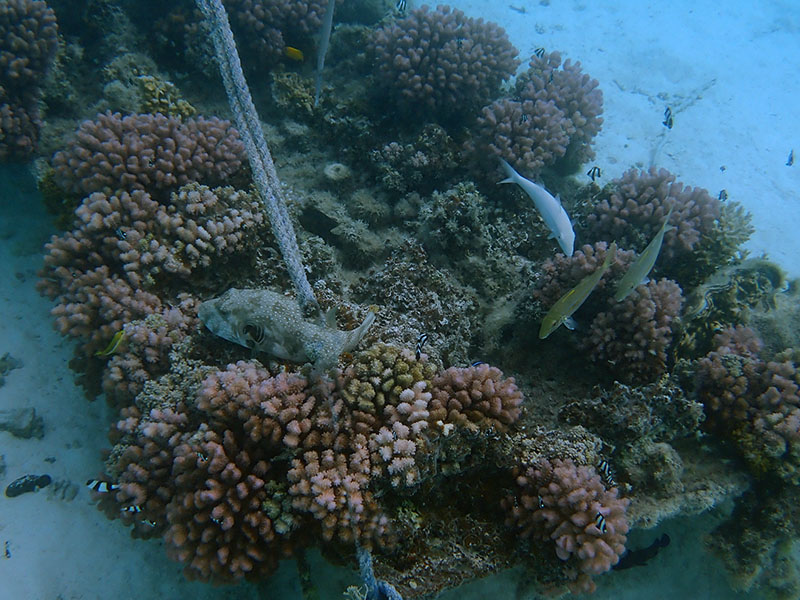
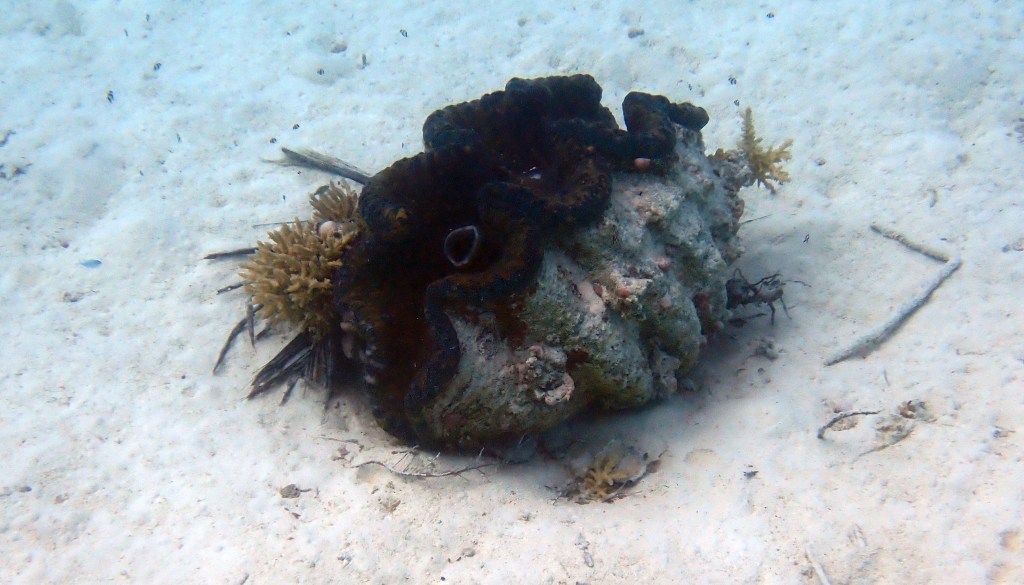
We visited four other islands, as well as a shipwreck for some excellent snorkeling with Giant Trevally, both black and blue fin. These are huge fish, some weighing up to 175 pounds and five feet long. They are also good eating when available.
Giant Trevally
small coral reefGiant Clam
We stopped on Maina Island for lunch with traditional Cook Islands food prepared by the captain himself. He served us grilled fish. I asked what kind of fish he responded “eating fish.” That it was. It was delicious. We also had paw paw (papaya) salad, sauteed bread fruit, bananas, and sea grapes, which were deliciously salty with a pop. If you like eating seaweed, these were great. (Me, I love seaweed. Seaweed is a staple in Japanese food and I have developed a taste for it. I eat just about everything Japanese.) During lunch, we watched hermit crabs sidle along to wherever they seemed determined to go.
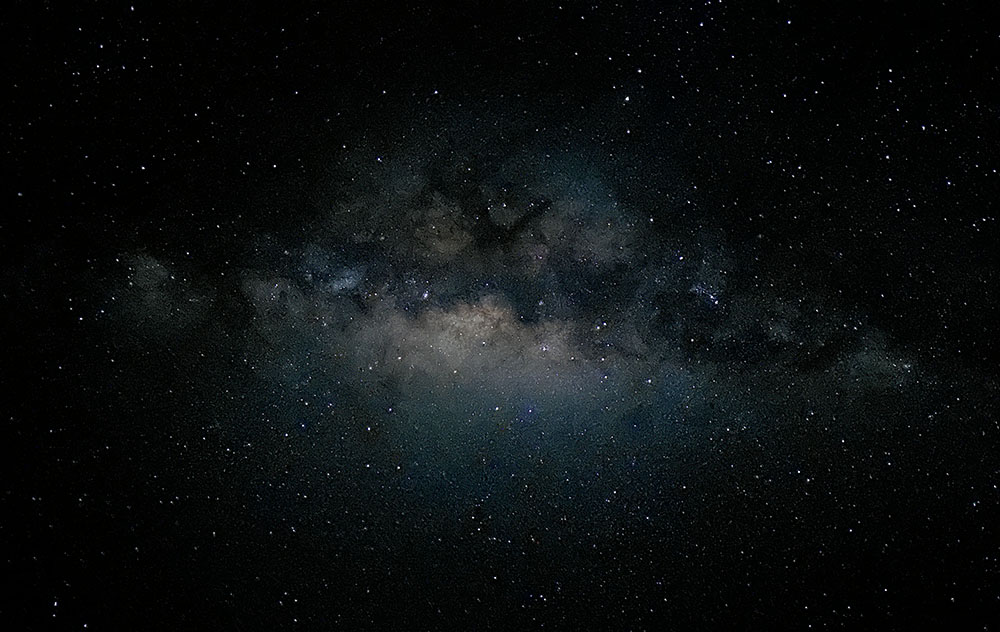
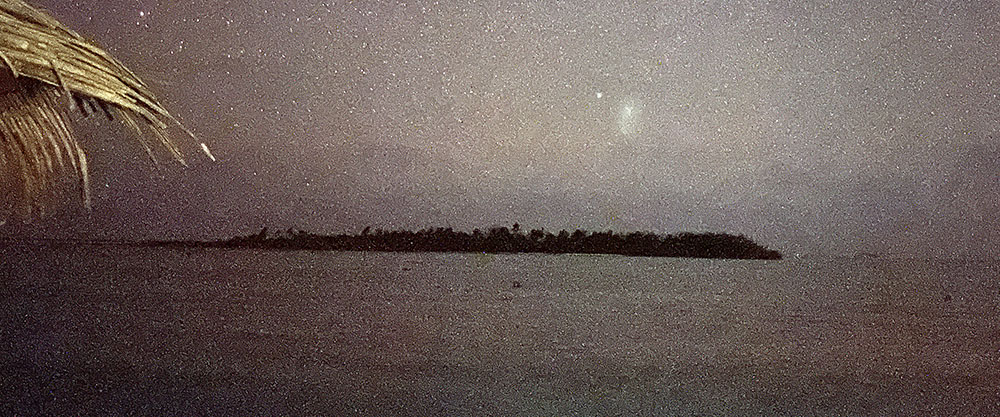
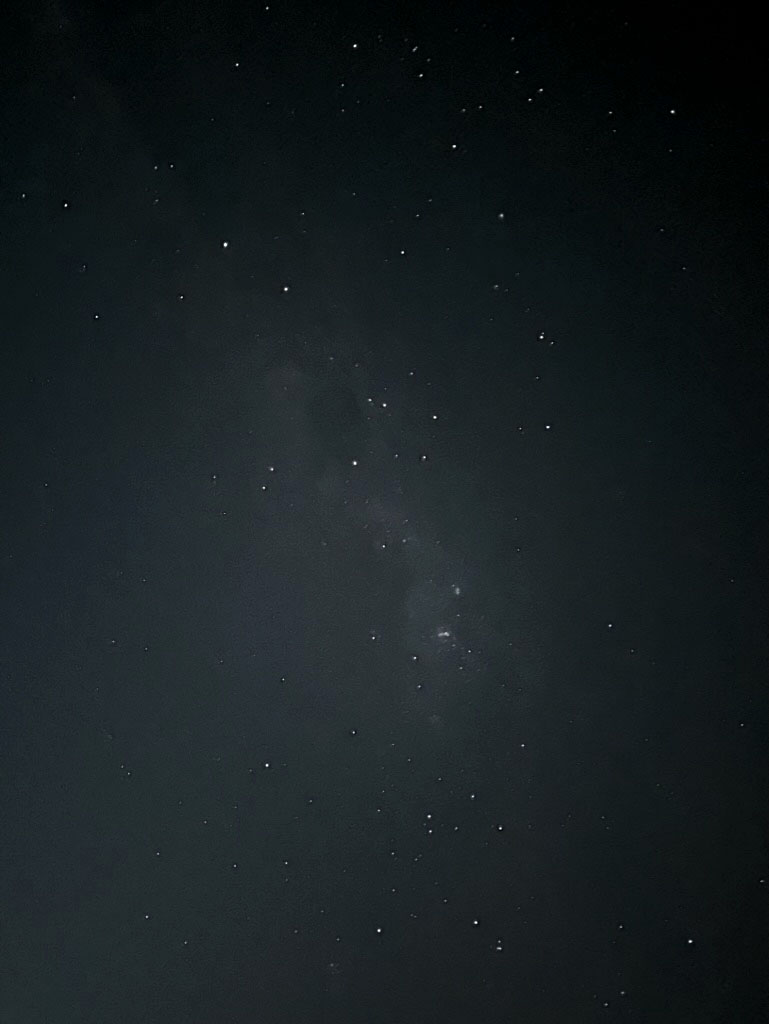
At night, we worked on our astrophotography from our cabin deck. It was gloriously dark, and I found out how good my iPhone camera is at taking pictures of the Milky Way. We have the core of the galaxy, in the second picture is another part of the Milky way with the Southern Cross and a dark nebula. And the final picture did strain my phone, but I got the Small Magellanic Cloud, a dwarf galaxy next to our Milky Way galaxy. [To think about all of the money and effort that people spend on this kind of photography and I did it with a simple phone is incredible. Once Apple figures out telephoto photography, I will never buy another DSLR.]
This is the galactic core, the center of our universe.More of the Universe. The Southern Cross, the main constellation in the Southern Hemisphere, used for navigation, is in the lower right next to the dark nebula.The iPhone captures the Small Magellanic Cloud, that fuzzy mass above the island.
All in all, the Cook Islands were beautiful and fun. I think it is a good bet we will go back and on our next trip there, we will stay on Rarotonga. I hope we will go fishing and play with sea turtles. I have a goal.
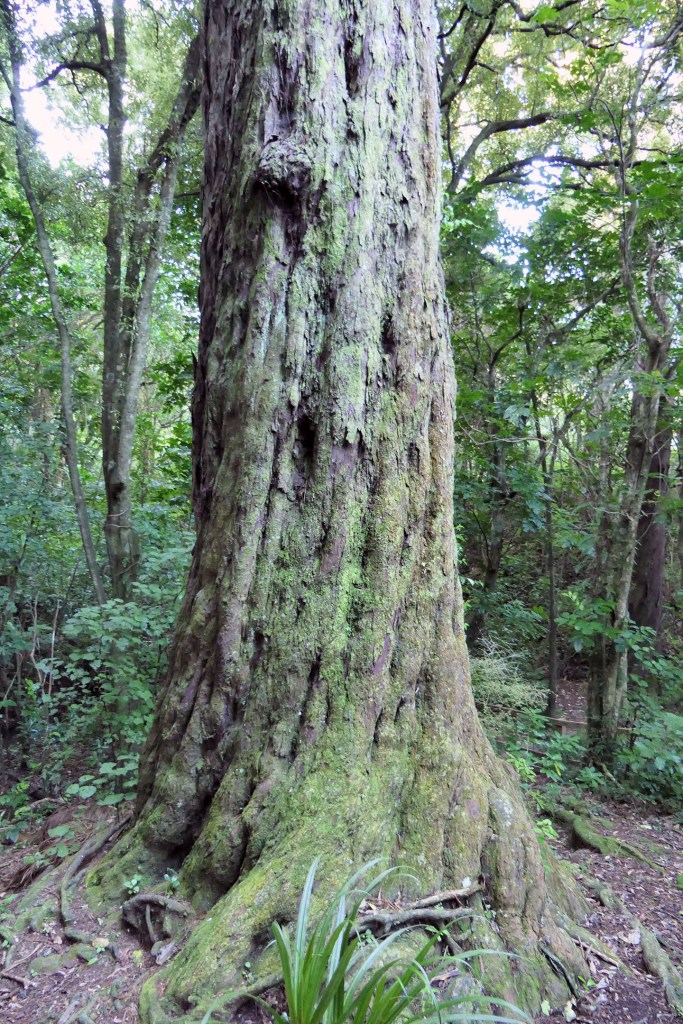
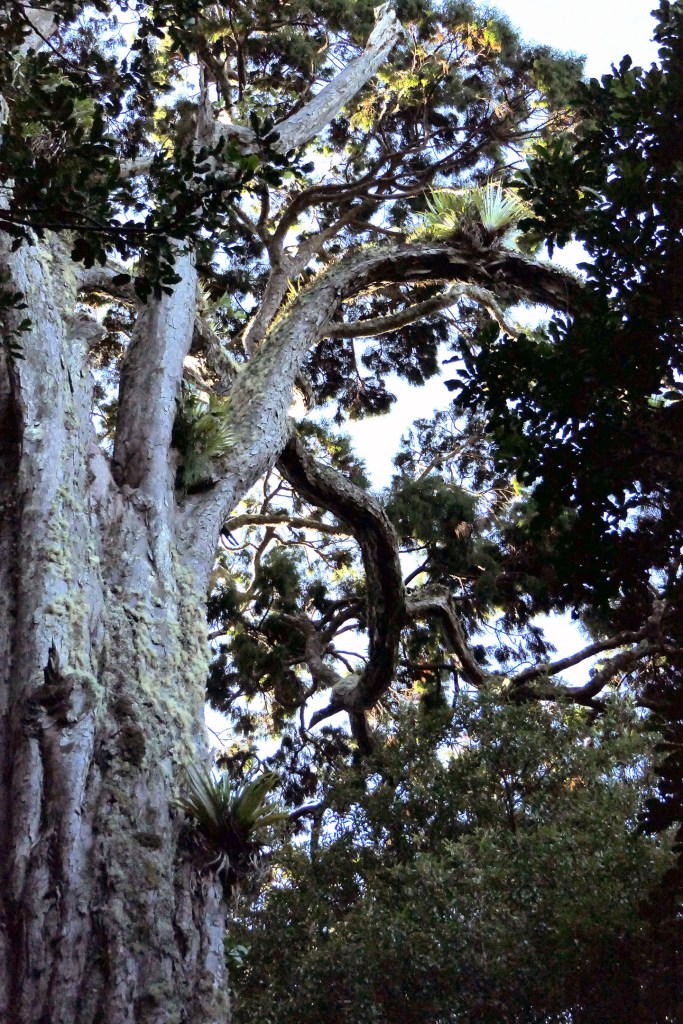
I went for a hike today in the Otari-Wilton’s Bush, a nature park in Wellington dedicated to restoring native plants and trees, that is pretty rugged and remote despite its being in the city. I had planned on hiking a loop trail that would have lasted two hours. But it seemed that some parts of the trail were closed off for repairs. I took a different path that led me to an 800-year old rimu tree (red pine), a tree native to New Zealand. This tree was already 400 years old when Captain Cook showed up in 1769 to claim New Zealand for Britain. (Why did they not kill him when they had the chance?) It was 500 years old when the Treaty of Waitangi was signed in 1840 in which the Maoris ceded to the Crown their sovereignty and their right to lands, but did not know it. The tree wept that day. The tree has seen the Maori regain their rights a little at a time and get compensation for and recognition of their losses. Who knows what it might see in the future if climate change does not kill it first?
Matt and I went to our first Wellington restaurant—Hiakai, serving Maori cooking inspired food. Hiakai means hungry, craving food, and boy were we. The chef, Monique Fiso, develops recipes using traditional Maori ingredients—foraged plants, usually leaves from trees and shrubs, garden grown vegetables like sweet potato and taro, seafood, and, of course, lamb. We even had a taste of tītī (aka mutton bird or the sooty shearwater), a Maori delicacy I tried the last time I was in NZ.
The dinner took three hours. Chef Monique came to our table, (and each diners’ table) to explain the dish and its meaning in Maori tradition. She gave us a better understanding of what was in the dish and why. That was a very interesting and personal touch. We discussed each taste and we got to ask questions. (Let me just say, never would a U.S. chef come to the table and explain each course in depth. That is left to the waiter.). We had eight tasting courses and the additional wine and drink menu which had some fun surprises. I think our favorite taste was the Pāua, or abalone, with a foraged marsh cress and lemon. If you like shellfish, it was the bomb. One course was a potato in the shape of a scallop topped with a bit of sea urchin to give it a sea flavor. We learned that scallops are endangered in NZ waters due to overfishing. This presentation was intended to remind us that this delicacy is not available in NZ. Plus it had sea urchin so that was a plus for us.
Our view is that if the food judges at Michelin went to New Zealand, and they do not, this restaurant would warrant at least one star.
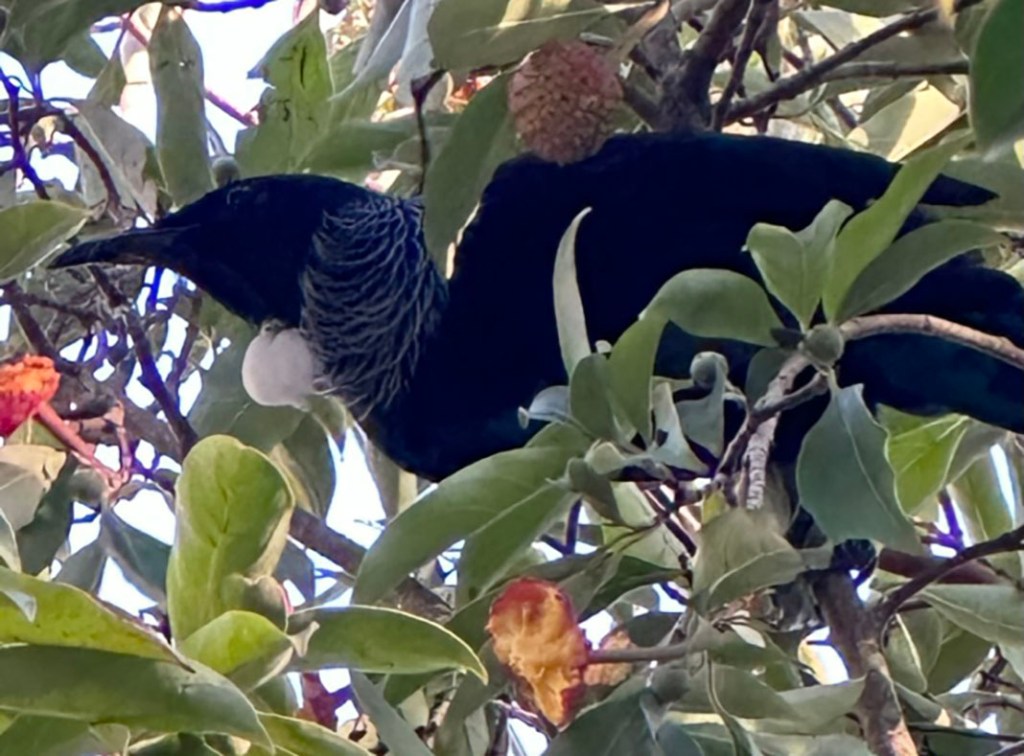
This is a tui, the mockingbird of New Zealand. It has two little white feather balls or tufts hanging from its neck and a comb. They are black iridescent in color.
It imitates other birds and just random snippets of sounds. Certain sounds–bells and beeps and squeaks and whirs–remind me of Artoo Detoo. The link will let you hear them. It is really charming. They were nearly wiped out by the 1990’s with only a few pairs left (thanks to predators and I am looking at you neighborhood cats). But with a concerted effort at restoration they now number in the thousands. You can hear them everywhere beeping and exiting bell-like notes.
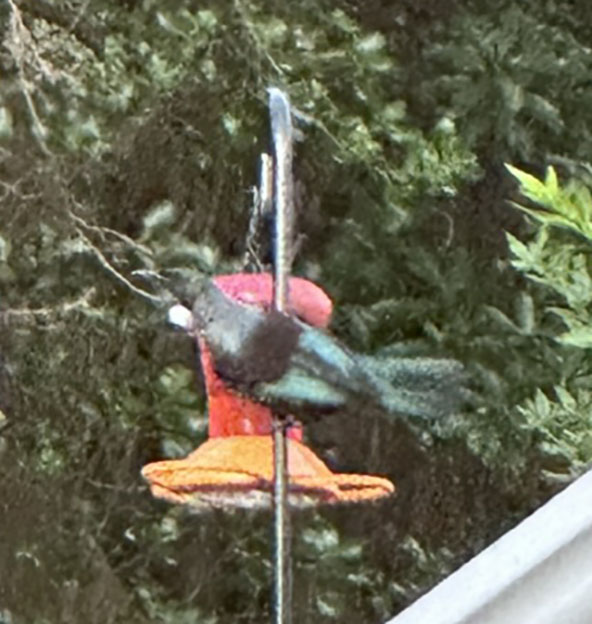
They love nectar. I put out some feeders and they have started to come by. (He was far away and so the picture is blurry. Sorry. I’ll post a better one if I can get him to stand still. He is a flitter.)
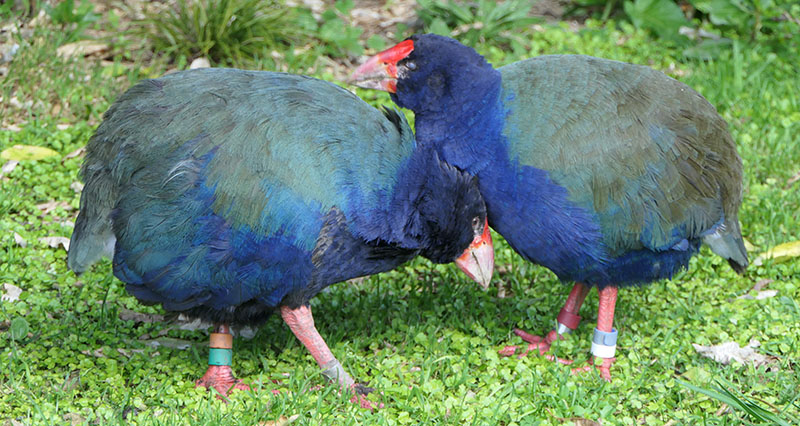
Another still endangered bird we saw at Zealandia was the takahe. Flightless and looking pretty darn clueless. If you are a flightless bird, unless you have some kind of defense through claws, it’s a tough life. All you can do is run. They are working at increasing their numbers by keeping them away from predators and hoping they breed.
[I know I talk a lot about food, but what do you expect from a cook?]
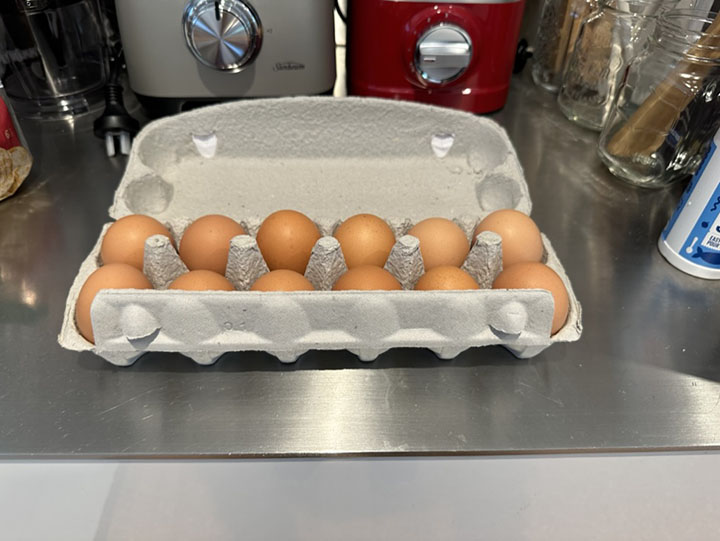
Eggs are not refrigerated here. Yep. Here they are sitting on my counter.
As you browse through the grocery store and eggs are on the shelf in the egg aisle. Matt was a bit freaked out by this, but he discovered the explanation—Americans have to refrigerate their eggs because we wash them after they are laid.
Eggs have a natural protective coating on the eggshell that keeps the egg inside stable preserving water and oxygen while it prevents bacteria from getting into the egg. Washing this coating off results in the eggshell being compromised and any tiny crack can let in bacteria. So once washed, they have to be refrigerated to keep them safe to eat. The U.S. is actually one of a a handful of countries that washes eggs. Imagine that. We are the paranoid ones on this.
The eggs are washed because of a fear of salmonella. Salmonella can be passed from the hen to the egg while the egg is forming and people have been sickened from salmonella infected eggs. This is why they tell us not to eat raw eggs. Washing the egg is meant to clean way any potential salmonella. But the salmonella is inside the egg, so why bother? Aesthetics of course. No one wants to see a dirty egg.
In countries where they do not wash eggs, they either vaccinate the hens keeping the egg salmonella free or, in the case of New Zealand, being an island, there is no salmonella. (There was one outbreak that they quickly addressed. The theory is that is arrived by an infected human or bird.) So I am free to eat raw eggs here if I want and I will not have to worry about salmonella.
If the hen has not been vaccinated, and in the U.S. we do not vaccinate, due to its cost and complexity (of course it is all about cost) then there is still the chance of being exposed, egg washing or not because the salmonella is already in the egg or the eggshell has been compromised somehow.
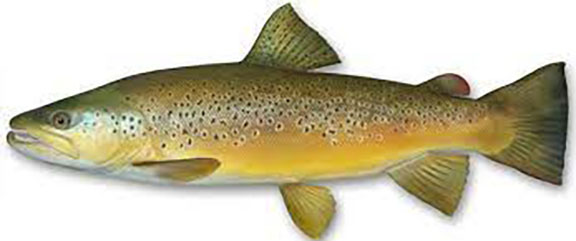
I have been searching for interesting fish for dinner and figured I would find some trout in the grocery store. But I did not see trout anywhere. I was completely puzzled by this because New Zealand is known for its trout fishing. Brown trout and rainbow trout are an introduced species, but they thrive here because there are plenty of streams and there are no predators. It is a huge recreational economy, with fishermen from all over the world coming in for some fly fishing. So I know there are trout here. Why could I not find it?
There was a guy here doing repair work and I asked him if they had trout. Maybe I was wrong. Yes, he confirmed there is a trout fishery here. And then it dawned on him: no, he had never seen it in a grocery store and he did not know why.
I did some investigating and the answer is surprising. The sale of wild trout is illegal in New Zealand. Trout farming is also prohibited. There is no prohibition on the sale of imported trout except for the fact that importation itself is prohibited. Thus, you can neither buy trout at the grocery store nor order trout in a restaurant.
The reason for these prohibitions has to do with the value of the recreational fishing industry. The New Zealand trout industry is “wild” trout. The fishery is not sustained and managed by stocking fish. So they are very concerned about the impact if people were allowed to take their catch and sell it. They fear poaching would occur to a degree that it would decimate the fishery. There are a lot of folks who are employed in the industry, and it generates millions in tourism dollars. They claim this is a delicate balance and that if they stocked they fishery, it would harm its value as a wild trout fishery. And they are adamantly opposed to farming trout for fear of disease that can be generated in farming pens. They also see a similar issue with any sale of farmed trout–it would be impossible to determine if wild trout were being poached and sold as farmed trout.
In a study I read, they acknowledge that people want to be able to buy trout. They also acknowledge that trout farming is economically beneficial. They know that many other countries have commercial trout fisheries. They have a farmed salmon industry here and the wild salmon fishing industry does not suffer from poaching issues. But all of this is discounted because their fear of damage to the wild fishery and to the tourism industry outweighs all of this.
Despite their claim that the fishery could be quickly decimated, it is hard to imagine because there are so many trout. This is not a threatened species by any means. There are places where the per day bag limit is eight fish and in some places there is no limit at all. Most other areas you can take two trout a day. The season runs from October to April.
This does not even get into the fact that trout are an introduced species and they are not great for the environment. They have been decimating native fish species.
But tourism dollars rule on this one and the Government seems to be quite comfortable depriving non-fishing Kiwis of a great fish so it can be made it available to tourists. Yes, anyone can go fishing and if they catch a trout, they get to eat it. But not everyone fishes. They encourage catch and release which also impacts whether a New Zealander gets to eat what he catches. It all seems quite unfair.
Well, I guess the only way I get to enjoy eating trout here is to learn how to fly fish. If I can’t land a trout, I will be deprived for years to come, which is very sad.
Matt and I joined the Wellington Astronomical Society because we love learning about astronomy, and we want to learn about astrophotography. After the last meeting, we were chatting with a woman who, when she found out we were from the U.S., asked if we thought it odd that we could not see the north star? I had not thought about it really, but she explained that she had learned to navigate her boat by using the stars and wondered if we knew where to look.
I did not have the heart to tell her that I can’t tell my right from my left let alone trying to figure out where north is using stars. Then she said something that really blew our minds. She asked us how we felt with the sun being in the north. I had no idea what she was talking about. But Matt had come home one day and said he did not understand why the sun is in the wrong place. It did not look right to him.
She explained to us that in the Southern Hemisphere, the sun crosses the sky in the north, and it goes from right to left. My response? I turned into Bill & Ted–No way! Yes way! Think about this. You folks up there in the Northern Hemisphere–find the southern exposure of your house. you know that on the south side of the house, the sun shines all day. In addition, the sun rises to your left and crosses along the south to the west which is on the right.
Here in the Southern Hemisphere, the sun does the opposite. It is the north side of the house that has the sun all day and the sun travels from right to left. There is an explanation as to why this happens. I found several websites on the subject, but I did not understand it and certainly cannot sum it up. (I admit I am not the smartest when it comes to math.)
This then raised in my mind the simple question, does that mean the moss grows on the south side of a tree? The answer is yes, the moss grows on the south side of the tree.
As for the rest of the sky, we will have to get used to the different constellations. There is no Little Dipper here but there are many more significant stars to see, and much more of the universe is visible from the Southern Hemisphere—the Milky Way, plus other galaxies, a few nebula are all fairly visible in a dark sky. We will certainly spend a lot of time getting to know that sky.
In the Southern Hemisphere you can see the galactic core of the Milky Way. It can be pretty dark here and we figure that taking great night sky pictures should be pretty easy here. Matt signed us up with the local Astronomical club to learn more about astrophotography. But just for fun, we decided to go into the backyard and see what we might shoot. I took the picture above with my iPhone. I was not even using a tripod. It is a little blurry. but there is the Southern Cross and the faint Milky Way. If we can see that much of the Milky Way in the backyard, going to a dark sky park is going to be awesome.