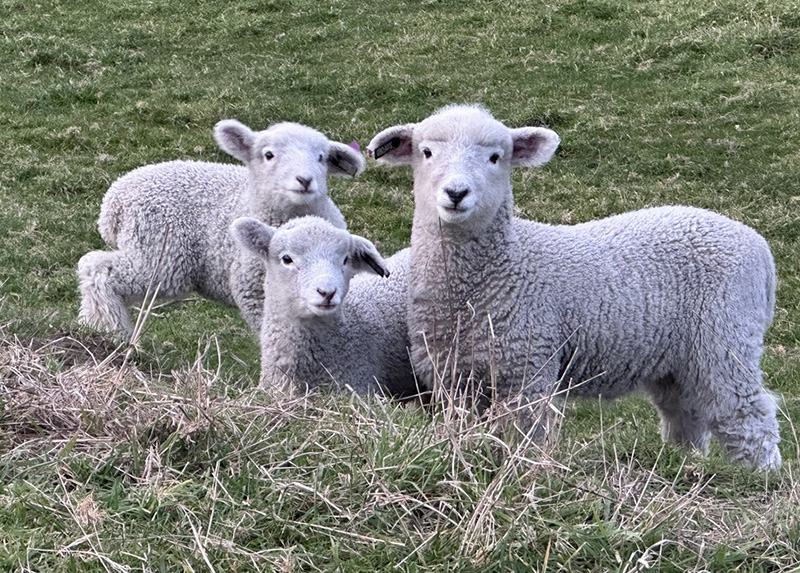
It is late winter and the young lambs are being born. I will never tire of seeing these adorable babies. And I am not the only one who feels that way. The other day I sat at the window and watched a toddler who had brought her young lamb to visit the beach. Now I have seen dogs. And I have seen horses. But never a lamb. She did not have it on a leash, and it was being completely uncooperative because it was too busy eating grass. So she tried to pick it up and carry it toward the beach. The lamb was as big as her. She pulled it up putting her hands in its armpits( Do lambs have arm pits? Leg pits?). The lamb’s body stretched to the ground. She stumbled along, as the lamb’s legs kept getting tangled in her own. She finally gave up and left it to graze while she ran toward the ocean. Mom came back and picked it up. They disappeared over the dune, and I never did find out if the lamb went into the water.
During the winter the heating situation in NZ is well, …challenging.
I am shivering, absolutely shivering. My home weather station tells me that it is 4C outside, a balmy 39F, and inside it is 17C (62F) and in the kitchen, it is 15C or 59F. Why is my house so cold? Did the electricity go off? No, it is something much worse, something unbelievable in this day and age but here we are. It seems that many or even most houses in New Zealand–like the one we live in–have no central heating system. Huh?
Yes, no heating system. It might be a relic of the old days when energy was expensive and people were hardy. Maybe it is something British. Gosh knows when I watch British television shows everyone always looks cold. I am not really sure. But the standard here is to heat the house by room, mainly the room that everyone occupies, the living area, and the rest of the rooms are either unheated or are heated as needed. How do Kiwi’s stand this? They are taught it from a young age and the answer is very practical—put on a sweater and close the curtains. You’ll get used to sitting inside without heat if you are dressed as if you are outside.
For us, this is insane. It is cold! Who wants to sit around in outdoor winter clothing? When we first moved here, we lived in a house that had radiators on the walls. They seemed pretty modern. But we soon learned another truth about NZ houses. The windows are kind of useless. In the house with the radiators, it should have been warm, but the windows were the original from say the 1940’s—wooden frames, single pane, and leaky as hell. Wellington is windy and the breeze coming through the closed windows actually rattled the blinds. It was cold. Simple as that. I had to sit next to the radiator to keep warm.
When we first moved into our current house, the only source of heat was a 25 year-old gas stove, a fake fireplace, that sat in the living room. It was downright scary. To turn it on you had to wait for the gas to flow through the line and then let the electric starter click. It clicked and clicked and clicked until boom! The now flowing gas ignited and the flame would burst out. It was terrifying. The fan rattled so loud we could barely hear the television.
We complained to the management about the danger of the stove. The gas fitters would come by, do their checks and certify that it was perfectly safe. I had a sense that they did not want to say it needed to be replaced because that would cost the landlord an arm and a leg. So they tried to clean it up and make it run better just to reassure me which it most certainly did not do. It was obvious that the stove simply needed to be taken out and shot.
Of course, setting aside its safety, one gas burner stove had no capacity to heat the entire house which meant the rest of the house was unheated– no heat in bedrooms, no heat in bathrooms. Our only option was to go out and buy space heaters for each room. It does work but it is expensive. Electric is not cheap here. So we tried to use the gas stove and just supplement with heaters. In the end, we were cold all of the time.
The manager defended the situation saying New Zealand only requires that one room be warm. Let’s contemplate that for a moment. If you rent a home, all the landlord needs to do is make sure one room is heated. What the hell is that? I finally contacted the owner directly and said, hey, we are cold. The guy lives in Texas so he at least understands central heating and cooling. He ordered the manager to arrange for heat pumps.
Now, I hate heat pumps. That name is a misnomer. If it is moderately cold, say in the 40’s, then it works okay. It isn’t forced air natural gas heating for sure. (God, how I miss that!). But when we get down to cold, the 30’s say, the pumps struggle and I find myself sitting under a cool breeze. I hate that! Even worse, they installed two heat pumps that are fashioned like room air conditioners. There is no vent system to spread the warmed air around the house. With one pump for the first floor, and one for the second, the house stays moderately warm. I no longer need to wear three layers of clothes. But because of the lack of venting, the unit on the second floor, located in a stairwell, does not heat any of the rooms. Add to that the fact that the windows in this house are old, singled-paned and leaky, I often find the bedrooms have fallen to the high 50’s, low 60’s. Brrrr. I know my brother would not mind this, but I am sorry. We like a warm house. So, we are back to using room heaters.
We are not alone. While this is perfectly normal for Kiwis, I have heard people like us, who have moved here from other countries, talk about the lack of heat with bafflement and, if not anger, a bit of fuming. The question is always the same, what is up with the heat? There is never a good answer.
So for all of you facing winter, think of how we spend winter here and thank your lucky stars for the heat in your home. In fact, turn it up!
While it was winter here in New Zealand, summer was full on hot in the U.S. and frankly I was looking forward to real summer heat. That just does not exist here. In New Zealand, if the temperature makes it up to the low 80s, they are complaining.
It had been two years since we were in the United States. (I know that sounds like a long time but when you are a senior citizen, the years just blows by.) We decided it was time for a visit back home. My sister was planning an all-hands-on-deck family gathering and we were on our way. We were staying in Annapolis as a sort of central point for Matt to go to some business meetings and see his family and for me to get some things done and to see my family.
So, after two years, how did it feel? The same but also very different. My first impression was, wow, people sure are angry and filled with attitude. Geeze. It felt like everyone was in a snit. I certainly understand why everyone is angry. But it pervaded the atmosphere. In New Zealand, few are angry (I’d say the indigenous folks are often not happy). But there is nothing here that really riles people up. Now I know some of you will say, wow that is great. Yes, but it can also be pretty numbing.
My second impression came when I drove on a highway for the first time in two years. The aggressiveness really put me on alert. I know we drive with speed in the D.C. area. But it felt like another magnitude. Going 70 made me the slowest person on the road. New Zealand is very different. People here think they are crazy, aggressive drivers. It is kind of quaint, and we have a good chuckle about it when it comes up. The reality is that they drive like maniacs on back roads where there is little room for error and they drive slow and steady on open highways. One reason is that the fines and penalties for speeding or doing anything suspect are harsh. Matt and I both learned our lesson after being pulled over for speeding. Basically, you pay a stiff fine and you get points based how far you are above the speed limit. That is normal. But if you get caught speeding three times in a five-year period, they take your license away. That will cause most people to chill.
Once we got our bearings, we did exactly what we came to do: buy stuff we can’t get in New Zealand and usually can’t be shipped here. By that I mean beer and wine. There are certain beers and wines we wish we had but are simply not available in New Zealand. We set aside a day of our trip to visit our favorite stores to stock up. I brought home a case of beer and a half case of wine. Yes, alcohol was at the forefront of our minds.
Then there were the many, many stops at CVS for sundries. Many items we might buy off the shelf in the U.S. are restricted or not available in NZ. If we want these things we have to get them shipped usually by Amazon and that is not cheap. So we stuffed our suitcases. For example, in NZ you need a prescription to get Sudafed. There are no cough suppressants here. They don’t have Benadryl. For me, I have certain skin allergies and I require fragrance free products. Those are pretty rare in New Zealand. So I cleared the CVS shelves of lotions and potions that I could use. When I asked my doctor here if lidocaine patches were available in NZ (I can’t remember why), she was stunned that such a thing even existed. So into the suitcase it went. I can’t even remember everything we lugged back but we were at the CVS just about every day because we would remember another thing we wished we had at home.
And then there was savoring foods that we cannot get in NZ. The grocery stores in the U.S. are marvels of abundance and variety and that just does not exist here. Everyone needs to appreciate this. The most important objective in my mind was cheese, one of my food groups. We bought a huge hunk of idiazabal cheese from Spain. Oh, the rapture. I savored American watermelon. They have watermelon here, but it just does not come up to the standards with which I assess watermelon. And peaches. God bless South Carolina and Georgia peaches!
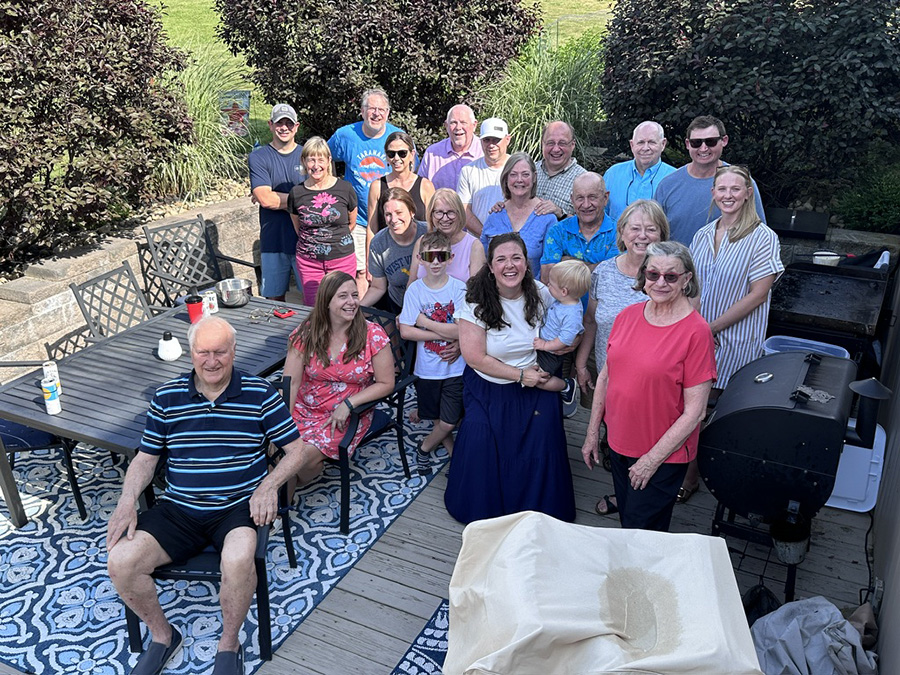
We also visited family and friends on our trip and we loved seeing everyone. My sister’s family barbecue was a great time. She managed to get 95% of us in the same place, a minor miracle. Here we are:
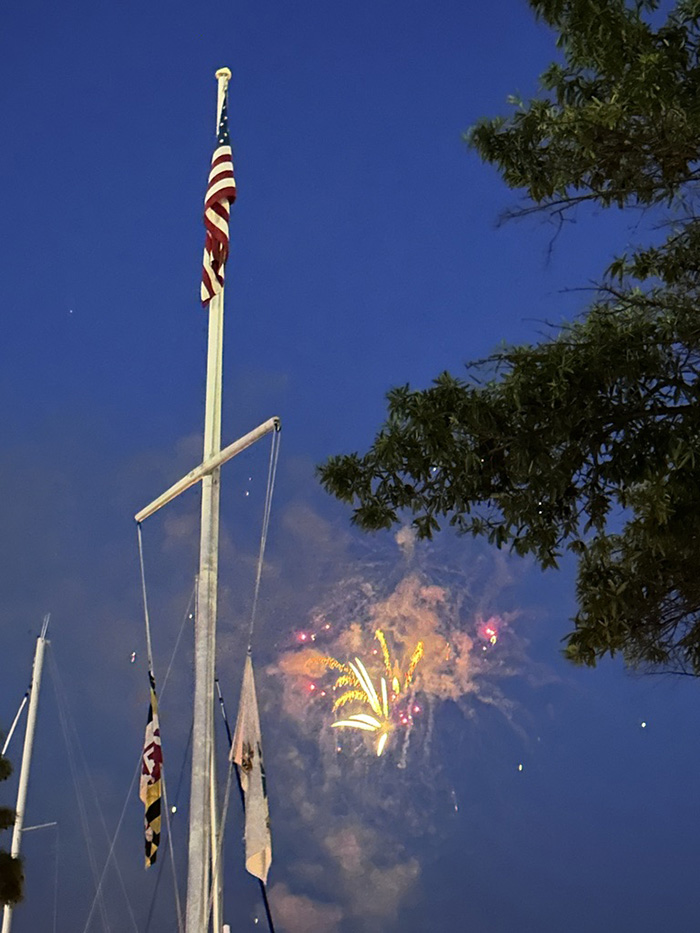
On the 4th of July we had a fun time with Matt’s family. And we even managed to see the fireworks in Annapolis.
So it was a good trip all around. But exhausting. The trip takes 32 hours door to door so it is not for anyone impatient with travel.
To spend time outdoors, some people like to hike. We go fishing. We like to catch fish, of course. We like eating them even more. But for me, the more important part of fishing is being in the outdoors on a river, lake, or the ocean just enjoying the sunshine and the breeze. We also use fishing as an excuse to travel.
First stop Christchurch. I had wanted to go salmon fishing. They farm salmon here and there are places you can drop a hook into a lake or river and the salmon are there ready to bite. I wanted to actually try to catch a wild salmon. We learned that some of the best wild salmon fishing is near Christchurch the largest city on the South Island. As of now, Christchurch is the second largest city in New Zealand, taking the mantle from Wellington. Known as the garden city (beautiful rose gardens), they have perfect weather for all things flowering. In 2011, Christchurch was hit with a massive earthquake and it decimated the city. Buildings collapsed or were rendered unusable, earth shifted, and lives were lost. We had visited the city in 2005 but we remembered little about it.
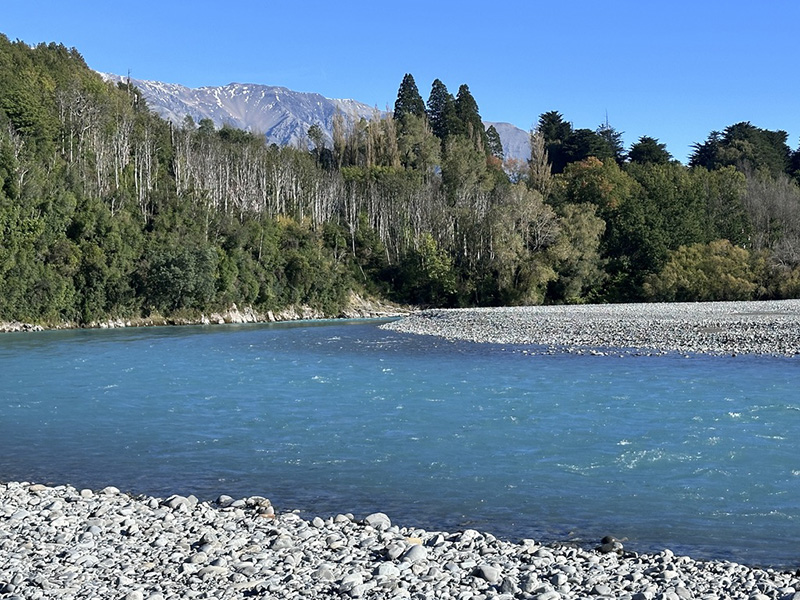
Unfortunately, we did not do much sightseeing because we had fish to catch. We had a five a.m. pick up time for a drive an hour south to the Rakaia River, which purportedly has the best salmon runs in New Zealand. The river is a braided river, which means the river moves according to flooding. The river is very shallow and rocky, so we had to be taken upriver in a jet boat.
We were de-boarded onto a spit in the middle of the river before dawn.
Yeah, fishing in the dark. Not fun. Kind of dumb actually.
The boat driver said see you in six hours and sped away. The guide was very upbeat even though it was still dark. We started casting into the dark water and we continued to cast for six hours with absolutely nothing to show for it but sore wrists. I was not happy to say the least. This was an expensive trip.
Great setting, bad fishing
What really ticked me off was that after we returned I did more extensive research and I learned that the salmon fishery on that river has all but collapsed. There are few fish to be had and the guide had to have known that. I felt like it was false advertising. Oh well, I learned something. Do more research before we make the effort.
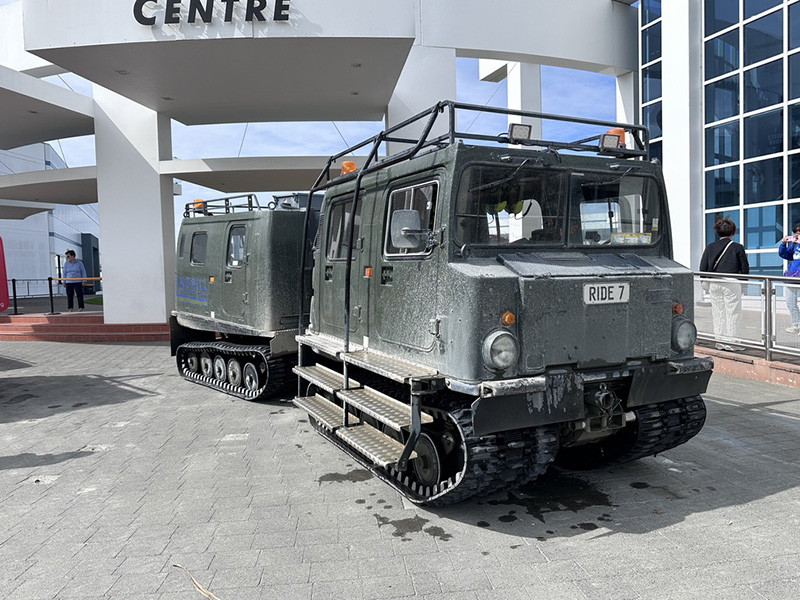
We still had a nice dinner in Christchurch and we visited the International Antarctic Center. This is an interactive museum/penguin research facility where you can learn all about living in the Antarctic. We took a very bumpy ride in a Haggland, the all-terrain vehicle that can travel in snow, ice, general bad weather and difficult terrain including the ability to cross a crevasse. (A crevasse is a crack in the ice surface, usually a glacier. If you fall in, you are gone.).
Not exactly a limo. It was a very bumpy ride/
We stood in a room to experience the equivalent of a winter storm with the cold and wind. (It honestly did not seem all that bad.). But alas, we were not able to get into the penguin encounter. Still, it was fun, and it was Antarctica. You can’t go wrong there.
Next stop Lake Taupo. At the end of the summer we drove to Taupo, about four hours north, and home to excellent trout fishing. In fact, this is the trout fishing capital of New Zealand. You have two options—go fly fishing on a river or go trolling on the lake. Seeing as fly fishing requires work and trolling requires sitting on a boat enjoying the day waiting for a to fish bite we chose sitting on our butts.
Lake Taupo is a huge inland lake, 238 square miles and over 600 feet deep, formed in the caldera of a still active and ancient supervolcano. It is part of a large volcanic geothermal hot spot that crosses the North Island. Nearby are two active volcanoes and to the north geothermal springs bubble. So the weekend was set for fishing and a visit to the geothermal hot springs spa.
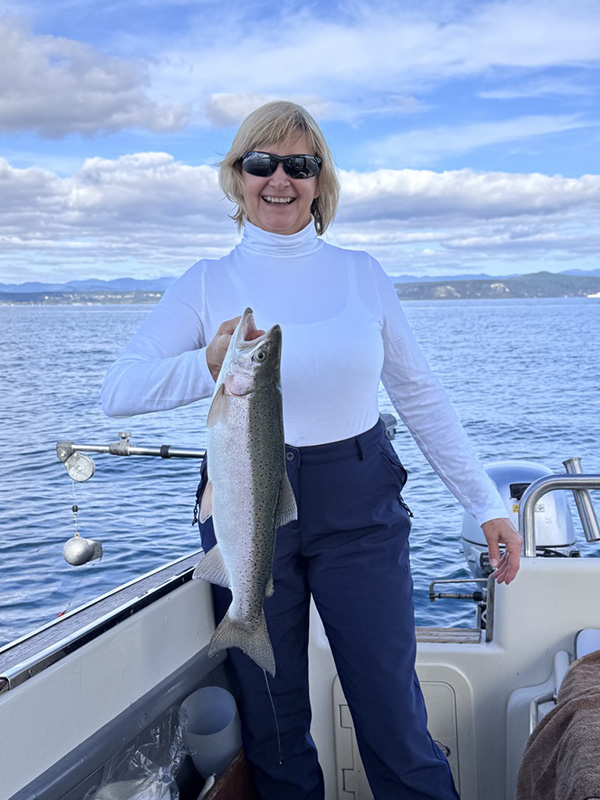
Our fishing trip was a huge success. Contrary to all fishing advice, we went out in the afternoon and pulled in four nice size trout. We threw one back for insufficient size. Another one got away.
We could have pulled in more, but I was getting concerned that we would have nowhere to store them at home. We took two of the trout to a local butcher for smoking and we brought two whole fish home with us. Oh, the joy of being able to eat trout. (See my entry about the absurd trout rules here.)
The next day we headed to the Wairakei Terraces thermal pools for a soak and a massage.
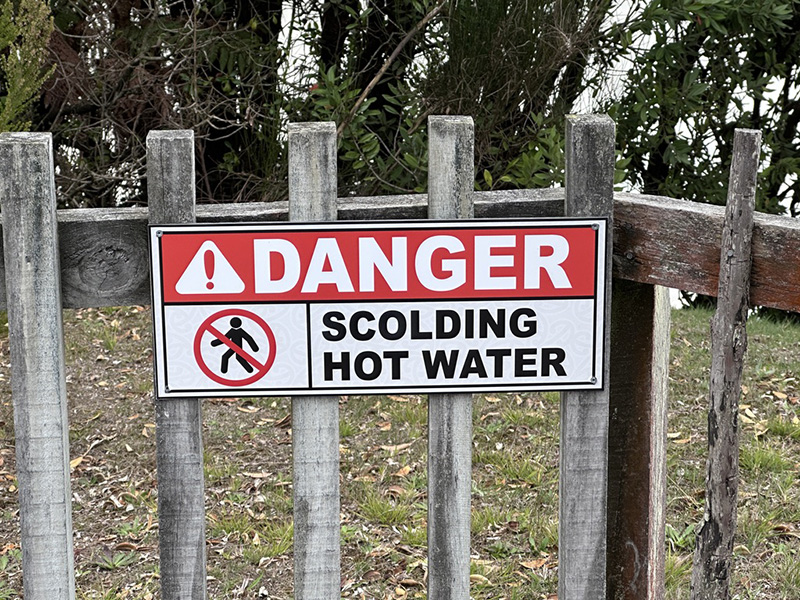
The North Island has several geothermal areas where bathing in water from hot springs is an option. The difference here was that these pools are filled directly from the steaming springs bubbling out of the ground just above our heads. There were four pools of varying temperatures, with the hottest pool measuring in at a scalding 105ºF. I step in it and said, “no way.” The people in it were so red, it looked like they had been scalded. We opted to spend our time in the second most hot pool. It was very relaxing and not too crowded.
This was the hot hot pool. The water comes straight from the bubbling hot spring to a water fall at the bottom of the photo. The guards were begging people not to sit in front of it but they really were not listening. Cooler pools in the background.someone needs to go to spelling school.
All in all, a very successful trip. We will most definitely return to Taupo when we run out of trout.
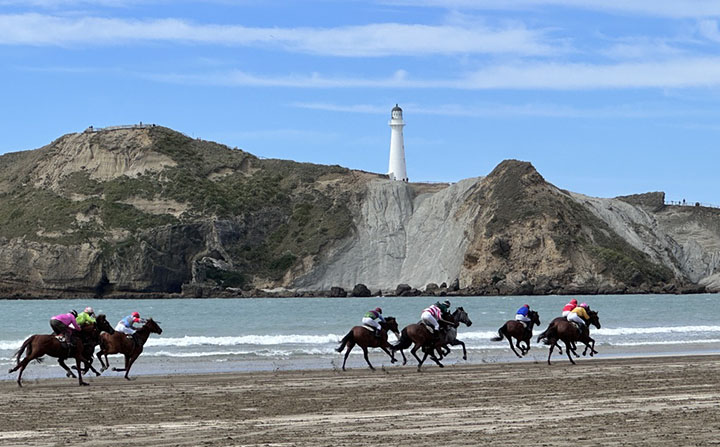
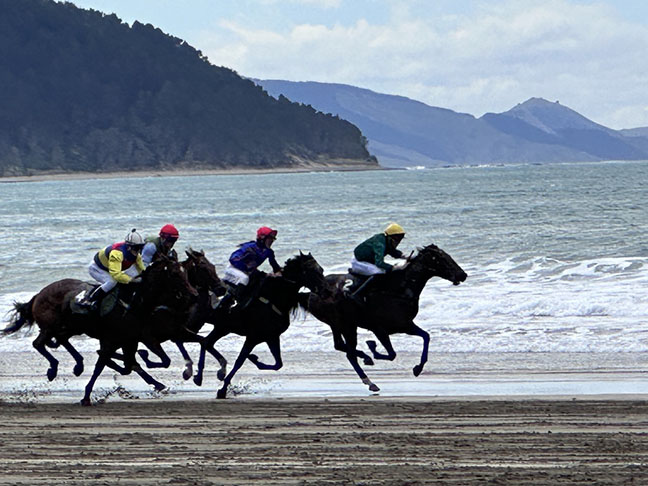
Okay, we like horse racing. Plus, how can you not love the idea of horses racing on the beach? Every year there is a day of horse racing on the beach next to the Castlepoint lighthouse located on the eastern shore of the lower North Island. This is an event that just celebrated its 151st year. It is a big deal and people come from all over to watch and just to enjoy a lovely day at the beach. Thousands of people line the beach with chairs and blankets and picnic baskets, and parking lots overflow with campers and trailers. It is a family event with kid races and entertainment between races.
A gentleman explained to me how the betting worked. There is no real information on horses. In order to bet on a horse, I had to pick a letter to bet on. That letter was later matched to a specific horse. So the horse I was betting on was totally random. Damn, if I still won. I had one horse place, and I won $22 on a $2 bet. Good times. Matt won one race too.
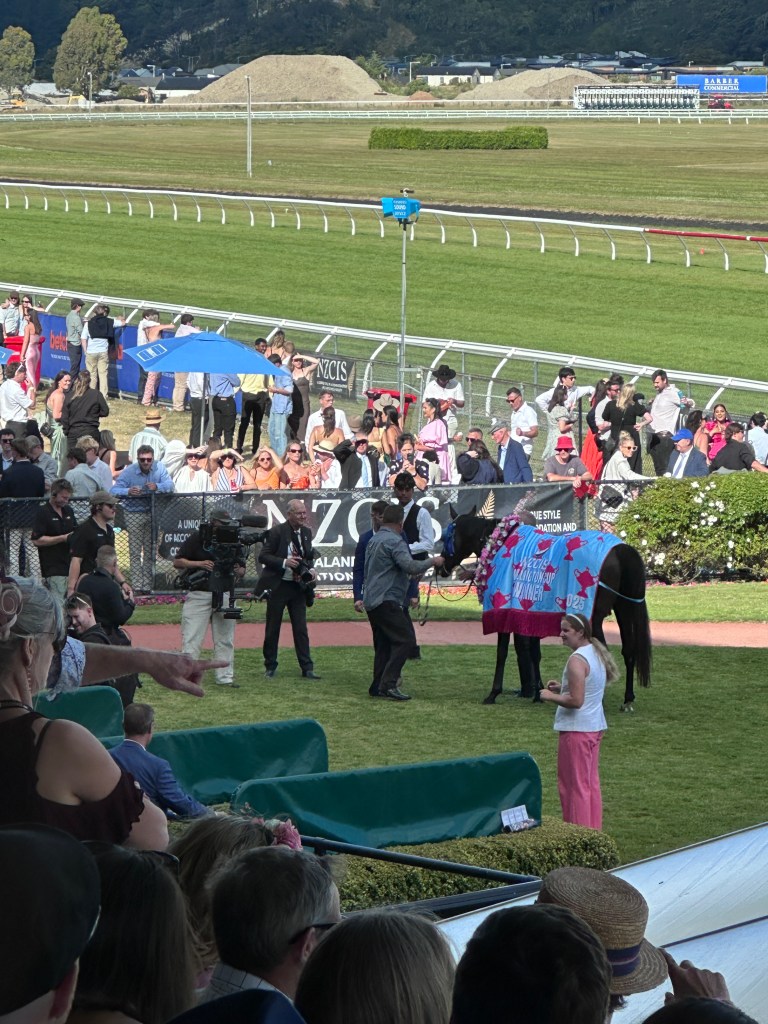
The U.S has the Kentucky Derby, the Preakness and the Belmont. New Zealand has the Wellington Cup. Nowhere near the size or prestige of the U.S. races, it was still fun to go out and place a few bets, drink some champers, and watch the horses. I picked a few winners over the course of the day, but not the winner of the Cup itself.
While in the U.S. summer is on the way, we are heading toward winter now. Good time Charlie’s that we are, we did a lot of different things over the summer. I already reported on the Trip to the sub-Antarctic Islands. Here are a few other highlights presented in several parts.
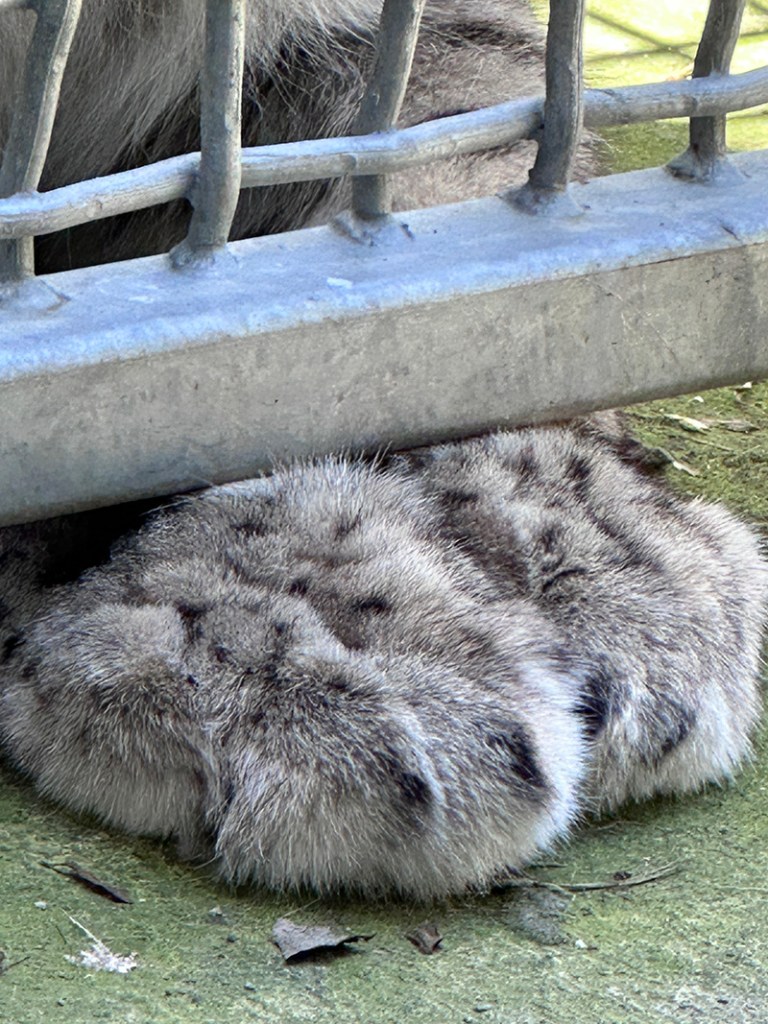
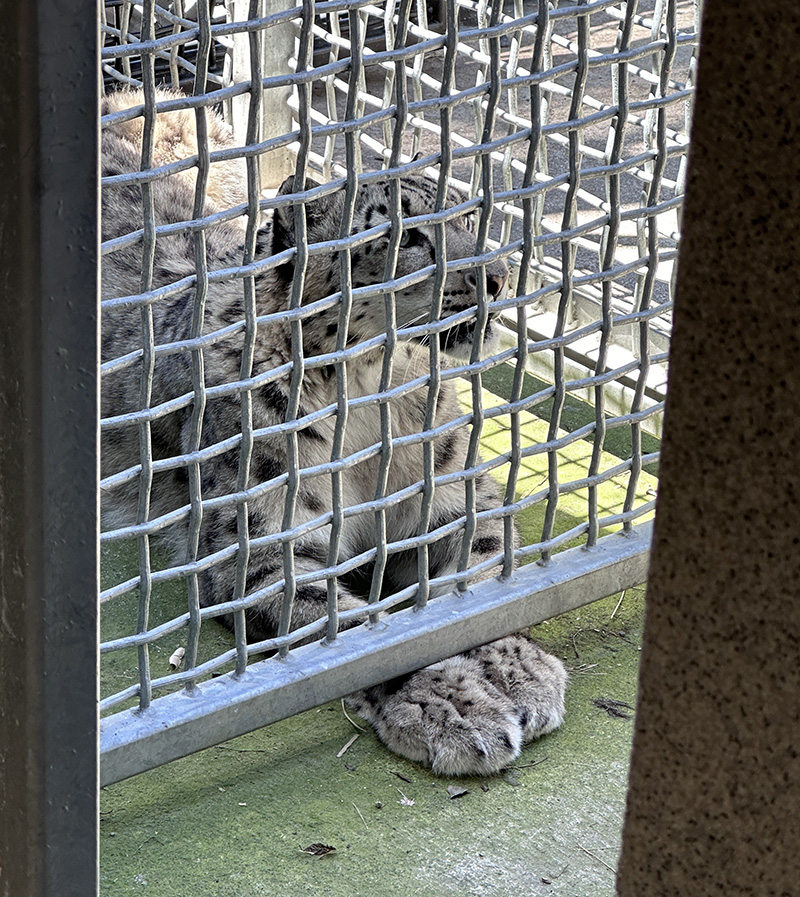
We visited the snow leopards at the Wellington Zoo. I don’t normally go in for zoos, but the Wellington Zoo built a sanctuary for two snow leopards. They were offering an encounter—which entailed getting up close and personal as one can get with a wild cat—with a metal fence between us—and letting us set out their food. It was hard to resist not visiting.
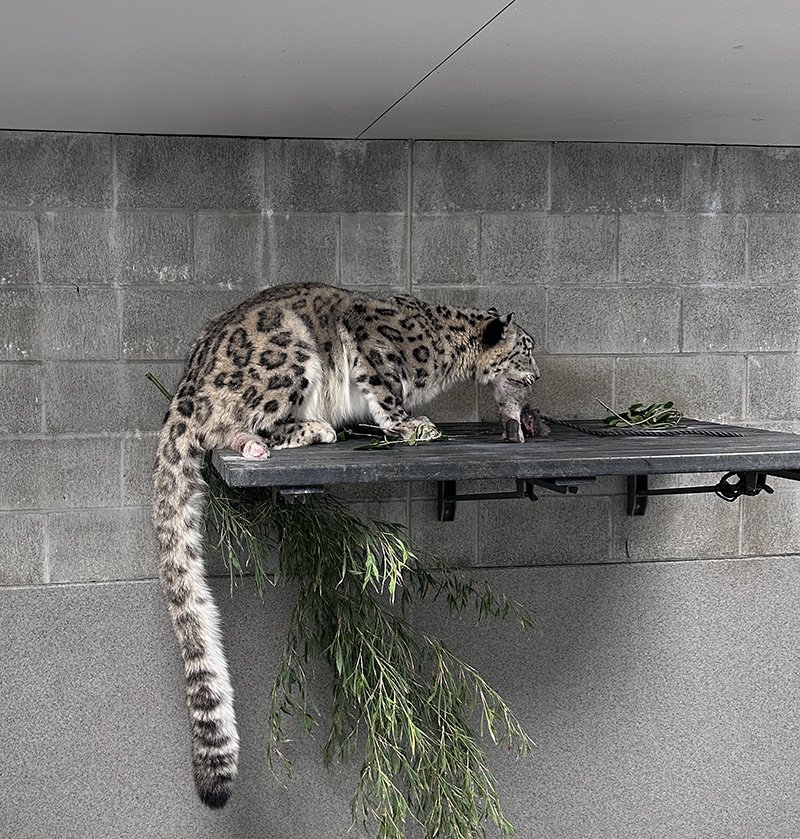
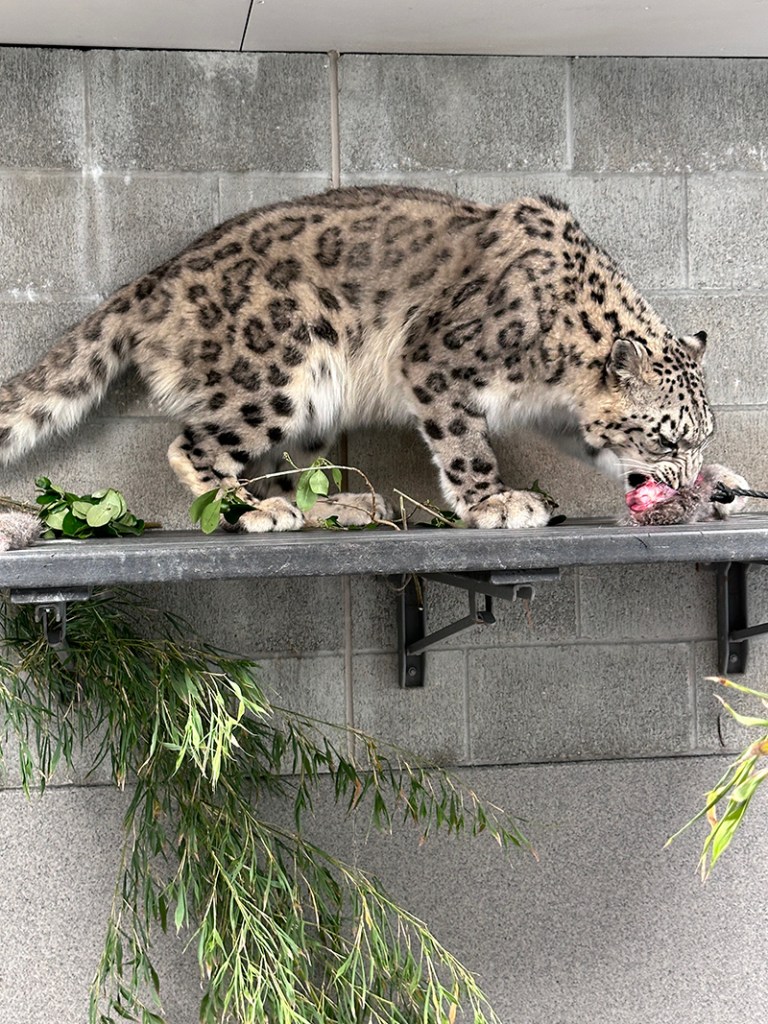
So gorgeous. Big paws and long luxurious tail. The visit was arranged for feeding time. We went into the working area of the enclosure, a fenced in/caged area where the cats come in through a series of gates to get dinner and whatever else they need. We were asked to take their meal, some lovely legs of lamb or goat or some other creature and put them out in the feeding area. Once done, we left the caged area and the keeper let the cat in.
waiting for dinner to be served by us
We watched her chow down on her leg. It was yummy. Only one cat was around. We later saw the other one having a nap in a small cave.
Knowing how difficult it is to see these creatures in the wild, we felt very lucky to be near them.
Matt had wanted to ride from the town of Eastbourne on the far side of Wellington Harbor to a lighthouse on southern coast called Pencarrow Head or the Māori name Te Raeakiaki, which means “the headland where the sea pounds.” And boy, does the sea pound there. And the wind blows. Hard.
On the way out along a gravel road, the wind was at our back and we flew along. Going back to Eastbourne was like trying to bike with a fully deployed parachute hanging off my back. It was a slog. I was on a flat feeling like I was climbing a mountain. Matt has an electric bike and he can just pedal along. Why don’t I get an electric bike? They are very popular here, but I feel the need to bull through when it is tough going. I feel like I accomplished something—mostly that my thighs are going to never forgive me.
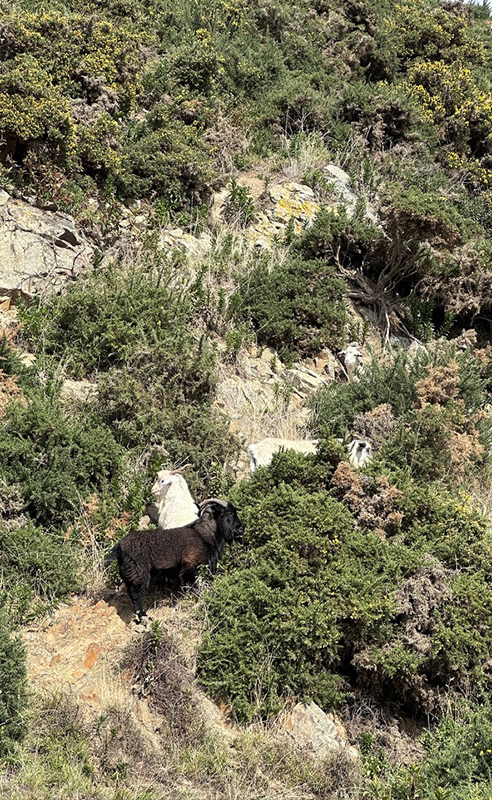
But it was a beautiful ride with a delightful view and even some wild goats.
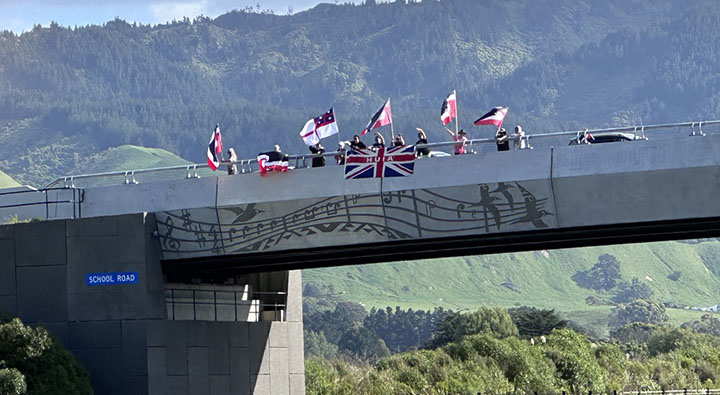
People supporting protesters heading for Wellington in November.
A few months ago there was a major protest by the Maori people over a proposed bill called the Treaty Principles Bill. You may have seen the video of the woman shouting a protest in the New Zealand parliament. The people in that video are performing a “haka.” You have probably seen the New Zealand All Blacks, the national rugby team, perform a haka before a game. Haka can be a celebration, or a dance meant to intimidate. I will explain why that was necessary to do in Parliament.
Here is the deal. The “All Lives Matter,” anti-woke movement has arrived here in New Zealand. (You, dear reader, may agree with those sentiments, but I think you all know that I do not.) These ideas do have an appeal to certain New Zealanders and it has provoked a battle over the interpretation of the 1840 Treaty of Waitangi.
This is going to be a very abbreviated explanation of the Waitangi Treaty and the contentious history around it. The Treaty is considered the country’s founding document. It sets forth the structure for governance, land ownership, and the protection of Maori interests in return for an agreement between the British government and the indigenous Maori. But fun fact, there were two versions of the treaty—one written in English for the British and one written in Maori. Alas, when you re-translate the Maori version, it does not read the same as the English version.
The British version said the Maori recognize the full sovereignty of the British over the land. It is unlikely the Maori understood what it meant to give up sovereignty. In fact, the Maori version simply says the Brits get the right to govern and even governance was a foreign concept. The Maori understood from their version that they were to have full control or chieftainship over their land and treasures. The British version says Maori have continued ownership of their land, but the Brits have what is known as preemption rights. A preemption right means the British control over ownership giving the Crown an overarching right before all others to purchase land. It also includes the authority to approve the sale or transfer of Maori land. (The United States via earlier British law also retained the right of preemption in its dealings with Native Americans.)
The ambiguity in the treaty led to internal wars between the Brits and the Maori, with ownership disputes, settler encroachment, and the loss of Maori land. Soon the Treaty was ignored by the British altogether until the 1960s and the Maori “Honour the Treaty” protest movement began. New Zealand came to terms with the problems the Treaty had created for the Maori, particularly land and culture loss, and sought to address the issue by enacting laws and creating the Waitangi Tribunal, which was empowered to look at breaches of the treaty.
Fast forward and the Tribunal and its development of principles of treaty interpretation are being called into question by a political party. This party seeks the enactment of a new law that would govern treaty interpretation and take it out of the hands of the Tribunal. The problem from the Maori perspective is that the proposal would wipe out any progress the Maori have made to protect and advance their culture and interests. The supporters of the Treaty Principles bill argue that the Maori are getting special treatment and the bill is intended to make sure all New Zealanders are treated equally, hence “All Lives Matter.” But that position ignores the Treaty’s clear statement that the Maori are entitled to govern their own land and “treasures.” Treasures means their culture, language, and the environment.
The fact is that the Maori have been second class citizens since the British arrived and whatever they have gained has been through long fought battles for a recognition of their right to live according to their culture and beliefs, as the Treaty guaranteed. That does not mean they have more rights or that they are getting special treatment. They are getting what was bargained for when they signed off on a Treaty to grant the British sovereignty over the islands.
When the Treaty Principles bill was introduced, the Maori party in Parliament was not amused and held a “haka” protest, as is seen in the video, in front of the man who introduced and has been pursuing this legislation. There was a major protest outside of Parliament too, where thousands gathered to support the “Honour the Treaty” movement.
Even so, the bill was introduced, voted on, and then died. Recently, it was announced that the same political party is pursuing another bill that would have similar impacts, by denying the treaty rights of the Maori. Once again, a battle will be fought over this legislation. In the meantime, it is not clear that we can expect another haka in Parliament. It been proposed to punish the Maori MPs who performed the haka with suspension from Parliament that has not yet been resolved. Rest assured, there will be more confrontation and protests in an effort to save Maori rights because the “All Lives Matter” movement, even though a minority, is here.
Yes, we have earthquakes here in New Zealand. According to Learnz.org.nz
Earthquakes happen every day in New Zealand. Approximately 14-15,000 occur in and around the country each year. Most earthquakes are too small to be noticed, but between 150 and 200 are large enough to be felt. …
The most powerful New Zealand earthquake in recent history occurred in the Wairarapa in 1855. During this magnitude 8.2 earthquake, land moved along at least 140km of the Wairarapa Fault. Where the movement was greatest, the land shifted across more than 18 metres along the fault. Part of the nearby Rimutaka Range rose more than 6 metres. This is the biggest known movement by a single earthquake to have been recorded anywhere in the world. [A meter is a little over three feet. So the land shifted about 60 feet and the mountain rose about 20.]
So take that California. You got nothin’ on New Zealand. There is an app called GEONET which tracks New Zealand quakes, locations, magnitude and impact, letting app users rate what the quake felt like. A quick perusal of the earthquake list shows that there is not a week that goes by that there is not some kind of earthquake somewhere in the country and there are some places in New Zealand that have earthquakes regularly, perhaps once a week. I make mental notes of the location because I would not want to live in those places. I would not say they happen often where we live, but they happen enough.
The quakes you can really feel start at about three magnitude. Whether you feel them depends on the depth. The shallower the quake, the more likely you are to feel it, the more likely it is to cause damage.
So what is it like? Here is how it goes: first you sense a bit of a shake and hear a rumble. It snaps you out of whatever you are doing and makes you a little more alert. I often suddenly feel anxious. Your brain starts trying to figure out what just happened. Was that a quake? Sometimes that is it and we all go, huh. That was a quake. But more often in the next second or two later, the floor feels like a rolling sea and the house vibrates from the motion of the earth beneath it, causing everything in the house to rattle and shake, the whole house seeming ready to crack from the movement. This lasts only a few seconds. If it lasts longer than a few seconds and is more severe, we have to get out because that might mean a tsunami and we are in a tsunami evacuation zone. We are instructed that if you are near the coast and feel a strong earthquake where it is hard to stand up or you seel a weak rolling earthquake that lasts a minute or more move to high ground or as far inland as you can, out of tsunami evacuation zones. The rule is “Long or Strong, Get Gone.” Are we ready? Yep. We have go bags prepared.
We just had a 4.1 here not long ago. It occurred fairly close to us but because of its depth, there was only light shaking. Think of a large truck rumbling by. The house shook but the dishes did not really rattle. Matt was in Wellington and did not even notice. As I said to him afterward, it scared the hell out of me. They always do. Unlike a weather event, earthquakes come with no warning as to when, how strong, or for how long. You are living in the moment and what will happen is a complete unknown. I don’t think I will ever get used to them.
If the quake is strong enough, heading to magnitude five and above, the dishes clatter on the shelves and the pictures on the walls are jostled. We have never experienced one that was more than that level of impact. At the next level, things crash and fall. We have not been there, thank God. During an earthquake the ground can move horizontally and vertically. In a severe earthquake there is something called liquifaction where strong shaking causes soil that is wet, sandy, and silty to act more like a liquid than a solid. Think about how sand moves when you step on it. It is water saturated and it does not take much to move it. Now imagine a building on top of sand that is shaking. That building has a good chance of being damaged or knocked down.
Probably the most famous recent quake was a magnitude 6.1 that hit the city of Christchurch in 2011 which resulted in 185 deaths and caused extensive damage to structures which are still being dealt with. Numerous office buildings, churches and hotels were on the verge of or totally collapsed. Homes were destroyed and even the sports stadium had to be torn down and rebuilt. But that is only one in a long list of earthquakes that have impacted communities throughout New Zealand. This country is located on numerous fault lines so it is not surprising but still it is unnerving.
I think it is pretty clear that we live out here in horse and sheep country, albeit, next to the beach. The beach is really a sleepy place with people walking dogs and people fishing. A crowded beach is seeing more than ten people looking in both directions at any given time.
I walk the beach from here to the next beach over, a little place called Peka Peka. It is about 2.5 miles up and back. On those walks I usually see maybe one or two people, usually walking their dogs.
But one day as I wandered along I thought I saw a naked butt. A man walked out of the ocean in front of me, he was about 25 yards away, and he was naked. I was perplexed. Here? On Te Horo Beach? A naked man? As I approached I did in fact confirm that, yes indeed standing in the dunes was a fully naked man.
Then I saw a woman pop up over the dune and she was totally naked too. Hmmm. Okay, I am guessing this is a nude bathing beach. But I had to find out if this was a one off or if this was truly a place where people went to swim naked.
And I have to say, the ocean here is fully facing the wide open ocean and it is not Bermuda. There is a lot of debris in the water, detritus from the nearby rivers which brings in logging debris, a lot of drift wood and smaller mulch size pieces. Then there is debris brought in by storms. Dead fish mostly. When I go into the water I wear, not only a bathing suit, but sandals because of the rocks and debris that tumble through the waves. There is stuff out there that you would definitely not want in your private parts.
So I asked a few people who live here about the naked people. Sure enough there is an “informal” nude beach that is accessed from a road that dead ends at the beach between Te Horo Beach and Peka Peka. I was warned not to venture into the dunes in that area because I might be surprised at what I saw.
In fact, I now see that this beach is quite the regular nude beach hang out. The other day I saw a guy who seemed to be a little unsure of whether he wanted to be naked. He stood in the dunes for a bit and then walked with purpose to the ocean. As I was coming back, I saw him in the dune again holding his clothes in front of him. Then he seemed to hurry back toward the road still holding his clothes in front of him. When I looked again, he had gotten dressed. Sorry no pictures although I was tempted.
I don’t really care that this exists. Hey, if you want to frolic in the water and dunes in your birthday suit and maybe get a little on the side, go for it. What is baffling to me is, why here? Given the rural area and the family and sport oriented nature of the beach, this does not seem like a place for dune hook ups and splashing around in the ocean buck naked. But there you are. Someone decided this was a great place for it.
New Zealand pretty much closes down for two weeks between Christmas and New Years. It is summertime, the kids are out of school, people are taking vacations, and it is the Christmas holiday season. I think the government and businesses just gave up trying to get anyone to work. So, except for essentials, for two weeks the country slows down to a near halt. We decided to join the party and take a vacation during the Christmas break. Destination = Subantarctic Islands in the Southern Ocean.
Matt has a dream. It is to see every species of penguin in the wild. My response is, sure, why not? Well, one problem is that they live in some pretty difficult (and expensive) places to reach. It just so happens that New Zealand and Australia have several species we can knock off the list but we have to travel to certain “subantarctic” islands in the Southern Ocean to see them. Well, poor, poor us had to get on a ship and sail south. Let’s get out the map and you can see these islands are on their way to Antarctica. We were heading for the Snares island chain (NZ), Auckland Islands (NZ), Campbell Island (NZ), and Macquarie Island (AU).
(You might ask why are they called Sub-Antarctic? I believe that means any island within the 40th and 60th latitudes. How can New Zealand and Australia lay claim to these islands that are far from their coasts? The answer is, I have no idea but the Falklands are in the same latitudes and Britain and Argentina have been fighting over ownership for years. So surely it has to do with planting flags and conquest. The Europeans were quite fond of claiming land on the basis of “discovery.”)
We were on an expedition ship with 120 other souls, spending Christmas looking for adventure and lots of pictures of penguins and albatross. Island landings would be handled by zodiac boats. We were under strict rules for engaging with the animals. No picking up and cuddling a penguin. Keep your distance and enjoy their adorable walk and their kooky and merry ways. Watch out for elephant seals who tend to have a bad attitude and when you see an albatross, just experience the joy of watching them glide along the air currents. And yes, there were days when it was cold and rainy and some very rough seas.
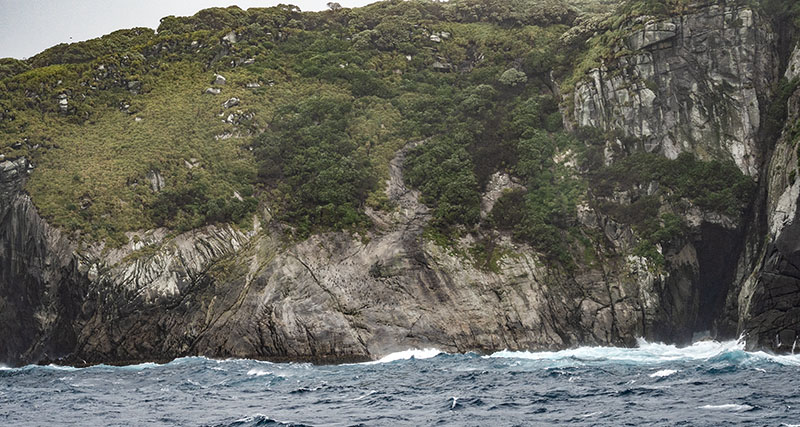
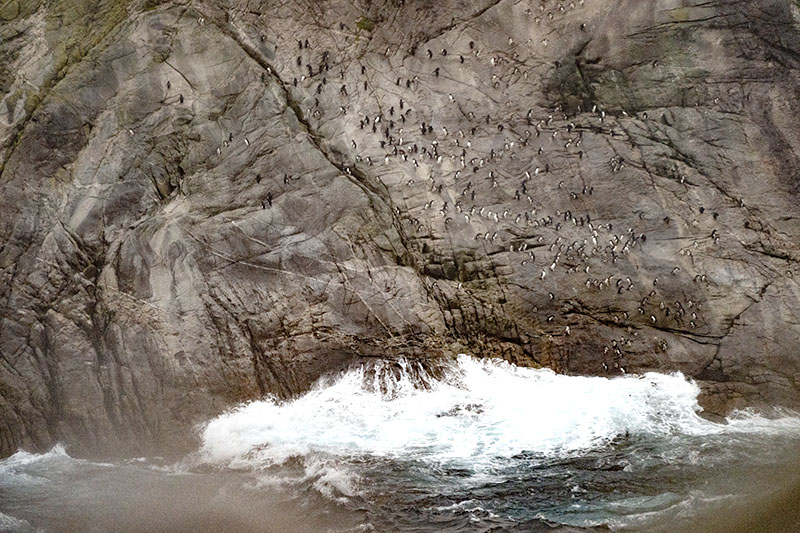
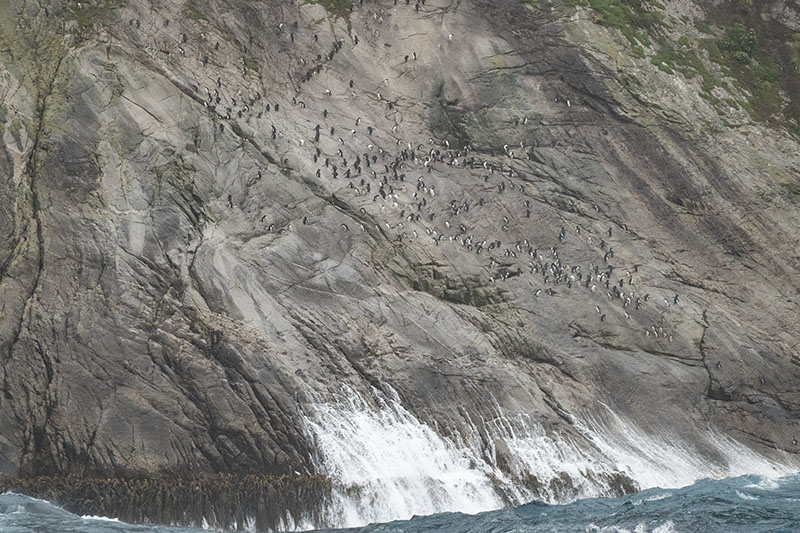
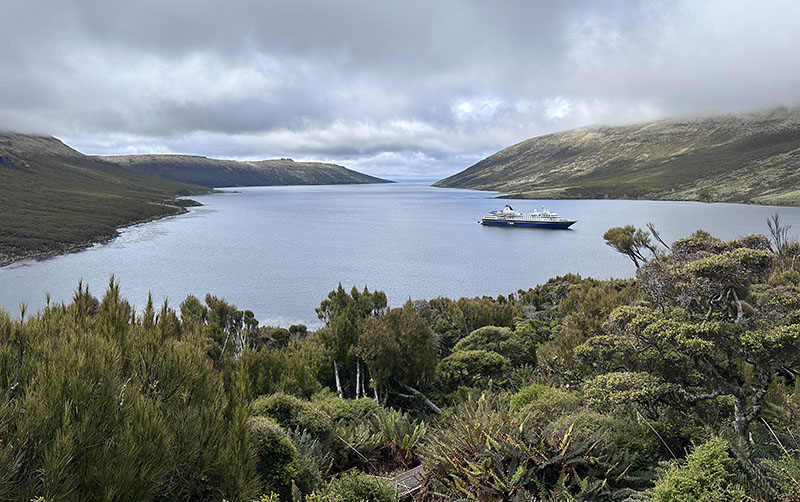
Every island was different. First stop, The Snares, a chain of islands and home to the elusive Snares Crested Penguin. Their favorite hangout is the penguin slide, a hill of bare faced rock rising from the sea which they had to climb to get home. The weather was so poor we could not land and had to watch the penguins coming and goings from the ship. We were pretty far off lest we crash, but we did see them. Check that penguin off the list.
Penguin slide is a sheer rock face. They jump onto it from the wave and then climb into the hill to nest.
Close up of rock face.
They ride the wave up onto the rock and then latch on with their claws. Up they go. Amazing little creatures.
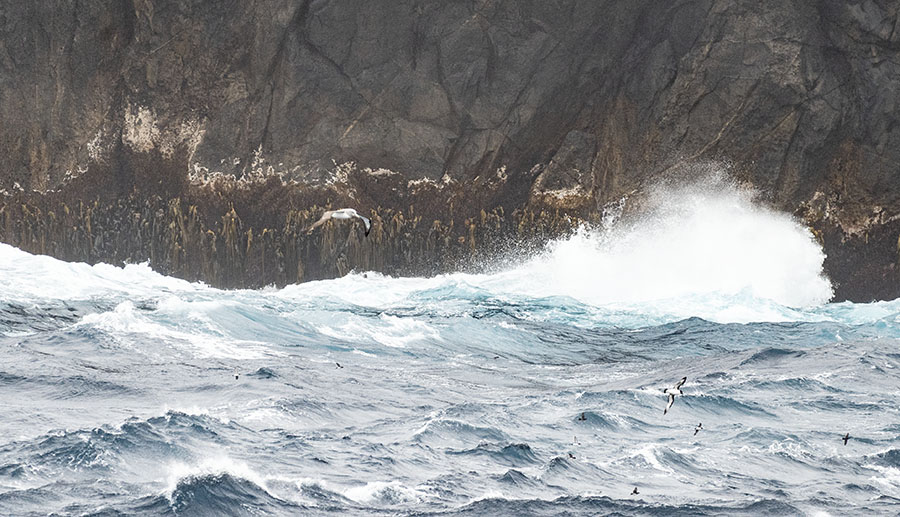
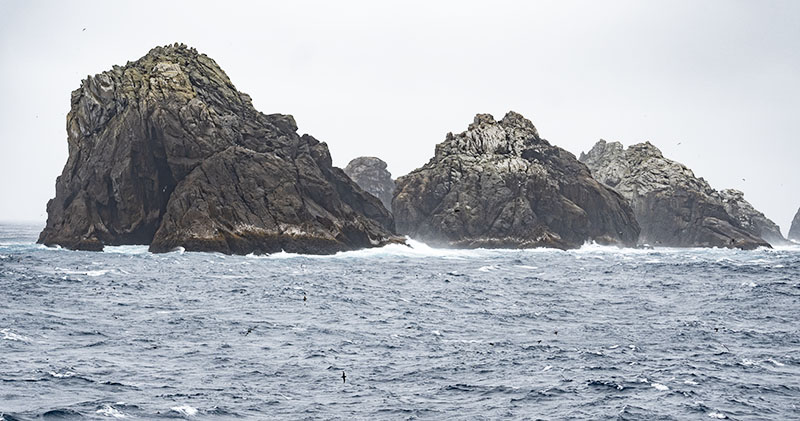
After the slide we cruised around the islands to see what we might see.
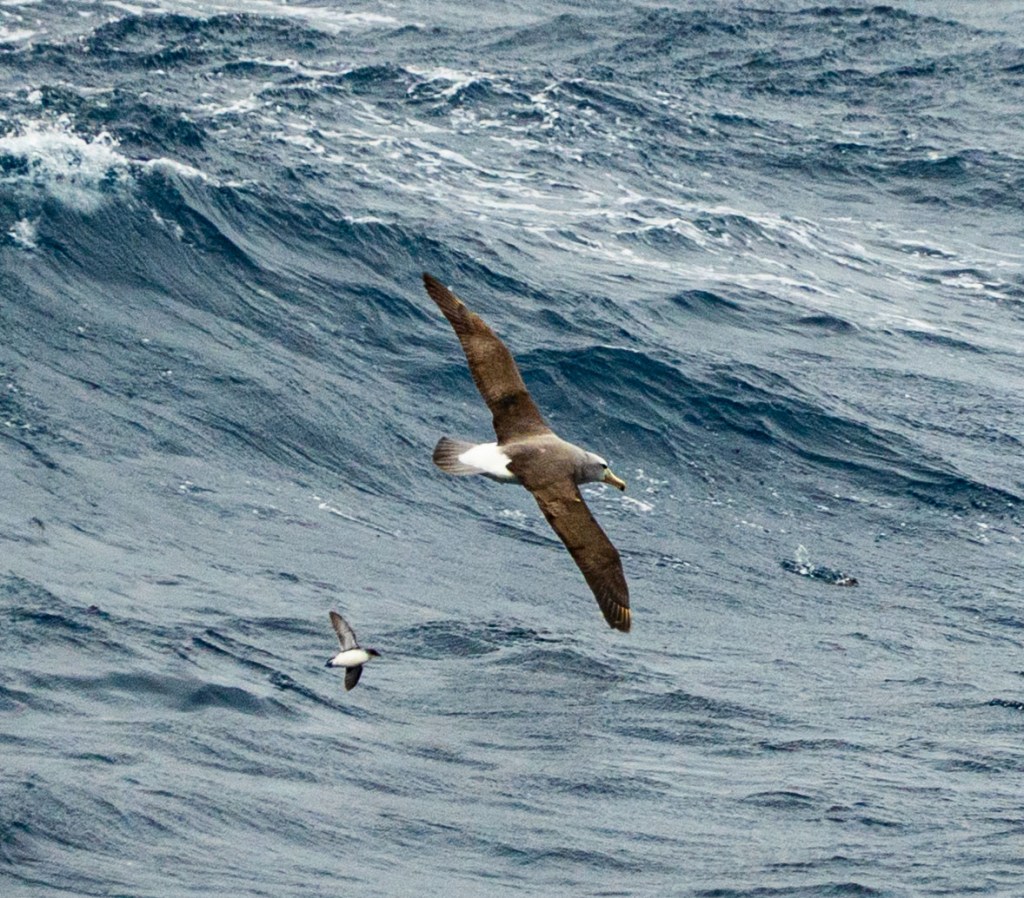
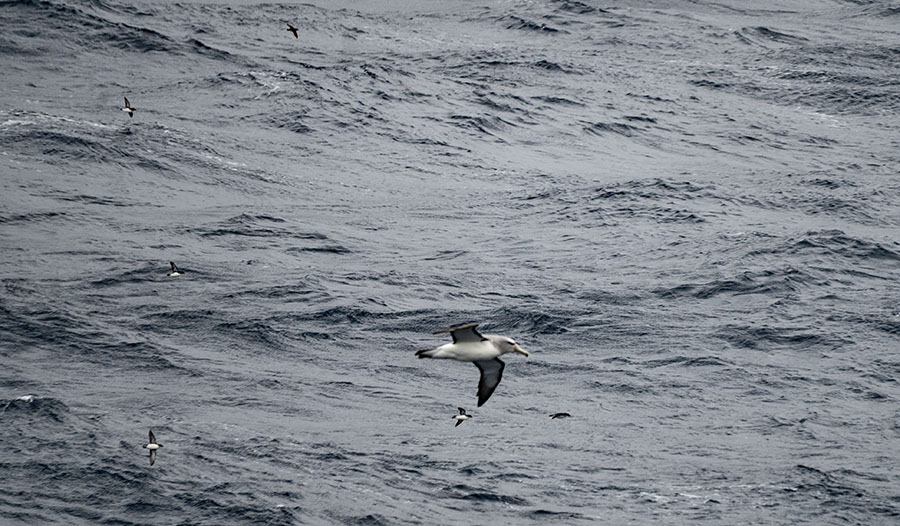
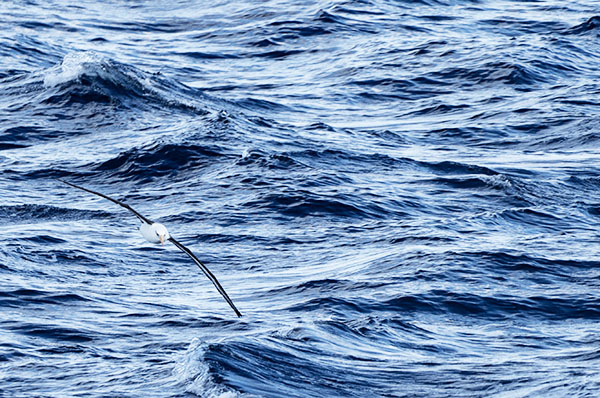
Bullers AlbatrossIf you look closely you can see Cape Petrels enjoying the foggy day around the rocks. One more albatross picture because I love them. Looks like a Salvin’s albatross being followed by Fairy Prions.
As you can see this was probably one of our worst weather days. The ship was rocking and people were not tolerating it too well. Lots of very green faces and lots of people not showing up for meals. (Matt took medicine and he was fine. I have sea legs and enjoy the rocking.)
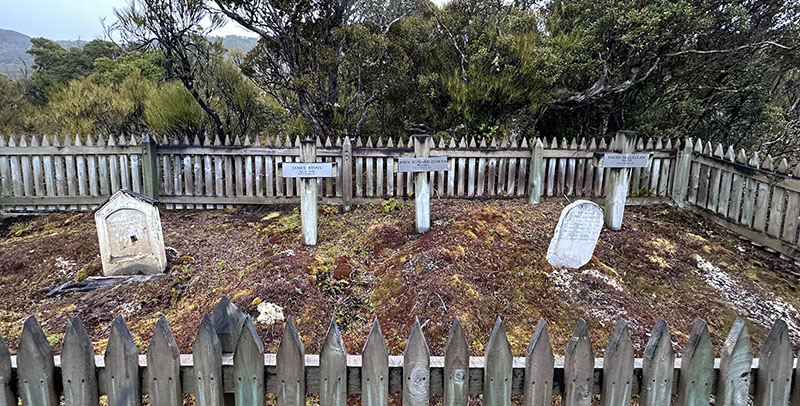
Next up was the Auckland Island. The Brits/Scots tried to settle this island. That effort failed because Auckland Island, like all the others, has a harsh environment, not prone to farming or ranching.
Settler Graveyard
The beauty of these islands is that, because they were never fully settled, they are largely untouched except for one gigantic problem: cats and rats, the predators left by whaling ships or other visitors. The inevitable result is a lot of dead birds. Add to that feral pigs who enjoy munching on vegetation and bird eggs and viola, a ruined island. But the New Zealand and Australian governments are methodically working to get rid of the invasive mammals—making the islands predator free–so the birds and flora can once again flourish. They have accomplished predator free status on Campbell Island.
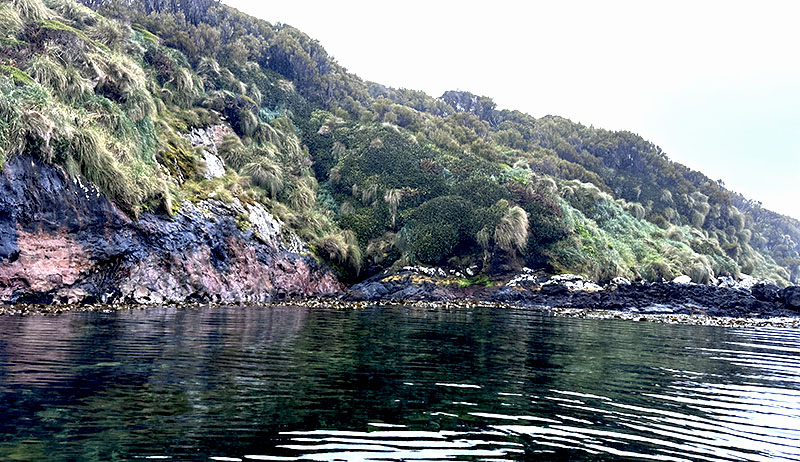
In the afternoon, we went out in the zodiacs to cruise along the coastline looking for birds mostly and to see what they refer to as mega herbs–basically, plants that are growing larger than normal.
We started out in a drizzle that soon turned into a driving rain. See how happy we are!
Finally, our zodiac guide decided we should head back to the ship. The air was so filled with rain and mist that we could not see very far. In fact, we could not see the ship. It is pretty unnerving to not be able to see the ship, especially troubling to hear the guide calmly radio the ship asking where it might be. It was far enough away that she could not make contact. She decided to head in the general direction up the coast. After a few miles we saw its outline and breathed a sigh of relief.
For dinner that evening we were treated to a barbecue on the ship deck. The weather turned out to be a bit cold but dry. The chef turned out an amazing feast of meats, veggies, and deserts. It was impressive.
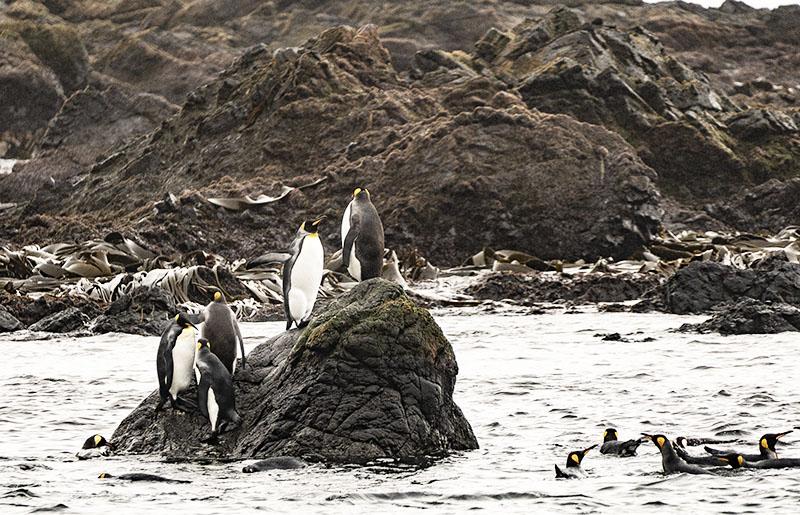
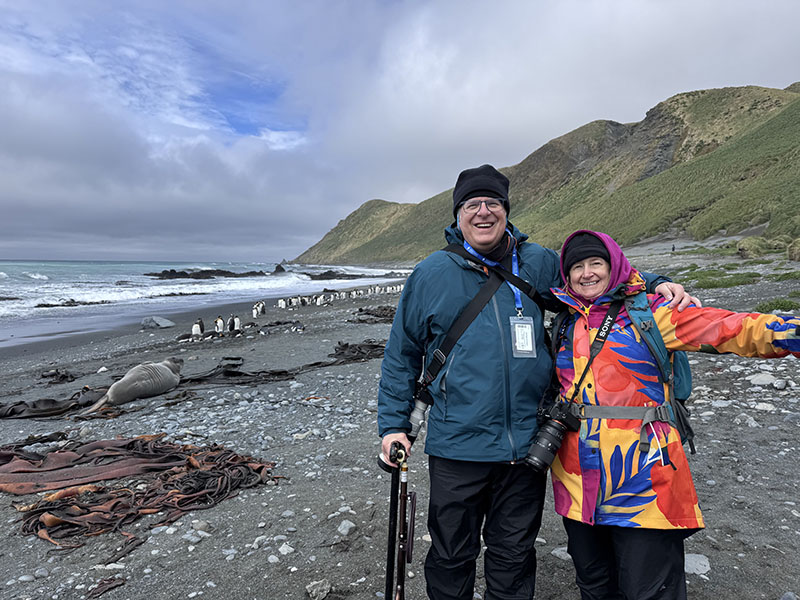
The next morning, we woke up at Macquarie Island where we would spend Christmas Eve. This is as far south as we would travel, much closer to Antarctica and the air temperature proved it. It was cold. But the penguins? Now we are talking! This island, part of Australia, is home to large colonies of Royal and King penguins, hundreds of thousands strong. The first landing was on the research station side and there were not that many penguins.
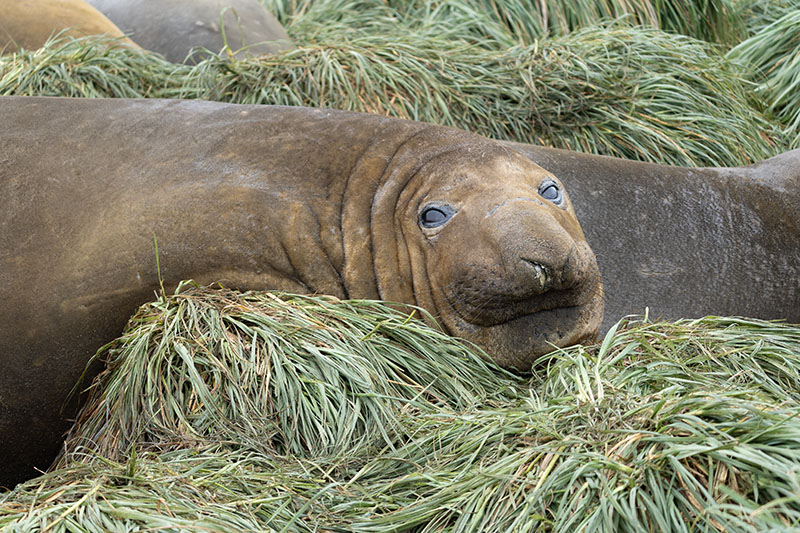
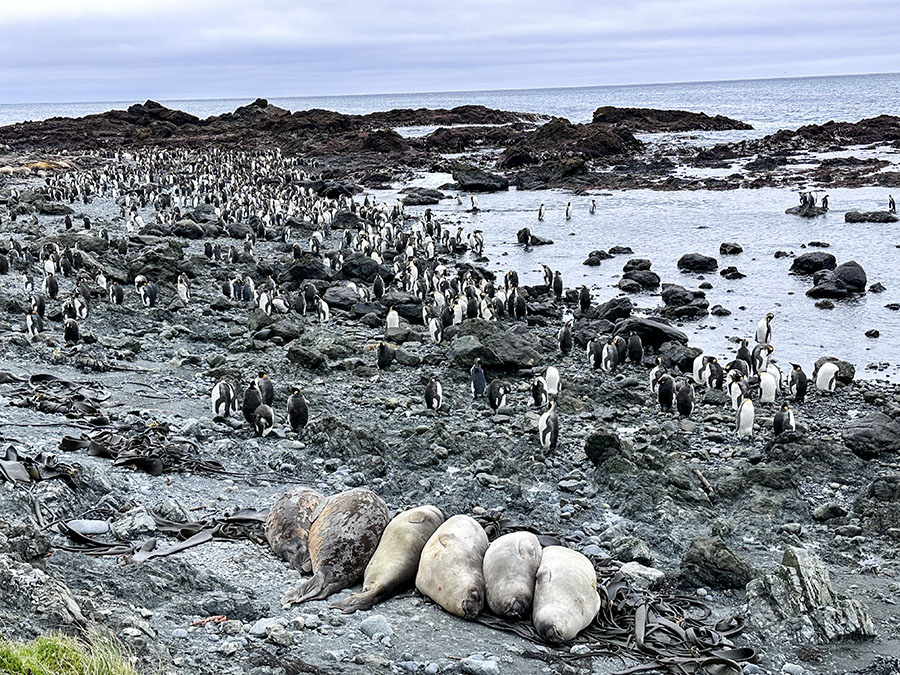
Huge and smelly elephant seals laid about the beaches and in the dunes, many were molting making them feel very itchy and cranky. Best to keep six feet away.
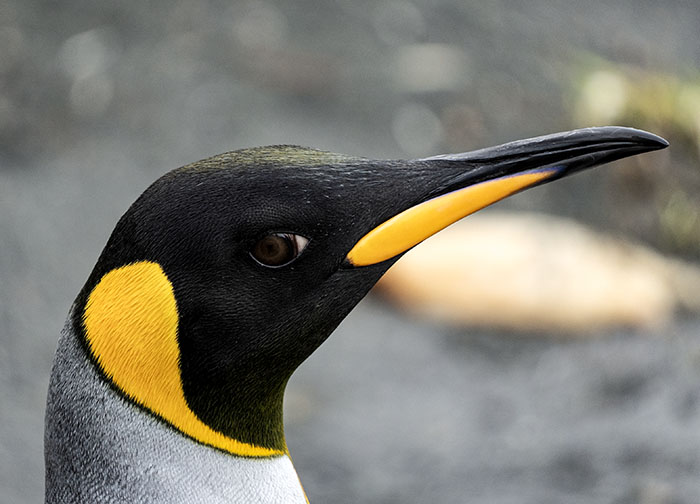
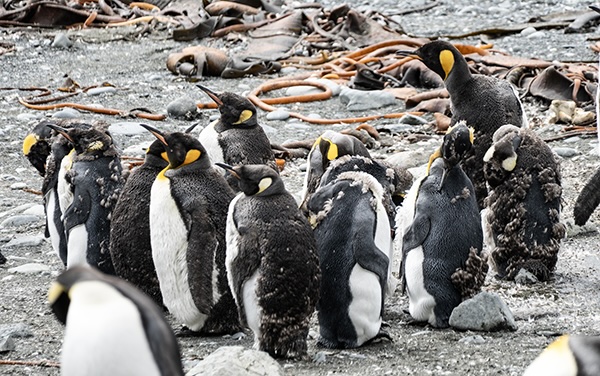
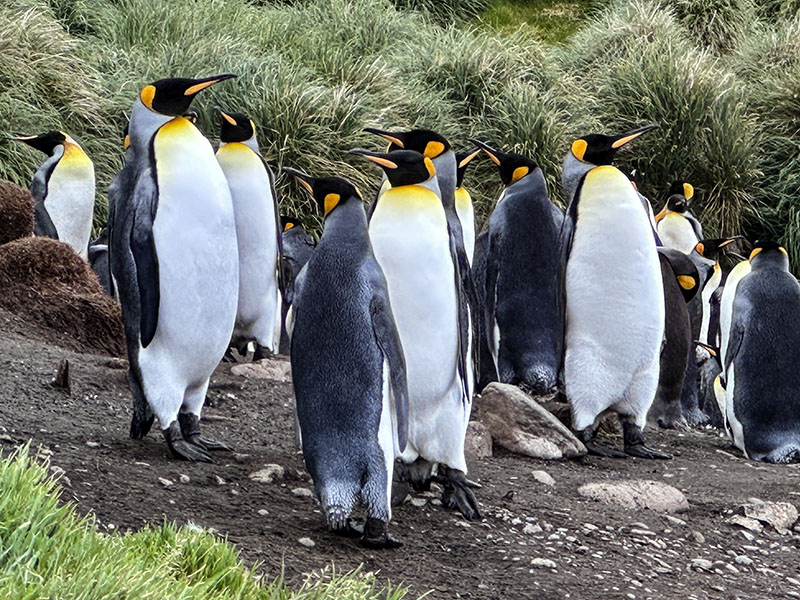
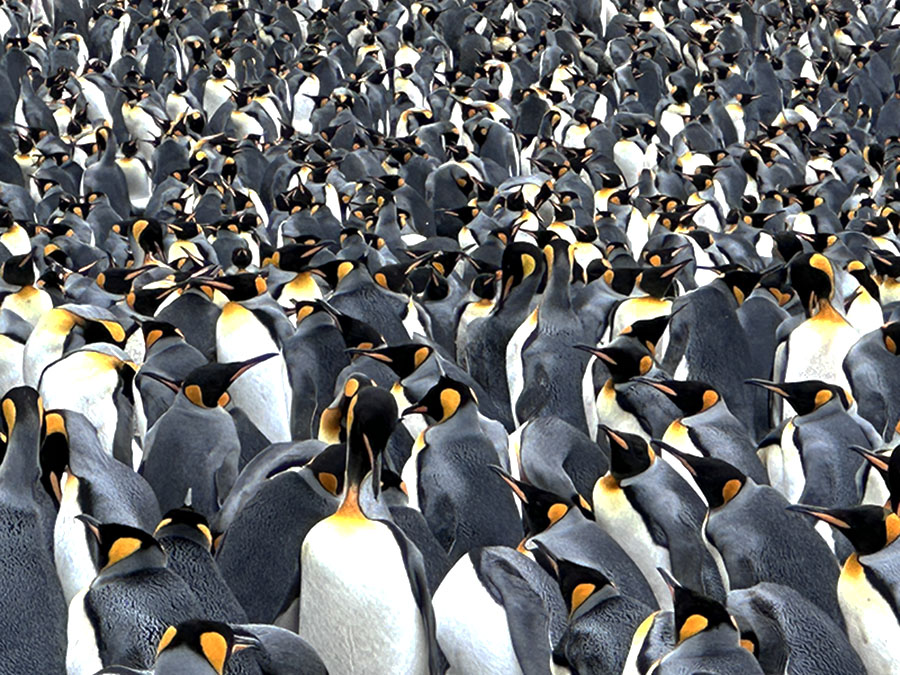
The King penguins were also molting, and it did not look fun. In fact, they looked miserable as they waited for their feathers to fall off, so that new ones could grow in.
Looks itchy
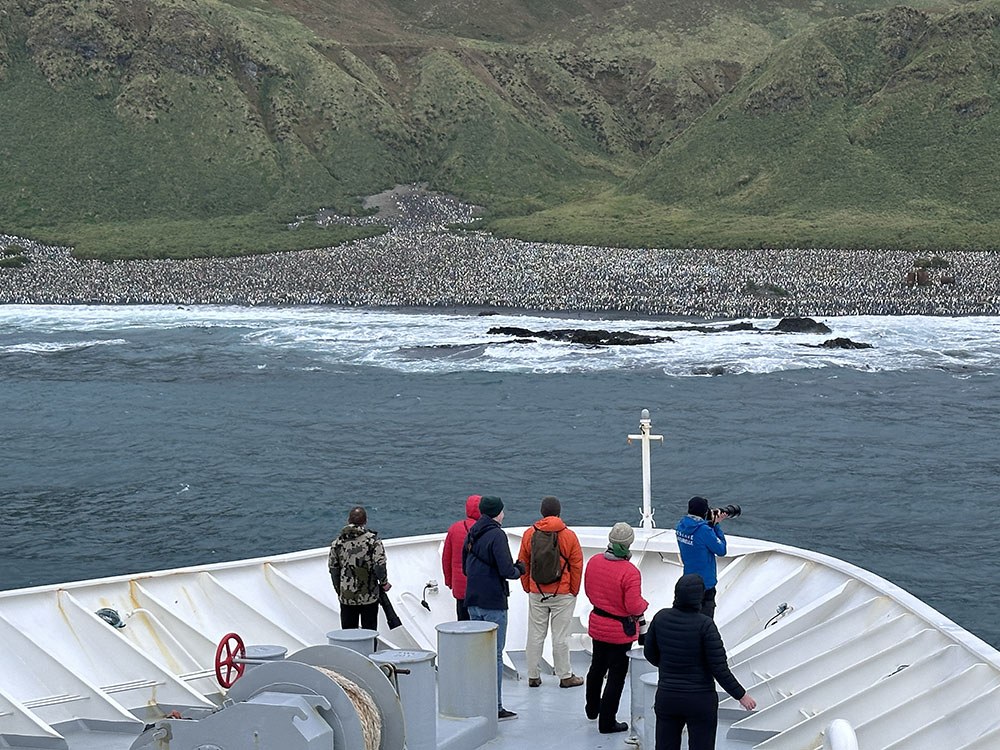
We next sailed to the other landing sight and boy, what a different view!
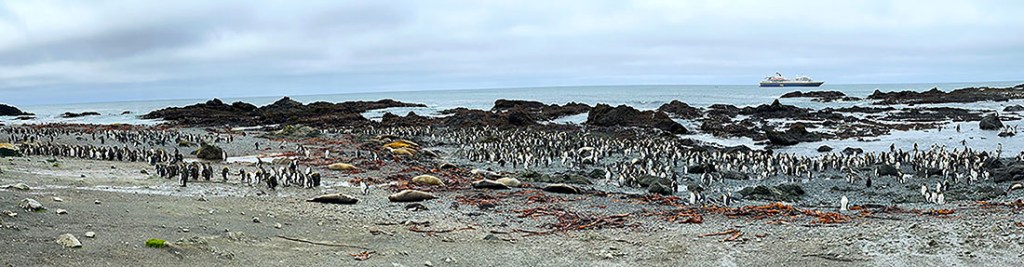
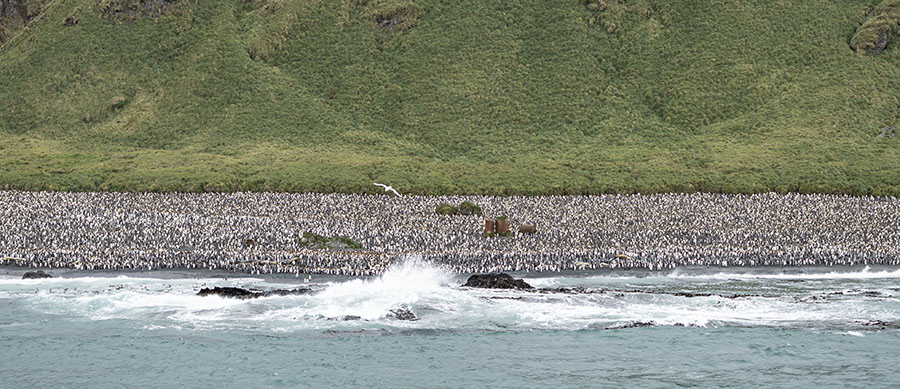
Those are all penguins
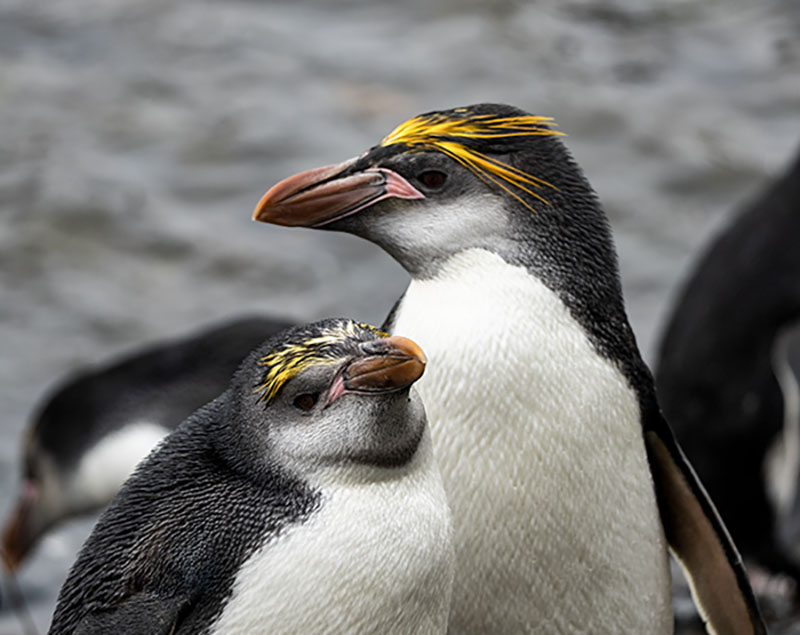
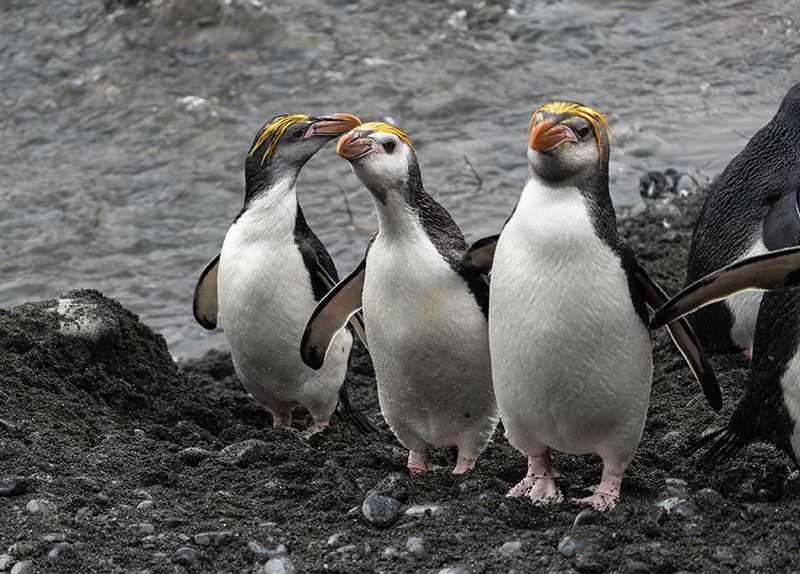
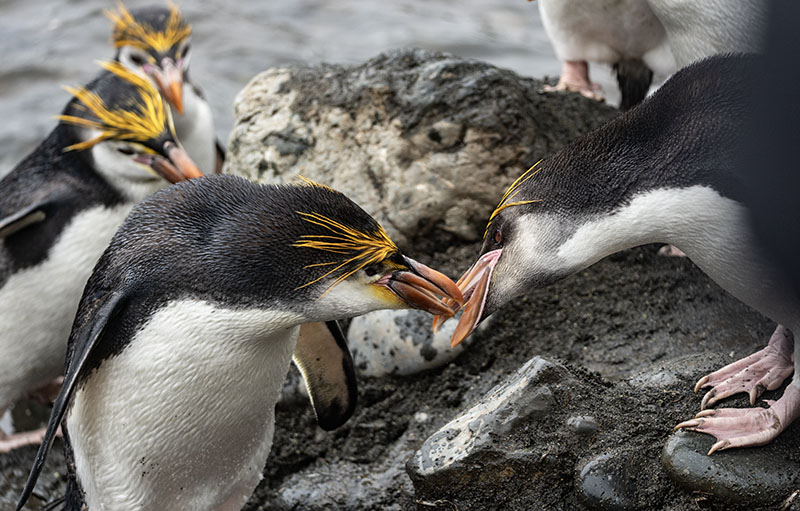
We did not land at this particular rookery. We went to a more sheltered cove for a zodiac landing. As we landed, a welcoming party of Royals waddled as fast as they could to see what was coming ashore. They were somewhat leery at first. But there is always one penguin, braver than the rest, ready to walk towards those very tall creatures coming out of the water (that would be us) to find out what the fuss was about. They posed for this close up.
These are Royal penguins. My personal favorite. The Royal penguins sport yellow and orange crests, plumage that makes them look like they should be dressed in Hawaiian shirts because they are just out for fun. They are on the smaller side and very curious.
Gosh, I could have sat on that beach and watched those Royals all day. So much activity. They swim, nip at each other, scurry this way and that, talk and preen and generally fuss. Adorable.
No fighting!
On the other side of the beach were the King penguins. Smaller than the Emperor penguin (the penguin you usually see in the documentaries), but very similar in coloring, the King penguins are much more reserved and stately. Interesting but not near as fun as the party boys on the other end of the beach.
That is a lot of penguins! As far as the eye could see.
Not sure what that elephant seal is up toGreat time on Macquarie Island!
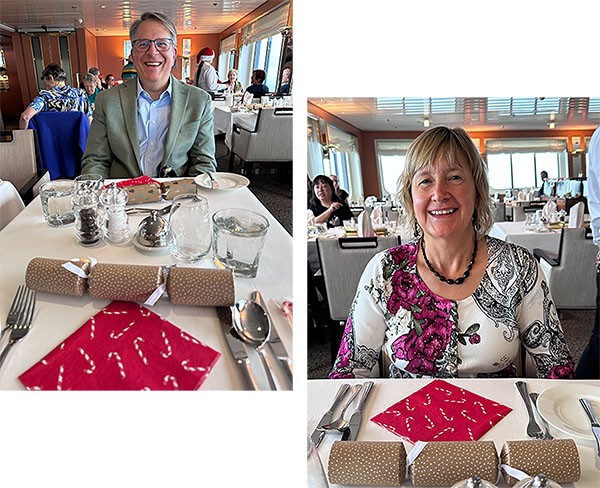
Christmas Day was spent at sea, eating and drinking way too much. A word about the chef. The food on the ship was equivalent to a four-star restaurant and I am not exaggerating. Every dinner was a three-course extravaganza. The chef, Jorg Lehmann, is Swedish and by the end of the trip I had to give him a hug. He gave us a Swedish twist for Christmas. On Christmas Eve, he served us Swedish pancakes with lingonberry sauce. He brought lingonberries to the end of the earth! Holy smokes that was unexpected. Christmas Brunch included herring and Swedish breads. Oh yes, please. Chef, you were terrific, and your staff was lovely. Cheers!
On to Campbell Island, where albatross were on the agenda.
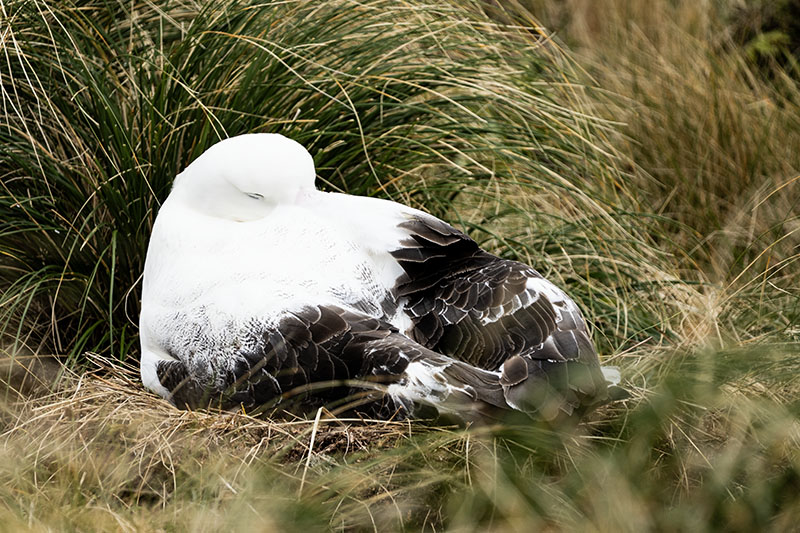
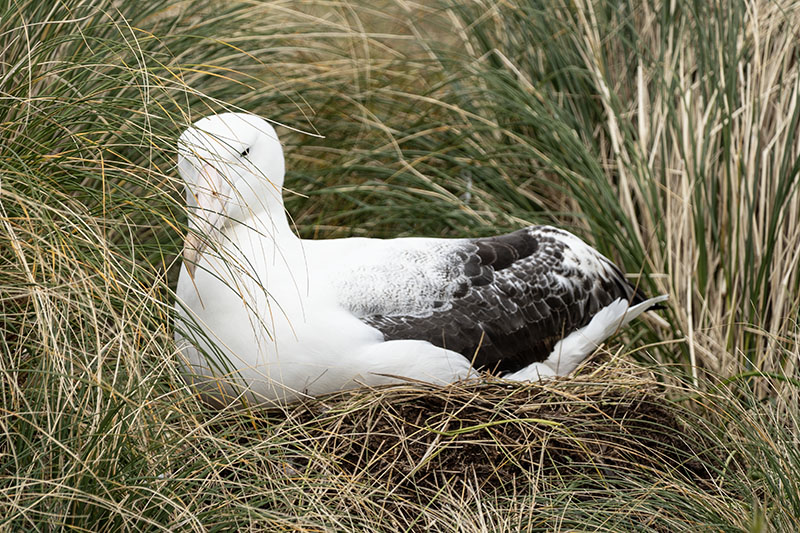
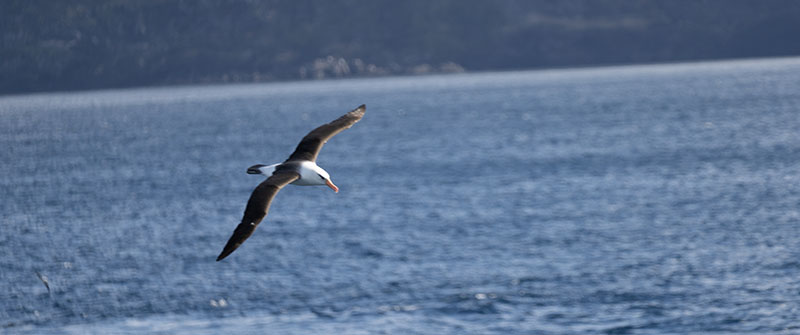
Albatross are fascinating to me. They are one of the largest birds on the planet. The wandering albatross can have a wingspan of up to eleven feet. They don’t flap. Their wings lock so they save energy when they fly. And they need it since they can fly for thousands of miles gliding on the air currents swirling around the earth. They sleep while flying and they sleep on the water. The only time they are on land is when they are nesting. They can live past 50 years.
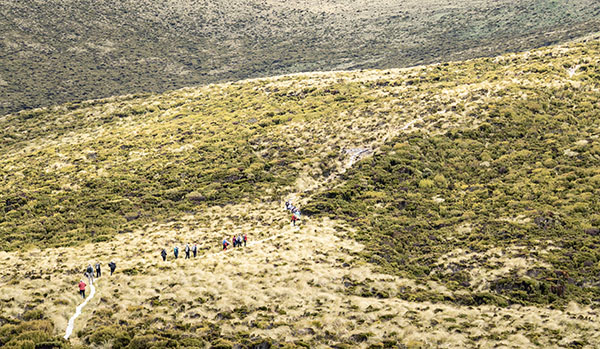
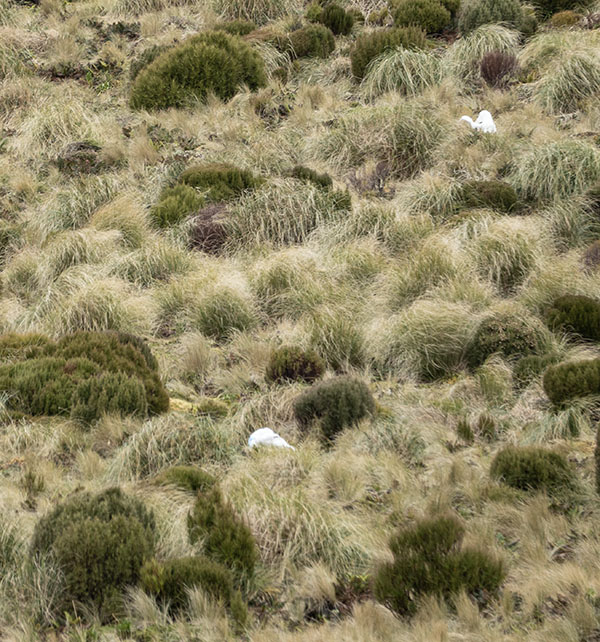
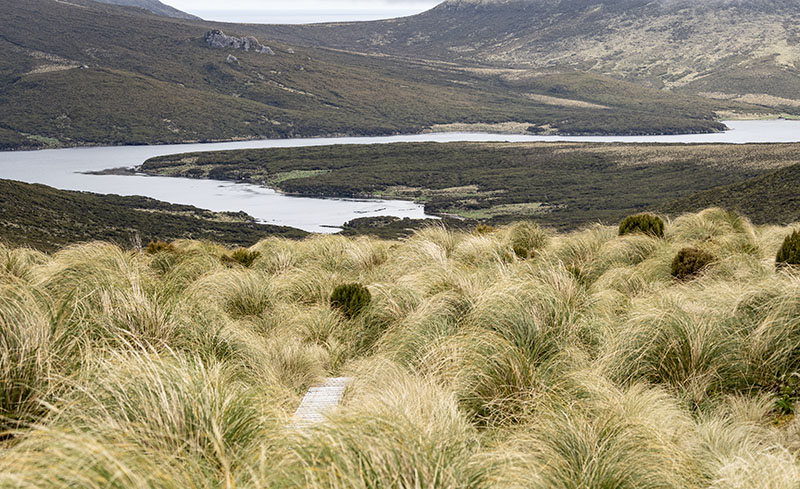
We climbed a rather large hill, it felt more like a mountain, to see the Southern Royal albatross nesting.
Trudging up the hill. This is a very long way from the top. We hiked about 3k total (2 miles)
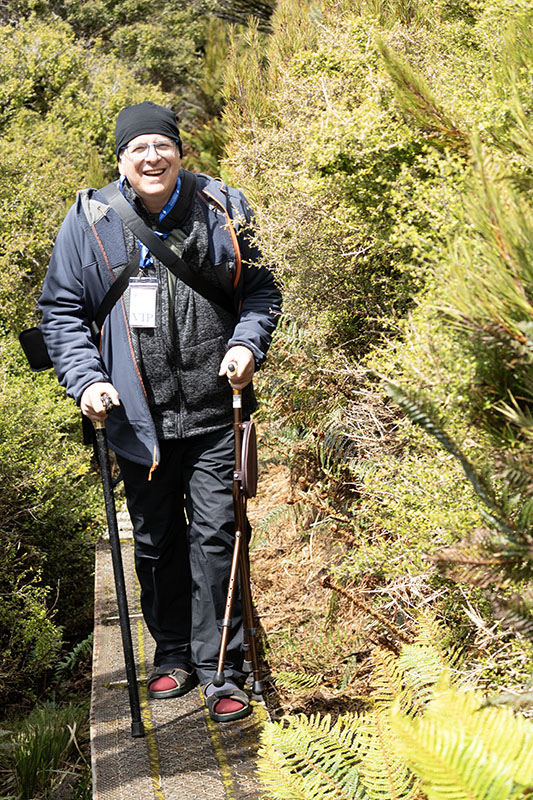
You may wonder how Matt is able to hike. Here is how:
He is carrying with him a folding cane chair. Along the way, he stops to take a break and get off his feet. He has traveled all over the world with that chair. He does have his distance limits and we don’t usually do more than about two miles. Note too that he is wearing sandals because that is the only shoe he can wear. He has fully water proof socks and in combination they are as good as hiking boots.
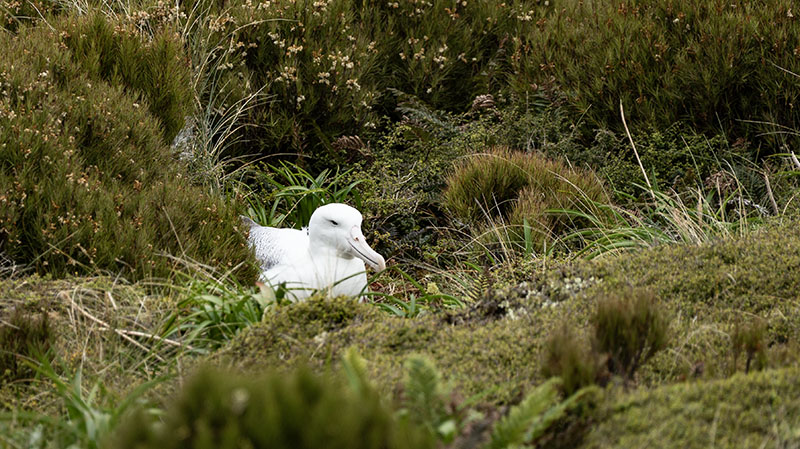
We finally made it to (kind of) the top and found this:
Hiding in the brushSleeping in the tussockCalm but wondering what all those animals were standing in front of her with long black objectsAlbatross nesting in the tussockSoaring
The hike up was worth it. Such beautiful birds. Albatross are only on land to nest so this was pretty special to see. Then of course we had to make our way down. It was a lot easier than going up.
Boardwalk through the tussock
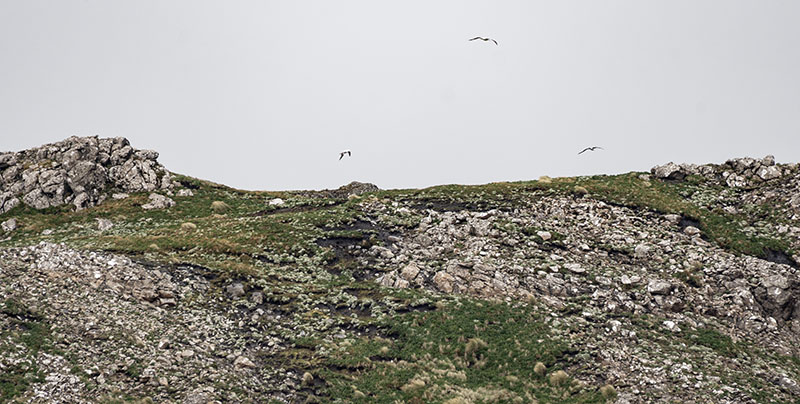
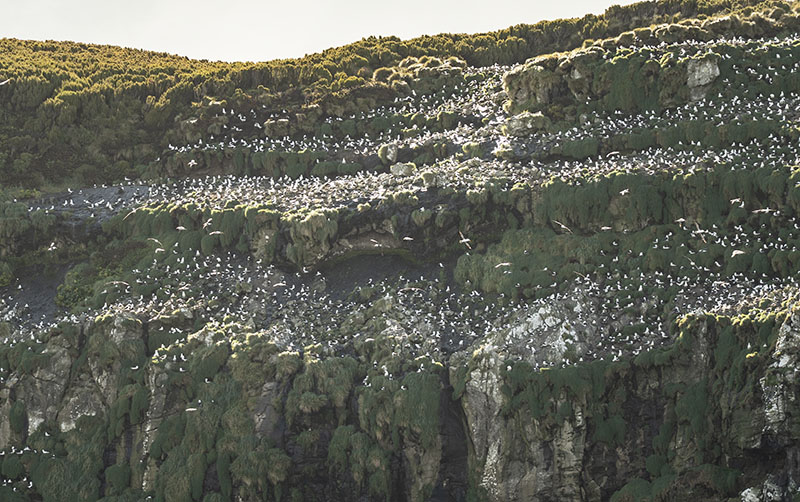
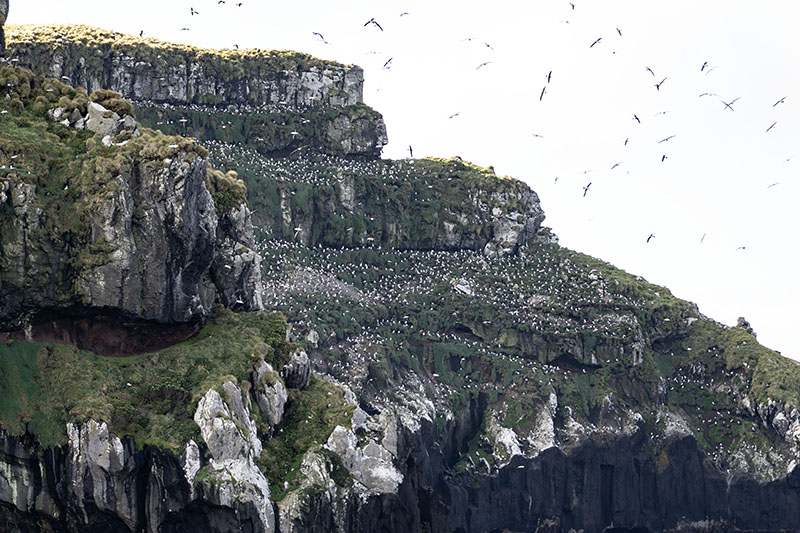
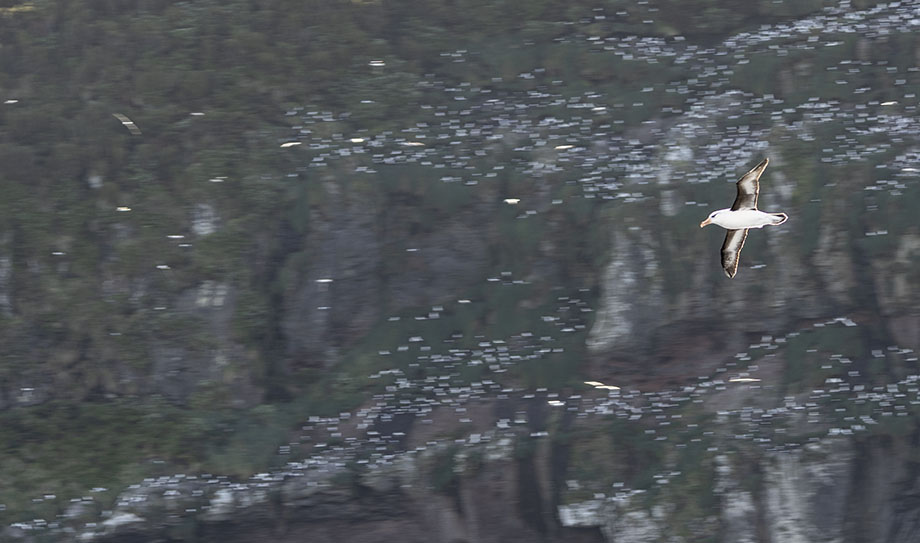
But the real drama was yet to come. During this trip, we often had albatross following the ship. But at Campbell Island, the sheer number of albatross was astounding. Rock cliffs on the Bull Rock held hundreds of thousands of nesting Campbell Island albatross, as well as Grey headed and Black Browed albatross. The sight was jaw dropping. The skies were filled with albatross and other smaller sea birds. The Captain slowed the ship to a crawl so we could get our fill of the sight and get some awesome pictures of the spectacle. It really was living a nature show.
So many birds!
I am not quite sure how I managed this one but the trip photographer was impressed.
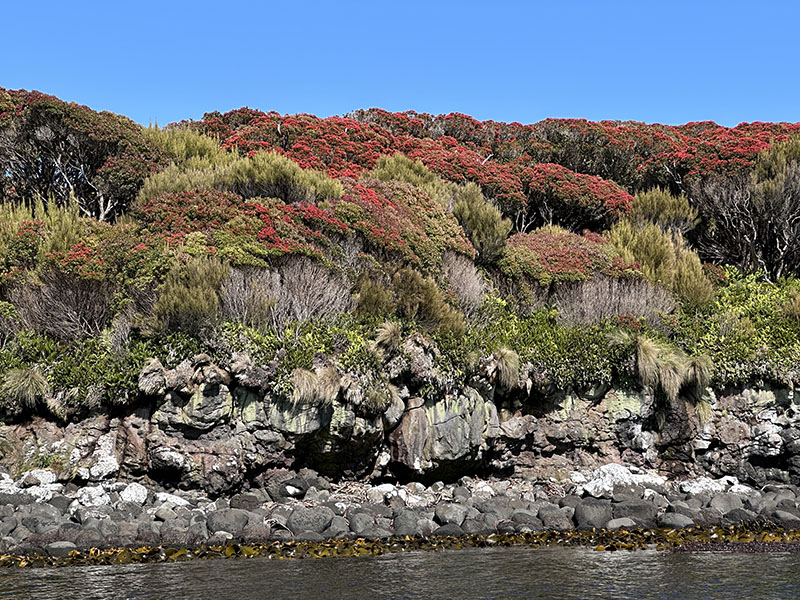
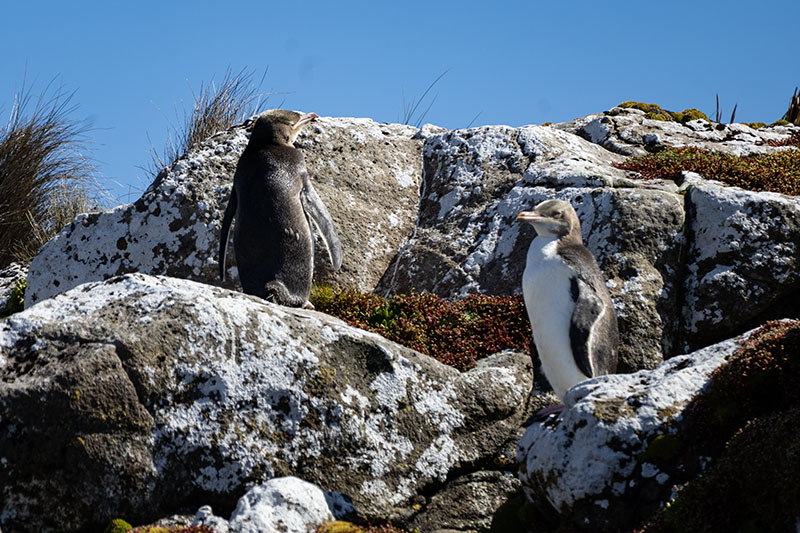
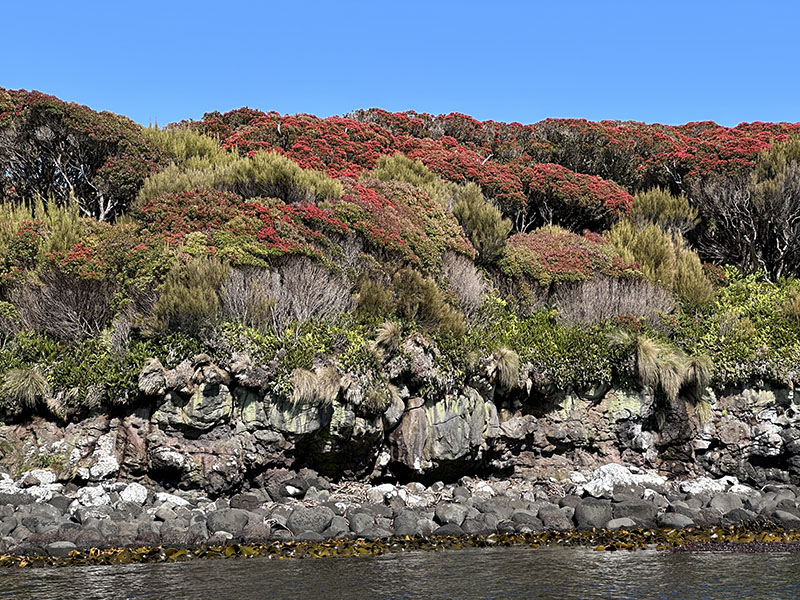
After that extravaganza, we started back toward the South Island. We stopped for another zodiac tour at Enderby island, part of the Auckland Island chain. Here we saw yellow eyed penguins up close and personal, and a nesting grey headed albatross. The Southern rata trees were in bloom as well.
Yellow eyed penguins. These are quite rare.Southern Rata trees, native to New Zealand.
Overall, if you love penguins and birds and nature of any kind, it was a fun trip. We actually met a couple on the boat who had no interest in penguins at all. But by the end, they were kind of warming up to them. How could you not? Look at these guys!
If New York is the city that never sleeps, then New Zealand is the country that is in bed by 10, for an early alarm tomorrow. I am a night owl, no news there. Unfortunately, I am now living in an entire country of early to bed, early to rise practitioners.
As someone who lived in a city for decades and grew used to having grocery stores with late hours, 24 hour pharmacies, and restaurants open until ten, the time line here just does not work for me. We learned the hard way that coffee shops and cafes close at 3 p.m. If you need caffeine in the afternoon, good luck. Restaurants are busiest between five and six and most close by nine. Five o’clock dinner out? Those are Pop Pop hours. Matt’s grandfather Pop Pop had to have dinner at five. Six was horribly late. Forget seven.
Shops and businesses are open only nine to five on weekdays. If people work from nine to five and shops are only open from nine to five, how does anyone get anything done? I guess people are expected to leave work if they need to run an errand. Even worse, waiting for the weekend to get anything done is also problematic since most businesses, aside from retail, are closed on weekends or are open only until noon.
Granted, the grocery stores are open a bit longer. One store makes it to 10 p.m. Another major grocery store has a sign that offers “late night” hours–on Thursday they are open until seven. Late night? Seven? That is just adorable. So far as I can tell, there are few if any 24 hour anythings in most of the country. (I can’t speak for Auckland, the largest city of one million. I am going to hope they have some kind of night life.)
This is a very rural country with a lot of people having grown up on farms or having lived in small towns where five is the time to close up shop. I often wonder if perhaps that is the cause of the general early bird syndrome. Whatever the reason, in order to get anything done here, you better set the alarm.
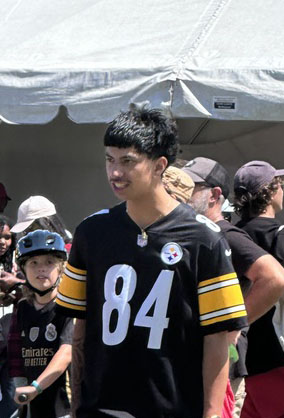
When we first moved here, we were walking on a beach and we saw a man with a Pittsburgh Pirates hat on. I ran up to him and asked what that was about. Turns out he was from Pittsburgh. He was married to a Kiwi and lived in New Zealand now. We had a nice chat.
Then I saw another Pirates hat. And another. So I started taking pictures of folks wearing Pirate hats.
I always ask if they know what the “P” stands for. Most do not know. One man told me his daughter bought it for him because his name was Pete. Another told me he had no idea what it meant but he liked the hat. So he bought it.
Then I started to notice Steeler wear. Not as much, but certainly there.
This guy is in full regalia
When I ask people if they have heard of Pittsburgh, some say yes, some no. The Steeler fans are more likely to know the team and the game they play.
Black and gold is the color of a local professional soccer team. The team made it to a playoff game and there were a lot of people in downtown Wellington dressed in black and gold team colors. I stopped a man and asked about the colors and said I was from a place in the U.S. where black and gold is the team colors. His friend said, “Yes, the Pittsburgh Steelers!”
Enjoying the Pittsburgh revelry at a Fat Freddy’s Drop show– my picture with a Pirates fan above and she knew who the Pirates were–I was completely perplexed that a man was wearing a Phillies shirt.
I went up to him and asked him if he knew what the Phillies were. He said he had visited Philadelphia and bought the shirt. He was not sure what sport they played.
And then good Lord, there was a Phillies hat. I may have to draw the line on Philly teams. Sorry John and Michele.
Overall, Pennsylvania seems pretty popular in NZ. Alas, I have yet to see anyone in Penguins gear. And no Baltimore hats either. I will update this with more photos as I see them. It is kind of fun talking to people about that “P.”.
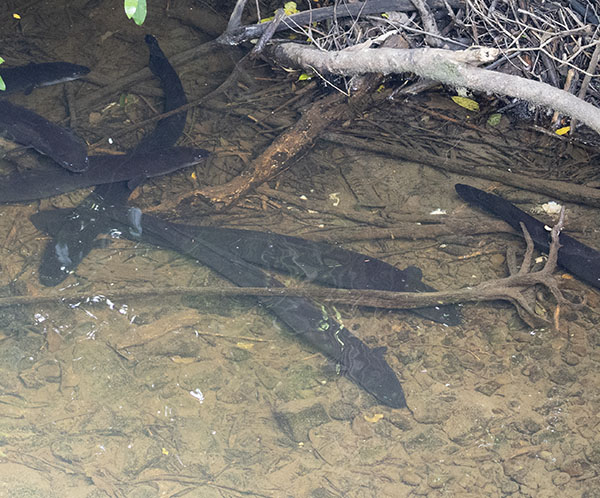
All I can say is yuck! Freshwater eels live in the creeks and streams here and it is just creepy. Look at the size of those things. I took this picture in a nature reserve. A big item on many tourist activities is to see the daily eel feeding. Yuck again! I have never seen a feeding and I am pretty sure I don’t want to see it.
If you wade in certain streams, there is a good chance they will swarm around your ankles. Just damn creepy. Eels were a favorite food of the Maori back in the day but I am not sure that is still true. Maori refer to eels as “tuna,” which is very confusing. But I certainly have never seen eel on any menu or for sale in the grocery stores. I have eaten smoked eel at the sushi bar but I try not to think about it.
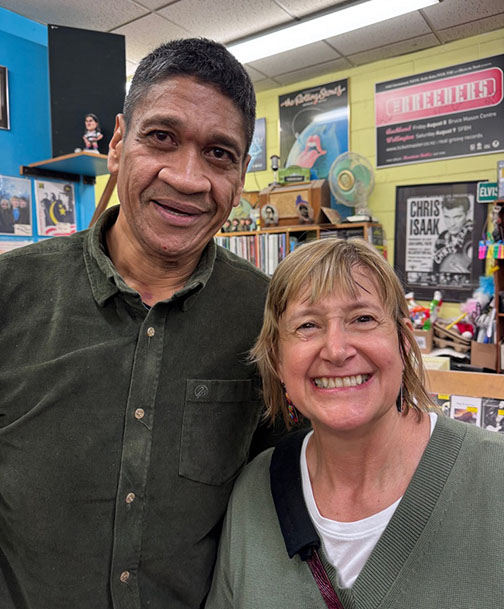
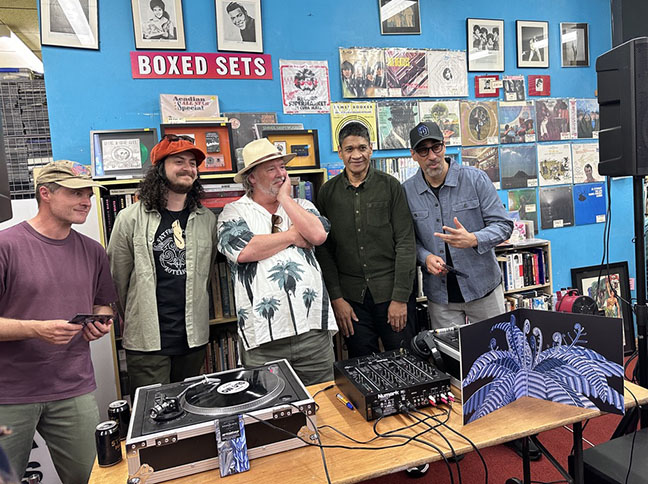
My favorite band had an in-store drop the needle event for the release of their new record—Slo Mo. Well, we were in heaven. Matt got there first and was talking to the band members who were there. So jealous. He was b.s.ing with the trombone player. By the time I got there, practically running to the store, I had worked up quite a sweat and the store was packed with people and stifling. So I was dripping. Never mind. I got to tell MC Mu that I absolutely adore him. Mu is the beats wizard, computer and sound boards churning out the rhythm. I felt like a teenager talking to her idol. Look at that grin. I don’t think I could have smiled any harder. We also gave some hero worship to the singer, Dallas Tamaira, aka Joe Dukie. He sounds like Bill Withers. Mellow and soothing. Now we have some concerts coming up. We are Fred Heads! Love them!!!
Yes, I said “toilet.” Americans are very delicate when it comes to referring to the facilities. We have ladies’ and men’s rooms, we have restrooms, we have bathrooms. In some places we have the “powder room.” We do not have “toilets.” But in New Zealand, they most assuredly have “toilets.” That is what the directional sign says and that is what they call it.
At first, I found it jarring to my delicate ears. Here is how it goes:
Me: “Can you tell me where the restroom is?”
Them: “Yes, the toilet is over there.”
Maybe this is my prudish side coming out but that sentence just bothers me. “Toilet” seems like such a strident word when spoken in a sentence. I was raised to say the much more indirect and genteel term, “restroom.” “Restroom” only vaguely suggests what might be going on in there. I’m resting. Leave me alone. But “toilet “expresses it loudly and clearly. And honestly, I just do not want to know what goes on in there other than resting, and I don’t want others to know what I might be doing in there besides resting.
Once you get over the word, there is a silver lining. New Zealand has the best and most available public toilets we have ever encountered. In the U.S., finding a public toilet is pretty much impossible. Usually, you have to find a fast food restaurant or some other business or building that has restrooms open to the public. And the maintenance can often be lacking.
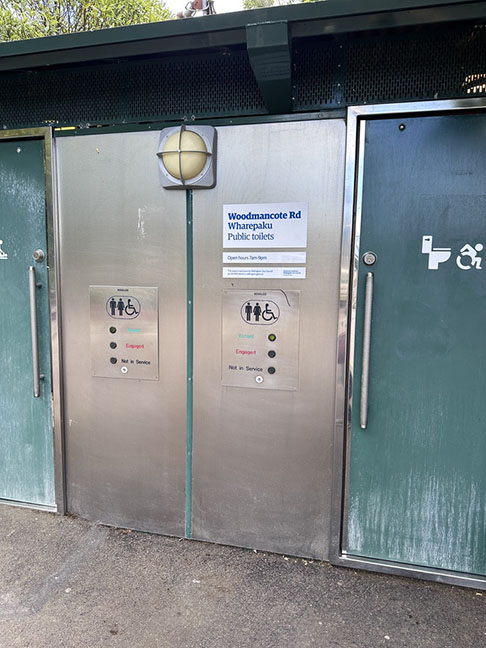
Here in New Zealand, every town or neighborhood seems to have a clean and bright public toilet. They are usually small buildings. Some are much like the facilities that you might find at any public park. But others are much newer with fancy chrome facades and doors which are opened with the push of a button. The door opens to a spacious room, with a toilet, sink, baby changing table, and a hand dryer. With the click of another button the door locks electronically and, in many of them, music begins to play and the fan kicks in. You then have ten minutes. The door will unlock after that time. No matter the style, the restrooms are always clean and stocked. The room has a tile floor and walls to prevent graffiti. You can tell someone cares.
So yes, they may use the cruder word, but the experience is anything but that. Hooray for New Zealand toilets!
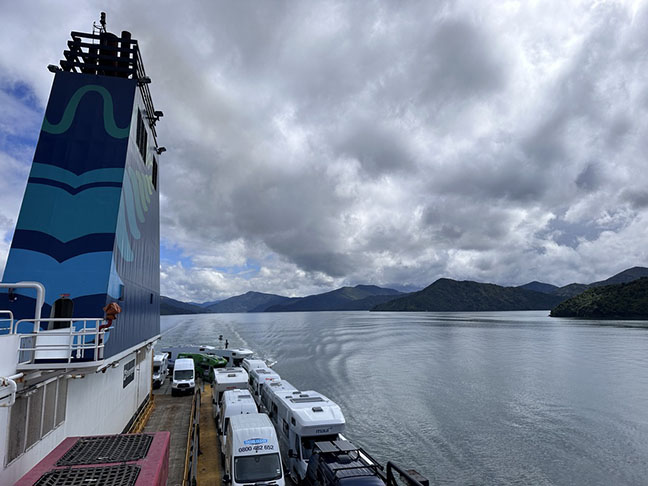
Kaikoura, located on the east coast of the South Island, is home to whale watching and bird encounters, both favorite past times. So off we went for a long weekend. To get to the South Island we have two options: take a plane or take the ferry. The ferry across Cook Strait is the best and most interesting option if you are headed to the northern part of the South Island. Drive your car on, have a seat, and watch the ocean go by for a few hours. Nearing the port of Picton, the ferry makes its way through tree covered islands, where a few houses sit and birds fly.
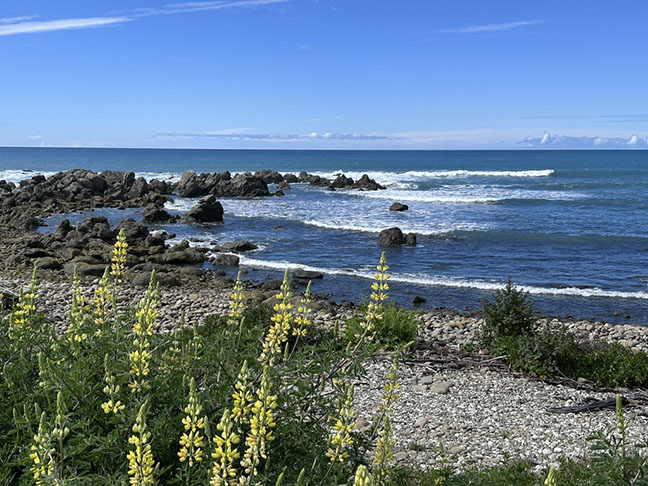
From Picton, the drive south to Kaikoura is another two hours along a picturesque, rugged coastline with crashing waves and bird colonies along the shore.
Kaikoura has an abundance of marine life supported by the cold nutrient rich water that rises up from the nearby deepwater Kaikoura Canyon. This water supports a large variety of fish, marine mammals, and seabirds. It makes Kaikoura a whale watchers paradise with a year-round pod of sperm whales and visits from humpback and blue whales in the right season. We have never seen sperm whales so that seemed like something to check off our unwritten list of things to do. They also had dolphin and albatross encounter tours. I am all about albatross, large, beautiful, and fascinating birds. We signed up for all of the tours and could not wait to get started.
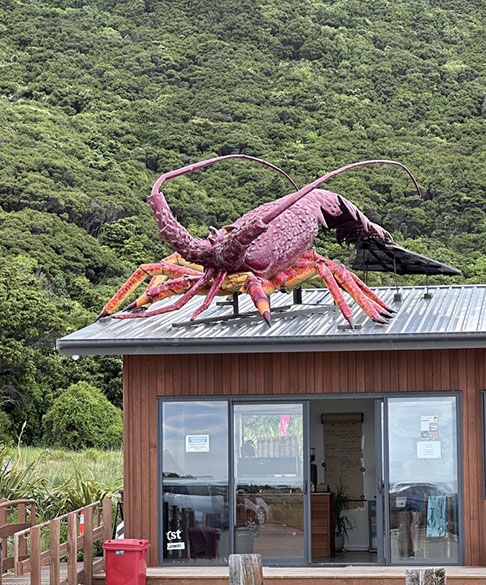
Lobster shack
But first we had to stop along the highway to eat crayfish. This is not your tiny Louisiana freshwater crawfish, but a type of lobster without the large claws. I could not find the reasoning behind it, but here in New Zealand, the lobsters are called crayfish. To avoid confusion, they are called rock lobster in the international seafood market. These crayfish are not only misnamed, they are wildly expensive. So we split a large one. No surprise that it tasted like a lobster. Having our fill of the large crustacean, we drove on.
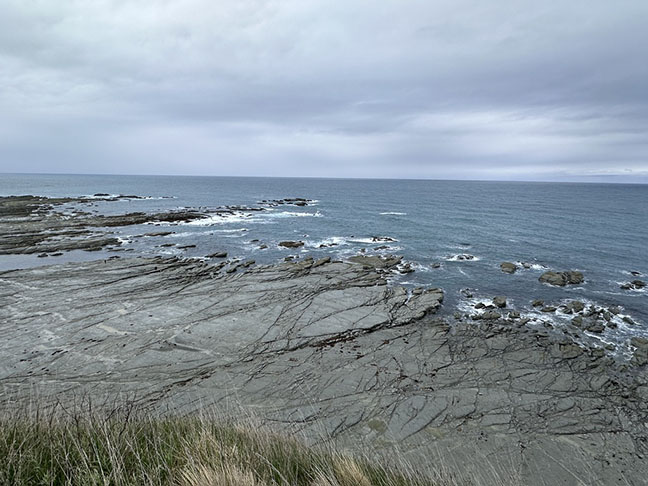
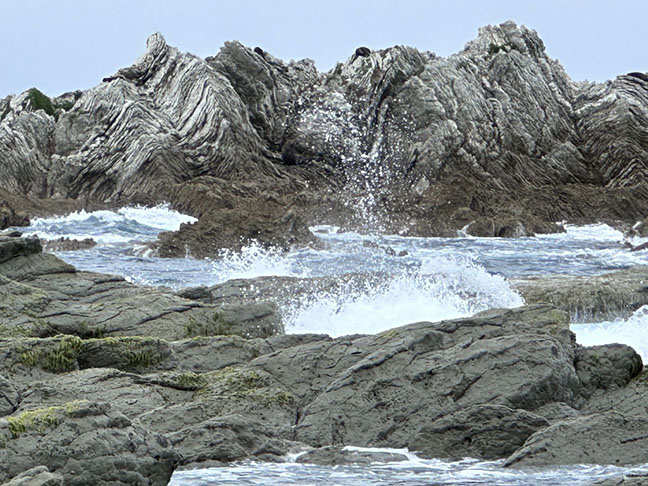
In 2016, Kaikoura was the site of a major earthquake, 7.8 on the Richter scale. It involved movement along multiple fault lines and was felt all the way to the North Island. It was so dramatic that the town rose three feet and the adjacent seabed rose six feet, the uplift heaving fish and marine life above the water line. The town, sliding along the fault line, was moved three feet north. A major tsunami later flooded the coast, killing more marine and freshwater life along the coast. If you want to read more about the Kaikoura earthquake, go here.
Rock upheaval
Only eight years later, the town seemed perfectly normal. The only apparent and visible aftermath was along the coast where seabed was clearly above the water surface and large boulders were thrust out of the earth.
While the earthquake would not disturb our trip, the weather had something else in mind. Once again, just like Fiji, we were thwarted by strong winds and rain. The winds were strong enough to force the cancellation of the tours we had signed up for—a dolphin encounter and albatross frolicking. The day was shot. We did not have any days to spare, and we had whale watching scheduled for the next day. But we worked the phones and figured out how to do at least one of the tours. We were in for the albatross if we were willing to go out at 6 a.m. Yikes! But hey, it involved a rare opportunity to see an endangered albatross and I love those beauties. We would have to swim with the dolphins another time.
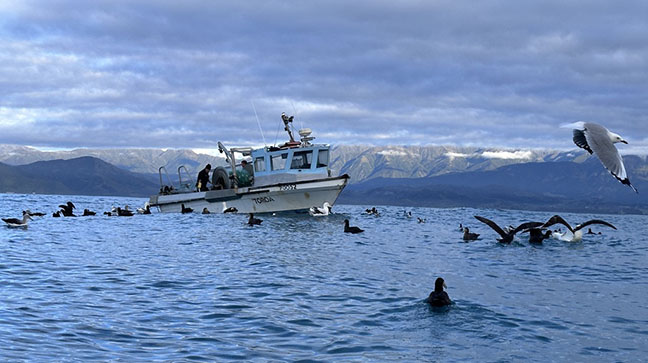
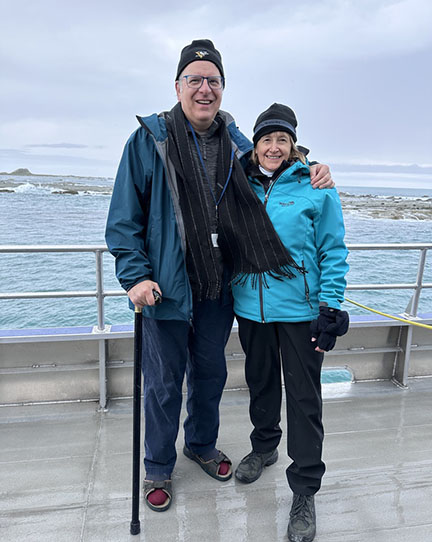
It was mighty cold at 6 a.m. so we dressed for winter. It was us and the boat captain. He was very knowledgeable and took us straight to the birds, which was easy since they follow fishing boats.
He tied a bag of fish to the back of our boat to lure them over. Yes, yes, that does not seem right. We should be watching birds in their natural state and not luring them with food. But the reality is that they were already following the fishing boat for the chance to grab some fish trash. Our boat was not teaching them anything different. It is called survival and adaptation.
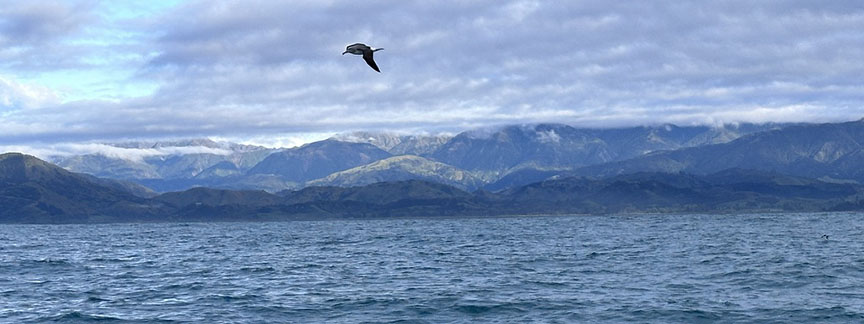
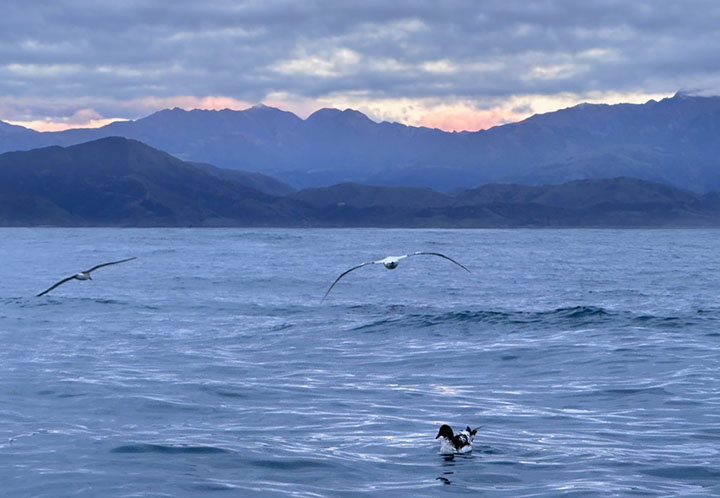
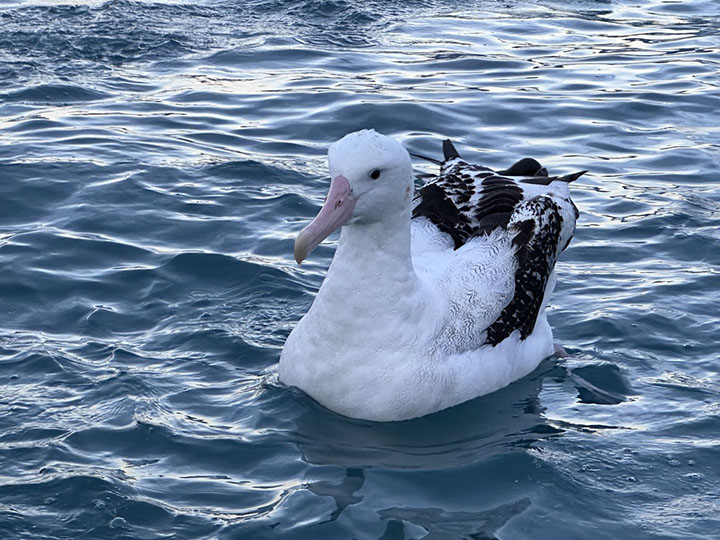
And here they come. Wandering albatross are large, gorgeous birds that dominate the sky when they fly. Their wingspan average about 12 feet. When they come in for a landing, they make an entrance. The other birds scatter.
Royal wandering albatross
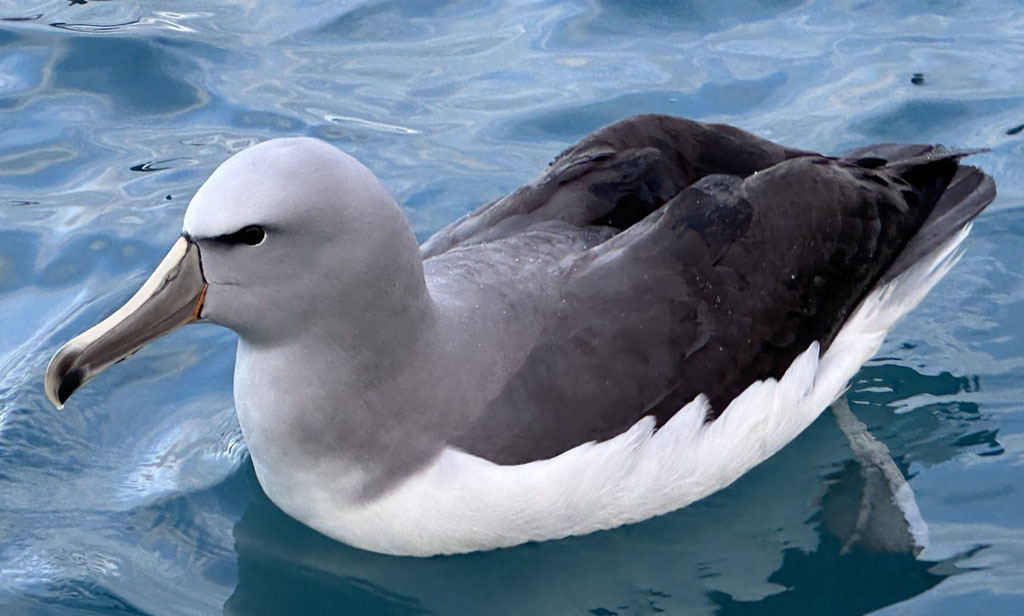
Among our visitors were royal albatross and the rare Salvin’s albatross or mollymawk. These birds are endemic to New Zealand and critically endangered. Smaller than the great albatross, they have a distinct grey head. Really quite beautiful.
Salvin’s albatross – rare
We also saw the endangered Hutton’s Shearwater, the only seabird to breed and nest in mountains happened to keep house in the mountains surrounding Kaikoura.
Then to our delight, the dusky dolphins showed up and gave us a short show:
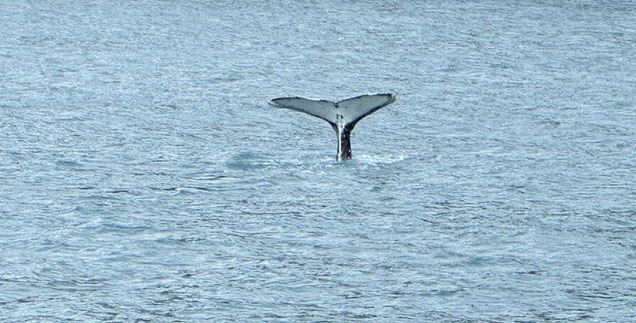
This was a well spent morning. Now we had to move on because we had whales to watch. We have been whale watching many times. Usually that involves humpback whales. We were hoping for sperm whales. No such luck. The weather was keeping us from going out to further toward the canyon. We had to settle for one lone humpback who did one roll and that was it. It was very disappointing.
Well, our time was up and we had to depart for the ferry back to the North Island. We will have to return to see the sperm whales and swim with the dolphins.
In New Zealand, there are few high speed, multi-lane highways. The two-lane highways go through towns. Foxton is a town about an hour north which we often pass through on our way to somewhere else. It is a beach town with large estuary and a very good bird watching site.
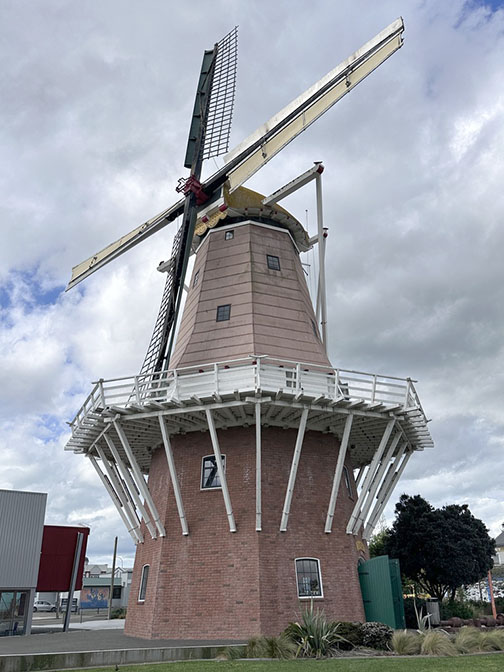
There is also a large windmill. We always promise ourselves we will stop for a tour but alas, they are usually closed when we drive by. It was a cloudy day, but it was not raining so we decided to drive to Foxton to take a look at the estuary. Lo and behold, the windmill was open when we arrived.
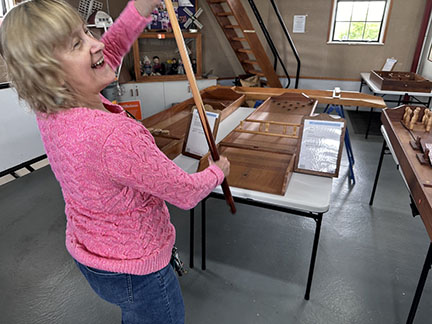
Inside was a Dutch wonderland. The first floor was the gift shop and, of course, I bought delft plates and windmill cookies. On the next floor was an array of old-time games, called Castle Games or Kasteel Spelen, provided by the local Dutch Club. Games with names like bowling billiards and shuffle billiards, each included elements of pool and shuffleboard. They were a lot harder to play then they looked. I immediately vowed I wanted to take one home.
Billiard cue and ball to knock down bowling pins.
Fifty points for me!
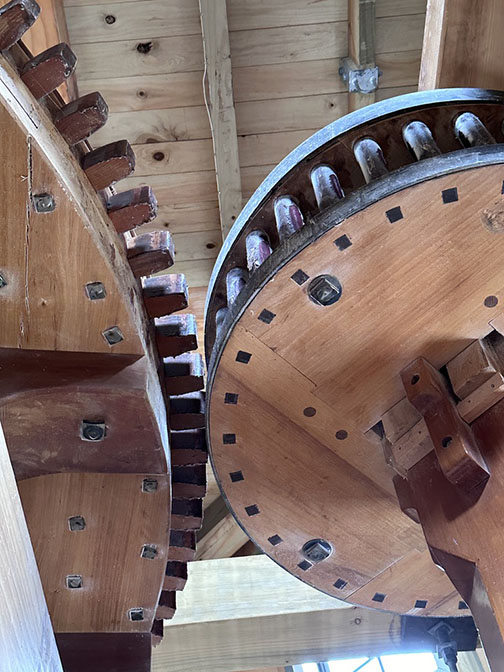
Then we went to the next floor where we discovered the most exciting part of the windmill. It is an actual working grain mill with wheels and gears and sifters. What fun! We bought buckwheat flour and corn meal (impossible to find in New Zealand).
So why is there a working windmill in Foxton? It seems that there is a long history of migration from the Netherlands to New Zealand and they have formed societies to keep up their traditions. There are numerous Netherlands Societies scattered across the country. There is even a Dutch Week, which we missed in 2024, but we are so taking part next year.
We vowed we would be back to visit and maybe play some more Kasteel Spelen.